Even when 404s in Google Search Console have climbed into the hundreds, the count by itself does not drop your rankings. This article covers how to sort that list into three — restore, 301, leave as is — and how to decide the order of restoration by the revenue each URL was earning before it disappeared.
Contents
TL;DR#
-
The fact that some URLs return 404 does not by itself put the site at a disadvantage
Google has written this since 2011, and the current documentation states that 4xx status codes other than 429 do not affect crawl frequency[2][3]
-
The number of entries in the list is not the number of causes
On our own site, about nine in ten of the detected 404s came back to the same single cause
-
Rolling everything into a 301 is a mistake
A URL with nothing to receive it is correctly left at 404, and Google writes that mistaken crawls of URLs that never existed can be ignored[3]
1. 404s Can Rise Without Rankings Falling#
The number of 404s does not by itself push rankings down. But letting the count hold your attention creates a different kind of loss.
Here is one loss that can happen. During an inventory of the URL list, a product page that had been among the top sellers turned out to have been returning 404 for three months. Neither the candidates to merge it into, nor which search terms people had been reading it through at the time, is left as material to decide with. The trigger sits three months earlier. On the day the list was opened, the only thing that registered was that the 404 count had climbed into the hundreds, and one line inside it went unseen.
The explanation that 404s are normal has been around for fifteen years. A Q&A article published in 2011 writes that 404s are a perfectly normal part of the web[3]. The same article also says that the fact some URLs return 404 does not affect how the other URLs on the site perform[3]. The tool was called Webmaster Tools at the time and the screens differ from today's, but that answer is still published at the same URL.
The current documentation lands on the same conclusion from a different angle. It states that 4xx status codes other than 429 do not affect crawl frequency[2]. The same table also says that a URL returning 404 is removed from the index[2]. What disappears is the URL you made a 404, and no mechanism by which it pulls the surrounding URLs along with it is described.
These are two separate grounds. The 2011 article is a direct answer to whether this puts the site at a disadvantage, while the current documentation is a specification for how the crawler treats it. The actual number of crawls can be checked in the Crawl Stats report[4].
2. The Number of 404s Is Not the Number of Causes#
The number of entries in the list is not the number of causes. Hundreds of 404s can fit inside one or two causes.
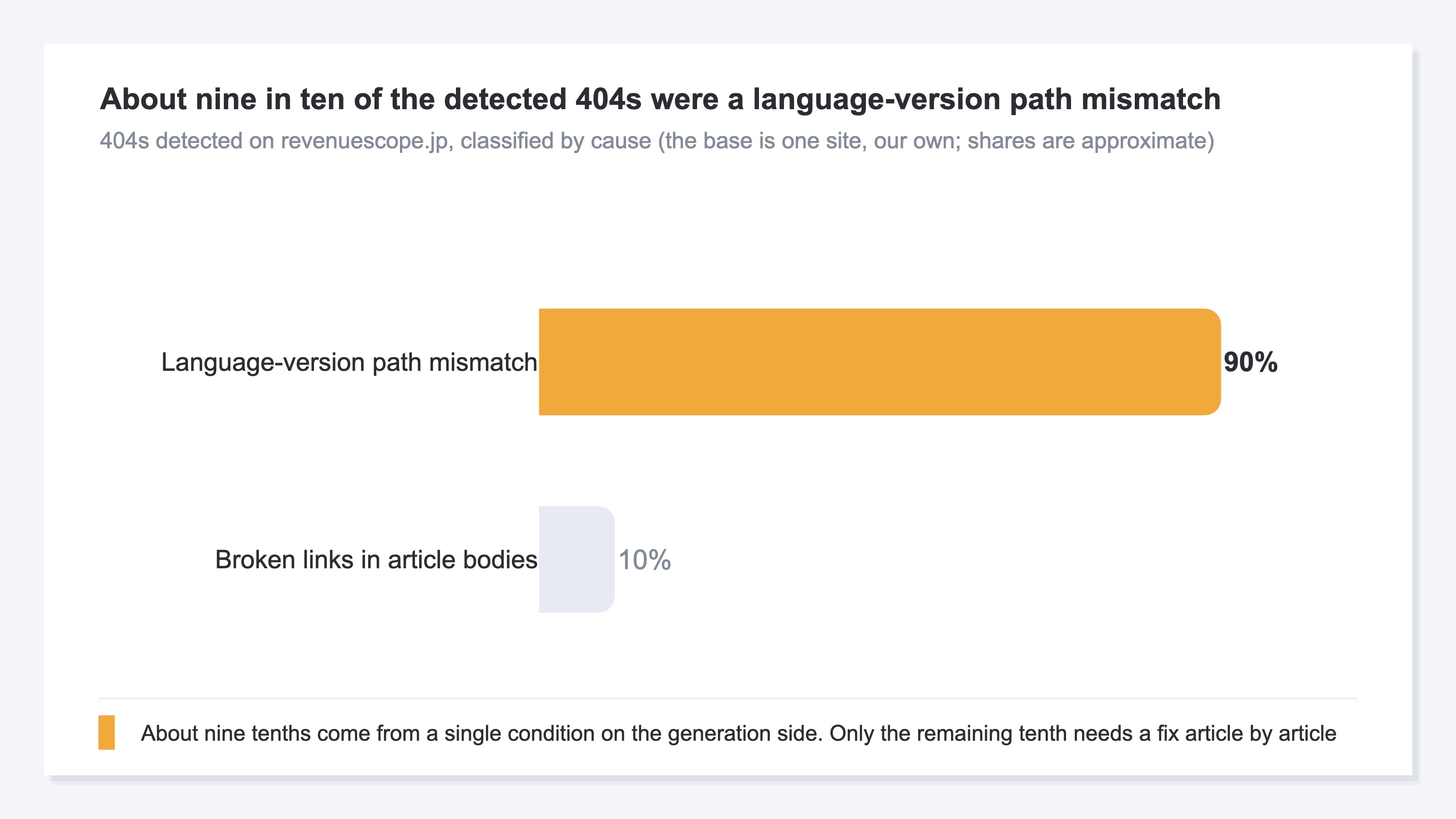
When we classified the 404s detected on our own site by cause, about nine in ten came from the same single cause: a mismatch in how language-version paths were specified. The count was taken in August 2026, covering every 404 an external crawling tool detected, split by where the fix would land. These were cases where an English-version path was generated for a page that only exists in Japanese, and the crawler reached it. The remaining one in ten were broken links inside article bodies. The base is a single site, our own, so the ratio will differ from site to site.
The response fits into two moves as well. Fixing the condition on the generation side stops nine tenths of it, and the rest is a link fix article by article. Working the list one entry at a time would have meant repeating the same fix several hundred times.
The size of the count and the weight of the response are not proportional. As covered in rankings dropped after a redesign, even when a large number of URLs disappear at once, one cause means one recovery.
3. Sort Into Three by What Evidence Remains#
The URLs that remain after the cause is fixed split into three, according to what evidence is left. Restore it, fold it into a 301, or leave it at 404.
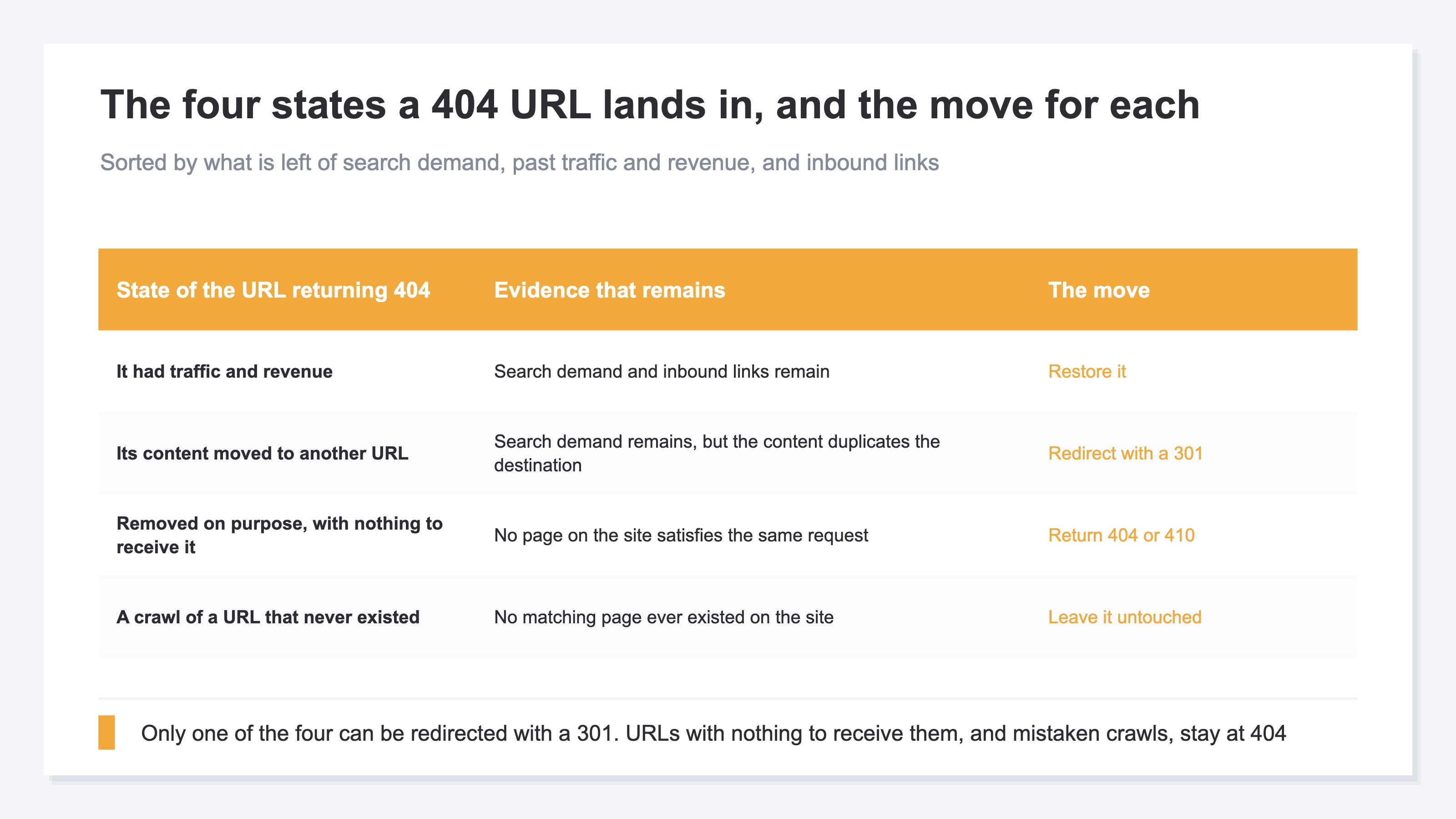
There are three pieces of evidence. Whether search demand for that URL remains, whether it had traffic and revenue before it became a 404, and whether links from outside still point at it.
If the content has moved to another URL, redirect it with a 301[5]. If no page satisfying the same user request remains on the site, returning 404 or 410 is the correct form[3]. Google treats 410 the same way it treats 404[3].
Rolling everything into a 301 is a mistake. Redirecting URLs with nothing to receive them to the home page in bulk is treated as a soft 404[3]. If the destination does not hold the same content, a 301 is not a better version of a 404.
Mistaken crawls of URLs that never existed are also best left untouched. A mistyped link on another company's site, or a CMS setting, can put a path your site never had into the crawl. Google states that 404s of this kind can be ignored[3].
One note: whether to delete or keep a product page that is still live is a decision made in advance, while this article deals with the decision made after a URL has already become a 404. The former is covered in keeping or deleting out-of-stock pages, and the conditions to check before deleting are in should you delete old articles.
4. The Only Thing to Fix Is a Soft 404#
404s themselves can be left alone. What gets fixed is the soft 404.
A soft 404 is the state where a URL that does not exist never returns a 404 status code, and only the screen carries a page-not-found message[1]. As long as the server returns 200, Google processes that page as a page with content. The representative cases are a setup that returns 200 in order to show a helpful message, and a setup that redirects unknown URLs to the home page[3].
The place to look is the Page indexing report. It has three views. The default, All known pages, covers every URL Google is aware of, whether or not it is listed in a sitemap[1]. All submitted pages covers only the URLs listed in a sitemap, and Unsubmitted pages only is the opposite[1].
To find problems in URLs you manage yourself first, switch to All submitted pages. To identify what the mistaken crawls actually are, switch to Unsubmitted pages only.
If the dates in the list are not updating, first separate whether the fix has not taken effect or the report has not caught up. The steps for that judgment are in Google Search Console not updating.
RevenueScope solution
Settling the three branches still does not settle which URL to start with. A URL that becomes a 404 stops receiving visits from that day. Page-level reports aggregate pages that had visits, so by the following month that URL drops out of scope. It is recorded as a 404 in Google Search Console, and yet it has disappeared from the side that holds how much revenue it was producing.
Checking it by hand means going back to a period before the 404, pulling page-level revenue again, normalizing the variations in how URLs are written, and then matching that against the list. What the exported list carries is clicks, impressions and average position, with no revenue in it. This matching gets repeated URL by URL every time a 404 appears.
RevenueScope resolves that mismatch. For content pages that have exposure in Google search, it shows landing revenue and search clicks per page on the same screen. Landing revenue is the amount that visits entering through that page ultimately produced (last-touch attribution to the entry page). Periods go back as the last 7, 30 and 90 days, so while a 404 is still recent, the record up to the moment visits stopped remains on the same row. The further out it gets, the more it falls outside the window, so pulling it early is the surer move.
Asking RevenueScope about Fictional Store A's disappeared URLs (illustrative — the last 90 days, spanning before and after the 404)
| Page | Landing revenue | Search clicks |
|---|---|---|
| /guide/sensitive-skin-lotion | ¥180,000 | 320 |
| /guide/uv-care-basics | ¥170,000 | 360 |
| /column/skincare-order | ¥20,000 | 480 |
| /items/spring-set-2025 | ¥0 | 40 |
Note: the four rows above are an example built around URLs assumed to have become 404s. The sample store that opens from the CTA runs on sample data, refreshed daily, so both the URLs listed and the amounts differ.
The most search clicks go to /column/skincare-order, but its landing revenue is ¥20,000. The leader by amount is /guide/sensitive-skin-lotion, which sits third by search clicks. Working the list from the top and working it in descending order of amount start on different URLs.
The top two by amount are ¥180,000 and ¥170,000, a difference of ¥10,000. That difference does not settle the order. What splits the decision is a condition not in the table: whether a page that can take on the same content still remains on the site. The content of /guide/uv-care-basics has been carried over into the current UV care article, so it can be folded into a 301. /guide/sensitive-skin-lotion has nothing to receive it.
The same reading applies to the order in which you rewrite pages that are still live. The steps are in which articles to rewrite first.
FAQ#
Frequently asked questions#
Q. We have 404s in the hundreds. Do we have to fix all of them?
A. No. Classifying them by cause cuts the target down considerably, and Google states that mistaken crawls of URLs that never existed can be ignored[3].
Q. Can we 301 every 404 to the home page?
A. Please don't. A setup that redirects unknown URLs to the home page is listed as a representative case of a soft 404[3].
Q. Do a lot of 404s reduce how often we get crawled?
A. 4xx status codes other than 429 are stated not to affect crawl frequency[2]. The actual number can be checked in the Crawl Stats report[4].
Summary#
Even when 404s spike, the count by itself does not drop rankings. The 2011 Q&A writes that 404s are a normal part of the web[3], and the current documentation states that 4xx status codes other than 429 do not affect crawl frequency[2].
The work is not to reduce the count but to classify by cause and then split the remaining URLs into three: restore, 301, leave as is. URLs with nothing to receive them stay at 404, and URLs that never existed go untouched. Only soft 404s, the ones returning 200, are what gets fixed[1].
What remains at the end is the order of restoration. Work down the list from the top, or work in descending order of the revenue each URL was producing before it disappeared. When those two do not agree, what is deciding which URL you start on is not a judgment but the sort order of the list.
See which ads actually drive revenue, at a glance
Free up to 2,000 sessions/month, AI connection included. No credit card required. Up and running in 5 minutes.
References#
- [1] Google Search Console Help "Page indexing report" (2026)
- [2] Google Search Central "How HTTP Status Codes Affect Google's Crawlers" (2026)
- [3] Google Search Central Blog "Do 404 errors hurt my site?" (2011)
- [4] Google Search Console Help "Crawl Stats report" (2026)
- [5] Google Search Central "Redirects and Google Search" (2026)