The page indexing report in Google Search Console has shown the same data for weeks without updating. What to check first with this symptom is the report, not your site. Data going stale and a site breaking are separate events. There are only three places to isolate.
Contents
TL;DR#
- A page indexing count that stops updating does not necessarily mean a fault on the site side
- Three places to check: whether the performance report is updating, whether URL inspection returns a normal result for an individual page, and whether your own page appears when you actually search
- If all three are normal it is a problem on the report side, and the right response is to wait — not to rewrite articles
- Since June 2026 the page indexing report has stopped and restarted three times, with a single update taking in 10 to 18 days at once
- Between updates the graph runs flat. The monthly report due date and the meeting that sets next month's budget still arrive in the same week
1. Before You Suspect a Penalty and Start Rewriting#
When the page indexing report stops updating, most site owners suspect a penalty first and start rewriting articles. But entering this symptom from the site side means fixing something that was never broken.
What the report returns is the number of pages that got indexed and the number that did not. That count going stale and the site's standing falling are, to begin with, separate events. Touch an article while neither rankings nor clicks have fallen and you are touching something that had nothing wrong with it.
What makes it worse is where you would confirm the result of that work. Whether a rewritten page got indexed shows up only in the count in that same report. And that report is the one currently stalled. You make a change, you cannot confirm it, you get uneasy and make another. Two weeks disappear in that round trip.
There are of course cases where rankings really have fallen. What you look at then is not the indexed count but clicks and average position in the performance report. If the position really has dropped, the order to fix in after a spam update lays out where to start.
If the stage you are at is that a published page has never once appeared in search, that is a different thing from this symptom. How long until a new site shows up in search covers the path a new page takes to reach the search results.
2. Report Side or Site Side, Only Three Places to Check#
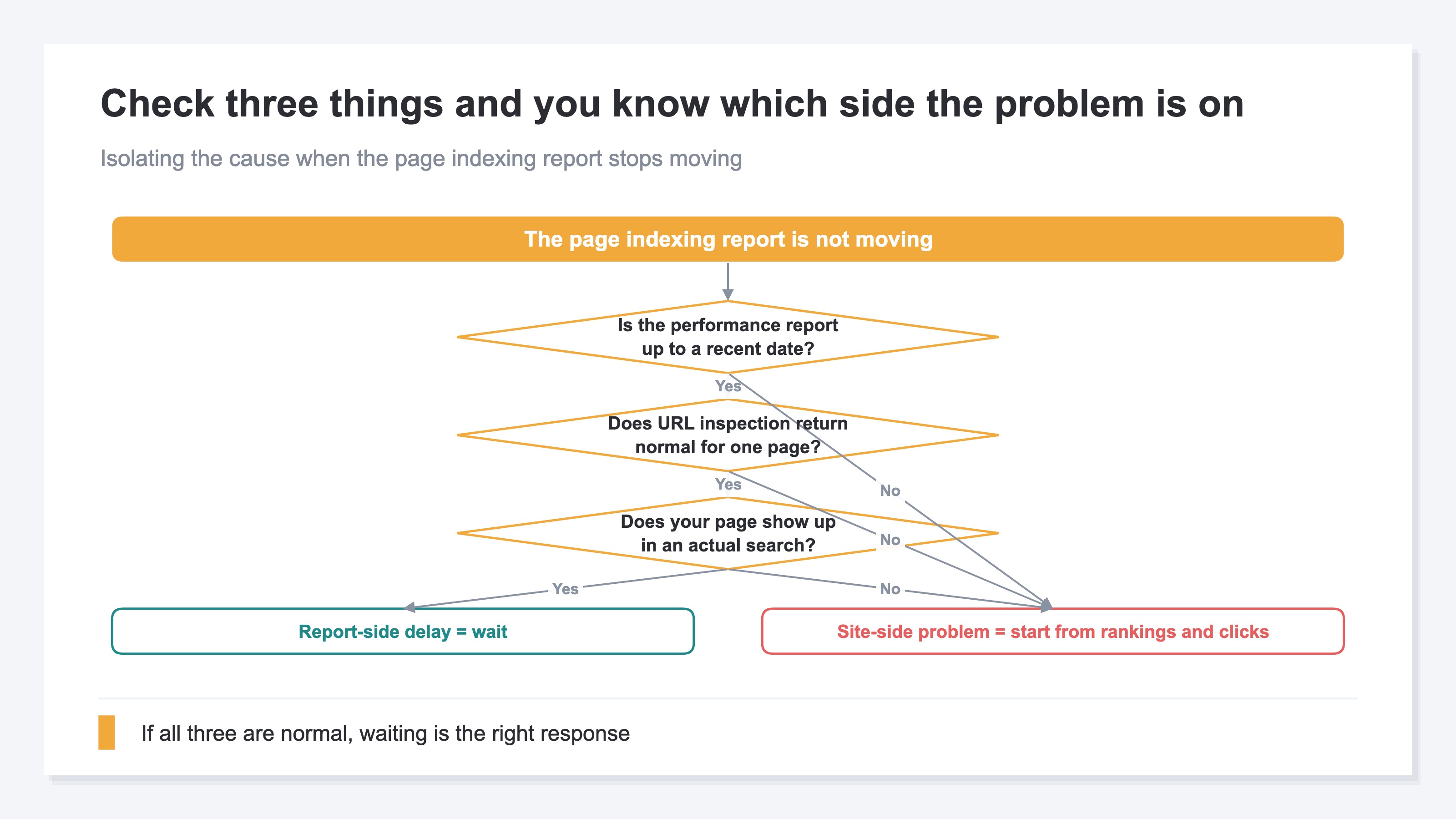
There are three places to check, and if all three are normal the problem is on the report side.
Is the performance report updating?#
The first thing to check is the performance report sitting next to the page indexing report. What the trade press is reporting as delayed this time is the page indexing report[4][6]. A temporary delay in the performance report was also reported in late June, but it cleared by the next morning[4]. No report has come out of it staying down for long. If this one runs up to a recent date, you know Google Search Console as a whole is not stopped.
What does URL inspection return for a single page?#
URL inspection returns the current state of one URL you specify. Even with the list report stopped, it stays usable for checking an individual page. If a normal result comes back here, there is little reason to suspect a site-side fault for that page on its own.
Its limits come from the same property. You see one URL at a time, so with hundreds of pages it never becomes a list of the whole site. What comes back reaches as far as whether that page is indexed. It does not answer whether that page is collecting visits, or producing revenue.
Does your page appear when you actually search?#
The last one is to close the report and search. Put the article title straight into the search box and see whether your page comes up in the results. If it does, that page at least exists in the search results. Whatever the count is showing, this is a fact taken by the same route your readers take.
If all three are normal, there is nothing to do on the site side. If even one catches, that is the starting point for the investigation. The way to think when Google Search Console's figures do not match expectations takes the same shape in when the click counts do not add up. The procedure for separating a broken tool from a different way of measuring is the same in rank trackers and Google Search Console disagreeing.
3. Not Stuck, Just Updating in Weekly Batches#
It is not stopped. It only updates in week-sized batches.
Start from the official record. Google's Search Status Dashboard carries no incident for this[1]. Google Search Console's data anomalies page has no entry for the page indexing report in June or July either[2]. That no official record exists is itself a fact you can confirm.
The delay itself, on the other hand, has been acknowledged. Google's John Mueller replied on July 1, 2026 to a post pointing out the delay[3].
Sorry for the delay. We're working on getting this back up to speed, but I don't have an ETA just yet.
An apology, work in progress, no timeline. These two sentences are the most concrete explanation on the public record as of late July.
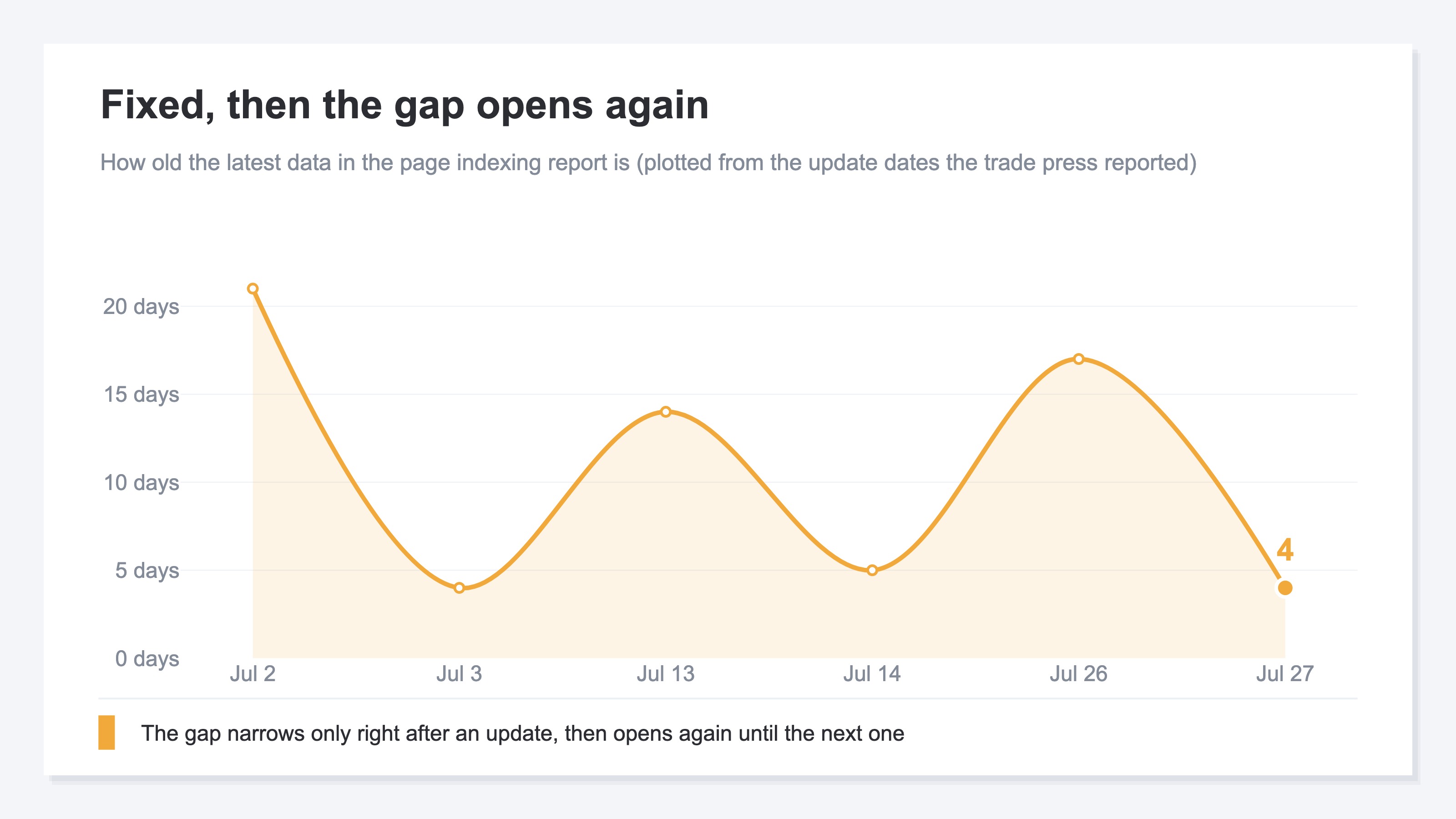
By trade press observation, the updates keep stopping and restarting[4][5][6]. It stopped on June 11, then on July 3 moved forward to June 29[7]. It stopped again, and on July 14 reached July 9. It stopped once more, and on July 27 reached July 23. Three restarts can be confirmed. Note that dates like these shift a day either way depending on time zone[5].
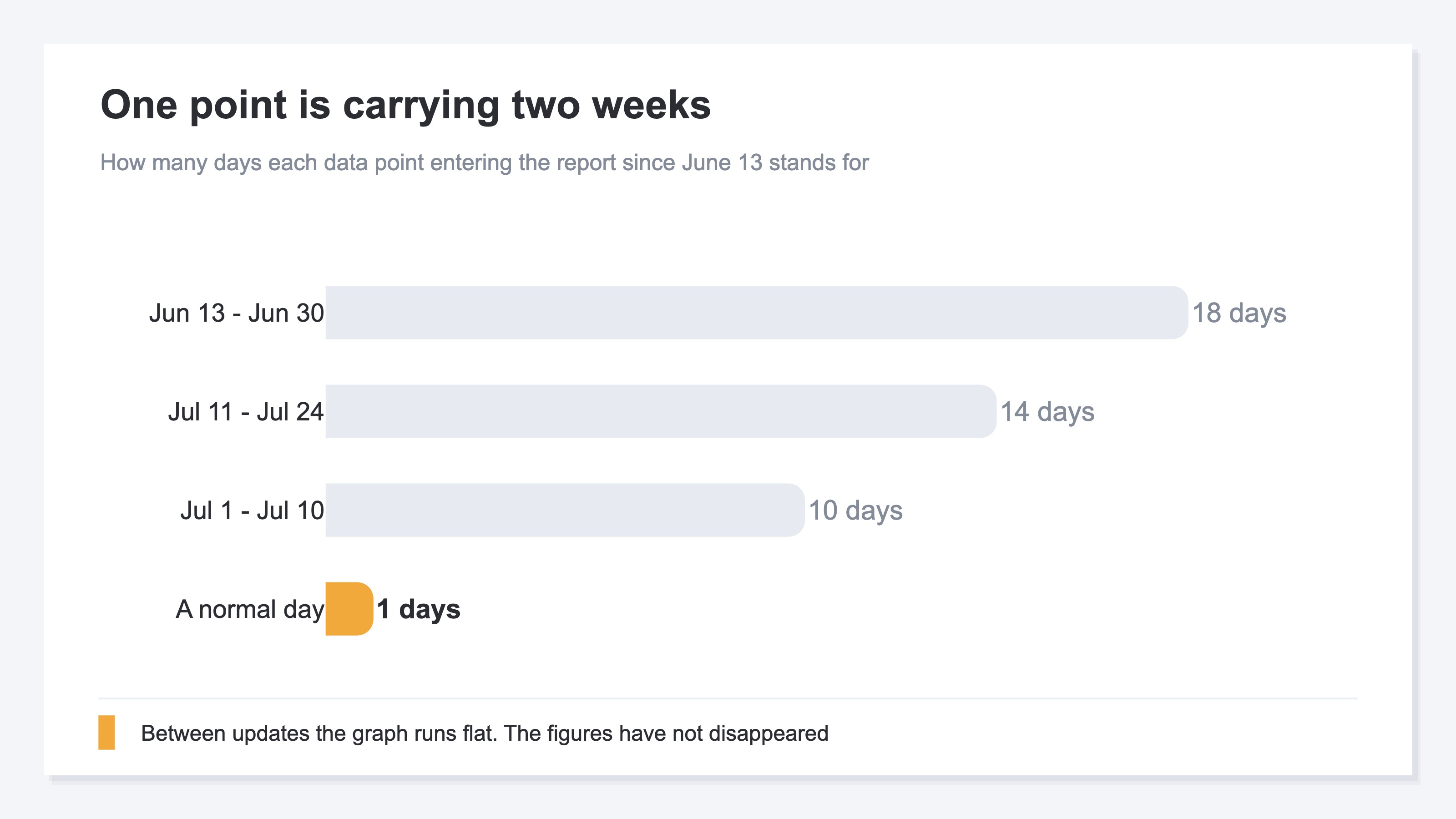
The problem starts here. One update takes in a stretch of days at once. Only three data points have entered the report since June 13, and they stand for 18 days, 10 days and 14 days as single blocks[5]. Between one update and the next, the graph runs flat. The figures have not disappeared. The figures on display simply carry no day-to-day movement.
So the state as of late July can be called neither fully fixed nor fully stopped. A state where it updates only in week-sized batches is continuing. That is the accurate way to put it.
On our own site's first-party measurement, day-to-day movement did not disappear over the same period. On a site where search accounts for close to 70% of all sessions, across the 42 days from June 13 to July 24, daily sessions matched the previous day's value exactly once. Between the highest and the lowest day the spread is more than 18x (both counted by Japan-time dates, with automated access excluded from the session counts). The page indexing report represents those same 42 days with three figures.
4. The Deadline for a Decision Won't Wait for the Report#
What hurts is not the waiting but that month-end arrives while you wait.
No recovery date has been announced. The July 1 reply ends at no timeline yet[3]. With no entry on the Search Status Dashboard[1], there is nowhere to go and check progress either. There is nothing on this side to estimate how many more weeks it takes.
The deadlines do not move. The monthly report due date arrives. The meeting that sets next month's ad budget usually falls in the same week. Meetings where "we will decide once the report is fixed" gets through are not that common.
The material for a decision gets assembled on the side of the data that keeps moving daily. What the month-end meeting needs is not how many pages got indexed. Where people came from this month, and where revenue came from. Those two can be confirmed without waiting for the report to recover. How to find content that lost search rankings lays out the procedure for confirming a real drop once updates return.
RevenueScope solution
A channel-by-channel breakdown is the material that fills this wait. RevenueScope displays sessions, revenue and RPS (revenue per session) for each traffic source, such as Google search and Direct. The same row also carries visitors, average time on site, bounce rate, and the number of sessions excluded by bot detection. The figures come from a tag placed on your own site, so they do not depend on Google Search Console's delivery status.
Ask an AI assistant such as ChatGPT over MCP, "how much revenue did people from search bring this month?", and it comes back in a form like the one below. Written out with fictional Store F for illustration, it looks like this.
| Channel | Sessions | Revenue | RPS | Avg. time | Bounce rate |
|---|---|---|---|---|---|
| Google search | 10,000 | ¥3,200,000 | ¥320 | 3 min | 55% |
| Direct | 3,000 | ¥750,000 | ¥250 | 2 min | 62% |
| ChatGPT | 500 | ¥100,000 | ¥200 | 5 min | 45% |
| Referral | 400 | ¥60,000 | ¥150 | 1 min | 70% |
Note: the table above is one example (illustrative) built for fictional Store F, and its figures do not match the sample data of the sample store that the demo reads (refreshed daily). What can be confirmed is not matching figures but whether the same decision can be made without waiting for a stalled report.
There is no surprise in it. By sessions and by RPS, the top position is the same Google search row. That is exactly what settles which row is the one to protect. If it falls by a fifth the following week, what to suspect is not the indexed count but search itself.
The bot-exclusion count on the same row does work too. In a week where sessions rose, if only the excluded count grew, what increased was not readers. It keeps a change in people and a change in bots from being mistaken for each other.
Note this row's movement week by week and, while the report updates in fits and starts, your side keeps accumulating day by day. When a week that fell turns up, that is the point to start from when you go to check the performance report and URL inspection. Reverse the order and you are back to fixing pages that never needed fixing.
FAQ#
Frequently asked questions#
Q. While the figures are not updating, is doing nothing fine?
A. If the three checks come back normal, there is nothing you can do on the site side to bring the report's counts back. If neither rankings nor clicks have fallen, no reason to touch an article turns up at that point either. If anything, note down the dates an update landed on. Later you can explain in-house how far the figures actually cover.
Q. When will it be fixed?
A. As of late July, no recovery date has been published. John Mueller replied on July 1, 2026 that recovery was in progress but that he had no timeline yet[3]. Google's Search Status Dashboard carries no entry for this either[1], leaving no official schedule to check progress against.
Q. Can the performance report's figures be taken at face value?
A. What is being reported as delayed this time is the page indexing report[4][6]. A temporary delay in the performance report was reported in late June, but no report has come out of it staying down for long[4]. That said, impressions and clicks carry aggregation gaps by design. Before putting them into an internal report, add a line about which period the figures cover.
Q. What should we do if the same thing happens again?
A. In this one episode alone, stopping and restarting has repeated three times[4][5]. Assuming the next one takes the same shape, deciding the order of the checks in advance finishes it faster. The performance report, URL inspection, an actual search. Work down those three and the isolation itself is over quickly.
Summary#
A page indexing count going stale and a site being broken are separate events. What to check first is the report. Whether the performance report is updating, whether URL inspection returns a normal result for an individual page, whether your page appears when you search. If all three are normal, there is nothing to do on the site side.
As of late July, the page indexing report updates only in week-sized batches. Neither fully fixed nor fully stopped. Between updates the graph runs flat, and a state where daily movement cannot be read is continuing[4][5].
Month-end arrives anyway. A decision has to be assembled on the side of the data that keeps moving daily. When the report stalls next time, which screen do you open first?
See which ads actually drive revenue, at a glance
Free up to 5,000 sessions/month, AI connection included. No credit card required. Up and running in 5 minutes.
References#
- [1] Google "Search Status Dashboard" (2026)
- [2] Google Search Console Help "Data anomalies in Search Console" (2026)
- [3] John Mueller (Bluesky) "Sorry for the delay. We're working on getting this back up to speed, but I don't have an ETA just yet." (2026)
- [4] Search Engine Roundtable "Google Search Console Page Indexing Report Delayed Two Weeks" (2026)
- [5] Search Engine Roundtable "Google Page Indexing Report Delays Give Static Data" (2026)
- [6] Search Engine Land "Page indexing report in Google Search Console delayed" (2026)
- [7] Search Engine Land "Google indexing report in Google Search Console fixed" (2026)