Google announced nothing, and yet this week the search rankings moved. This article covers how to catch that movement without waiting for an announcement, and which of the pages that dropped to work on first. The axis isn't how far a page fell — it's the revenue that page is generating.
Contents
TL;DR#
-
Google itself publishes that unannounced updates are always in flight
The documentation states that positions in search results are not fixed in place, and that the change shows up in search traffic too[1]
-
The official check is built on the assumption that you know the rollout dates
Three of its four steps need a start date and an end date
-
The same size of drop doesn't produce the same order of work — landing revenue changes it
The size of a drop is the size of the fall, not the size of what you lose
1. No Announcement Doesn't Mean Something Is Wrong#
Over August 5 and 6, 2026, reports spread that search rankings were moving unusually widely. Google hasn't acknowledged it, and reporting suggests it may never[2]. Not being acknowledged and nothing having happened are two different things.
Google writes that it is continually making updates to its search algorithms, including smaller core updates, and that these are not announced because they aren't widely noticeable[1]. That passage describes the path by which improvements get reflected — it does not say that a drop was caused by an update that went unannounced. What you can draw from it is two things: that unannounced updates are always in flight, and that positions in Google's results were never static in the first place, so search traffic can rise and fall on its own[1].
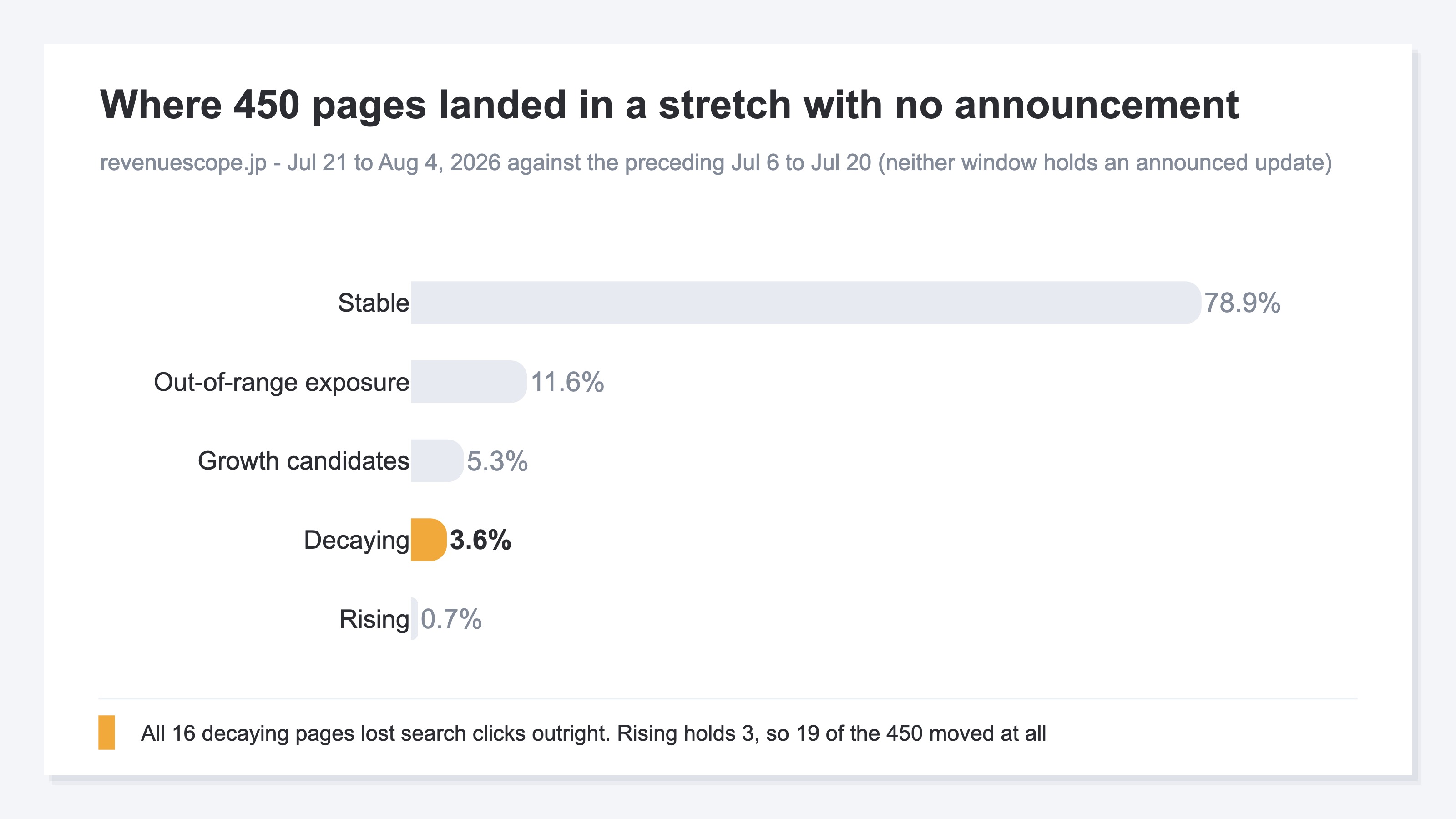
We checked on our own site. The comparison was July 21 to August 4, 2026 against the preceding July 6 to July 20. Neither window contains a single announced ranking update[3]. Even so, among the 450 pages with exposure in Google search, 3.6% lost search clicks and 0.7% gained them. Just under eight in ten were stable, and outside that sit the pages that get exposure but no clicks and the pages that are a step away from page one.
Let's fix the scope before going further. What this article covers is the case where the ranking moved while you changed nothing. If it's the week after a rewrite, the cause is on your side, so go to Rankings dropped after a rewrite; if it follows an announced update, go to When Google's spam update drops your rankings.
When people say "there was an update," what they are pointing at is the event of rankings moving a lot. What Google announces as an "update" is only the large ones among those. The same word is covering two different ranges, so before you use the presence or absence of an announcement as material, those two have to be lined up.
2. The Official Steps Start From a Rollout Date#
The check Google walks you through is made of four steps[1]. Three of them can only be run once the start and end dates of the rollout are known.
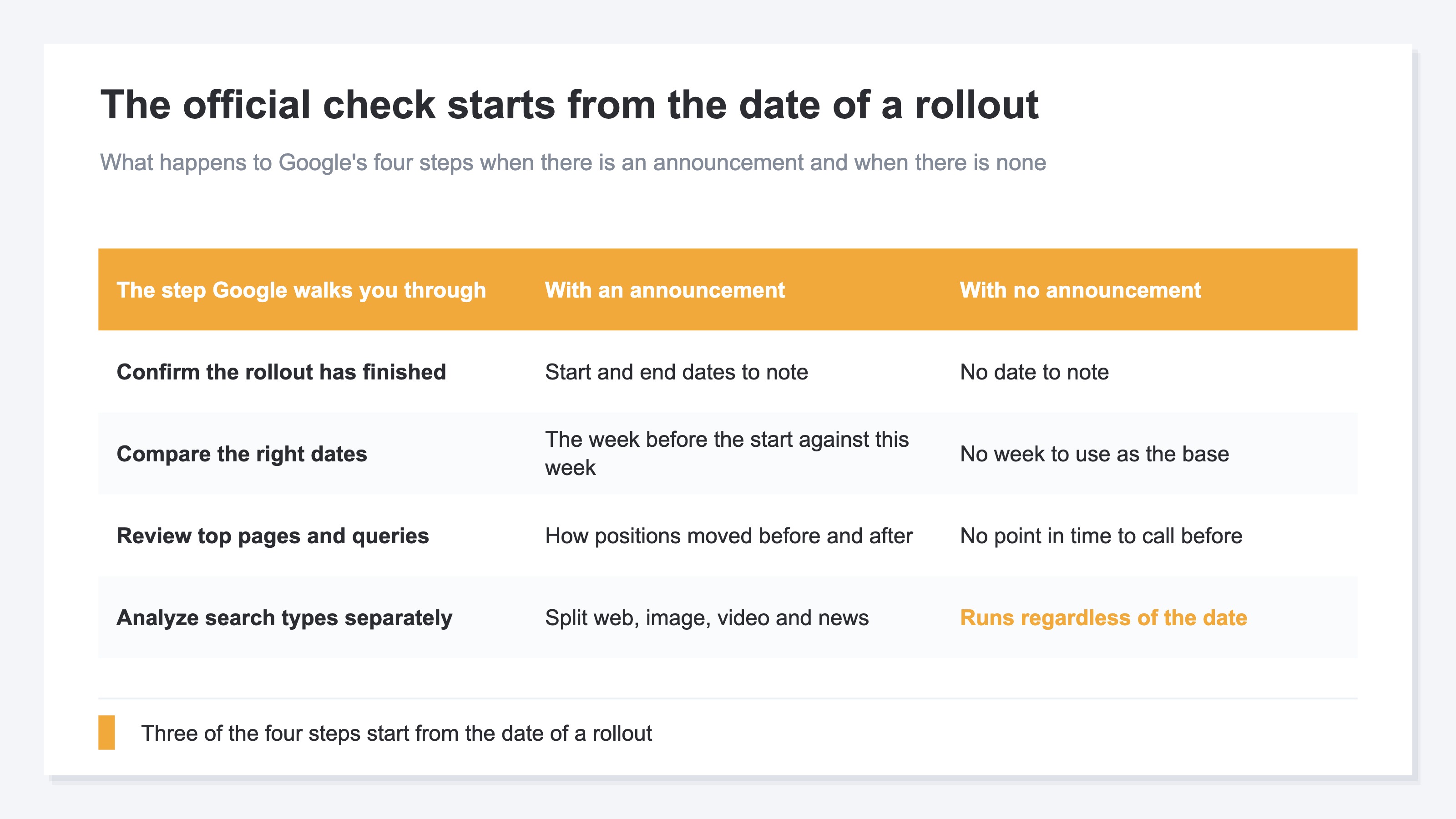
Announced updates are listed in the ranking history on the Search Status Dashboard[3]. A movement that never appears there has no date to note, so the first step stays empty, and the one after it — the week before the rollout started — never gets decided either.
The position value itself is less stable than it looks. The average position in Google Search Console is the average of the topmost position at which the page appeared[4]. Why tools disagree with each other is covered in Rank trackers and Google Search Console disagree.
The positions RevenueScope displays come from the same source and are averaged the same way. That is why RevenueScope doesn't put position at the center of the judgment: the main axis is the change in search clicks, and position is used to find where there is room to grow.
Some tools publish a volatility score every day, and several of them were reported to be turbulent over the same days[2]. What they measure, though, is how turbulent the results are as a whole — a different quantity from which of your own pages gained and which lost. Your site can come through a turbulent day untouched.
The procedure isn't at fault. It is simply built around events whose dates get announced.
3. Catch the Movement Without Waiting for an Announcement#
If you aren't waiting for an announcement, you decide the comparison window yourself. Not "before and after the announcement" but "the previous window of the same length." The last two weeks against the two weeks before them. In this shape you can run it every week.
Google advises varying the response by the size of the drop. For a small drop in position, such as from 2 to 4, it says there is no need to take drastic action and recommends avoiding changes to content that is already performing well; for a large drop, such as from 4 to 29, it recommends going on to a deeper assessment[1]. That line assumes a before-and-after comparison, but put the previous two weeks into the "before" and it carries over as it is.
How to identify the pages that dropped is written up in How to find content that lost search rankings. What isn't settled is the order in which you work through that list.
Traffic can also fall without revenue moving. Telling those apart is covered in Search traffic down, revenue flat.
Both of the things you need are already being recorded. Google Search Console holds which pages lost search clicks, and your own measurement holds how much revenue the visits that entered through those pages generated. There is nothing new to start measuring. The only thing not settled is how to join those two at the level of the same page.
4. Priority Among the Pages That Dropped Comes From Revenue#
How far the search clicks fell, and how much revenue the page is generating. Place the pages that dropped on those two, and they separate into four groups.
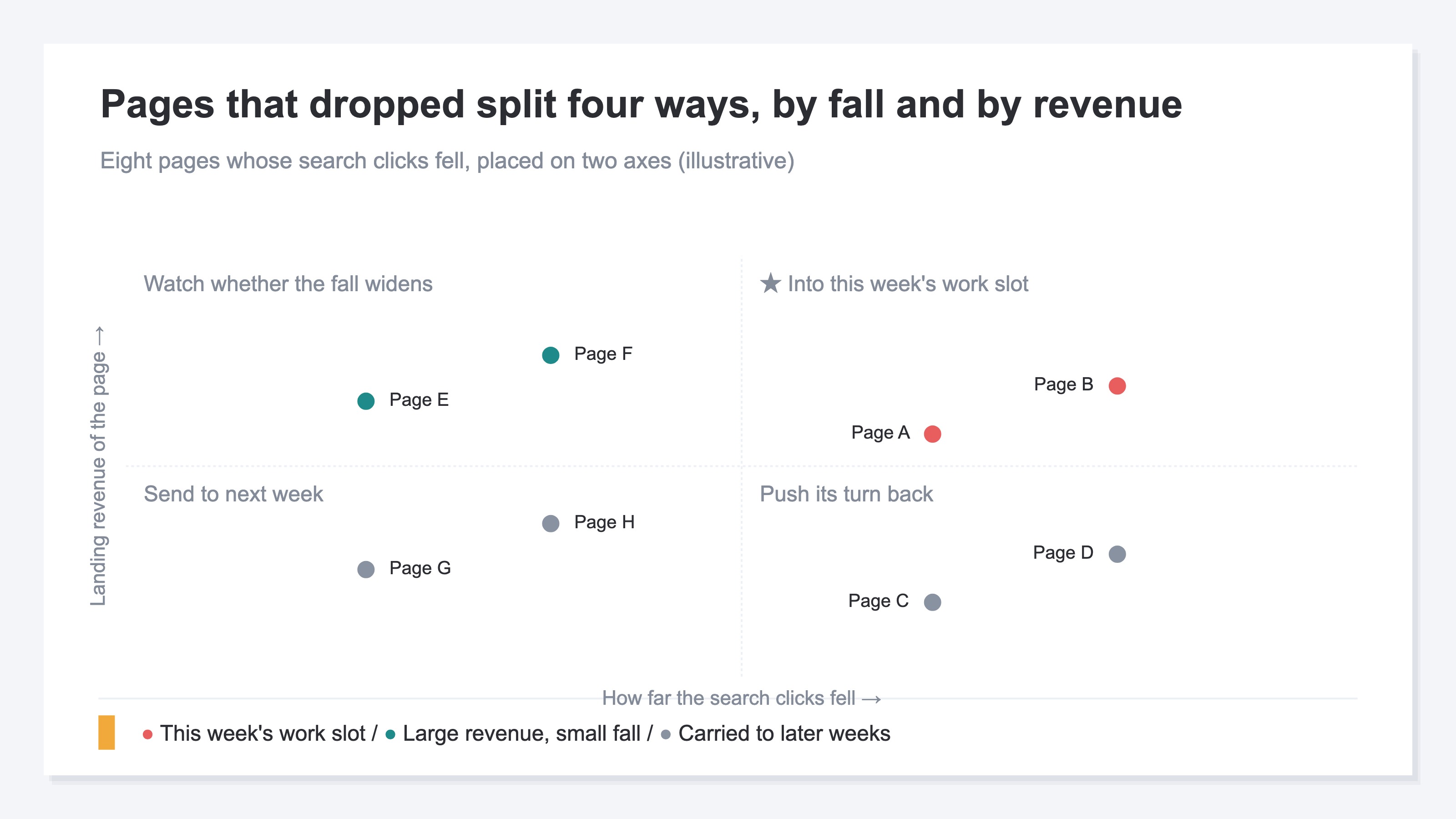
Upper right — clicks down a lot and revenue large — comes first. Lower right fell just as far but has no revenue attached to it, so its turn can be pushed back. Lower left is small on both counts, so it goes to next week. The one that is easy to miss is upper left: a page whose fall is small but whose revenue is large never surfaces near the top while you are working in order of how far things fell.
Onto these four, lay the line Google draws that we saw in the previous section. Upper left has a small fall, so it often lands in the range of a small drop like 2 to 4, where Google does not recommend drastic action[1]. It becomes something to watch for whether the drop widens, rather than something to edit. Conversely, if upper right is a large drop like 4 to 29, it is the one to carry on to a deeper assessment[1].
The weekly routine is simple. Rebuild the four groups every week, and put only the upper-right group into this week's work slot. Lower right and lower left go to the following week. Because the following week reorders by the same rule, a page with large revenue returns to the top the moment it drops, and a page with no revenue attached never climbs no matter how many weeks it is carried. Instead of rethinking the order each time, you settle one rule and follow it.
RevenueScope solution
Catching the movement without waiting for an announcement, and settling the order in which you fix things. RevenueScope takes that part. It compares the content pages that have exposure in Google search across the latest period and the immediately preceding period of the same length, sorts them into states, and shows measured landing revenue alongside.
Landing revenue is the amount finally generated by the visits that entered through that page. Visits judged to be bots are excluded. The comparison period is yours to specify, so the same shape comes out every week whether or not anything was announced.
Asking RevenueScope about Fictional Store A's content pages (illustrative)
| Page | Search clicks | Average position | Landing revenue |
|---|---|---|---|
| Choosing a shampoo for wavy hair | 300 → 180 | 6 → 11 | ¥400,000 |
| The basics of applying hair oil | 400 → 240 | 7 → 12 | ¥0 |
| How much treatment to use | 90 → 80 | 9 → 10 | ¥120,000 |
| Shipping and return timelines | 60 → 55 | 12 → 13 | ¥30,000 |
Note: the sample store runs on sample data that is refreshed daily, so the page names and figures above will not appear on the demo screen. The table above is an example built to explain the reading.
The top two both lost two fifths of their search clicks, and both fell by five positions. Split that two-fifths drop into volume and content: in volume, the larger loss is the hair oil page, which gave up 160 clicks; in content, the one that still holds landing revenue is the wavy-hair shampoo page at ¥400,000. The same two fifths points at opposite repairs. On the ¥400,000 side, what you restore is the position itself. On the ¥0 side, what you review isn't the position but which search intent the page is being called for.
The one that goes into this week's work slot is the wavy-hair shampoo page. The hair oil page, which lost the most search clicks, goes to the following week.
FAQ#
Frequently asked questions#
Q. Is there any way to find out later whether it was an update that went unannounced?
A. Reporting suggests some of these end without ever being acknowledged[2]. If you have fixed your own comparison window in advance, you can judge without waiting for an announcement.
Q. Should a page whose position dropped be rewritten right away?
A. There is time to check the size of the drop and the landing revenue first. Google itself says a small drop in position, such as from 2 to 4, needs no drastic action[1].
Q. Can search clicks fall while the position hasn't?
A. Yes. Average position is the average of the topmost position at which the page appeared[4], so if the way it is displayed changes, clicks can fall while the average holds. That is the reason to put search clicks, not position, at the center of the judgment.
Summary#
Rankings moving while nothing is announced is not the exception. That smaller updates go unannounced all the time, and that positions were never fixed in place to begin with, are both written by Google[1]. Even so, three of the four steps in the check need dates, so on a movement with no announcement you cannot get past the first step.
Instead, you decide the comparison window yourself. The last two weeks against the two weeks before them. On top of that, attach landing revenue to the pages that dropped, and re-sort the order by the same rule every week. What goes into the work slot is not the page that fell the furthest but the page that carries the revenue.
The next day the rankings turn turbulent, what will be sitting at the top of your list?
See which ads actually drive revenue, at a glance
Free up to 2,000 sessions/month, AI connection included. No credit card required. Up and running in 5 minutes.
References#
- [1] Google Search Central "Google Search's core updates and your website" (2025)
- [2] Search Engine Roundtable "Google Search Ranking Volatility Heated Into August 5th & 6th" (2026)
- [3] Google "Google Search Status Dashboard History for Ranking" (2026)
- [4] Google Search Console Help "Performance report (Search results): Overview and basic setup" (2026)