The week after a rewrite, that page's ranking fell. Do you roll it back, or wait? Try to decide on the size of the drop alone and the case for reverting and the case for waiting stand equally tall. What settles it is how much revenue that page is producing right now. This article separates out what the drop is actually made of, then covers a way of deciding that changes the length of the observation window according to the size of the revenue.
Contents
TL;DR#
-
"It dropped" comes in three kinds, and each one takes a different response
Noise partway through reassessment, an overlap with movement on the search side, and the rewrite itself making the page worse
-
The starting point for isolating it is whether the pages that fell are only the rewritten ones
Google likewise says it is important to check whether the decline is happening across the whole site, on several pages, or on one very important page[2]
-
The cost of reverting is close to constant whatever the size of the page; only the risk of waiting scales with revenue
A recrawl can take anywhere from a few days to a few weeks, and requesting it again doesn't make it happen sooner[3]
-
For the same size of drop, the number of weeks you can wait differs page by page
The larger a page's landing revenue, the shorter you cut the observation window; small pages can wait for the next recrawl
1. A Rank Drop After a Rewrite Splits Into Three#
Underneath the single outcome "it dropped" sit three events of different kinds. Noise that occurs partway through reassessment. A case where movement on the search side and the rewrite happened to land in the same week. A case where the rewrite itself lowered the assessment. The three take separate responses, so before you measure the size of the drop, settle which of them you are looking at.
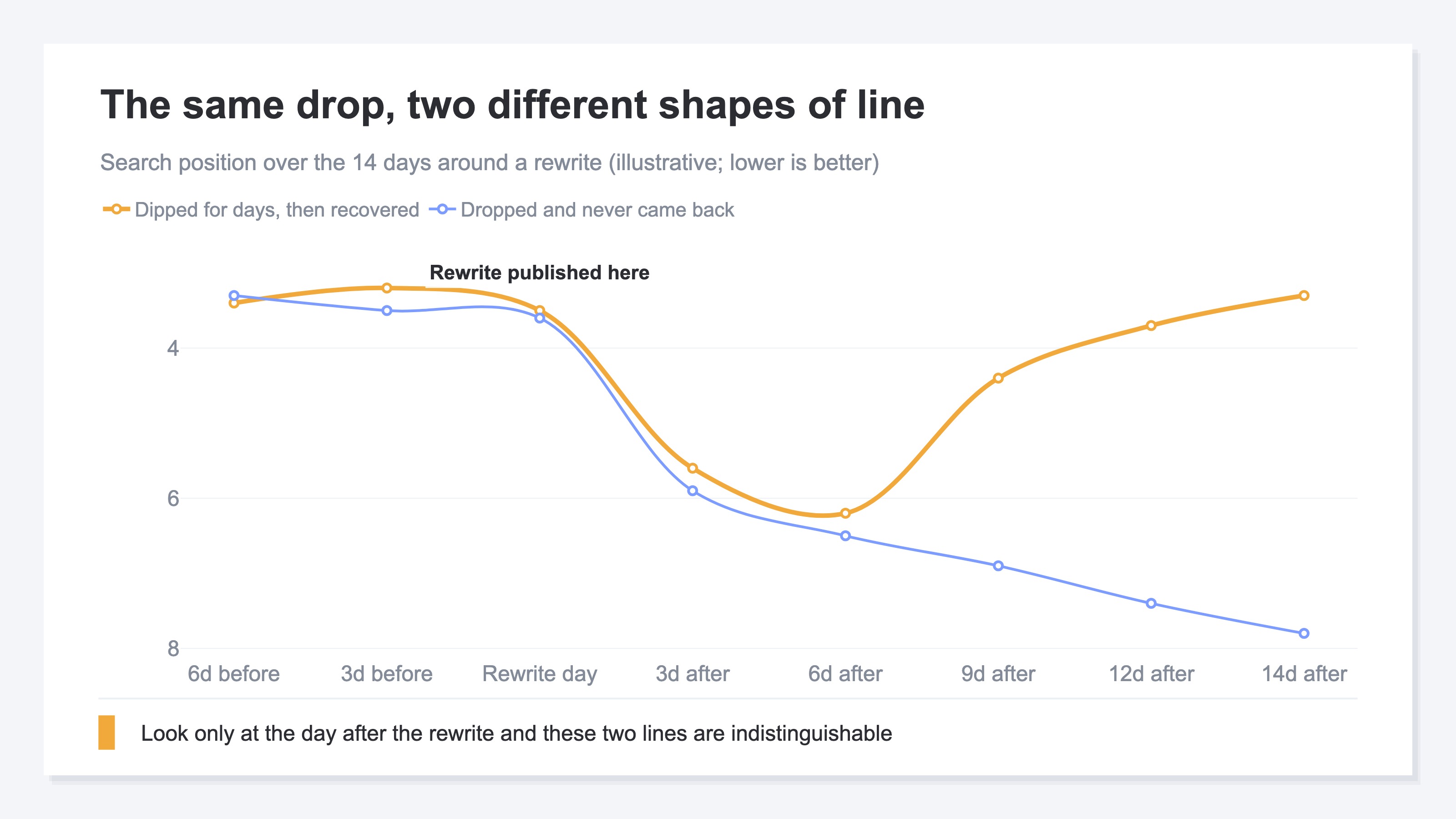
Which of the two lines you are tracing gets clearer the more days you stack up. How many days that takes is the subject of the next section. What gets settled first, here, is narrowing where you look down to one place.
That one place is the question of whether the pages that fell are only the rewritten ones. Google writes that it is important to check whether the decline is occurring across the whole site, on several pages only, or on one very important page[2]. If pages you didn't rewrite are falling alongside it, the cause sits outside the rewrite. If only the rewritten page is falling, what remains is a choice between noise and the rewrite making things worse.
Whether it overlaps with movement on the search side can be guessed from the timing. On core updates, Google recommends first confirming that the rollout has finished[1]. On top of that, you wait at least a week after completion before analyzing the site in Google Search Console[1]. If you were rewriting in the middle of a rollout, the drop you can see there isn't necessarily the result of the rewrite.
When the rewrite itself lowered the assessment, there are signs you can recognize. Among its self-assessment questions, Google raises whether you are changing the date on a page purely to make it look fresh without substantively changing the content[5]. Where you referred to other sources, you are also asked whether you can show added value and originality rather than a plain copy or rewording[5]. A rewrite that adds almost nothing to the body and only refreshes the update date runs into both of these. For the places you must not touch before a rewrite, see Don't break your winning pages when you rewrite; for the option of fixing the title rather than the body, see Rewrote it but clicks won't grow.
2. The Observation Window That Tells Noise From a Real Drop#
Google says small rises and falls in position can always happen. That includes cases where the position recovers naturally without you doing anything in particular[2]. It also writes that if a page is already performing well, it is better to avoid fundamental changes[2]. In other words, pulling your hands back immediately after a drop is not the way Google recommends.
What you need in order to tell them apart isn't analytical skill; it's days. The most recent data in Google Search Console may be provisional, and because collection is still in progress it can move over the following hours[4]. Data from the day after a rewrite is, in that sense, a figure that hasn't settled. Week and month granularities exist for the same reason: to smooth day-level movement and read the longer-term trend[4].
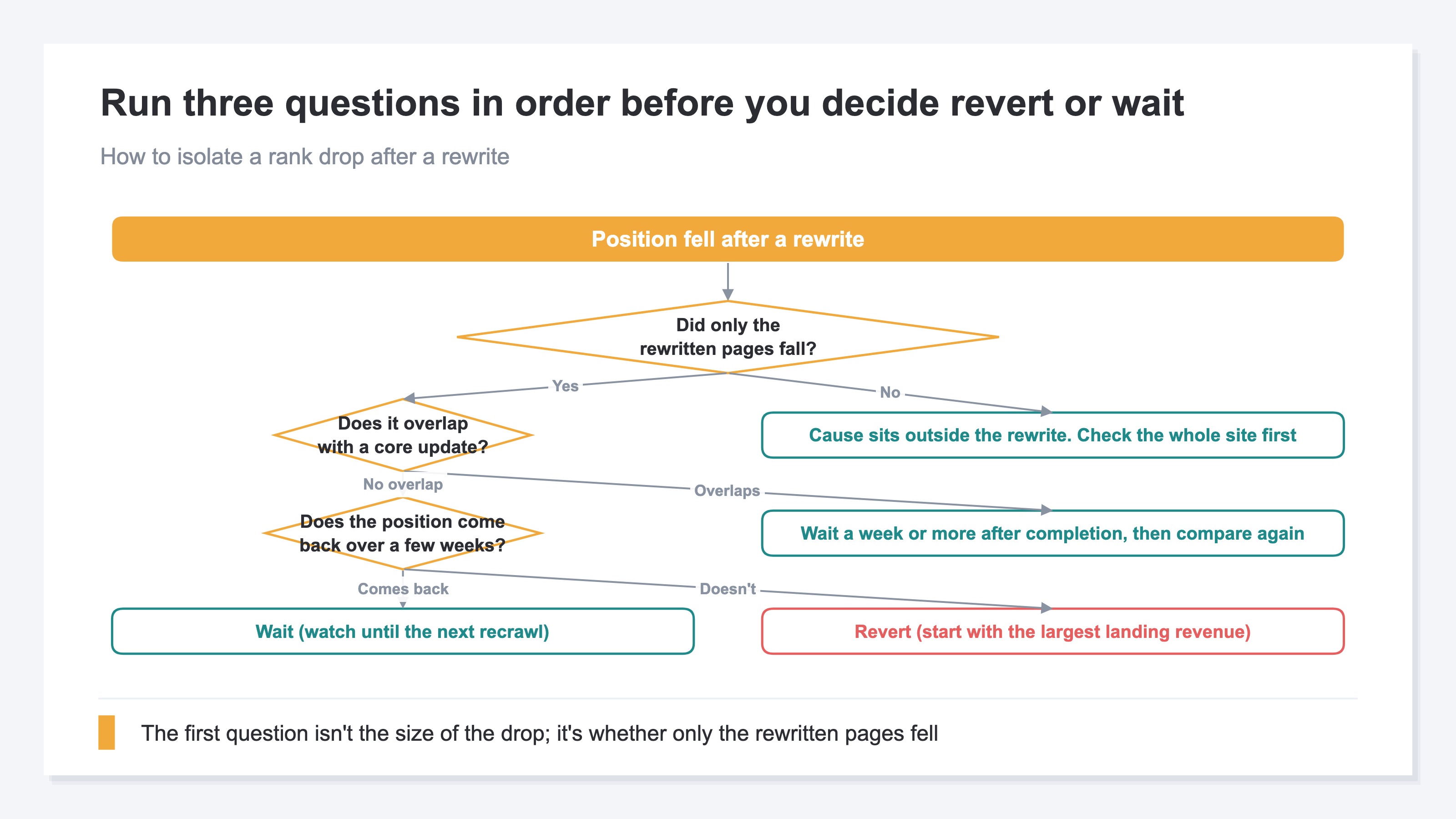
There is official guidance on the waiting time after you make a change, too. Google says that even when you change a site, it can take time for the effect to appear[2]. On that basis, it recommends generally waiting a few weeks before analyzing again in Google Search Console[2]. What you check is whether there has been a good effect on search position[2]. The few weeks meant here are not time spent staring without fixing anything. They are the time it takes for the result of a fix to show. A rollback is a kind of change as well, so the same waiting time applies after you revert. If it overlaps with a core update, you wait at least a week after completion and then compare the week before the rollout started against the current week[1].
The size of the drop itself is material for deciding the size of the response. Google raises a fall from position 2 to position 4 as an example of a small decline[2]. At that size you are within the range of the small rises and falls in position, and it is better to avoid making fundamental changes to a page that is already performing well[2]. For a large decline such as position 4 to position 29, you move on to a self-assessment of the whole site[2].
There is one more thing Google writes plainly, about how to treat the absolute value of position. The explanation is that in general you don't need to place much weight on the absolute value of search position, and that impressions and clicks are what ultimately serve as the indicator of a site's success[2]. The phenomenon where position hasn't moved yet clicks alone fall happens for a different reason, and is covered in Same rank, fewer clicks. If the numbers from a rank tracking tool and Google Search Console disagree, see Rank trackers and Google Search Console disagree.
3. Revert or Wait Is Decided by Page Revenue#
The cost of reverting and the risk of waiting are not sitting on the same scale. On the revert side there is the work of rolling the rewrite back, and the waiting time that follows it. Even if you request a recrawl, crawling can take anywhere from a few days to a few weeks[3]. Requesting a recrawl of the same URL over and over doesn't get it crawled sooner[3]. Nor does requesting it necessarily mean it shows up in search results right away[3]. This weight barely changes whether the page is large or small.
The waiting side is different. What decreases while you wait is the revenue that page was producing. The amount changes by an order of magnitude from page to page. The number to look at here is landing revenue. Landing revenue is the total revenue ultimately produced by the sessions that entered through that page, with purchases made on a different page after browsing around added back onto the entry page. Its character as a metric is laid out in Measuring article CVR tells you little.
Search positions for two pages rewritten in the same week at Fictional Store B (illustrative)
| Entry page | Before rewrite | After rewrite | Size of drop |
|---|---|---|---|
| Choosing a moisturizing cream | 2.1 | 4.2 | 2.1 |
| The order to apply toner | 2.0 | 4.0 | 2.0 |
Both of these fit the position 2 to position 4 shape that Google raises as an example of a small decline. The sizes of the drop are 2.1 and 2.0, a difference of only 0.1. Two pages rewritten on the same day and fallen by the same amount: which one do you revert first? The four kinds of data in this table don't settle that order. What settles it is one more figure that isn't in the table — how much that page sells in a month.
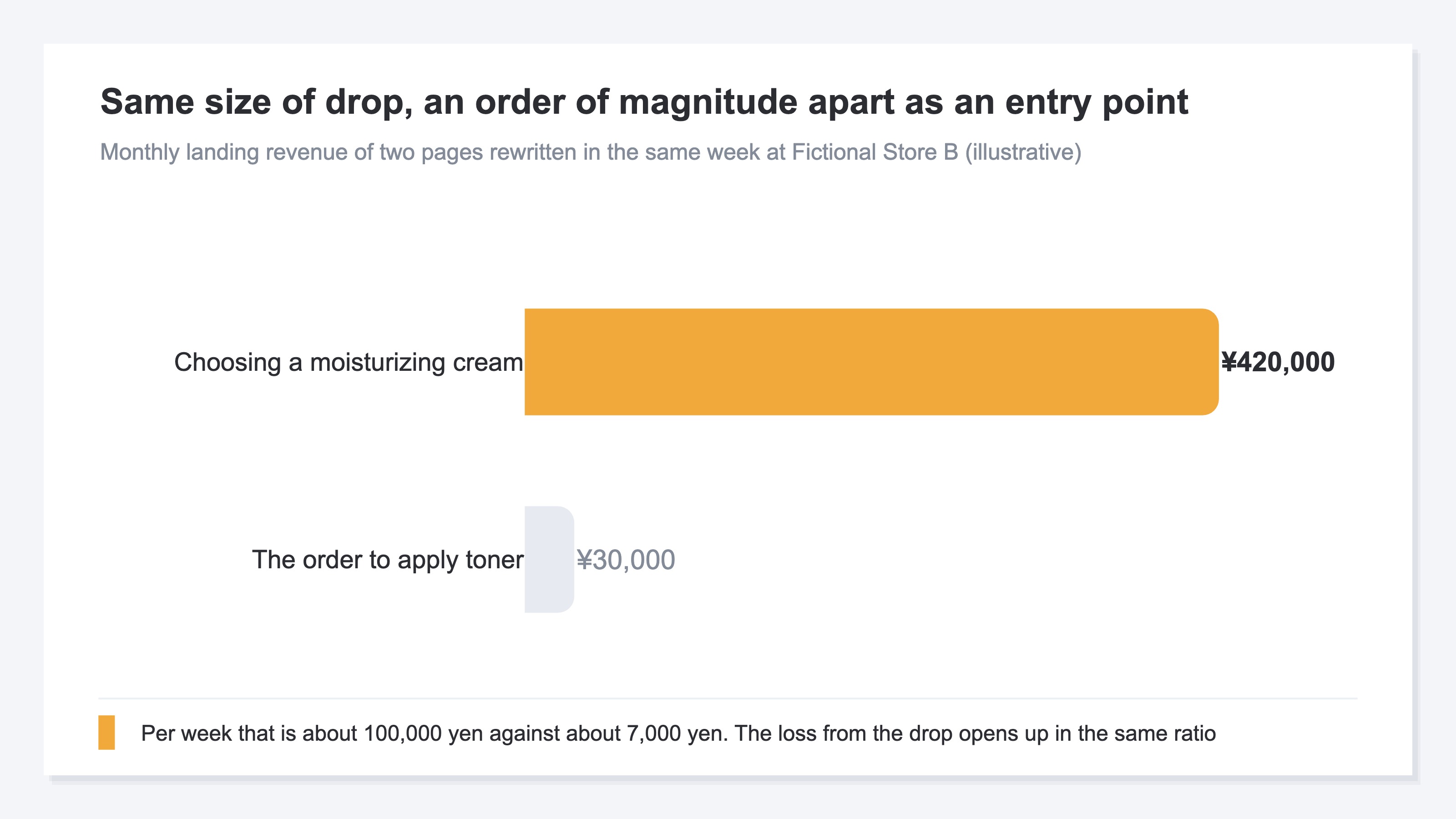
Monthly landing revenue for "Choosing a moisturizing cream" was ¥420,000, and for "The order to apply toner" it was ¥30,000. Converted to a weekly figure, that is roughly ¥100,000 and roughly ¥7,000. What you lose here is not the whole amount. It is only the portion that fell away because the position dropped. Over the same period, search clicks on the upper page fell by about a third. If an entry point producing ¥100,000 a week falls by that proportion, the loss works out to somewhere around ¥30,000 a week. Leave it down for two weeks and that is somewhere around ¥60,000. The lower page has a base of ¥7,000 a week, so the same proportion doesn't reach ¥5,000 over two weeks. That is not an amount that justifies the rollback work and the round trip of a recrawl. Out of drops that differ by only 0.1, the number of weeks you can wait is the one thing that comes out differently.
If you run this by hand, you look up each rewritten URL one at a time in the page-level table in Google Search Console, compare the periods before and after the rewrite date, and record position and clicks. Then you pull revenue for the same URL from the landing page report in GA4 and line the two figures up in a single row. The awkward part is that this work doesn't finish in one pass. For the few weeks it takes the shape of the line to settle, you repeat the same procedure every few days, once for every page that fell. The reason a conclusion on revert or wait comes late is not that reading positions is hard; it is that this repetition can't keep up with the number of rewrites.
RevenueScope solution
What deciding revert or wait needed were two things: how that page's position moved, and that page's landing revenue. The content improvement suggestions in RevenueScope display both in a single table.
The content improvement suggestions classify the pages that appear in search into five states against the prior period: stalling, headroom, rising, low-click and steady. The classification badge, the period-over-period change in search clicks and search position, and the landing revenue for visits that entered through that page are displayed in one table, one line per page. Landing revenue is the amount the sessions that entered from a rewritten page ultimately produced, added up onto the entry page itself. Sessions judged to be bots are not included.
Among the classifications, stalling has a strict line drawn in its definition. Stalling is attached to pages whose search clicks actually fell. Pages where only the position dropped don't enter that bucket. Only where a page with real traffic dropped in position and clicks are also not growing does it enter the same bucket, as an early warning. What RevenueScope aggregates is the change in position and the landing revenue for each rewritten page. For whole-site analysis, carry on with GA4.
Asking RevenueScope about Fictional Store B's rewritten pages (illustrative)
| Page | Classification | Search clicks | Position | Landing revenue |
|---|---|---|---|---|
| Choosing a moisturizing cream | Stalling | 120 → 80 | 2.1 → 4.2 | ¥420,000 |
| The order to apply toner | Stalling | 45 → 30 | 2.0 → 4.0 | ¥30,000 |
| Reapplying sunscreen | Steady | 58 → 58 | 3.5 → 3.6 | ¥180,000 |
| Skincare for sensitive skin | Low-click | 2 → 0 | 24.0 → 25.5 | ¥0 |
Note: it is normal for the numbers not to line up. The four rows above are an example built for explanation, while the demo screen carries the sample store's sample data, refreshed daily.
The two rewritten pages at the top are both judged stalling. Their landing revenue is ¥420,000 and ¥30,000, and that is the only place where they open up widely. Search clicks on the upper row have fallen by a third, so the arithmetic says somewhere around ¥30,000 a week is being lost from an entry point worth ¥100,000 a week. That is why you cut the observation window at one week and prepare the rollback in parallel. The lower row comes to about ¥2,000 a week at the same proportion, so you watch it until the next recrawl comes around. Reapplying sunscreen has barely moved in either position or clicks, so no effect from the rewrite is showing. The next move is to put a deadline on the top row and take the remaining three rows out of this week's work.
FAQ#
Frequently asked questions#
Q. If I restore the version from before the rewrite, will the position come straight back?
A. Not straight away. Even if you request a recrawl, crawling can take anywhere from a few days to a few weeks[3]. However many times you request it for the same URL, it doesn't get crawled sooner[3]. It is also written that requesting it doesn't necessarily mean it appears in search results right away[3].
Q. We fell from position 2 to position 4. Should we revert?
A. Google raises a fall from position 2 to position 4 as an example of a small decline[2]. Small rises and falls in position can always happen, and it is said to be better to avoid fundamental changes to a page that is already performing well[2]. That said, on a page with large landing revenue, it is the number of weeks you spend watching that you cut shorter.
Q. How long do I have to wait before I can judge it a real drop?
A. There is no official standard that fixes a uniform number of days. Google says small rises and falls in position can always happen, and explains this including cases that recover naturally without you doing anything[2]. Because the most recent data is provisional and can move within hours[4], you don't decide on the next day's figures. If it overlaps with a core update, you wait at least a week after completion and compare the week before it started against the current week[1].
Q. Is a page that dropped in position the same as a page that has stalled?
A. They are not the same. In the content improvement suggestions in RevenueScope, stalling is attached to pages whose search clicks actually fell. Pages where only the position dropped don't enter that bucket. Only where there is real traffic, the position dropped, and clicks are also not growing does it enter the same bucket, as an early warning.
Summary#
When a position falls after a rewrite, the first thing to settle is not whether to revert. It is whether the pages that fell are only the rewritten ones. Google likewise says it is important to check whether the decline is occurring across the whole site, on several pages only, or on one very important page[2].
The size of the drop stays material for deciding the size of the response. Google raises a fall from position 2 to position 4 as an example of a small decline, and for a large decline such as position 4 to position 29 it recommends a self-assessment of the whole site[2]. Even for the same decline, what to do next isn't settled by that alone.
What settles it is comparing the cost of reverting against the risk of waiting. The weight on the revert side is the rollback work plus a recrawl of a few days to a few weeks[3], and it is close to constant whatever the size of the page. On top of that, once you have reverted, the few weeks it takes to confirm whether there was an effect come around again[2]. Only the loss on the waiting side grows in proportion to that page's landing revenue. So this is where the line goes. On pages with large landing revenue, cut the observation window at one week, and decide on reverting with the amount you would lose in that week as the ceiling. On pages with small landing revenue, wait until the next recrawl comes around and look at the shape of the line. Two pages with the same size of drop don't need to reach a conclusion on the same day.
See which ads actually drive revenue, at a glance
Free up to 5,000 sessions/month, AI connection included. No credit card required. Up and running in 5 minutes.
References#
- [1] Google Search Central "Google Search's core updates and your website" (2025)
- [2] Google Search Central "Debugging drops in Google Search traffic" (2025)
- [3] Google Search Central "Ask Google to recrawl your URLs" (2025)
- [4] Google Search Console Help "Performance report (Search results): Overview and basic setup" (2026)
- [5] Google Search Central "Creating helpful, reliable, people-first content" (2025)