You rewrote the article, but clicks won't grow at all. You add to the body, yet the click count in Google Search Console (GSC, the free tool for seeing your search impressions and clicks) barely moves. If you're growing the articles on an ecommerce site, this is a wall you hit often.
In fact, two causes are stacked inside this spinning of the wheels. The first is fixing the wrong place. When you have impressions but no clicks, the problem is usually not the thickness of the body — it's how the page looks in the search results, that is, the title. The second is fixing the wrong page. You keep working the pages already ranking near the top and overlook the ones that are just one step away. This article lays out, plainly, how to tell whether you should expand the body or fix the title, using four points: impressions, click-through rate, nearness to revenue, and ranking position.
Table of contents
TL;DR#
- When a rewrite doesn't grow clicks, it's usually not that the body is thin — it's that you're mistaking how the page looks in the results (the title) and which page to fix (its rank band)
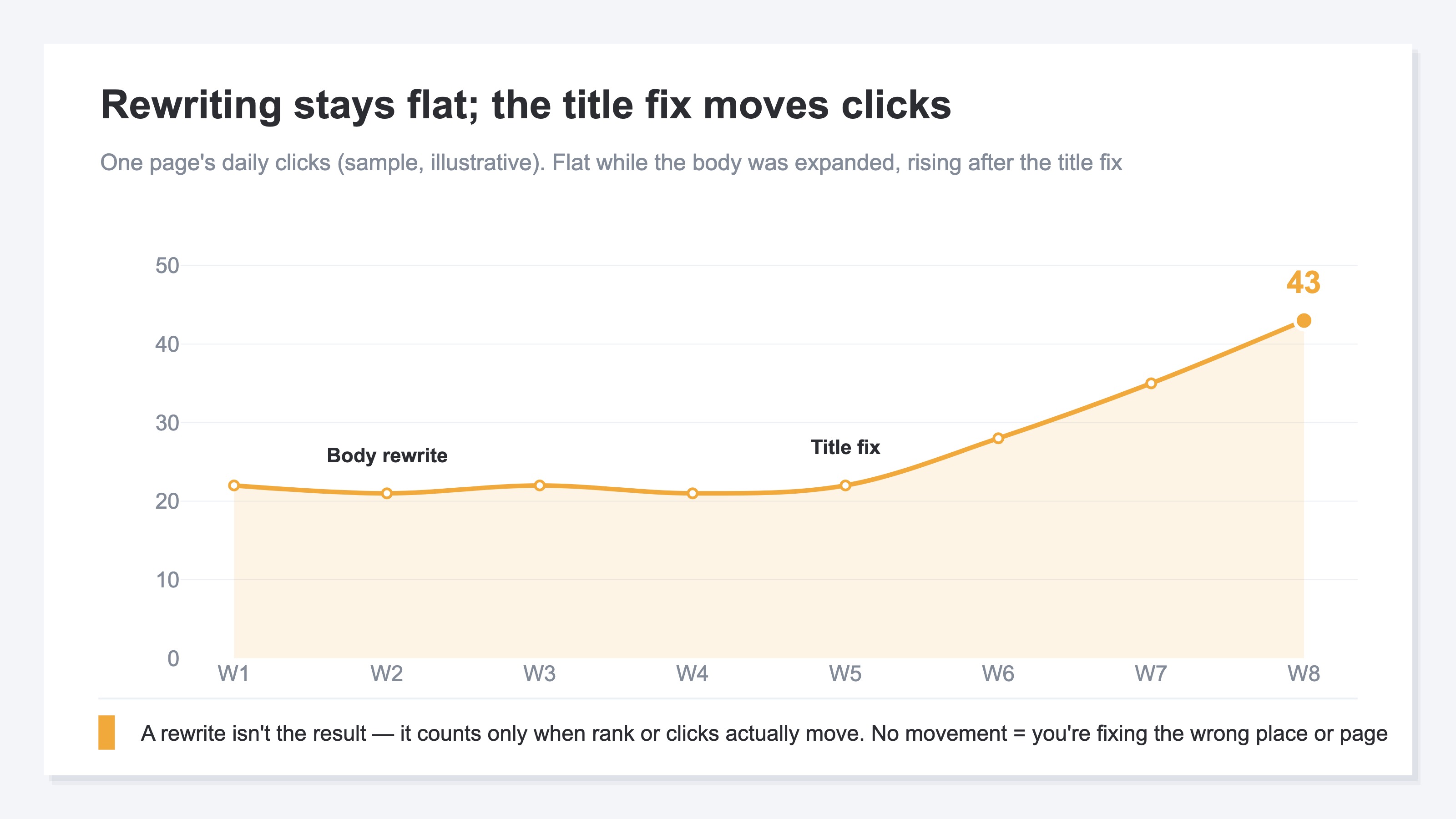
- If you have impressions but no clicks, the problem is the title, not the body. No matter how much you add to the body, if the one line that gets chosen in the results doesn't change, clicks won't move
- The other way to spin your wheels is fixing only the pages already near the top. The real upside is in the "one step away" pages, ranking roughly 8th to 20th
- Body or title is decided by four points: impressions, click-through rate, nearness to revenue, and ranking position. Fix in order — start with pages that are near revenue, at a near-page rank, with a low click-through rate
1. Why rewriting the body doesn't grow clicks#
Here's the bottom line: when a rewrite doesn't grow clicks, you've usually mistaken both the place to fix and the page to fix. Before thickening the body, check those first.
When clicks don't grow, most people first assume "the body must be thin" and start adding text. More headings, more information. But if the page is showing in the results (you have impressions) yet gets no clicks, readers never reach the content in the first place. Thicken the content all you like — all that's visible in the results is the title and the description. If that doesn't land, no amount of body work gets the page chosen, and clicks won't move. The question of which page to fix first among many low-click pages is laid out in Impressions but zero clicks. That article is about which page to pick from among several low-click pages; this one goes one step further, telling you which lever to pull — title versus body — for the single page you've chosen.
The other way to spin your wheels is aiming at the wrong page. It's tempting to start with the eye-catching top pages (page one of the results, high up). But working a page already in the top 5 over and over leaves little upside. What really pays off are the pages ranking roughly 8th to 20th — the "one step away" band. A small edit here can push them onto page one and grow clicks substantially. Pushing this band tends to win more than polishing what's already high.
And a rewrite isn't "done once you do it." Editing the text is not itself a result — it only means something once the ranking or clicks actually move. If you touched a page and nothing moved, that's a signal you're off on the place or the page.
2. Being seen and being clicked are not the same#
The bottom line: being "seen" in the results and being "clicked" are two different things, and if you miss this difference you'll misjudge how much the title weighs.
Impressions are the number of times your page appeared in the results. Click-through rate (CTR, the share of those appearances that got clicked) is the share that was actually chosen. A more detailed breakdown of the terms is in What is click-through rate (CTR). Plenty of impressions but a low CTR means you're being seen but not being chosen.
Why are you seen but not chosen? Eye-tracking studies that follow how people look at search results report that people don't read the results word for word. They skim the front of the title and, in an instant, judge "does this look like it answers what I want to know?" In other words, the contest is decided in the first half of the title. If the words the person searched aren't in the title, if it isn't instantly clear what the page is, if the description reads stiff and unhelpful — those mismatches get you passed over even when you're shown.
So the first thing to suspect in an article that won't grow clicks isn't the length of the body — it's the title and description that appear in the results. However much you thicken the body, what the reader sees is that one line. Matching it to the searcher's words and the answer they want is the single most effective move.
3. Which to fix, the body or the title#
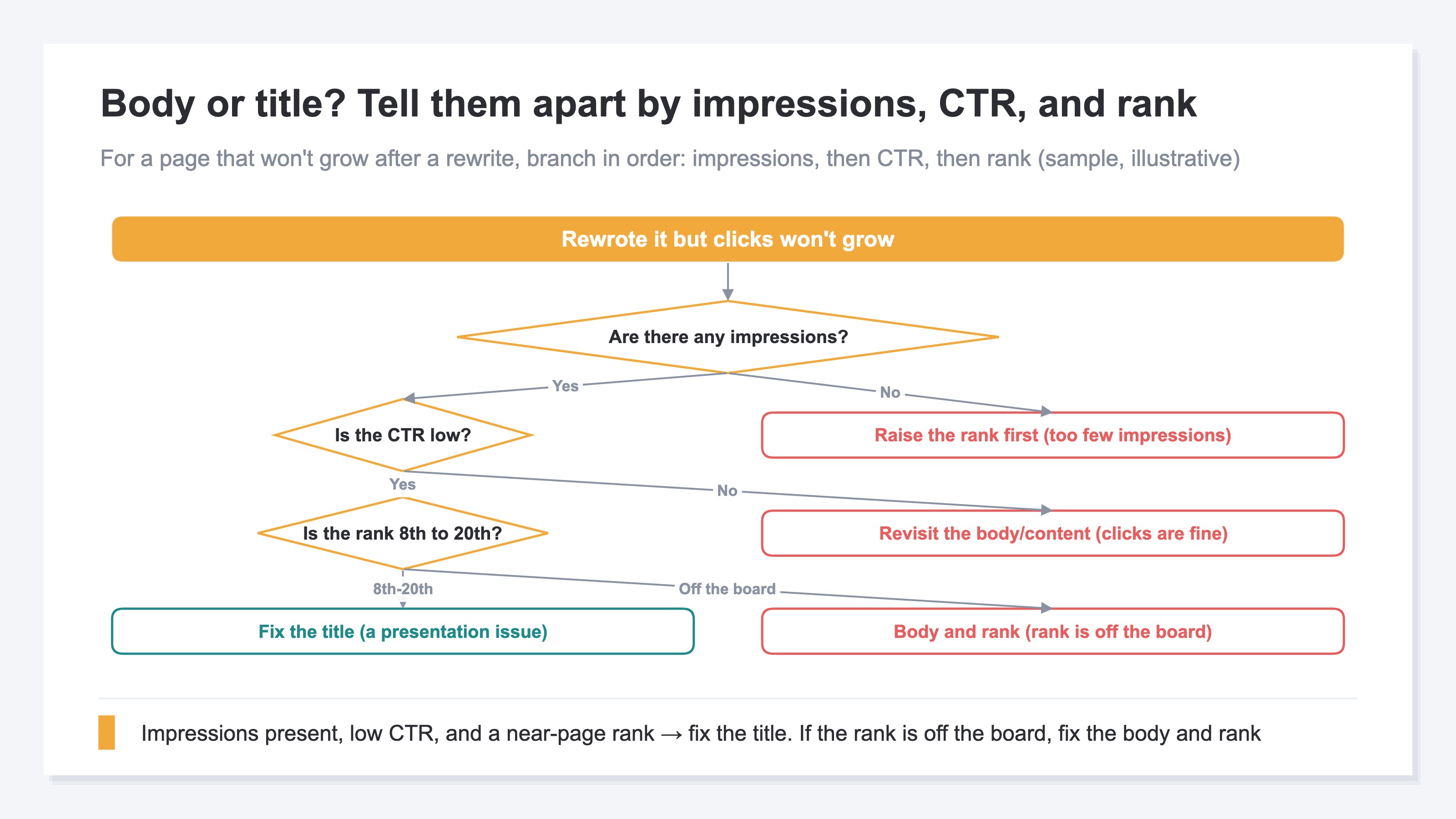
The bottom line: don't decide body-versus-title by gut — tell them apart with four points: impressions, click-through rate, nearness to revenue, and ranking position.
Here's the line of reasoning. First look at impressions. If impressions are few to begin with, the page isn't showing enough in search yet — that's a ranking problem to solve before the title. Next, if you have impressions but a low CTR, you're being seen but not chosen. That is the target for fixing the title and description. Conversely, if the page ranks high and earns clicks but conversion is weak, only then do you revisit the body. Where you're stumbling — impressions, CTR, or rank — completely changes the move.
On top of that, decide the order by nearness to revenue. The page with the most impressions is usually just someone looking up the meaning of a word, and fixing it stays far from revenue. So fix the low clicks first on pages showing for buy-intent searches like price, comparison, and how-to. For the same effort of "fixing a title," starting from pages near revenue turns the added clicks straight into prospects. How to find the near-page-rank pages with the most opportunity is collected in Pick striking-distance keywords by revenue.
The thinking for fixing a title isn't complicated. Put the searcher's words and the one thing they most want to know in the front half of the title. Results get cut off partway, so push the important words to the front. In the back half, add the one thing that sets you apart from other results (a concrete number, target, or conclusion). For example, for someone looking up "shipping cost guide," a title that touches the conclusion — "how much for free shipping" — gets chosen over one that only says "free shipping conditions." The same goes for the description: lead with the conclusion, in plain words. From here, once you get into mass-producing many title candidates that land, the work of verifying which candidate worked, one by one, is waiting for you.
One note: everything above assumes "the ranking hasn't dropped." If impressions themselves are falling or the ranking position is down, that's a ranking problem, not a title one — that's the cue for How to find content whose ranking dropped. When the ranking is unchanged but only clicks are falling, an AI summary may be taking the answer, which is handled separately in Same rank, fewer clicks. First tell which of these is happening, then choose the move.
RevenueScope solution
Here's the bottom line: telling "which to fix, the body or the title, and starting from which page" across dozens of pages every week, with GSC and manual effort alone, is quietly, genuinely heavy work. This is where RevenueScope begins.
With GSC too, you can trace impressions, CTR, and ranking position one page at a time. But continuously scanning dozens of pages every week to catch which are "shown but low-CTR," and of those which are "near revenue at a near-page rank," is a slog. RevenueScope classifies content pages into five states by period-over-period impressions and clicks: slipping, grow candidate, rising, off-board exposure, and stable. On top of that, it lets you tell apart each page's ranking position, CTR, and measured landing revenue on a single screen.
The table below, for a sample-data fiction site (a demo EC store you can experiment with in place of your own), classifies articles and pages by state and lays out landing revenue and the next move.
| Page | Class | Rank | CTR | Landing revenue (90d) | Next move |
|---|---|---|---|---|---|
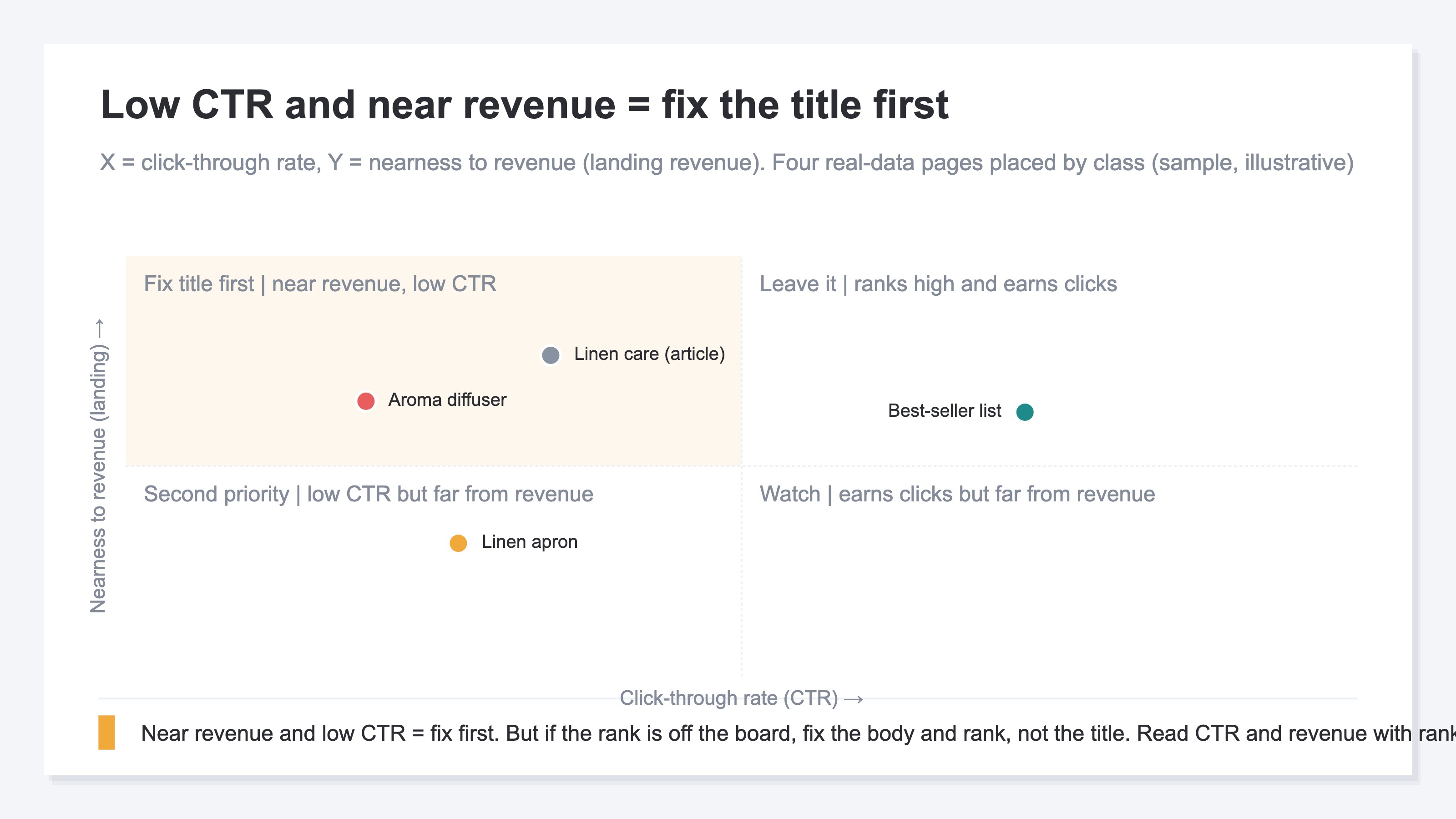
| Aroma diffuser | Grow candidate | 6.7 | 0.9% | ¥120,251 | Fix title first (13K impressions, near-page rank, low CTR) |
| Linen apron | Grow candidate | 10.2 | 0.9% | ¥20,533 | Title + a short FAQ to reach page 1 |
| Linen care (article) | Off-board exposure | 32 | 0% (zero clicks) | ¥122,783 | Body and rank, not title (off the board) |
| Best-seller list | Stable | 3.3 | 5.3% | ¥148,513 | Leave it for now (ranks high, earns clicks too) |
The point of this table is that the page to fix doesn't fall out of "most impressions" or "most landing revenue" order either. The aroma diffuser — landing revenue a large ¥120,251, rank a near-page 6.7, CTR a low 0.9% — is the top candidate for a title fix. On landing revenue alone, linen care (article) is also large at ¥122,783, but its rank of 32 is off the search board, so the page to fix is the body and rank before the title. Meanwhile, the best-seller list, already at 3.3 with a 5.3% CTR, has enough presentation, so leave it be. Only by reading rank, CTR, and revenue together does this "which to fix, and from where" emerge.
What RevenueScope gives you is the priority — which page's title to fix, and in what order. It overlays ranking position, CTR, and measured landing revenue on a single screen and names the top page to fix. Landing revenue is the revenue of sessions that landed on that page (purchases made on other pages after browsing are counted back to the entry page), captured from real measurement, so you can build the fixing order starting from the pages nearest revenue. Even on a site with no sales yet, it points to the order using read-through signals like average time and reach rate, plus how many more clicks near-page-rank search terms could add. Once the materials are in hand, all that's left is choosing the words for the front half and rewriting the title — the heaviest part, telling which page to fix first, is what RevenueScope takes on.
FAQ#
Frequently asked questions#
Q. I rewrote the article but clicks won't grow. What should I check first?
A. First look at impressions and CTR. If you have impressions but a low CTR, the problem is the title and description in the results, not the body. No matter how much you add to the body, if the line visible in the results doesn't change, clicks won't move. Conversely, if impressions themselves are few, that's a ranking problem — you need to raise the rank before the title.
Q. Which pages should I fix the title on for the best efficiency?
A. Start with pages at a "one step away" rank of 8th to 20th that are also near revenue. Polishing pages already in the top 5 leaves little upside. A near-page-rank page can be pushed onto page one just by adding a title or a short FAQ, and clicks can grow substantially. Of those, fix pages showing for buy-intent searches like price and comparison first, so the added clicks connect to prospects.
Q. If I fix the title, will clicks grow right away?
A. Usually not right away. It takes Google a few days to a few weeks to read the new title or description and reflect it in the results. And whether the CTR moved can't be judged until a certain amount of impressions accumulates. Note the date you fixed it and check after watching for about two to four weeks. Fixing over and over in a hurry makes it impossible to tell which change worked.
Summary#
When a rewrite doesn't grow clicks, it isn't that the body is too thin. In most cases, you've mistaken the place to fix and the page to fix. If you have impressions but no clicks, the problem is the title, not the body. What's visible in the results is that one line, and if it doesn't land, no amount of body-thickening gets it chosen.
And the page to fix isn't the eye-catching top page — it's the "one step away" pages ranking 8th to 20th. Fixing those in order of nearness to revenue, starting with the lowest CTR, grows clicks for the same effort and connects to prospects. Body or title is told apart with four points: impressions, click-through rate, nearness to revenue, and ranking position. Start with one page you're worried about: check whether you have impressions, whether the CTR is low, whether the rank is one step away, and whether it's near revenue. Once the place and the page are set, you avoid spinning your wheels on a rewrite.
See which ads actually drive revenue, at a glance
Free up to 5,000 sessions/month, AI connection included. No credit card required. Up and running in 5 minutes.