Your ranking has barely moved, yet you open Google Search Console (GSC, the free tool for seeing your search impressions and clicks) and the clicks alone are quietly sliding. Sound familiar? When a ranking drops, at least the cause is obvious. But when the ranking holds and only the clicks fall away, it's unsettling in a way that's hard to shake.
This "same rank, fewer clicks" pattern is now happening across many ecommerce sites. Behind it sits the AI summary that appears above the search results. This article lays out how to tell whether that click loss is "traffic eaten by an AI Overview" or "a win where AI cited you and chose you" — using three points: ranking, clicks, and AI-referred traffic.
Table of contents
TL;DR#
- When the ranking hasn't changed but clicks fall, reaching for the same drawer you use for a "ranking drop" leads you to the wrong fix. Steady rank with fewer clicks is a different phenomenon from a ranking drop
- A click drop hides two opposite realities. One is "eaten loss," where the AI summary answers the question on the search screen and the visit disappears. The other is "a chosen win," where AI cites you and people arrive via AI and buy
- The key to telling them apart is looking at three points: ranking, clicks, and AI-referred traffic. GSC shows you ranking, clicks, and impressions — no further. Whether it's a loss or a win only becomes clear once you connect the traffic that actually arrived via AI to its revenue
- Diagnose first, edit later. Rushing to rewrite the title of a page that's winning can destroy the very win you should be protecting
1. Don't assume fewer clicks means a ranking drop#
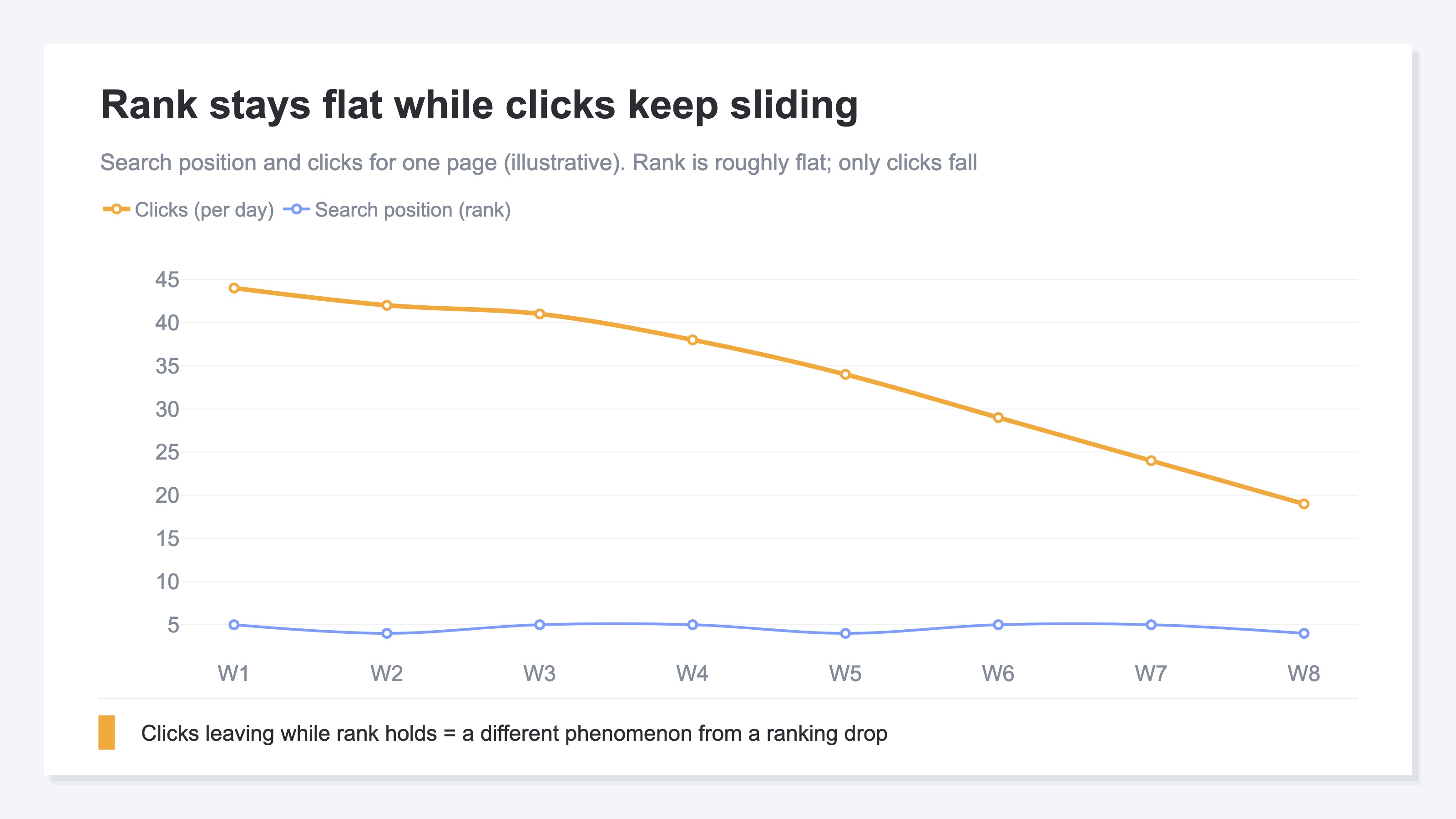
Here's the bottom line: when clicks fall while the ranking is unchanged, don't apply the same fix you'd use for a "ranking drop." Correctly identifying what's actually happening comes first.
One trigger is the generative-AI performance report Google added to GSC. You can now see how often you appeared in AI Overviews (the AI summary shown above the search results) and similar surfaces[2]. But all this report shows is impressions — no clicks, no ranking position, no revenue. What it does and doesn't reveal is covered separately in How to read GSC's AI search report. Here we use it simply as a doorway to understanding the phenomenon.
When an AI summary appears above the results, readers can get everything they need from that summary and stop clicking the links below. So the ranking stays at #1, yet clicks alone fall. GSC's position, clicks, and impressions do show you this symptom[1]. What they don't tell you is whether it's a "bad loss" or "actually a good sign." So don't jump to "ranking drop" — move on to the next diagnosis.
2. Separate traffic eaten by AI from exposure chosen by AI#
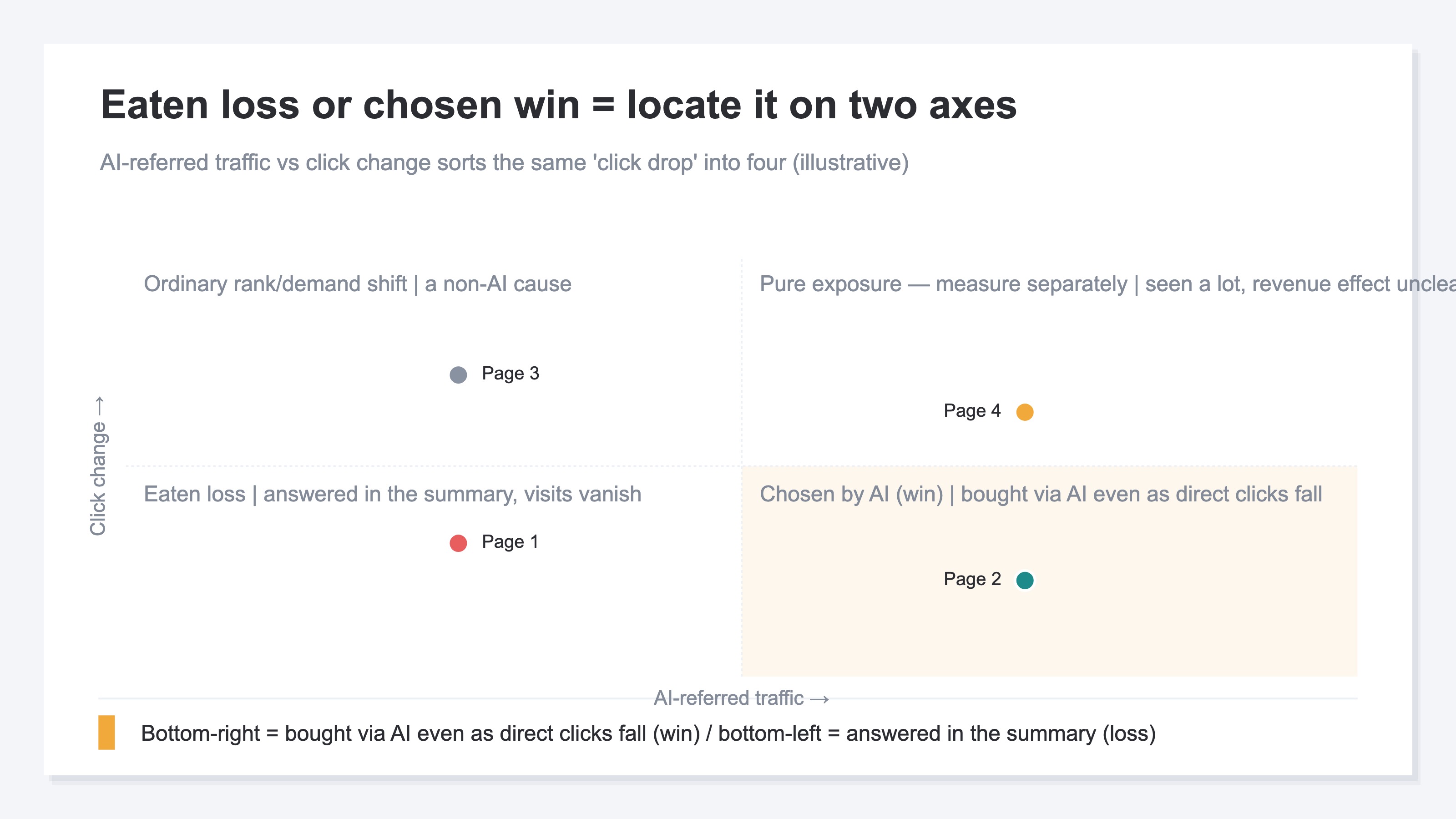
The bottom line: a steady-rank click drop holds two opposite realities, and the first step is to separate which one you're looking at.
The first is "eaten loss." The AI summary answers the question completely on the search screen, and the reader never reaches your site. You're shown, but the visit and the click both vanish — the so-called zero-click state (the query is answered on-screen and no one arrives). Both the traffic and the revenue behind it are lost.
The second is "a chosen win." AI cites your page, and prompted by that answer, readers arrive at your site via AI and buy. Even if direct clicks from search fall, if traffic through AI assistants like ChatGPT or Perplexity rises and turns into revenue, that's not a loss — it's a win. How AI-referred traffic connects to revenue is explored in The revenue contribution of AI citations.
The same-looking "click drop" can mean two very different things inside. In fact, one article on our own site had 1,230 search impressions, ranked #1 in organic search, and was even cited in the AI summary — yet direct clicks from it were 0. Stare at the numbers alone and it looks like a total failure. But if people are arriving and reading via AI, the story changes completely. That's why we position it as eaten or chosen before we act.
3. Tell them apart with three points — ranking, clicks, AI traffic#
The bottom line: whether it's a loss or a win isn't decided by any single number — you can only tell by connecting three points: ranking, clicks, and AI-referred traffic.
With just the two points of ranking and clicks, you can see that clicks fell, but you can't distinguish whether the reason is AI stealing the answer or AI citing you and moving the visit to a different entrance. Only by layering on a third point — whether people are actually arriving via AI and buying — does the direction become clear.
Let's be precise about GSC's coverage. GSC shows you Google's search and AI-summary impressions, no further. "Pure exposure" — shown inside an AI summary but no one came — appears as impressions[3]. Meanwhile, traffic that actually arrived from non-Google AI like ChatGPT or Perplexity, and its revenue, never appears in GSC. In other words, GSC alone lets you see the symptom of falling clicks, but structurally can't get you all the way to judging whether it's a loss or a win. Other reasons your impression and click counts don't reconcile between totals and details are covered in Why your Google Search Console clicks don't add up.
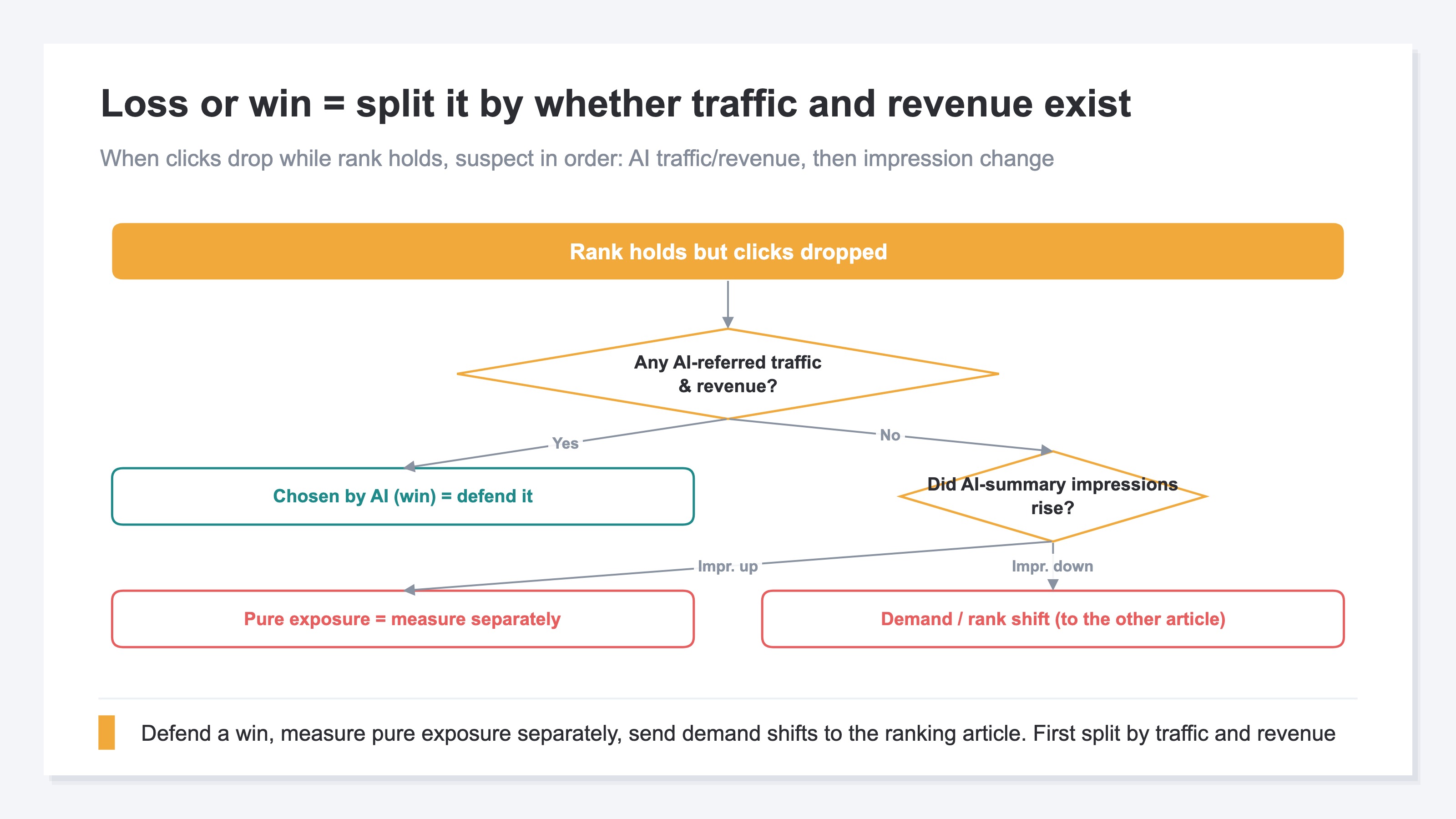
Here's the line of reasoning. First confirm the ranking is holding, then check in the trend whether clicks really are falling continuously. On top of that, confirm whether there's AI-referred traffic and revenue. If people are arriving via AI and buying, it's "a chosen win." If there's no AI-referred visit and only AI-summary impressions are rising, it's "eaten pure exposure." If the impressions themselves are also falling, that's a genuine ranking or demand shift — and that's the cue for a different article, How to find content whose ranking dropped. This article is its counterpart, working from the premise that the ranking has not dropped. A free way to roughly check AI-referred traffic is collected in A free check for AI traffic.
4. Decide your next move once you've diagnosed#
The bottom line: diagnose first, edit later — and never confuse the page that's winning with the page that needs fixing.
The diagnosis splits into three moves. The first is "protect." A page chosen by AI and bought via AI referral — don't casually touch its title or snippet. Rewriting it in a panic because clicks fell can break the very wording AI is citing, and you'd hand your win away yourself. This is the biggest pitfall.
The second is "fix." A page with impressions but no clicks and no visits, and no AI-referred revenue, is a straightforward candidate for title and snippet improvement. The thinking on which page to fix first is in Impressions but zero clicks, but mind the order. That article works from the premise that "zero clicks is a fix target" and prioritizes what to fix. This article sits one step earlier, inserting the judgment that "even with zero clicks, if the ranking holds and AI is citing you, it may not be a fix target at all."
The third is "win it back." A page purely shown in the AI summary with the visit gone is one to reshape so AI citation leads to a visit, or to build a path where people can arrive via AI too. Either way, first position where you are — win, loss, or pure exposure — then choose your move. Reverse the order and fix first, and you become the one destroying what you should protect.
RevenueScope solution
Here's the bottom line: doing the work of connecting three points — ranking, clicks, and AI-referred revenue — across dozens of pages every week with GSC and manual effort alone is quietly, genuinely heavy.
RevenueScope solves this. First, pinpointing the pages where "the ranking is the same but only clicks dropped." GSC can trace a trend one page at a time, but scanning dozens of pages daily and continuously catching the divergence where ranking stays flat and only clicks fall is a slog. RevenueScope returns the daily and weekly trends of position, clicks, and impressions for the pages you specify, all at once, narrowing down over time to the pages where clicks peel away while the ranking holds.
On top of that, it tells a loss from a win by revenue. It shows which pages people arrive at via AI and how much they buy in the landing session, broken out by AI channel. The table below lists AI-referred traffic and revenue by page for the sample-data fiction site.
| Page | AI-referred visits (90d) | AI-referred revenue (landing) | Assessment |
|---|---|---|---|
| Best-seller list | 74 | ¥80,861 | Chosen by AI and selling = protect |
| Linen care (article) | 78 | ¥39,892 | Article converts via AI referral = protect |
| Aroma diffuser | 83 | ¥45,028 | Chosen, but revenue skews to a single AI |
| Eco-gift feature (article) | 75 | ¥11,097 | High exposure but thin revenue = check |
What stands out in this example is that even when direct clicks from search fall, the pages where people arrive via AI and actually buy (wins) and the pages with plenty of visits but thin revenue (to check) split apart clearly in monetary terms. Staring at ranking and clicks alone, this line never appears.
What RevenueScope puts in monetary terms is the traffic that actually arrived via AI and the revenue of its landing session. Read those figures as a floor — "at least this much is arriving via AI and buying" — and since AI doesn't always pass along the referring source, the real AI-referred contribution runs higher still. The pure exposure shown in an AI summary but with no visit is read alongside the impressions in GSC's AI search report, so you can position where each page sits — win, loss, or pure exposure. RevenueScope connects those three points — ranking, clicks, and AI-referred revenue — on one screen and lays out, page by page, the material for deciding protect, fix, or win back.
FAQ#
Frequently asked questions#
Q. My ranking is still #1 but clicks dropped. Should I fix the title right away?
A. Too soon. First confirm whether that page has AI-referred traffic and revenue. If AI cites you and people arrive via AI and buy, that's a win, and casually editing the title can break the very wording AI is citing. What you fix is a page with no AI-referred visits, no revenue, and only impressions.
Q. Where can I tell whether I'm shown in an AI summary?
A. Impressions in Google's AI summary are visible in GSC's generative-AI performance report. But all that appears there is impressions — no clicks, no ranking, no revenue. And it only covers Google's own AI features; traffic from other AI like ChatGPT isn't included. The key is not to read "impressions went up" as "revenue went up."
Q. Can I say for certain that the click drop was caused by AI?
A. No. If the impressions themselves are falling, that may be a genuine ranking or demand shift, not AI. Only when the ranking holds, impressions hold, and clicks alone fall should you suspect the AI summary's effect. Finding dropped pages when impressions are falling is covered in a separate article.
Summary#
When the ranking is the same but only clicks fall, reaching for the same drawer you'd use for a "ranking drop" leads you to the wrong fix — because a click drop hides opposite realities. "Eaten loss," where the AI summary answers the question and the visit disappears, and "a chosen win," where AI cites you and people arrive via AI and buy. The look is identical, but the move is the exact opposite.
The key to telling them apart is looking at three points: ranking, clicks, and AI-referred traffic. GSC shows ranking, clicks, and impressions, no further; whether it's a loss or a win only becomes clear once you connect the AI-referred traffic and its revenue. Start with the one page you're worried about: check whether the ranking holds, whether clicks really are falling continuously, and whether people are arriving via AI and buying. Once you know where you are — win, loss, or pure exposure — you can avoid the accident of rushing to fix a title and destroying a win. Diagnose first, edit later.
See which ads actually drive revenue, at a glance
Free up to 5,000 sessions/month, AI connection included. No credit card required. Up and running in 5 minutes.