
ChatGPT, Perplexity, and the AI summaries that now sit above Google's search results (AI Overviews). Over the past year, it has become far more common for your products or brand to be cited there—"this store is good"—and for visitors to be sent your way. Being picked up by AI is, in itself, good news.
But this is where many marketers get stuck. "Being cited by AI" and "that person actually buying and turning into revenue" are completely different things. Citations seem to be rising, yet how much that traffic contributes to revenue never shows up when you open GA4. This article first makes clear what AI citation revenue contribution actually is, then walks through why AI-driven revenue becomes invisible, the limits of chasing "citation counts," and a realistic way to measure that contribution.
Contents
This article in brief#
- AI citation revenue contribution has two layers: "were you cited" (visibility) and "how much revenue did that traffic become" (revenue contribution). Many people conflate the two
- Traffic from AI often arrives with no source tag (UTM) on the link, so GA4 buckets it as "Direct" or unknown. That's why the revenue doesn't tie back
- Chasing "how many times you were cited in ChatGPT" doesn't translate to revenue. What matters is whether the people who arrived via AI actually bought, and how much, broken down by entry point
1. What "AI citation revenue contribution" means#
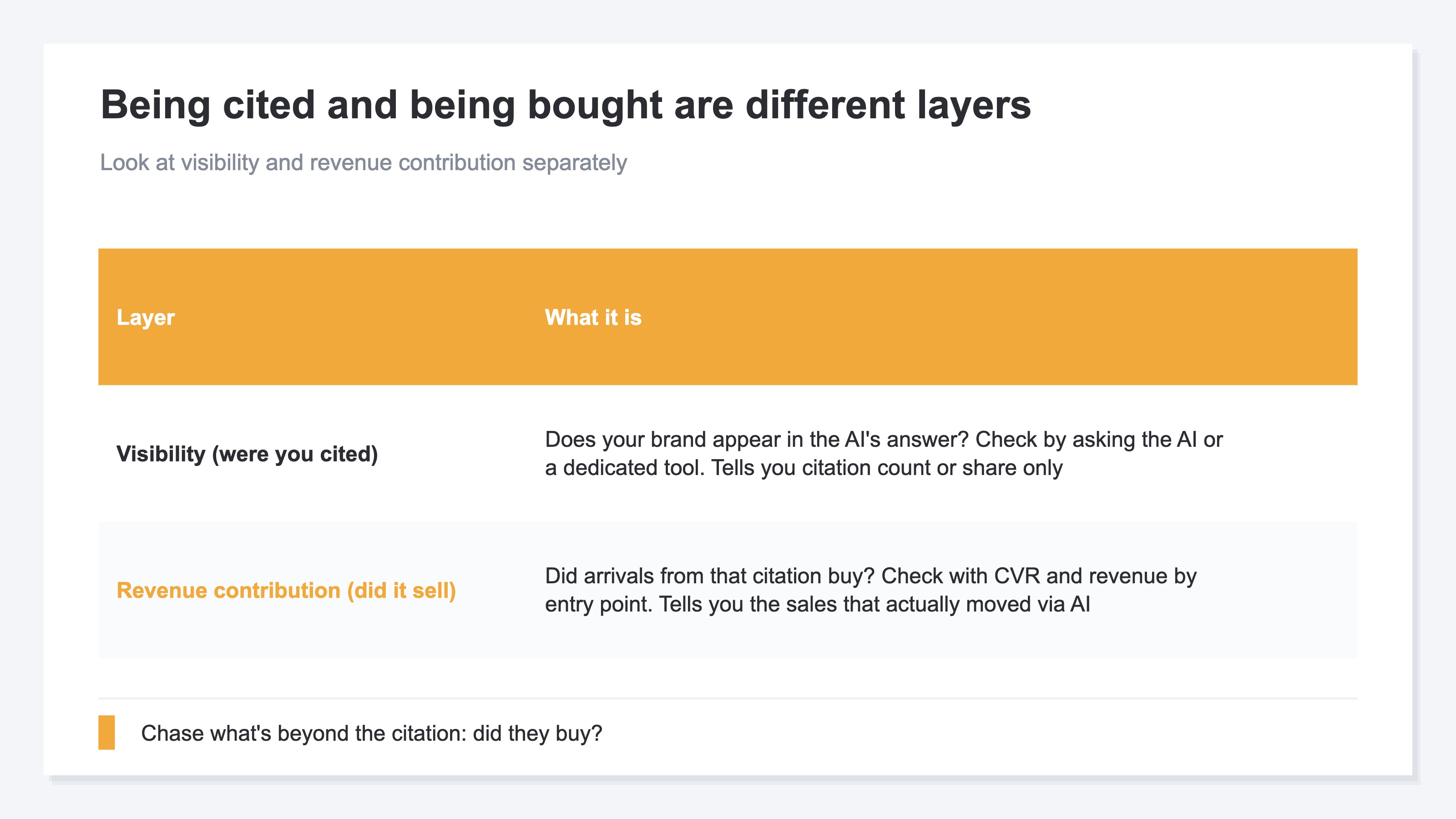
To put it plainly: to see AI's revenue contribution, you first need to separate two layers—"were you cited" and "did it contribute to revenue."
The first is visibility: whether your brand shows up in the AI's answer. For example, when someone asks ChatGPT "what's a good EC analytics tool?", does your name come up? The second is revenue contribution: whether the people who arrived because of that citation actually bought, and how much revenue that became. These two get treated as the same thing, but they are entirely different.
In practice, many marketers wear themselves out chasing only "were we cited." They spend hours every week manually checking whether their brand appears in ChatGPT or Perplexity, celebrating when it shows and despairing when it doesn't. But being cited is not, in itself, a guarantee of revenue. If the people who arrive just look and leave, the revenue is zero. What you should really be chasing is what lies beyond the citation: whether they bought.
2. Why AI-driven revenue becomes invisible#
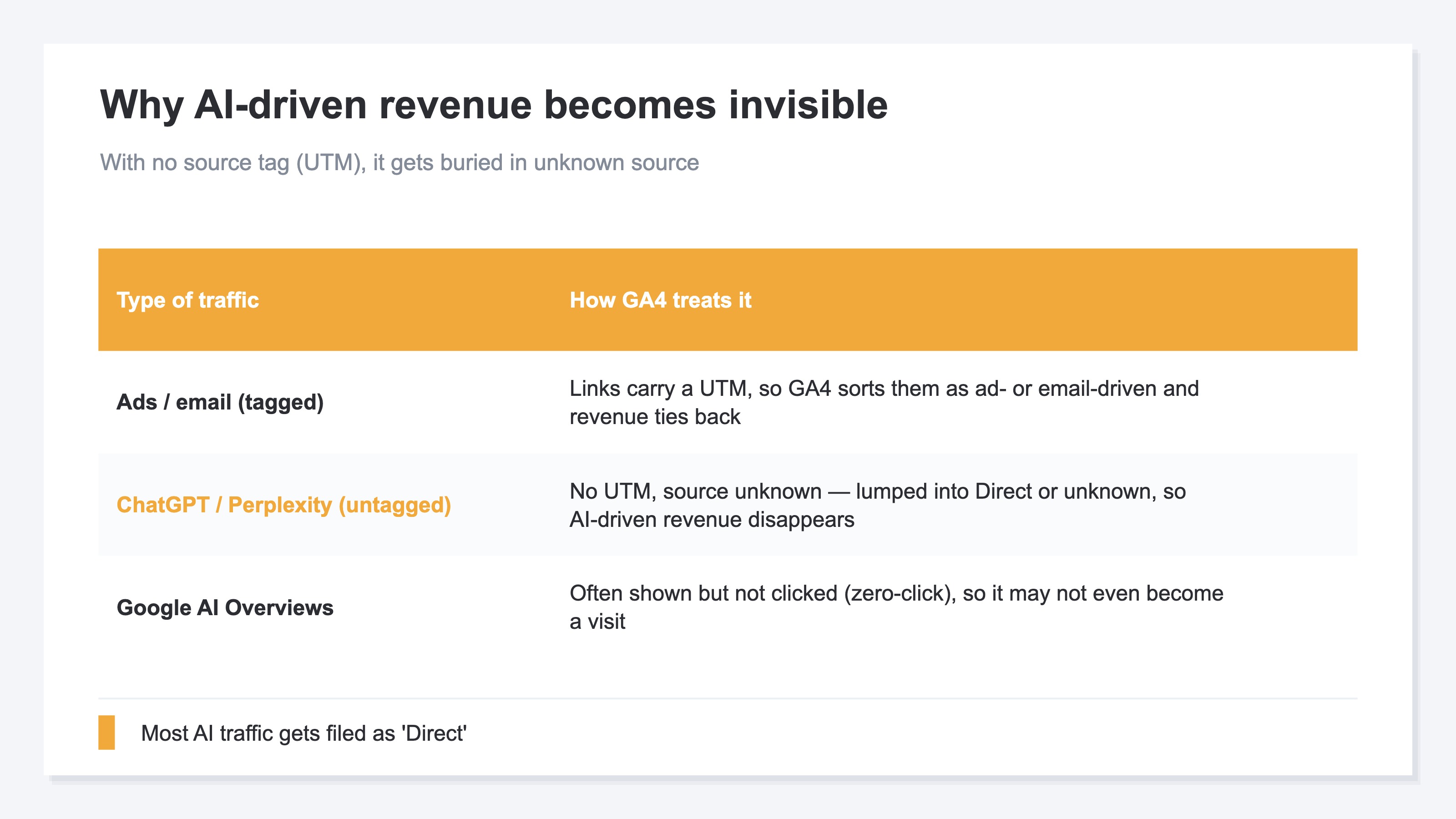
To put it plainly: the biggest reason AI traffic doesn't tie back to revenue is that the links carry no source tag (UTM).
Normally, the links you put in ads or email newsletters carry a UTM tag. GA4 reads that tag and sorts the revenue: "this came via ads," "this came via email." But the links ChatGPT or Perplexity place inside their answers often carry no such tag. So GA4 can't determine the source and lumps the visit into "Direct" (the same bucket as a bookmark or a typed-in URL) or as unknown.
As a result, the revenue AI sent your way gets mixed into a gaping pile of "unknown source." The sale did happen, but you can't tell it came via AI—so AI's contribution looks smaller than it really is. With Google's AI Overviews it's worse: the answer may be shown, but people are often satisfied and don't click through (this is called zero-click), so it may not even become a visit. Between "shown," "arrived," and "bought," there are several steps down.
3. Counting "citations" won't tell you about revenue#
To put it plainly: tools that count how many times you were cited by AI have multiplied, but that's a different number from "how much it contributed to revenue."
A wave of dedicated tools now tracks how often your brand is mentioned in ChatGPT or Perplexity—your citation share. Being able to see that share is genuinely useful. But here's the catch: "mentioned," "recommended," and "actually bought" are all different. A rise in mere mentions doesn't mean those were buyers.
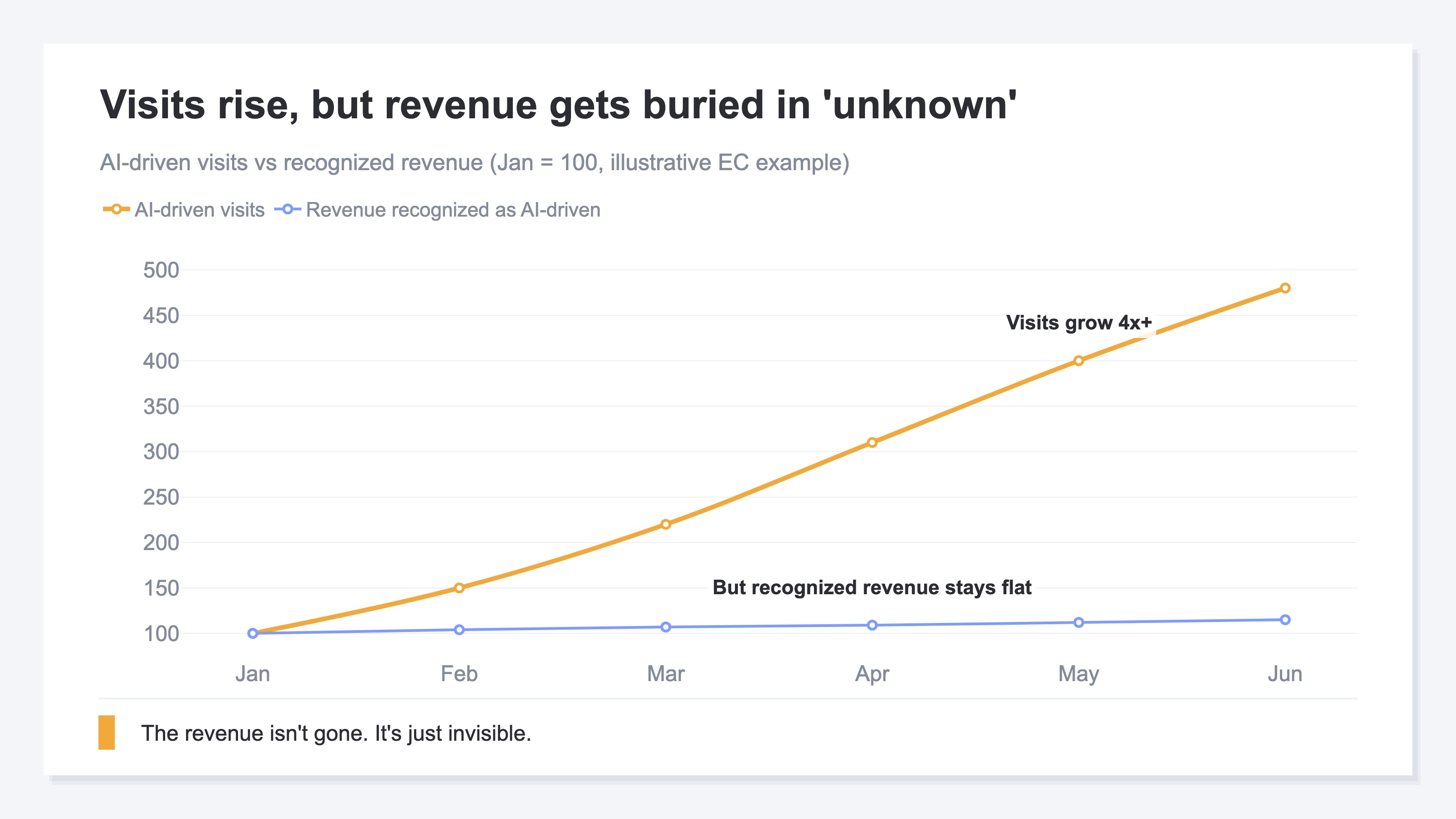
On top of that, AI answers wobble enough to return different brands for the same question on different days. Your brand is in the top spots on Tuesday and nowhere to be found on Thursday. So "citation count" can hint at direction, but it makes a poor basis for revenue. What you really want to know isn't the number of citations—it's whether the people who arrived via AI bought, and how much. As the chart below shows, even when AI-driven visits rise, the revenue recognized as AI-driven barely moves as long as it stays buried in "unknown source." The revenue may be moving; you just can't see it.
RevenueScope solution
When you try to capture AI citations in terms of revenue, you keep hitting the same wall: "how much did the people who arrived via AI actually buy?" is nowhere to be found. It's buried in the unknown-source pile, and you have to carve it out to see it.
RevenueScope carves out that AI-driven traffic buried in unknown source, and shows the conversion rate (CVR, the share of visitors who actually bought) and revenue by entry point (ChatGPT, Perplexity, Google AI Overviews, and so on)—the figures shown are demo data.
| Entry point | Visits | CVR | Revenue |
|---|---|---|---|
| ChatGPT | 1,800 | 2.1% | ¥210,000 |
| Perplexity | 600 | 2.6% | ¥95,000 |
| Google AI Overviews | 2,400 | 0.7% | ¥80,000 |
| Search (organic) | 5,000 | 3.5% | ¥520,000 |
The thing to read in this table is that Google AI Overviews, with the most visits (2,400), has the lowest conversion rate at 0.7%. Many people see the answer in the display and leave satisfied—the flip side of zero-click. ChatGPT and Perplexity, by contrast, have fewer visits but conversion rates in the 2% range, because those people arrive with intent. In other words, instead of lumping all AI traffic together, you can tell which entry points bring people who mean to buy. And these figures are after excluding automated-program (bot) traffic. AI-related crawlers and bots slip into traffic easily, and not excluding them makes AI's contribution look bigger than it is.
Let me be clear about one thing. What RevenueScope does is show the revenue from people who arrived via AI and bought, broken down by entry point. It does not tell you "how many times you were cited inside ChatGPT's answers" (your citation share itself)—that's the job of a separate, visibility-measuring tool. What RevenueScope surfaces is the revenue that actually moved as a result of the citation. It gathers the material to check citations against revenue; the decision of where to act is yours.
FAQ#
Frequently asked questions#
Q. How do I check whether I'm being cited by AI?
A. The basic approach is to actually type the kinds of questions your shoppers might ask ("what's a good ○○?") into ChatGPT or Perplexity and see whether your brand comes up. Because AI answers wobble day to day, don't do it just once—try the same question several times, across multiple AIs. This is a check of "visibility (were you cited)," and there are dedicated tools for it. But that's a separate question from "did it contribute to revenue." Even if you're cited, if the people who arrive don't buy, there's no revenue.
Q. Can I see AI traffic in GA4?
A. Partly, but with limits. Google is expanding measurement of its own AI surfaces, such as AI Overviews, but that's impression counts, not revenue. And traffic from ChatGPT or Perplexity often carries no source tag (UTM), so GA4 tends to file it under "Direct" or unknown. To see AI-driven revenue properly, you need to carve out what's buried in unknown source and look at conversion rate and revenue by entry point.
Q. If my "citation count" rises, will revenue rise too?
A. Not necessarily. "Mentioned," "recommended," and "actually bought" are each different things. A rise in mere mentions doesn't turn into revenue unless those are shopping-minded people. Conversely, some entry points have few citations but high conversion rates (like ChatGPT, where people arrive with intent). Rather than the count itself, it's more practical to look at whether the people who arrived via AI bought, and how much, by entry point.
Conclusion#
AI citation revenue contribution has two layers: "were you cited" (visibility) and "how much revenue did that traffic become" (revenue contribution). Many marketers exhaust themselves on the former, but being cited is not, in itself, a guarantee of revenue.
The tricky part is that AI traffic often carries no source tag (UTM), so it gets buried as "Direct" or unknown in GA4 and the revenue doesn't tie back. That's why chasing "citation counts" alone won't reveal revenue contribution.
What matters is carving out the AI-driven traffic buried in unknown source and looking at it through conversion rate (CVR) and revenue by entry point. Do that, and you can see—through numbers, not guesswork—whether the people AI sent are really buying, and which entry points are working. First confirm whether you're cited in the major AIs, then shift your eyes to whether that traffic is becoming revenue. Once you can see that, "we got picked up by AI" becomes something you can talk about in terms of sales.
See which ads actually drive revenue, at a glance
Free up to 5,000 sessions/month, AI connection included. No credit card required. Up and running in 5 minutes.


![[Research] More AI Traffic Isn't Proof It Worked: Tell the Real Gain by Revenue](/_next/image?url=%2Fimages%2Fnews%2Fai-referral-revenue-real.jpg&w=3840&q=75)