
Someone asks ChatGPT a question and reaches your store from a link in the answer. Someone researches on Perplexity and opens your site as a cited source. Traffic from AI is no longer rare. But which AI's visitors actually buy is usually invisible. Tools that measure whether you were cited by ChatGPT or Perplexity have multiplied — but that is the "were you seen (exposure)" story, a different layer from "how much sold." AI engines (ChatGPT, Perplexity, Gemini, and others) differ in both traffic volume and how visitors buy. This article covers why you need to read revenue by engine, how "cited" differs from "bought," and how to measure the value of quality even when volume is small.
Table of contents
TL;DR#
- Visitors from AI differ by engine (ChatGPT, Perplexity, Gemini) in both volume and how they buy. A lumped "AI traffic" hides the difference.
- "Cited (exposure)" and "bought (revenue)" are different layers. Many tools measure citations, but how much click traffic sold by engine has to be read separately.
- AI traffic is often small in volume today, but per-session revenue can run higher than standard organic. Read by revenue, not volume, and its value shows.
1. Visitors from AI buy differently by engine#
Bottom line: visitors from AI reveal their differences when you split them by citing engine instead of lumping them together.
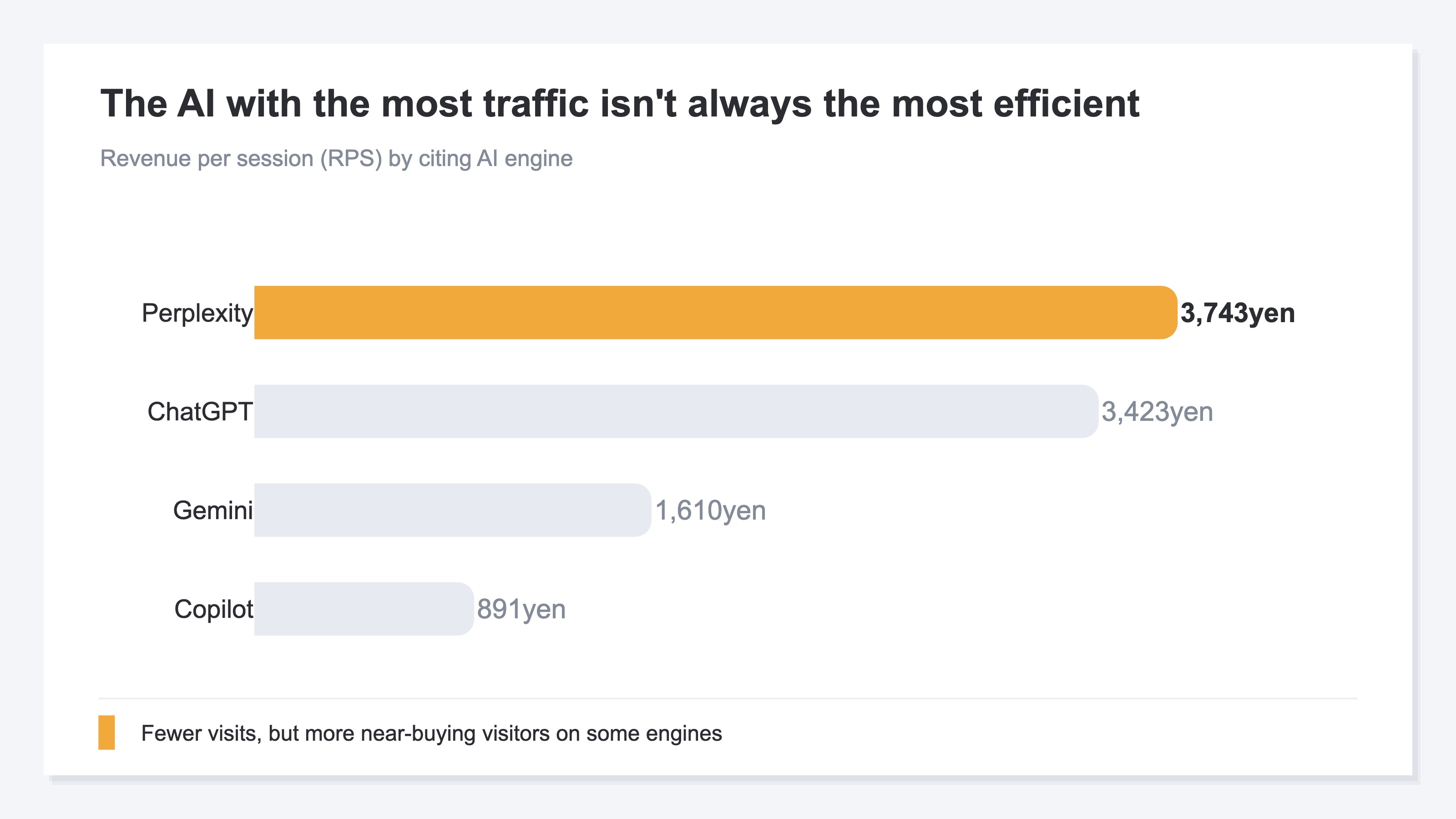
Lump everything as "AI traffic" and visitors from ChatGPT, Perplexity, and Gemini all fall into one box. But each AI answers differently and shows links differently, so the intent of arrivals differs too. Some engines send people who follow a link at the end of their research; others send people who glance and bounce. As a result, revenue per session (RPS) differs by engine.
The chart below lines up revenue per session (RPS) by citing AI engine, as an illustration. The engine with the most traffic isn't always the most efficient. Some engines send fewer visits but more people on the verge of buying, with higher RPS. Watching only a lumped "AI traffic," you miss the crucial difference of which AI's visitors buy.
2. "Cited" and "bought" are different things#
Bottom line: being "cited (exposed)" by AI and that traffic "buying (becoming revenue)" are different layers. Confuse them and you misread the numbers.
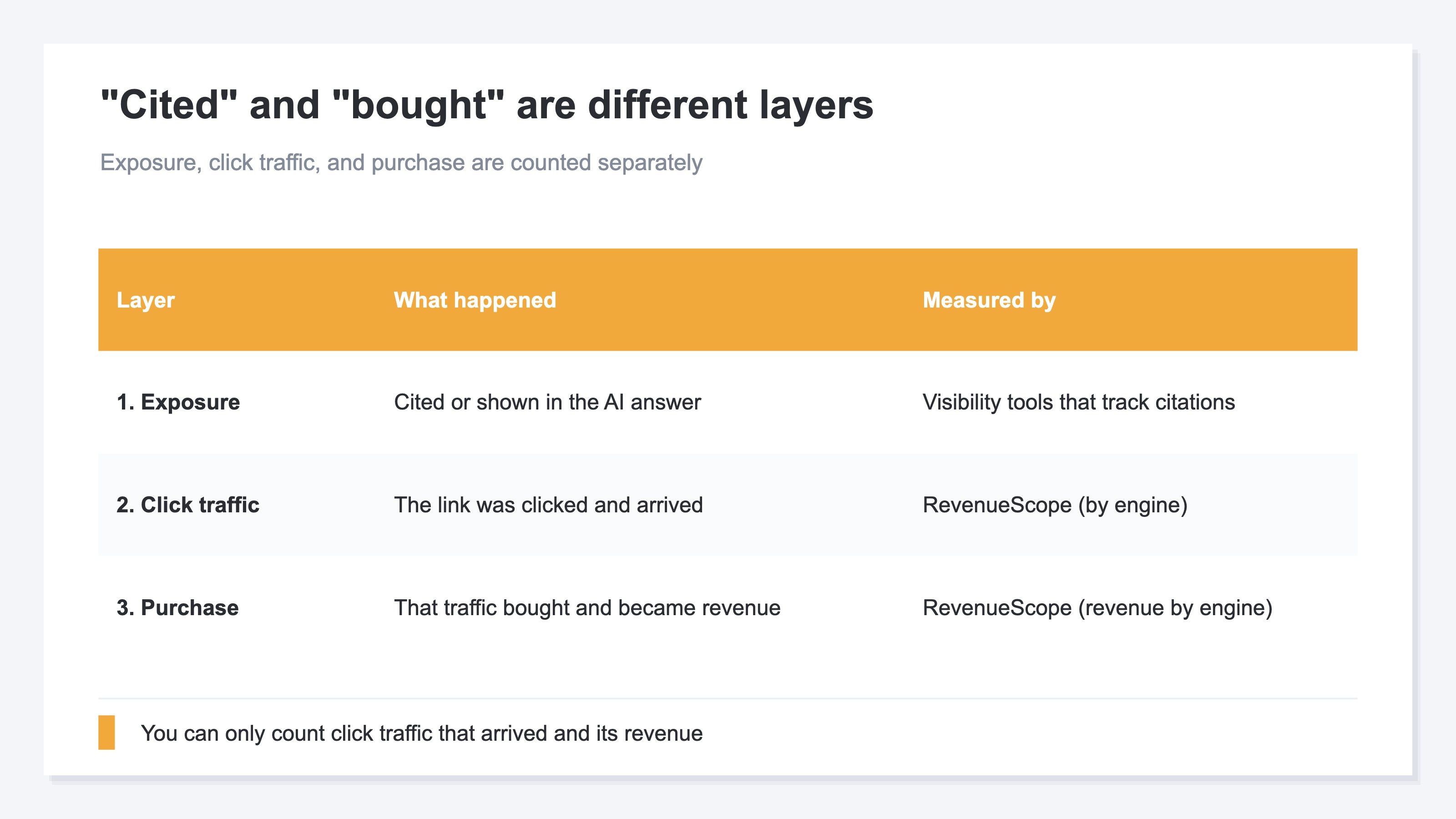
Lately, tools that measure how often your site is cited in ChatGPT or Perplexity answers (exposure, visibility) have multiplied. That's a useful metric, but exposure is only the "appeared in the answer" stage. Beyond it come the stage where a link is clicked into traffic, and the stage where that traffic buys and becomes revenue. The three layers must be counted separately.
Here's an important boundary: you can only count the click traffic that actually arrived and its revenue. Exposure shown inside an AI answer but not clicked is invisible to your own analytics. So if you want to know "how much you're cited in ChatGPT," that's the job of an exposure tool. If you want to know "how much the people who came via ChatGPT bought," that's a different view of post-click traffic and revenue. Separate the two, and you stop confusing what each number represents.
3. AI traffic is small in volume, but worth catching by quality#
Bottom line: AI traffic is often small in volume today, but read by per-session revenue, its value shows.
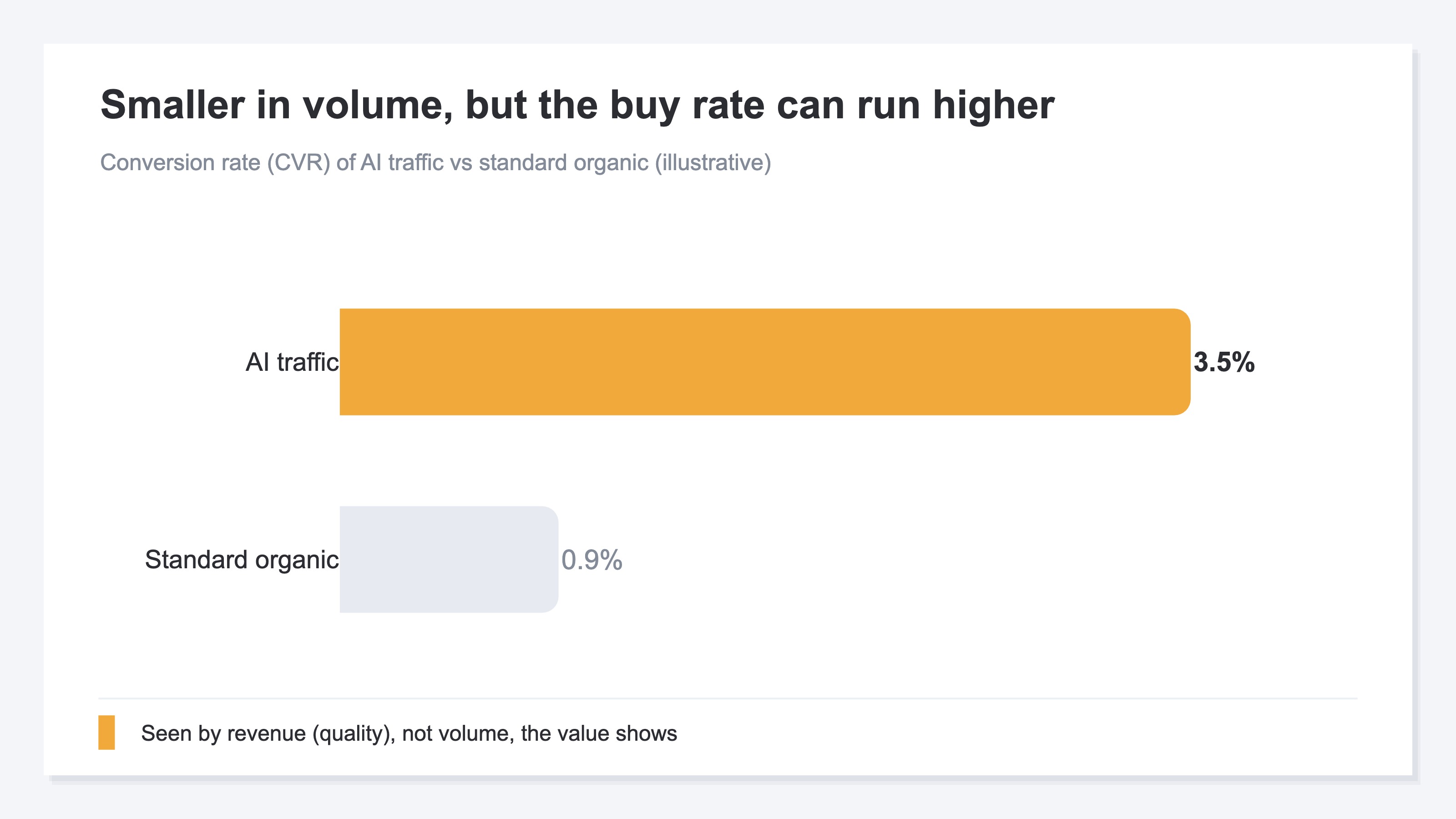
Traffic from AI is often a few percent of total sessions. By volume alone it's small, tempting you to defer it. But volume and quality are different. People who arrive after asking an AI have often finished comparing and deciding, with intent already set. So revenue per session (RPS) and conversion rate (CVR) can run higher than standard organic.
The chart below lines up the conversion rate (CVR) of AI traffic versus standard organic, as an illustration. Far behind on volume, AI traffic can still come out ahead on buy rate. That's what it means to read by revenue (quality), not volume. Judge by volume alone — "small, so defer it" — and you miss prospects whose intent is already set. Read by revenue per engine, and when it grows you'll know early which AI to prioritize.
RevenueScope helps
Trying to learn which AI's visitors buy, you hit two walls. One: traffic from ChatGPT or Perplexity, without setup, gets lost in "source unknown (Direct)" and can't be split by engine. Two: lining up not just "traffic count" but "revenue" by engine is heavy by hand.
RevenueScope takes over that split. It separates click traffic from AI by citing engine (ChatGPT, Claude, Perplexity, Gemini, Copilot, and others) and lets you compare each engine's traffic, bounce rate, and revenue in one view (figures shown are demo data).
| Citing AI | Traffic (visits) | Bounce | Revenue |
|---|---|---|---|
| ChatGPT | 142 | 38% | ¥486,000 |
| Perplexity | 53 | 41% | ¥198,400 |
| Gemini | 38 | 55% | ¥61,200 |
| Copilot | 11 | 64% | ¥9,800 |
The point of this table is that traffic count and revenue aren't always in the same order. ChatGPT is largest in both traffic and revenue. But Perplexity, with less than half ChatGPT's traffic, can match or exceed it on revenue per session (revenue ÷ traffic). The lower the bounce rate, the more it signals visitors with set intent. Lining up revenue by engine this way, you see in numbers which AI's visitors buy.
To be clear: RevenueScope counts only the click traffic that actually arrived and its revenue. It does not measure exposure shown but not clicked, or "how much you're cited in ChatGPT" (visibility). It does not calculate gross margin or inventory. What RevenueScope takes over is preparing the material — splitting AI click traffic by engine, bots excluded, and lining it up by revenue. Which AI to invest in is up to you.
FAQ#
Frequently asked questions#
Q. Traffic from ChatGPT and Perplexity lands in "Direct." Why?
A. AI tools often don't tag links with a source marker (parameters like UTM). Without a marker, analytics judges the origin "unknown" and assigns much of it to Direct [1]. So AI traffic gets lost in Direct and can't be split by engine. Reassign it as a referral using the citing domain (chatgpt.com and so on) as a clue [2], or use a mechanism that splits it automatically, to separate by engine.
Q. If there's a tool to measure "whether I was cited," isn't that enough?
A. The purpose differs. A citation (exposure) tool sees "how often you appeared in the answer," good for gauging brand awareness or GEO (optimization for AI search). What this article covers is the revenue layer — "how much the people who clicked through bought." More exposure doesn't always lead to traffic or revenue. Track exposure with an exposure tool, and revenue with a revenue view, separately, to stay accurate.
Q. AI traffic is still small, so can't I defer it?
A. By volume alone, you'd be tempted to. But AI traffic carries many people with set intent, and per-session revenue can run high. Read it by engine now, and when traffic grows you can immediately decide which AI to prioritize. Getting an early read on "which AI brings buying customers" makes your later moves faster.
Conclusion#
Visitors from AI differ by engine in both volume and how they buy. A lumped "AI traffic" hides the difference. The first split to make is by citing engine (ChatGPT, Perplexity, Gemini).
On top of that, separate "cited (exposure)" from "bought (revenue)." Citation tools have multiplied, but how much click traffic sold by engine has to be read separately. Hold the boundary too: you can only count traffic that actually clicked through, and its revenue.
AI traffic may be small in volume today, but read by per-session revenue it's worth catching. Line up revenue by engine, and when traffic grows you can judge — by numbers, not gut — which AI's visitors buy.
See which ads actually drive revenue, at a glance
Free up to 5,000 sessions/month, AI connection included. No credit card required. Up and running in 5 minutes.



![[Research] More AI Traffic Isn't Proof It Worked: Tell the Real Gain by Revenue](/_next/image?url=%2Fimages%2Fnews%2Fai-referral-revenue-real.jpg&w=3840&q=75)
![[Research] How Visible Is Your Brand in AI Search? You Can Measure It](/_next/image?url=%2Fimages%2Fnews%2Fai-search-brand-visibility.jpg&w=3840&q=75)