![[Research] How Visible Is Your Brand in AI Search? You Can Measure It](/_next/image?url=%2Fimages%2Fnews%2Fai-search-brand-visibility.jpg&w=3840&q=75)
Ask ChatGPT or Gemini "what's a good option in this category?" and how often does your name come up? Curious, some people have asked the AI directly: "does my site show up?" But asking a plain AI won't tell you where you actually stand right now. Recent research reports that across more than 100 brands, appearance rates in AI answers split into a large three-tier gap. That's a cross-study average, though — where your own brand sits today is a different matter. This article covers what "visibility" in AI search means, the three-tier gap the research shows, where you tend to get cited, and how to measure your own exposure.
Table of contents
TL;DR#
- Visibility in AI search means how often your name shows up in the answers ChatGPT or Gemini give.
- Asking a plain AI "do I show up?" won't tell you your current state — the answer changes every time you ask.
- Recent research reports a large three-tier gap in appearance rates across 100+ brands. But that's a cross-study average; where your own brand sits today is a separate question.
- That's exactly why it pays to be in a state where you can measure your current position. How much you show up can be measured across engines and over time.
1. What "visibility" in AI search means#
Bottom line: visibility in AI search means how often your name comes up in the answer when someone asks ChatGPT or Gemini "what's a good option?"
Not long ago, "search" meant what rank you held in Google's results. Now, more and more people ask an AI directly, and the AI names a few sites or stores. Whether your name is in that answer or not — that is your visibility, your exposure, in AI search. It's less about rank and more about "did you make it into the answer at all."
A natural first move: ask ChatGPT yourself, "what's a good option in this category?" and check whether your name appears. It's useful for a rough read. But it's risky to feel you've grasped your current state from this alone. The AI's answer shifts a little each time you ask, so one appearance doesn't mean "I show up," and one miss doesn't mean "I don't." A one-off look is only a first gut check. What you really want to know — how much you show up — needs a bit more sustained measurement.
2. The three-tier gap the research shows#
Bottom line: recent research reports a large gap in appearance rates by brand stature. But that's a cross-study average, not a statement about your brand today.
The source of this is a study titled "Generative Engine Optimization at Scale: Measuring Brand Visibility Across AI Search Engines." Across more than 100 brands, it ran over 100,000 prompts to AI and measured how often each appeared in the answers [1].
The result: appearance rates split into roughly three tiers by brand stature. Global household names appeared in about 73% of relevant answers, mid-market brands in about 44%, and niche or small brands in about 11%. The chart below shows that three-tier gap as an illustration.
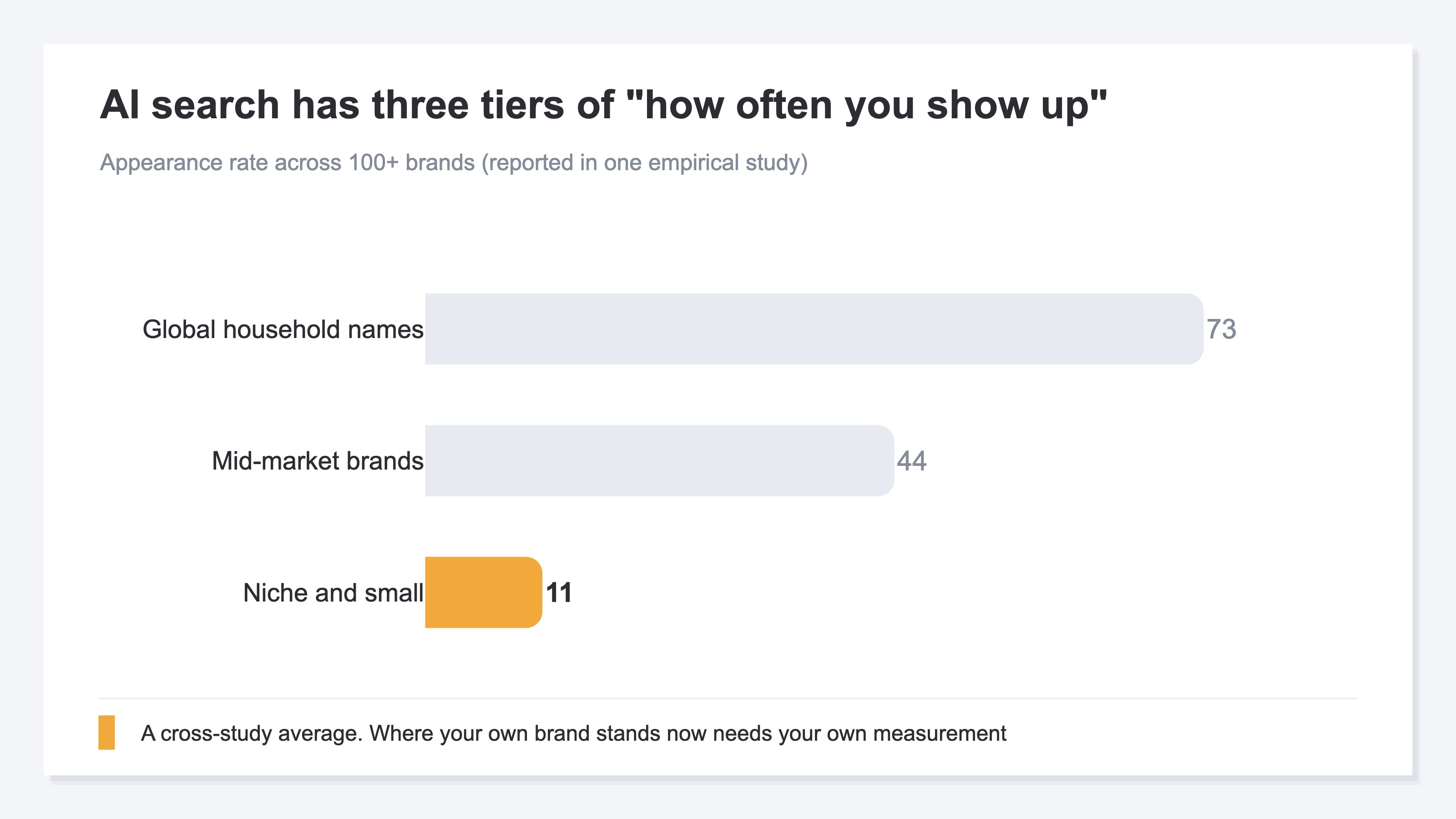
One thing to make clear: this study is still a preprint (not yet peer-reviewed), so treat it as "this kind of pattern is reported," not as "a proven universal law." Also, what it examined is a cross-section of 100+ brands, not any single company. The three-tier gap is an average flattened across the whole set. Where your own brand sits among these tiers today can't be read off the average. Even if "small brands average 11%," your brand may happen to appear often in a category you're strong in, or may show up below the average. So don't mistake the average for your current state — confirming with your own data is what's accurate.
3. Where you tend to get cited#
Bottom line: the same research reports that the sources AI cites most are corporate websites and so-called "best-of" listicles. That's a hint for where to show up more.
When AI assembles an answer, it doesn't pull from every page in the world equally. There are page types it tends to cite. According to the research, most citations went to corporate websites, followed by best-of articles like "top 10 picks for X." Video, community, and encyclopedia-type pages get cited too, but less than corporate sites and listicles.
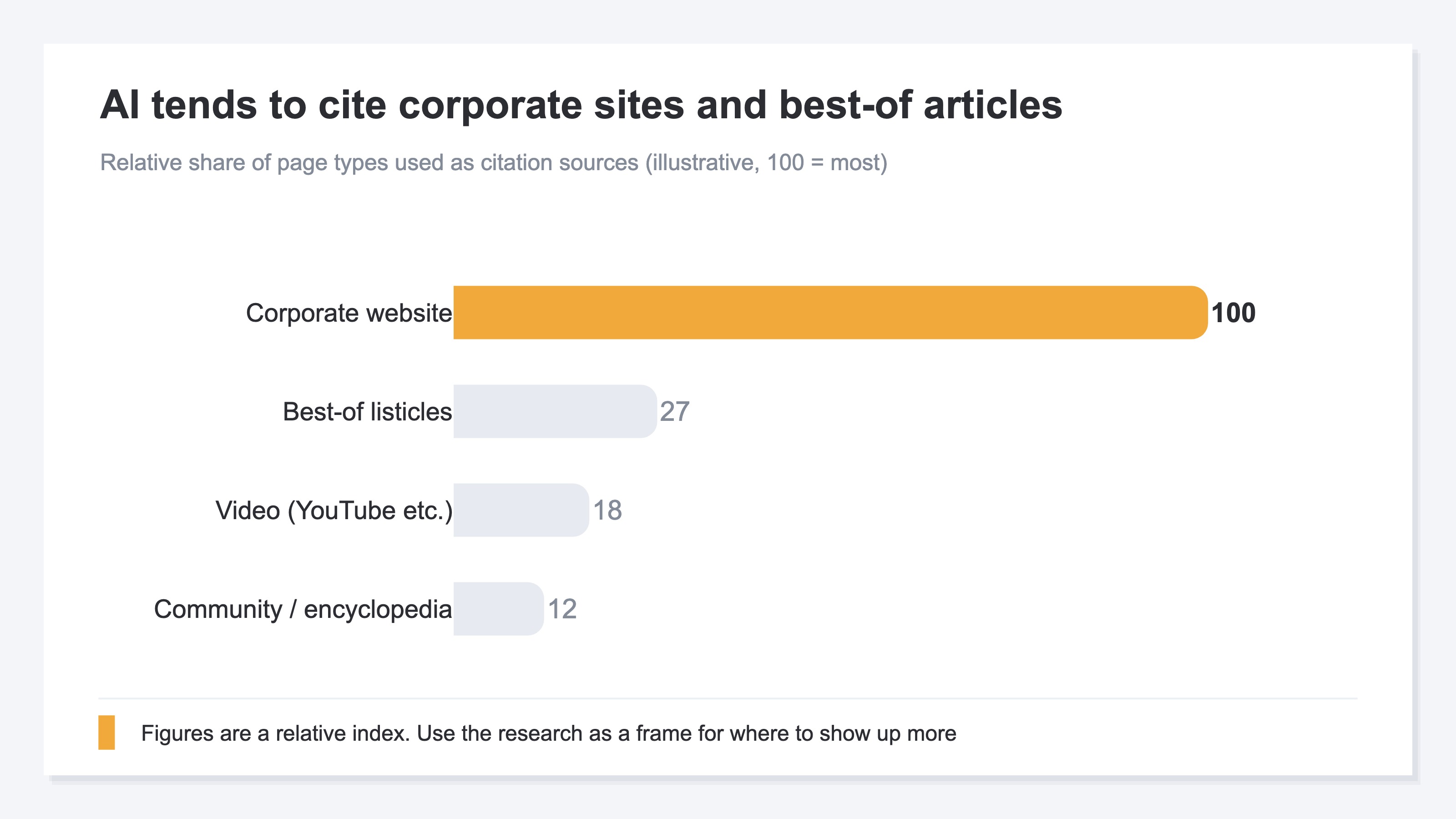
The direction this points to is simple. Tell carefully, on your own corporate site, what you offer and what you've achieved. And create occasions for your name to land in the "best-of" lists for your category. Neither is special; the idea itself isn't hard. Note that the chart's figures are a relative guide (an index), and since the source is a cross-study, your category won't show the exact same ratios. Read it as a direction for "where you tend to get cited," not as fixed numbers.
4. Measuring your exposure over time#
Bottom line: to confirm "is it working?" as you grow where you show up, it helps to measure your exposure not once, but across engines and over time.
What's hard isn't making the moves, it's measuring whether they're working. Exposure doesn't grow in one go — it shifts slowly over months. And while you're building it, "is this working?" is hard to see. That's exactly why, before flailing away, it helps to be in a state where you can measure how much you show up right now.
But try to do this by hand and you hit a wall fast. The chart below splits measuring exposure into three stages.
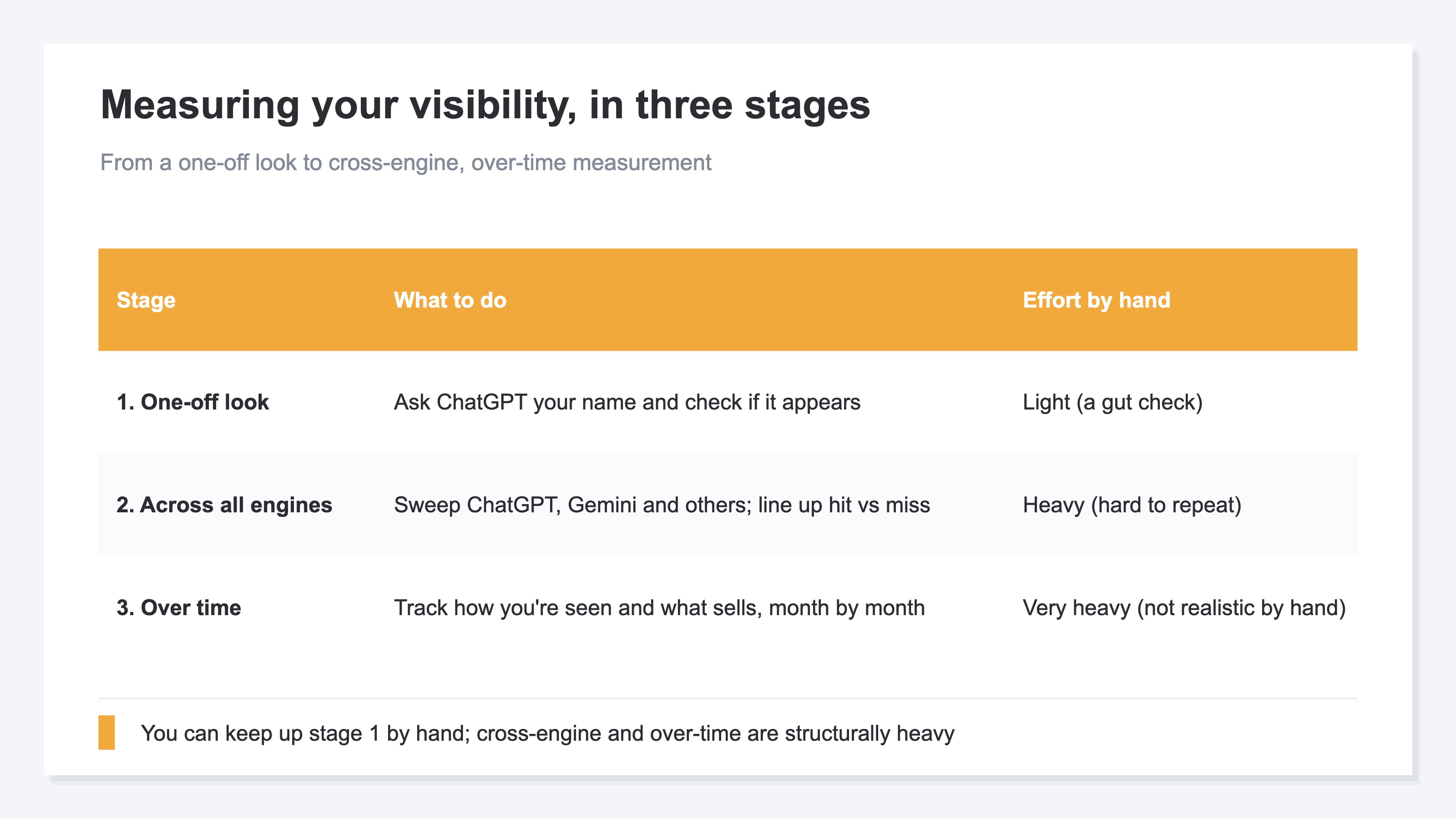
Stage 1, the "one-off look," you can do by hand. But stage 2, "across all engines" — sweeping not just ChatGPT but Gemini and others and lining up hit versus miss — gets heavy to repeat by hand every time. And stage 3, "keeping it up over time" — tracking how you're seen month by month, page by page — isn't realistic by hand. The idea is simple, but measuring it continuously is structurally far heavier.
On top of that, exposure can't be captured as a binary (appeared / didn't). How many times out of how many, in which category's questions, and whether the appearance led to a click and a sale — once you try to read context and change over time, a manual look just isn't enough.
RevenueScope helps
By now the direction for growing where you show up is clear. But trying to measure "is it working?" as you build, you hit the stage 2 and stage 3 walls by hand. Sweeping across all engines to line up hit versus miss, and tracking it over time, is something you can try once yourself — but month by month, page by page, it's structurally laborious.
RevenueScope takes over that continuous measurement. It separates click traffic from AI by citing engine (ChatGPT, Claude, Perplexity, Gemini, and others) and by page, and lets you compare each one's traffic, revenue per session (RPS), and revenue lined up in one view (figures shown are demo data). You can line up "which AI is sending how much" across engines, and connect it through to "are those visitors buying."
| Citing engine | AI traffic | Revenue per session (RPS) | Revenue |
|---|---|---|---|
| ChatGPT | 128 | ¥1,040 | ¥133,120 |
| Perplexity | 47 | ¥3,180 | ¥149,460 |
| Gemini | 39 | ¥760 | ¥29,640 |
The point of this table is that traffic count and revenue per session aren't in the same order. ChatGPT draws the most AI traffic, but its revenue per session is modest. Perplexity gets less traffic, but its visitors buy well, so RPS is high and it leads on revenue. Chase exposure (how much is coming) alone and you might have poured effort into ChatGPT while deferring the Perplexity traffic that actually drives sales. Lining up "seen × bought" by engine in one view, you see in numbers where to direct the effort of growing your exposure.
To be clear: RevenueScope counts only the click traffic that actually arrived and its revenue. It does not measure exposure where your name merely appeared (no click), or the total visibility of "how much you're mentioned in ChatGPT." It does not calculate gross margin or inventory either. What RevenueScope takes over is preparing the material — splitting AI click traffic by engine and page, bots excluded, and lining it up by revenue to compare continuously. Where to grow your exposure is up to you.
FAQ#
Frequently asked questions#
Q. Can't I just ask ChatGPT directly "do I show up?" and know?
A. It's useful for a rough read, but not enough on its own. The AI's answer changes each time you ask, so one appearance doesn't mean "I show up." It also won't tell you how you do on engines other than ChatGPT, or whether an appearance led to a sale. Keep it as a gut check, and measure across engines and over time with click traffic and revenue to stay accurate.
Q. Does the research figure "small brands at 11%" apply to my brand?
A. It's safer not to apply it directly. That's an average across 100+ brands, and the reported value of a still-preprint study. Your brand may happen to appear often in a category you're strong in, or may show up below the average. Treat the average as a reference for the overall pattern, and measure your own current position with your own data to stay accurate.
Q. If I just grow exposure (how much I show up), does revenue follow?
A. Sometimes it does, but not always. You can be highly visible yet thin on sales, or modest in exposure with visitors who buy well. Exposure (being seen) and revenue (being bought) are different layers, so read them separately. Watch both lined up, and you can choose where to put your effort by numbers.
Conclusion#
Visibility in AI search means how often your name comes up in the answers ChatGPT or Gemini give. Ask a plain AI "do I show up?" and the answer shifts each time, so it won't tell you your current state.
Recent research reports a large three-tier gap in appearance rates across 100+ brands. But that's a cross-study average; where your own brand sits today is a separate question. It's a preprint, too, and the key is not to mistake the average for your own current state.
That's exactly why it pays to keep your exposure in a "measurable state." A one-off look you can do by hand, but cross-engine and over-time measurement is structurally heavy by hand. Measure how much you show up by engine and page, lined up through to revenue, and you can judge — not by gut — where to direct the effort of growing where you show up.
See which ads actually drive revenue, at a glance
Free up to 5,000 sessions/month, AI connection included. No credit card required. Up and running in 5 minutes.
![[Research] What Makes AI Recommend Your Site: It Comes Down to Reviews and Reputation](/_next/image?url=%2Fimages%2Fnews%2Fhow-ai-picks-stores.jpg&w=3840&q=75)


![[Research] Why AI Recommends Big Brands: A Single Rating Can Flip It](/_next/image?url=%2Fimages%2Fnews%2Fai-recommends-big-brands.jpg&w=3840&q=75)
![[Research] More AI Traffic Isn't Proof It Worked: Tell the Real Gain by Revenue](/_next/image?url=%2Fimages%2Fnews%2Fai-referral-revenue-real.jpg&w=3840&q=75)