![[Research] Why AI Recommends Big Brands: A Single Rating Can Flip It](/_next/image?url=%2Fimages%2Fnews%2Fai-recommends-big-brands.jpg&w=3840&q=75)
Ask ChatGPT or Gemini "what's a good option in this category?" and the AI tends to name famous brands, even when the products are comparable. So is this tilt fixed, leaving smaller sites at a disadvantage from the start? Recent research argues that for equivalent products the recommendation rate for famous brands climbs to nearly its maximum, yet that advantage collapses on a slim rating edge. In other words, the tilt is something that moves, with room to break it. This article covers why AI's pick tilts toward large players, how that tilt can be broken, why "everyone playing the same move" leads to mutual collapse, and how to measure whether a move actually drove AI-driven revenue.
Table of contents
TL;DR#
- AI's pick tilts heavily toward famous brands for comparable products, so recent research argues. That's a structural wall for smaller sites with a thin reputation stack.
- The tilt isn't fixed, though. The research shows that a slim rating edge from a competitor can break a famous brand's monopoly.
- But when everyone plays the same move (such as inflated marketing claims), the gain nearly vanishes, and those who didn't play drop out of the recommendations entirely — a "mutual collapse" structure.
- That's exactly why, rather than copying the trending move, it helps to measure whether a move drove "your own AI-driven revenue" and to choose which moves to keep.
1. Why AI's pick tilts toward big brands#
Bottom line: AI's pick tilts heavily toward famous brands for comparable products, so the research goes.
AI learns from a huge volume of text, also gathers information through search, and assembles an answer. The more a brand is talked about and the more reputation it has stacked, the more easily it appears in that answer. A large player running for years is a notch ahead on review counts, on media coverage, and on name recognition. AI tends to pick "what's widely spoken of," so the heavily-talked-about large player naturally rises to the top.
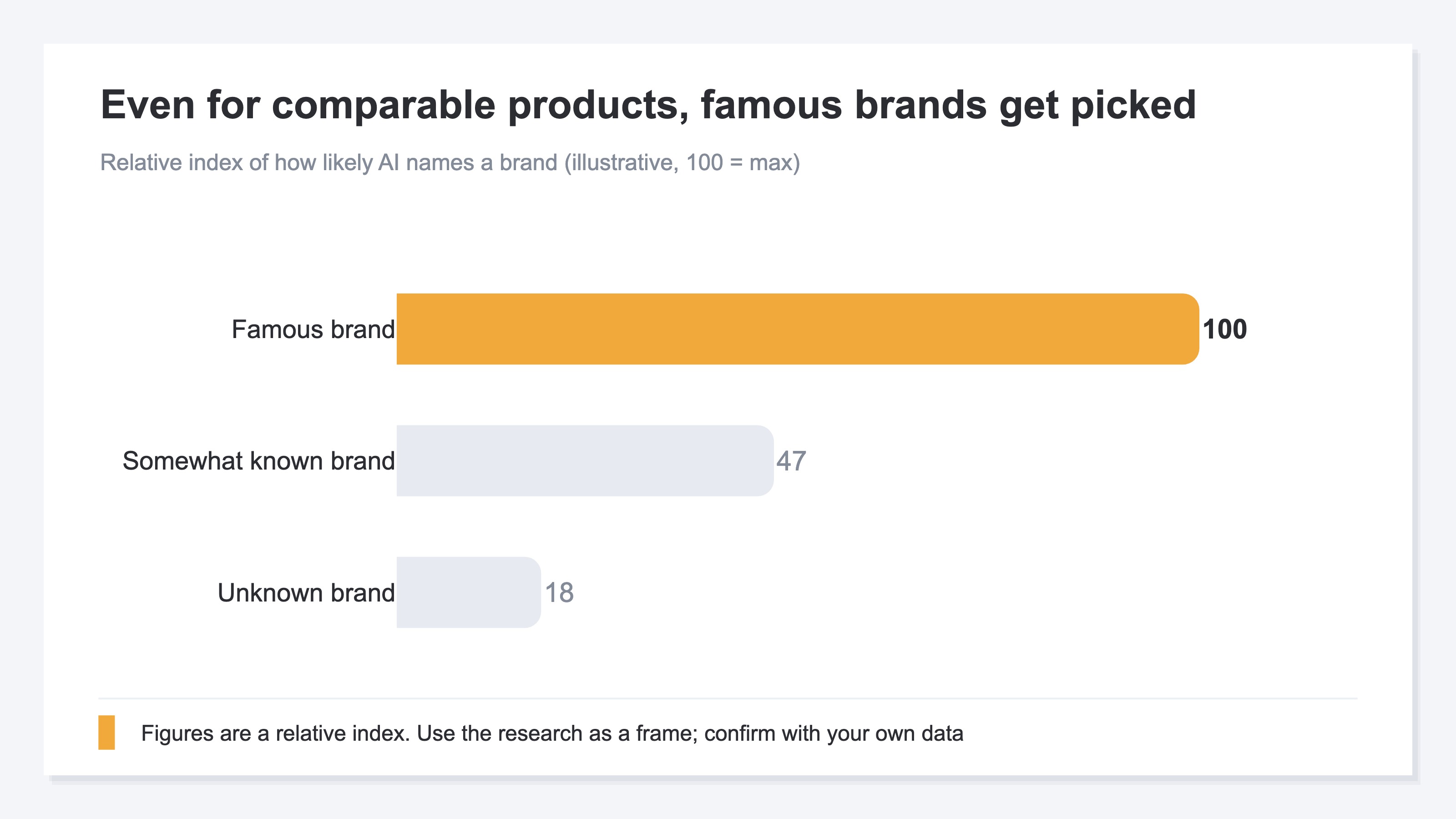
Here's the study behind this. Titled "Incumbent Advantage: Brand Bias and Cognitive Manipulation Dynamics in LLM Recommendation Systems," it used skincare products and repeatedly asked several AIs (GPT-4o-mini, Claude Sonnet, and Gemini 3 Flash) which brand to recommend, examining what moved the result [1]. In this study, when product quality is roughly equivalent, the recommendation rate for famous brands climbs to nearly its maximum.
The chart below illustrates this "tilt toward famous brands" against an unknown brand. Even at equivalent quality, the famous brand is more likely to be named by the AI.
One thing to make clear: the subject of this study is skincare, and the AIs tested are those three. The numbers themselves are about that subject, so read every chart here as a relative guide (an index). The skeleton — "the famous brand gets picked even at equal quality" — likely applies broadly to e-commerce and service sites, anywhere AI recommends by name, though how strongly it applies varies by category. This study is also still a preprint (not yet peer-reviewed), so treat it as "this kind of argument is emerging," not as "proven." How it actually plays out is best confirmed with your own site's data.
Note that "being picked by AI" and "being bought via AI" are different layers. Being named in the answer doesn't guarantee traffic or revenue. We cover that distinction in AI Citation Revenue Contribution: Being Cited Isn't the Same as Being Bought, so here we just hold "picked ≠ bought" and move on.
2. That tilt collapses on a slim edge#
Bottom line: the tilt toward big brands isn't fixed. The research shows that a slim rating edge from a competitor can break the famous brand's monopoly.
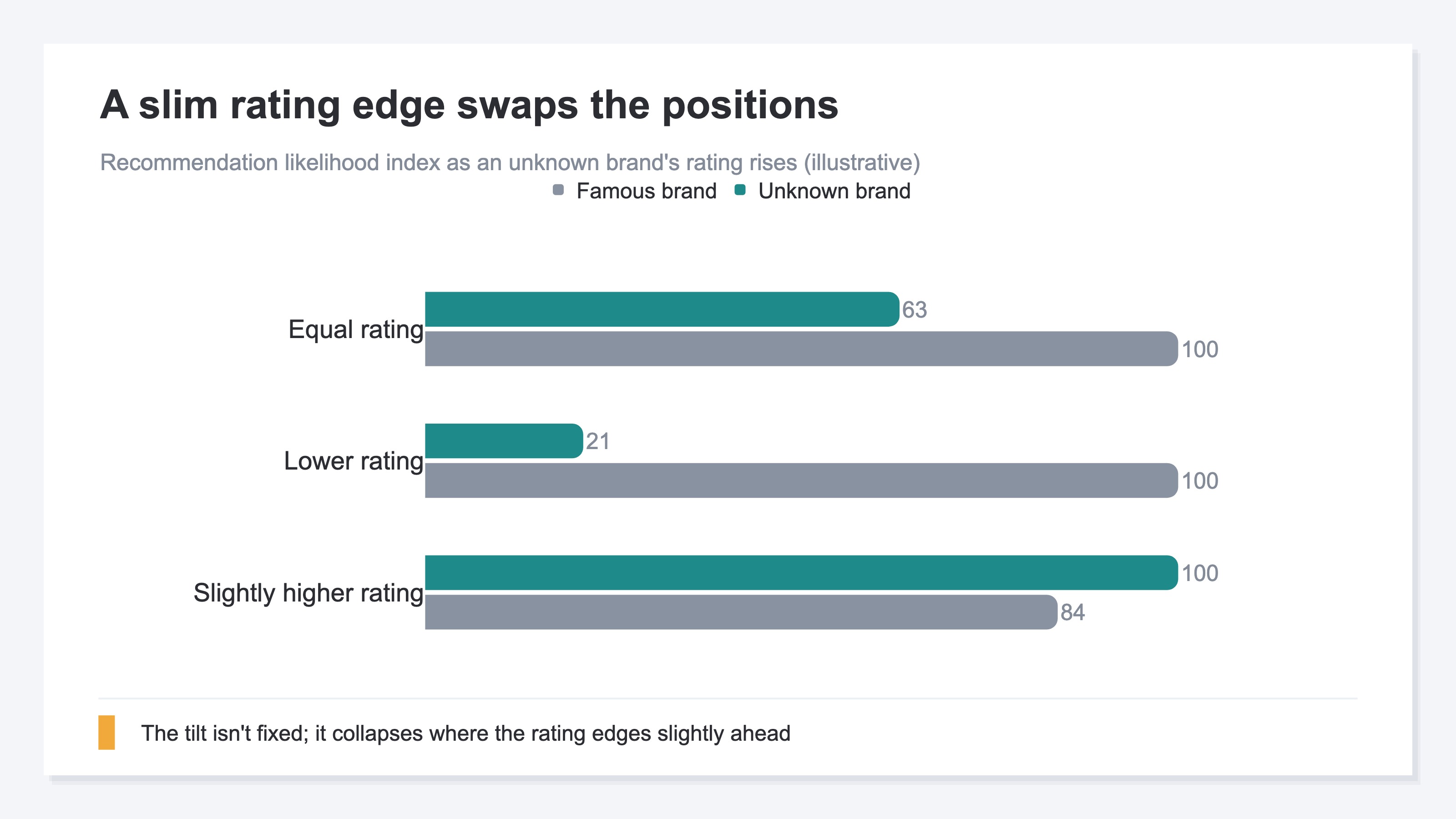
In that same study, while the famous brand's recommendation rate climbs to near maximum, that advantage disappears once a competitor's rating is just slightly higher (under a 0.1-star difference) [1]. It also argues that legitimate authority cues — objective track records or evidence, for example — leave room to break the monopoly. Put another way, the tilt isn't fixed like rock; it's a "dynamic" thing that moves on a slim margin.
The chart below illustrates how recommendation likelihood shifts as an unknown brand's rating rises a little. While the rating is low, the famous brand leads by a wide margin, but at the point where the rating edges slightly ahead, the positions swap. That's what "collapses on a slim edge" means.
The key here is not to read this gap as "a difference in talent" or "too late now." What creates the gap is the accumulation of ratings and reputation, not the merit of the site itself. Because ratings and reputation can be built up afterward, the wall isn't fixed. Concretely: build a flow that gets buyers to leave reviews, tell the story of your results and evidence carefully on your own site, and create more occasions for your name to come up in media and communities. Since AI answers cite only a handful of sources, as covered in How to Find Best-Sellers That AI Never Cites, it's realistic to watch "can you get into the cited set" more than "do you rank high."
3. Everyone playing the same move leads to mutual collapse#
Bottom line: the tilt can be broken. But when everyone plays the same move, the gain nearly vanishes — that's the trap.
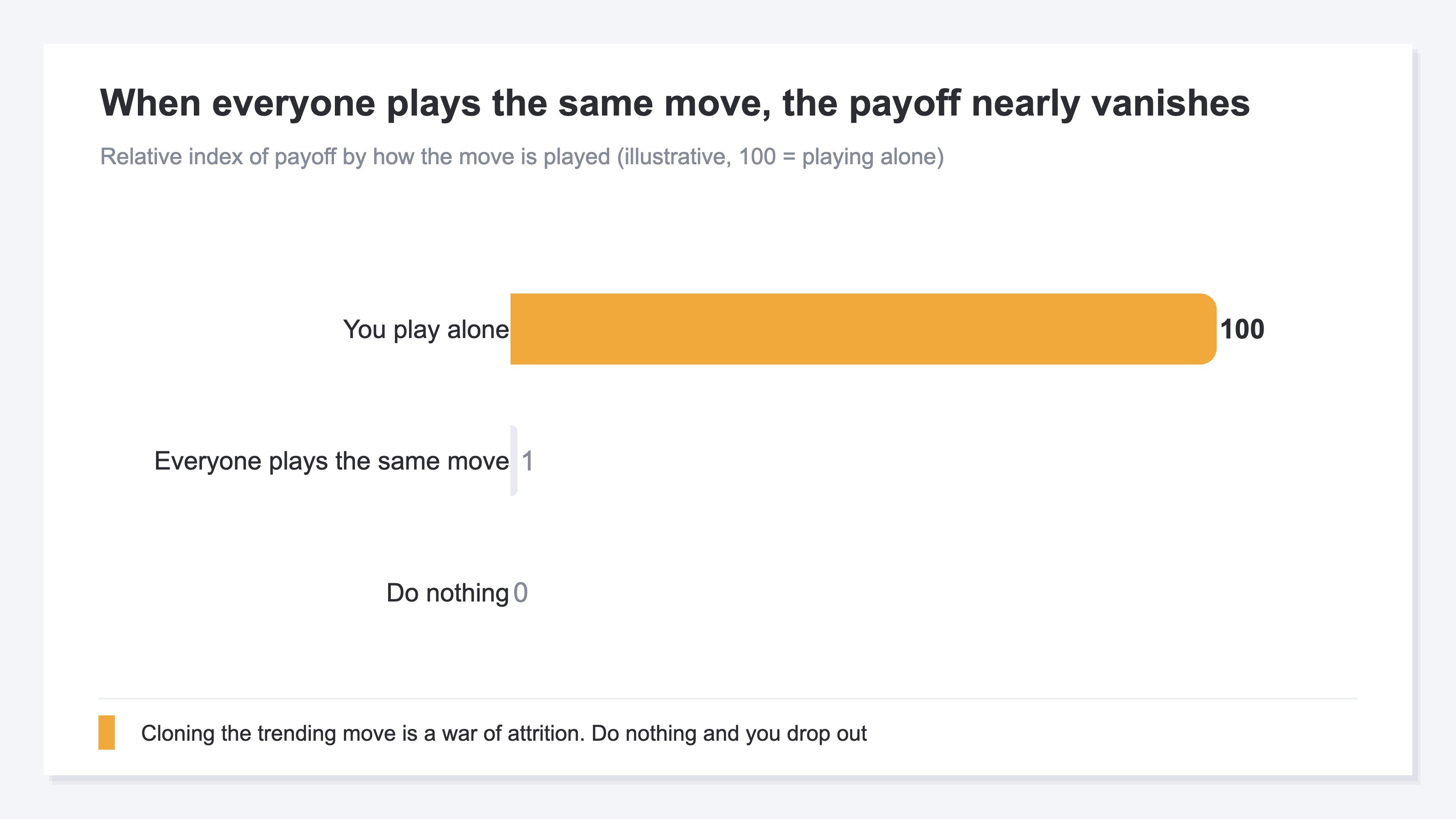
The same study points out one more important thing: when many brands deploy the same optimization move (including inflated marketing claims) all at once, the payoff per brand falls to nearly zero. In the study's terms, the payoff a brand gets when acting alone shrinks sharply once everyone plays the same move. And those who didn't join the war of attrition drop out of the recommendations entirely [1]. This is a "social dilemma" structure: everyone moves in good faith, and everyone ends up worse off.
The chart below illustrates this structure. Play the move alone and your payoff is large. But when everyone plays it, the payoff nearly vanishes. Meanwhile, do nothing and you drop out of the candidate set. Comparing the three, "copying the trending move as-is" turns out to be the least worthwhile choice.
What follows is simple. Cloning the "how to please AI" template wholesale is jumping into a war of attrition yourself. You might cut in temporarily with inflated claims, but if everyone does the same, the effect fades — and inflated language erodes reader trust. The move to make is not the same move as everyone else, but stacking legitimate strengths only you can claim, and — this is the crux — measuring whether a move drove "your own AI-driven revenue" and keeping only the moves that work. The more moves you add, the harder it gets to see what's working. That's exactly why being able to measure pays off.
RevenueScope helps
By now it's clear the tilt can be broken, but that cloning the trending move turns into a war of attrition. What's left is how to measure "did the move work?" Trying to measure it yourself, you hit two walls. One: traffic from ChatGPT or Gemini, without setup, gets lost in "source unknown (Direct)" and can't be separated as AI-driven. Two: reading AI traffic not just by "visit count" but by "revenue" is heavy by hand, every time. As What GA4's AI Assistant channel does and doesn't show notes, the raw numbers skew easily with bots and Direct, and while you can check once yourself, tracking it page by page and month by month is structurally laborious.
RevenueScope takes over that split. It separates click traffic from AI by citing engine (ChatGPT, Claude, Perplexity, Gemini, and others) and by page, and lets you compare each one's traffic, revenue per session (RPS), and revenue in one view (figures shown are demo data). You can check "did the move grow AI traffic" and "is that traffic actually buying" lined up on the same screen.
| Page | AI traffic | Revenue per session (RPS) | Revenue |
|---|---|---|---|
| Home / listing page | 96 | ¥1,180 | ¥113,280 |
| Featured product page | 41 | ¥4,260 | ¥174,660 |
| How-to / helpful article | 132 | ¥620 | ¥81,840 |
The point of this table is that traffic count and revenue per session aren't in the same order. The how-to article draws the most AI traffic, but its revenue per session is low. The featured product page gets less traffic, but its visitors buy well, so RPS is high and it leads on revenue. If you'd chased only "are we showing up in AI," you might have poured effort into the high-traffic how-to article while deferring the product page that actually drives sales. After making a move to break the tilt, lining up "which move drove which page's revenue" in one view lets you choose what to keep and what to drop by numbers, not gut. AI Traffic and Revenue by Engine: Which AI's Visitors Buy covers this by-engine view in more detail.
To be clear: RevenueScope counts only the click traffic that actually arrived and its revenue. It does not measure exposure where your name merely appeared (no click), or the total visibility of "how much you're mentioned in ChatGPT." It does not calculate gross margin or inventory either. What RevenueScope takes over is preparing the material — splitting AI click traffic by page and engine, bots excluded, and lining it up by revenue. Which move breaks the tilt is up to you.
FAQ#
Frequently asked questions#
Q. Does this mean smaller sites simply can't beat famous brands?
A. No. It's true that AI's pick tilts toward large players, but the research also shows that a slim rating edge from a competitor breaks that monopoly. What creates the gap is the accumulation of ratings and reputation, not the merit of the site itself. Growing reviews, stating legitimate evidence, and creating occasions for your name to come up all leave room to cut in. The key is to be in a state where you can measure "is it working?" as you build.
Q. Can I win by cloning a "how to please AI" template?
A. Not recommended. The research points to a "mutual collapse" structure where, when many brands play the same move at once, the payoff per brand falls to nearly zero. Copying the trending move as-is is a war of attrition, and inflated claims erode reader trust. The move to make is not the same as everyone else's, but stacking legitimate strengths only you can claim, then measuring whether the move drove revenue and keeping the ones that work.
Q. If AI names me, does revenue go up?
A. Sometimes, but not always. Being "picked / seen by AI (exposure)" and that traffic "buying (revenue)" are different layers. Some pages are named often yet thin on sales; others are modest but their visitors buy well. Measure a move by AI-driven revenue, not exposure, and you can choose which moves to keep by numbers.
Conclusion#
AI's pick tilts heavily toward famous brands for comparable products — so the recent research argues. For smaller sites with a thin reputation stack, that's a structural wall.
The wall isn't fixed, though. The research shows that a slim rating edge from a competitor breaks the famous brand's monopoly. The tilt isn't rock; it's a "dynamic" thing that moves on a slim margin. At the same time, the research points to a mutual-collapse structure: when everyone plays the same move, the payoff nearly vanishes and those who didn't play drop out of the candidate set.
That's exactly why, rather than copying the trending move, it helps to stack legitimate strengths only you can claim and measure whether a move drove "your own AI-driven revenue." Chase exposure alone and you tend to spend time on effort that shows up but doesn't sell. Line up "which move drove which page's revenue" in numbers, and you can judge — not by gut — what to keep and what to drop.
See which ads actually drive revenue, at a glance
Free up to 5,000 sessions/month, AI connection included. No credit card required. Up and running in 5 minutes.
![[Research] What Makes AI Recommend Your Site: It Comes Down to Reviews and Reputation](/_next/image?url=%2Fimages%2Fnews%2Fhow-ai-picks-stores.jpg&w=3840&q=75)


![[Research] More AI Traffic Isn't Proof It Worked: Tell the Real Gain by Revenue](/_next/image?url=%2Fimages%2Fnews%2Fai-referral-revenue-real.jpg&w=3840&q=75)
![[Research] How Visible Is Your Brand in AI Search? You Can Measure It](/_next/image?url=%2Fimages%2Fnews%2Fai-search-brand-visibility.jpg&w=3840&q=75)