![[Research] What Makes AI Recommend Your Site: It Comes Down to Reviews and Reputation](/_next/image?url=%2Fimages%2Fnews%2Fhow-ai-picks-stores.jpg&w=3840&q=75)
Ask ChatGPT or Gemini "what's a good option in this category?" and the AI names a few sites or stores. So what decides that pick? Recent research argues that the number of reviews, ratings, and how much a brand is talked about (researchers call these "reputation signals") move AI recommendations heavily, and that the result tilts toward large players. Does that mean a smaller site with thin reviews is at a disadvantage before it even starts? This article covers why reviews and reputation decide the pick, why large players tend to win, whether smaller sites have moves to make, and how "being picked" differs from "being bought."
Table of contents
TL;DR#
- AI recommendations aren't picked at random. Recent research argues that the number of reviews, ratings, and how much a brand is talked about move them heavily.
- Because reviews and reputation matter, recommendations tilt toward large players who already have them. That's a structural wall for smaller sites.
- The wall isn't fixed, though. Stack reviews and reputation steadily, and measure whether you're being picked and seen, and there's room to close the gap.
- The key is to read "seen by AI (exposure)" and "bought via AI (revenue)" separately. High exposure doesn't guarantee revenue.
1. Reviews and reputation move the recommendation#
Bottom line: which site the AI recommends is moved heavily by the number of reviews, ratings, and how much a brand is talked about — so the research goes.
AI learns from a huge volume of text, also gathers information through search, and assembles an answer. The more a site is spoken of well, the more easily it appears in that answer. Concretely, this means review counts, average ratings, mentions across social and media, and how often the brand name comes up.
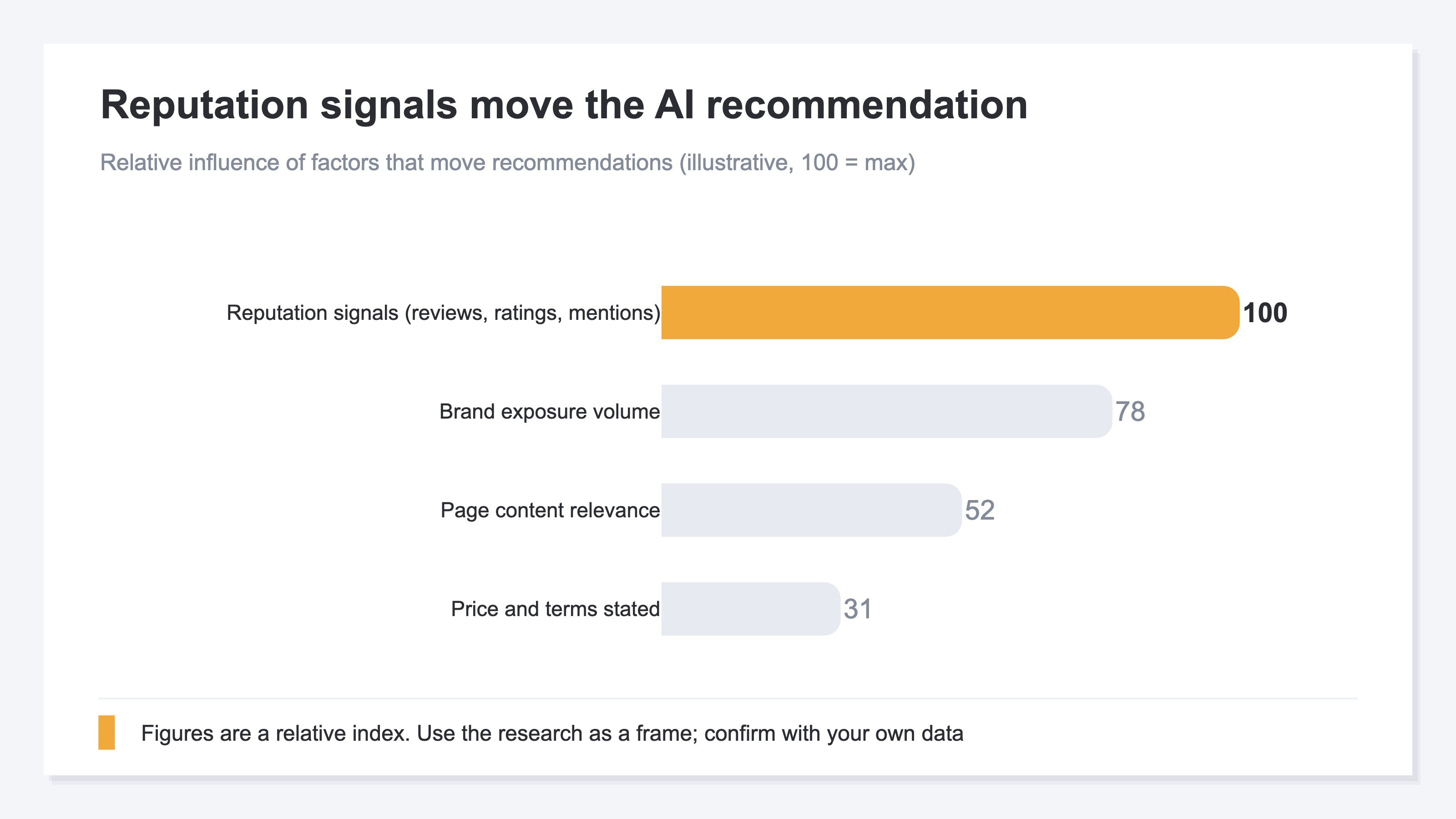
The chart below shows, as an illustration, the relative influence of the factors that move a recommendation. Reviews and reputation matter most, followed by how much a brand is talked about. Page relevance and stated prices matter too, but less so.
One of the references here — "Whose hotel does the AI recommend? An algorithm audit of reputation signals in LLM-assisted hotel selection" — repeatedly asked an AI which hotel to recommend and examined what moved the result [1]. The subject is hotels, but the skeleton — "reviews and reputation move the recommendation" — likely applies broadly to e-commerce and service sites, anywhere AI makes recommendations. The numbers themselves are about hotels, so read every chart here as a relative guide (an index). These studies are also still preprints (not yet peer-reviewed), so treat them as "this kind of argument is emerging," not as "proven." How it actually plays out is best confirmed with your own site's data.
2. Why large players tend to win#
Bottom line: because reviews and reputation matter, recommendations tilt toward large players who already have them. That's a structural wall for smaller sites.
It makes sense when you think about it. A large player running for years is a notch ahead on review counts, on media coverage, and on brand recognition. AI tends to pick "what's widely spoken of" for its answers, so the heavily-talked-about large player naturally rises to the top. At equal quality, a smaller site with a thin reputation stack starts at a disadvantage — a study titled "Incumbent Advantage: Brand Bias and Cognitive Manipulation Dynamics in LLM Recommendation Systems" points to exactly this incumbent bias in AI recommendations [2].
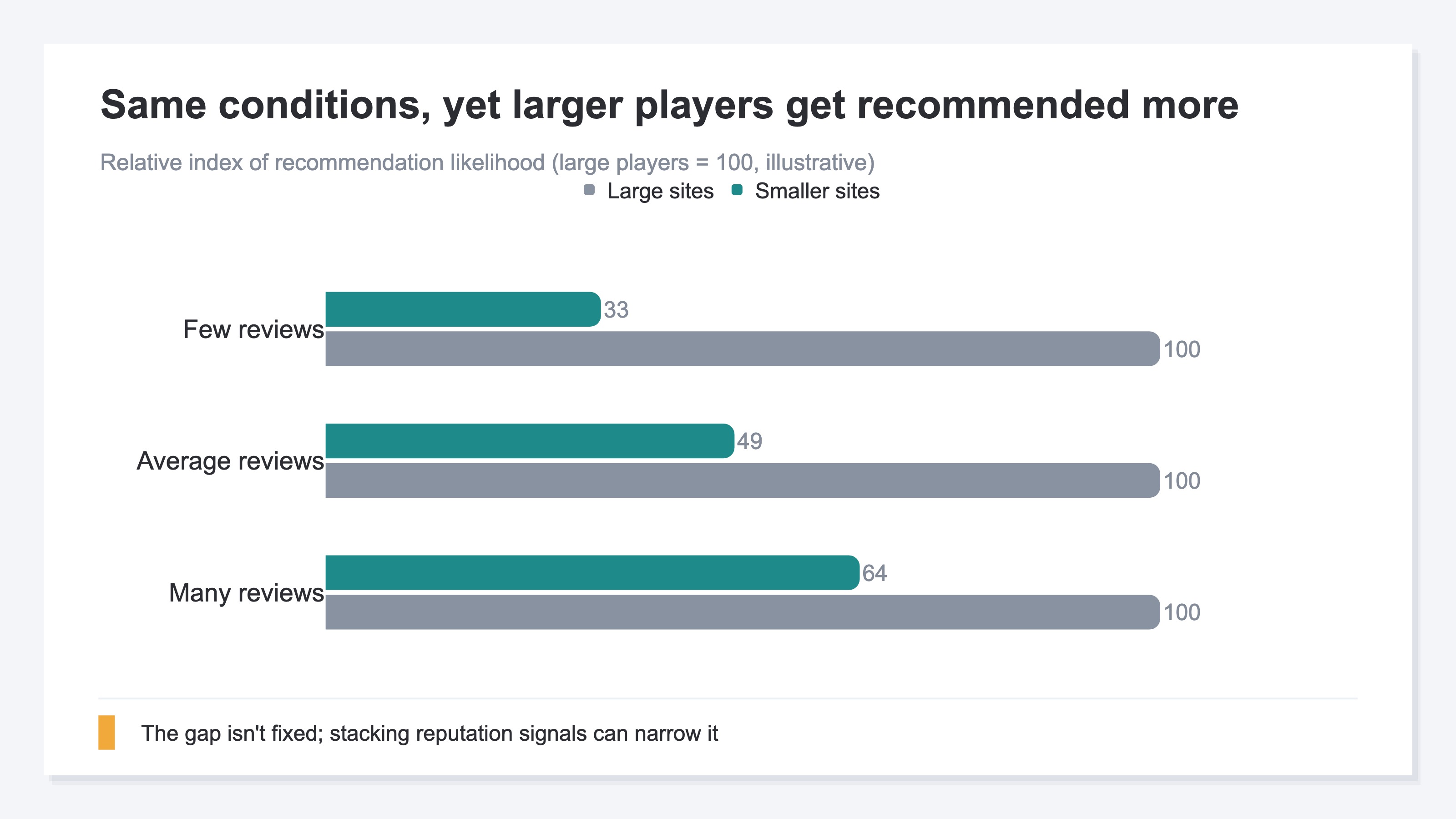
The chart below shows, as an illustration, how much the recommendation likelihood differs between large and small sites when their review stack differs. With large players set to 100, smaller ones tend to fall below even under the same conditions, and the gap widens the fewer reviews there are.
The key is not to read this gap as "a difference in ability" or "too late now." What creates the gap is the volume of reviews and reputation, not the merit of the site itself. Because reviews and reputation can be built up afterward, the wall isn't fixed. The next section looks at how to build them.
3. Smaller sites do have moves to make#
Bottom line: incumbent bias is a structural wall, but by steadily building reviews and reputation there's real room to close the gap.
The direction is simple: grow the reviews and reputation that AI picks up, little by little. For example, build a flow that gets buyers and users to leave reviews, tell the story of your work and results carefully on your own site, and create more occasions for your name to come up in media and communities. Since AI answers cite only a handful of sources, a study titled "What Gets Cited: Competitive GEO in AI Answer Engines" argues that getting into the cited set matters more than ranking high [3]. None of this is special; the idea itself isn't hard.
What's hard isn't the idea, it's keeping it up. Reviews and reputation don't pile up in one go — they grow slowly over months. And while you're building, it's hard to see "is this working?" That's exactly why, before flailing away, it helps to be in a state where you can measure how visible you are to AI and how often you're being picked right now.
One common move worth naming: asking ChatGPT yourself "what's a good option in this category?" and checking whether your name comes up. It's useful for a rough read, but don't rely on it alone. The answer changes each time you ask, counting "how many times out of how many" by hand isn't realistic, and it certainly won't tell you "once seen, how much sold." Keep it as a gut check, and measure what you really want to know — being seen and being bought — with a different view. That's the next section's theme.
4. "Being picked" and "being bought" are different things#
Bottom line: being "picked / seen by AI (exposure)" and that traffic "buying (revenue)" are different layers. Confuse them and you misjudge where to put your effort.
Appearing in the AI's answer is a good thing. But that's only the "seen" stage. Beyond it come the stage where a link is clicked into a visit, and the stage where the visitor buys and becomes revenue. More exposure doesn't always lead to traffic or revenue. Some pages are highly visible yet thin on sales; others get modest exposure but visitors who buy well.
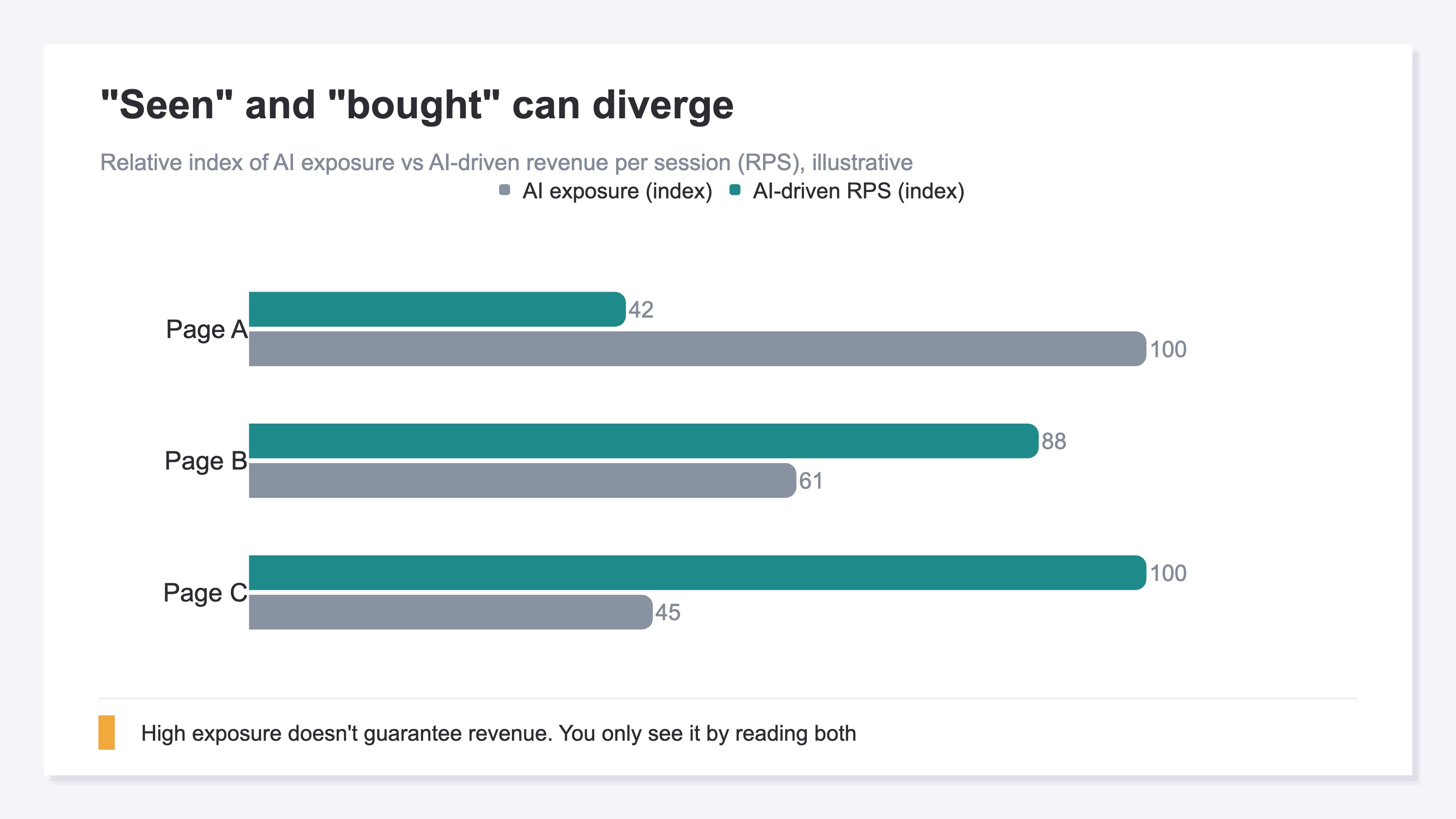
The chart below compares, as an illustration, AI exposure against revenue per session (RPS) from AI traffic, page by page. The most-exposed page isn't always the best seller. In fact, a page with modest exposure can have higher revenue per session. That's what it means to read exposure and revenue separately.
Chase exposure alone and you may convince yourself "we show up a lot in AI, so we're doing fine," while pouring time into effort that isn't producing sales. Watch both exposure and revenue, and you can see which pages are seen by AI and also bought from — choosing where to invest by numbers, not gut.
RevenueScope helps
By now the direction for building reviews and reputation is clear. But trying to confirm "is it working?" as you build, you hit two walls. One: traffic from ChatGPT or Gemini, without setup, gets lost in "source unknown (Direct)" and can't be separated as AI-driven. Two: reading AI traffic not just by "visit count" but by "revenue" is heavy by hand, every time. You can try once yourself, but tracking how you're seen and how much sells, page by page and month by month, is structurally laborious.
RevenueScope takes over that split. It separates click traffic from AI by citing engine (ChatGPT, Claude, Perplexity, Gemini, and others) and by page, and lets you compare each one's traffic, revenue per session (RPS), and revenue in one view (figures shown are demo data). You can check "are we seen (traffic)" and "are we bought (revenue)" lined up on the same screen.
| Page | AI traffic | Revenue per session (RPS) | Revenue |
|---|---|---|---|
| Home / listing page | 96 | ¥1,180 | ¥113,280 |
| Featured product page | 41 | ¥4,260 | ¥174,660 |
| How-to / helpful article | 132 | ¥620 | ¥81,840 |
The point of this table is that traffic count and revenue per session aren't in the same order. The how-to article draws the most AI traffic, but its revenue per session is low. The featured product page gets less traffic, but its visitors buy well, so RPS is high and it leads on revenue. Chase exposure (traffic volume) alone and you might have poured effort into the how-to article while deferring the product page that actually drives sales. Lining up "seen × bought" in one view this way, you see in numbers which page deserves the effort of building reviews and reputation.
RevenueScope counts the AI click traffic that actually arrived and its revenue. Because it focuses on revenue-based metrics — revenue per session (RPS) and revenue — rather than gross margin or inventory, you can match, page by page, how much of your visible traffic is actually being bought.
FAQ#
Frequently asked questions#
Q. Does this mean smaller sites simply can't get picked by AI?
A. No. It's true that AI recommendations tilt toward large players, but that's a difference in the accumulated volume of reviews and reputation, not the merit of the site itself. Growing reviews, telling the story of your work, and creating occasions for your name to come up all leave room to close the gap. The key is to be in a state where you can measure "is it working?" as you build.
Q. Isn't checking whether my name shows up in ChatGPT enough?
A. It's useful for a rough read, but not enough on its own. The AI's answer changes each time you ask, and counting "how many times out of how many" by hand isn't realistic. On top of that, it won't tell you "once seen, how much sold." Keep it as a gut check, and measure click traffic and revenue with a different view to stay accurate.
Q. Can't I just assume "more exposure means more revenue"?
A. Sometimes it does, but not always. Some pages are highly visible yet thin on sales; others get modest exposure but visitors who buy well. Exposure (being seen) and revenue (being bought) are different layers, so read them separately. Watch both lined up, and you can choose where to put your effort by numbers.
Conclusion#
Which site the AI recommends is moved not by mood but by the number of reviews, ratings, and how much a brand is talked about — so the recent research argues. Because reviews and reputation matter, recommendations tilt toward large players who already have them, a structural wall for smaller sites.
The wall isn't fixed, though. What creates the gap is the volume of reviews and reputation, so building it steadily leaves room to close the gap. The idea isn't hard; what's hard is keeping it up, and that it's hard to see whether it's working.
That's exactly why it helps to separate "seen by AI (exposure)" from "bought via AI (revenue)" and be able to measure both. Chase exposure alone and you tend to spend time on effort that shows up but doesn't sell. Line up "seen × bought" in numbers, and you can judge — not by gut — which page deserves the effort of building reviews and reputation.
See which ads actually drive revenue, at a glance
Free up to 5,000 sessions/month, AI connection included. No credit card required. Up and running in 5 minutes.
References#
- [1] arXiv "Whose hotel does the AI recommend? An algorithm audit of reputation signals in LLM-assisted hotel selection" (2026)
- [2] arXiv "Incumbent Advantage: Brand Bias and Cognitive Manipulation Dynamics in LLM Recommendation Systems" (2026)
- [3] arXiv "What Gets Cited: Competitive GEO in AI Answer Engines" (2026)


![[Research] Why AI Recommends Big Brands: A Single Rating Can Flip It](/_next/image?url=%2Fimages%2Fnews%2Fai-recommends-big-brands.jpg&w=3840&q=75)
![[Research] How Visible Is Your Brand in AI Search? You Can Measure It](/_next/image?url=%2Fimages%2Fnews%2Fai-search-brand-visibility.jpg&w=3840&q=75)