
Ask ChatGPT or Gemini "what stores do you recommend?" and the AI names a few sites by name. Does your own store come up — and how do you get it to? More and more people are wondering.
This article walks through how AI search (GEO) differs from ordinary search, the basics of the base that makes ChatGPT more likely to cite you, and "what you don't need to do," in order. On top of that, it moves to the most important question: after you make a move, how do you confirm whether it actually worked? For more on measuring how your own site looks to AI, see How your brand shows up in AI search as well.
Table of contents
- What AI search (GEO) is, and how it differs from ordinary search
- The basics of the base that gets you cited by ChatGPT: reputation, organized information, first-party data
- What you don't need to do: misconceptions like llms.txt
- Confirming whether it worked: the next move is measurement
- How RevenueScope helps
- FAQ
Key takeaways#
- AI search (GEO) isn't about lining up by rank in search results; it's about getting named inside the AI's answer. What works is less rank optimization and more reputation, organized information, and first-party data
- You can build the base that gets you cited, but talk of "shortcuts to showing up," like llms.txt, still mixes in thinly grounded misconceptions. Focusing on building the base is the sounder bet
- Even after you make a move, you can't tell whether AI-referred visits grew unless you measure. AI traffic tends to blur into unknown origins in standard analytics, and this is the fork that decides the next move
1. What AI search (GEO) is, and how it differs from ordinary search#
Bottom line: ordinary search is a world where you get found by "rank"; AI search is a world where you get "named inside the answer." The moves that work, and how things look, are both different.
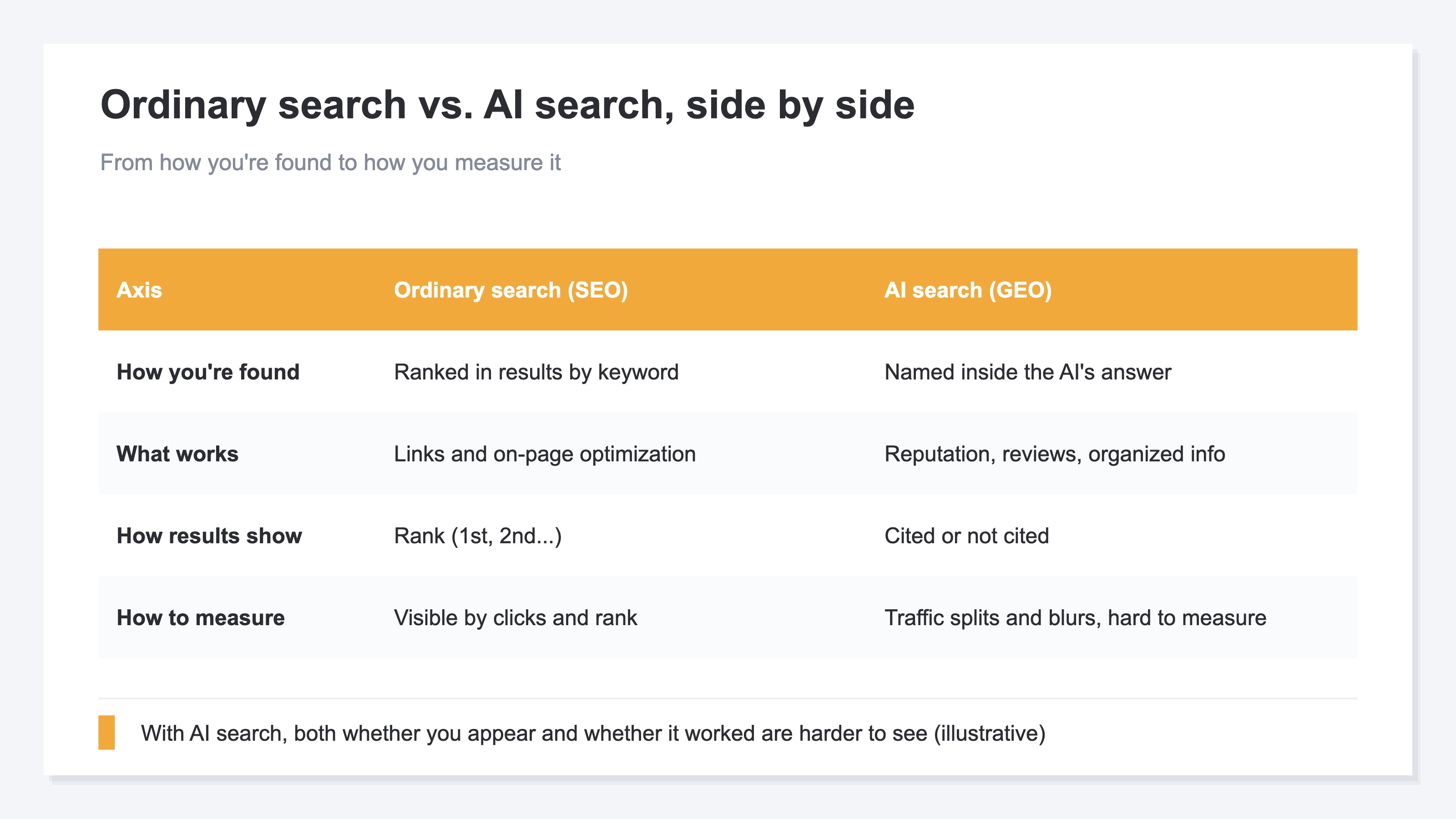
In ordinary search (SEO), pages line up by rank against the words you typed. First, second, and so on — so you can check your own position with your eyes. In AI search (GEO), by contrast, ChatGPT or Gemini answers the question in prose, and names a few sites or stores inside that answer[1]. It's a world of "cited or not," not rank.
There's one more difference. Because the AI bundles its answer into a single passage, users often don't bother opening a site at all. You're showing up, yet no click happens. So both "did I show up" and "did it work" get harder to see than in ordinary search.
The figure below lines up ordinary search and AI search by the axis you look at. What you get found by, what works, how results appear, how to measure the effect. On every axis, AI search is the harder one to get a grip on.
2. The basics of the base that gets you cited by ChatGPT: reputation, organized information, first-party data#
Bottom line: there's no shortcut to getting cited by ChatGPT more easily. What works is the patient base-building of accumulating reputation, conveying information in an organized way, and putting out first-party data.
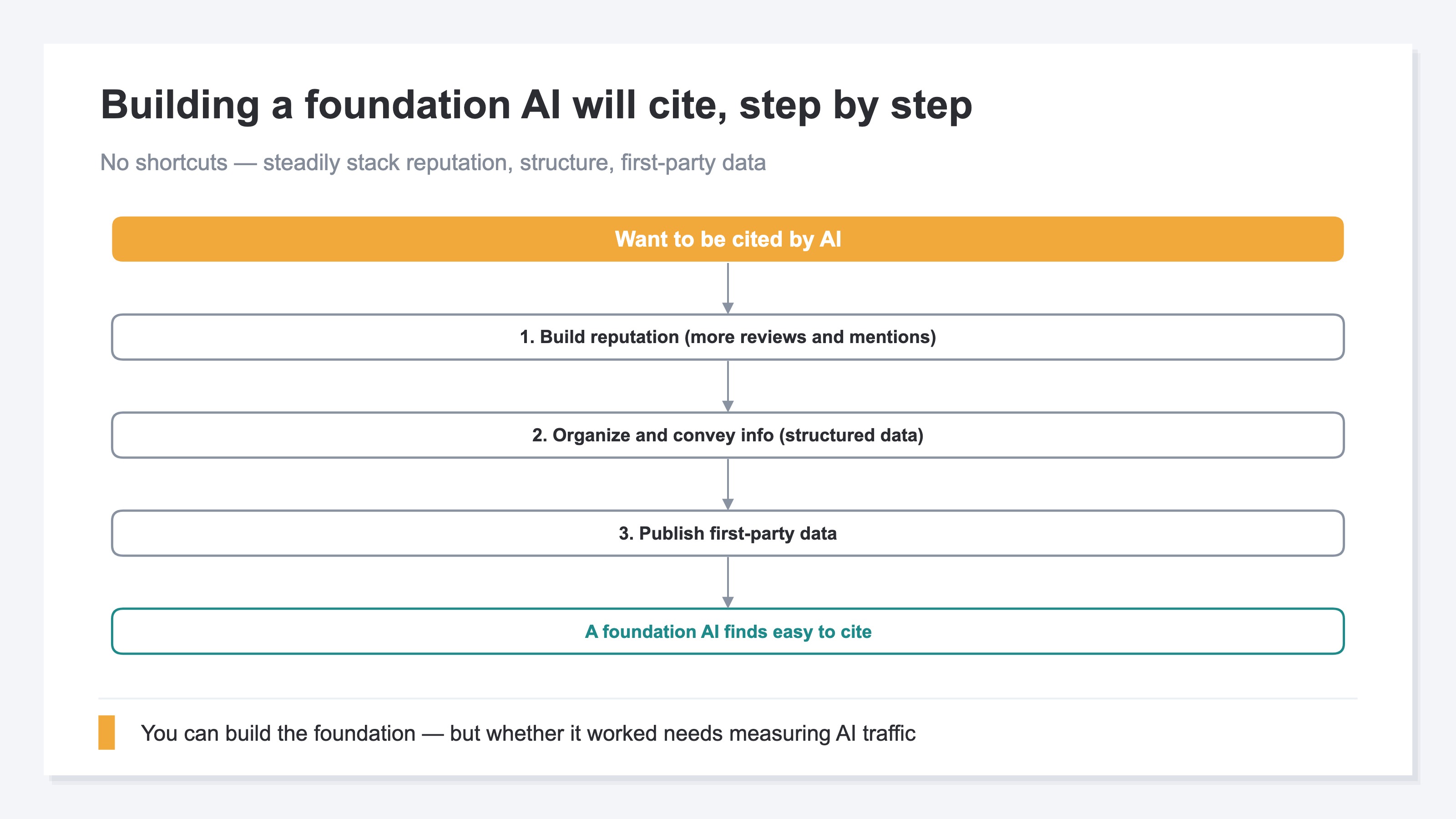
So how do you become easier to cite? There are three ideas. The first is reputation. AI tends to pick what's talked about and rated well across the wider world. The more chances your name comes up in word of mouth and on other sites, the more likely you are to make the shortlist. For more on what AI looks at when it chooses, What makes a site AI picks digs deeper.
The second is conveying information in an organized way. Write the facts — product name, price, features, areas served — on the page in a form that's easy for both people and AI to read. There are also mechanisms for organizing information in a set format (structured data)[2]. The third is first-party data. Data and experience that only you hold, and an original angle, become a strength no copy from elsewhere can match — and a reason to be cited.
The figure below is the flow of this base-building. The thing to watch is that even when you can build the base, that alone doesn't tell you "whether it worked." That connects to the next chapter.
3. What you don't need to do: misconceptions like llms.txt#
Bottom line: many of the "shortcuts" that claim "put this in place and you'll show up in AI" are still thinly grounded. Rather than spending time on dubious tricks, focusing on building the base is the sounder bet.
When AI search draws attention, claims of shortcuts surge all at once too. Take the talk that "place a file called llms.txt and AI will read you more easily." It sounds handy, but the major search engines haven't officially confirmed they use it, and for many such things the effect isn't clear. Some folk theories have been explicitly denied by the very side that does the searching[3]. For the assumptions floating around AI search, Google debunks GEO myths sorts them out.
To begin with, the rules of AI search aren't fully settled yet. Each engine chooses differently, and we're at a stage where it may have changed by next month. For how far GEO has been established, GEO isn't established yet is a useful reference. That's exactly why, rather than chasing tricks, it's realistic to put your time into the base — reputation, organized information, first-party data — which tends to work across any engine. Adding one trendy setting matters less than adding one more reason for customers to talk about you; the latter works for longer.
4. Confirming whether it worked: the next move is measurement#
Bottom line: even when you build the base, you can't tell whether AI-referred visits grew unless you measure. And those visits tend to blur into unknown origins in standard analytics.
This is the most important part. Even after you make a move, if you can't see whether it worked, you can't decide whether to keep going or fix course. But AI-referred visits are hard to measure. There are two reasons.
One is the limit of confirming it yourself by asking ChatGPT. Trying "does my store show up?" is an important first step, and it's useful for getting an initial feel. But even the same question returns different answers on different days, and it changes by person. Above all, asking can't tell you how many came as visitors and how much they bought. A single eyeball check is a helpful aid, but on its own it isn't enough to decide whether to continue.
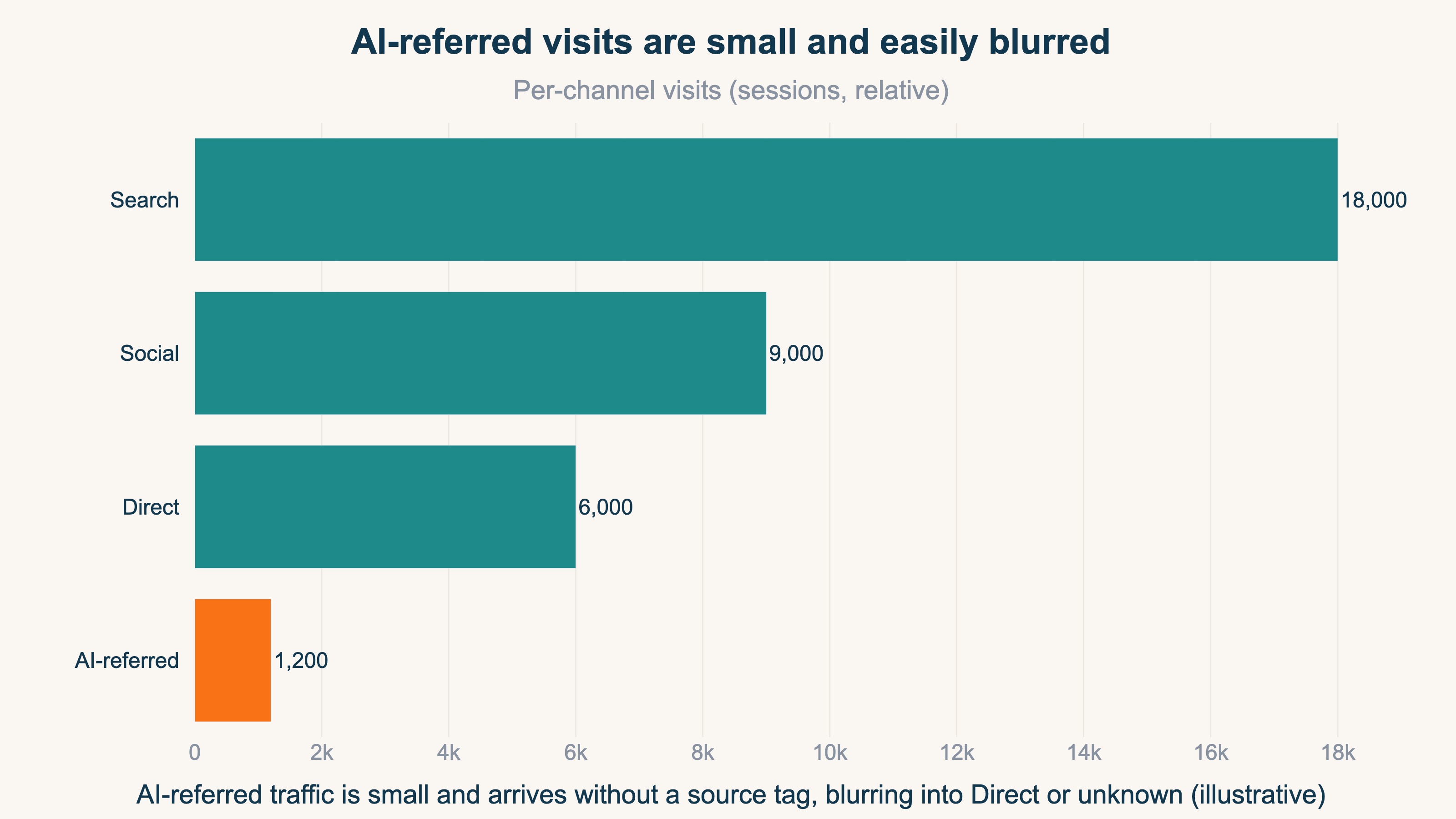
The other is that the origin gets blurred. People who arrive at a site from an AI answer often land without a marker of where they came from (the referrer), and standard analytics tends to lump them into "Direct" or unknown origins. As the figure below shows, AI-referred traffic, small in volume as it is, gets buried in ordinary search and disappears from view. The free entry point for checking is collected in Checking AI traffic for free, but free manual work always comes with things it misses.
RevenueScope solution
By now the wall is in view. You can build the GEO base, but you can't tell whether AI-referred visits grew unless you measure, and those visits blur into unknown origins in standard analytics. Try to confirm it by hand and it becomes a heavy, repeated task you have to rebuild every time, per engine and per period.
RevenueScope is not a tool for getting you onto AI. It doesn't make ChatGPT cite you, and it doesn't increase your AI exposure. The moves to show up (GEO) are yours to make. What RevenueScope takes on is the other side — measuring, after those moves, whether AI-referred visits grew. Specifically, it splits out the traffic that looks to be from AI answers as its own row, compares it against the previous period to see the rise or fall, and finds pages that look citable yet are being missed (the display is demo data).
| Traffic type | Visits | Revenue per visit (RPS) |
|---|---|---|
| AI-referred (ChatGPT and the like) | 1,200 | ¥320 |
| Search | 18,000 | ¥240 |
| Social | 9,000 | ¥150 |
| Blurred into unknown origin | some missed | — |
The thing to read here is that you can split AI-referred traffic into a single row and compare it against the other channels on the same screen, right down to revenue per visit (RPS). Even if the volume is small, if they're buying well, the value of growing it comes into view.
Traffic that lands without a marker (the referrer) is disclosed as-is in an unknown-origin row — the industry-wide lower bound, shown plainly rather than hidden. Because it sits on one screen, even the small volume of AI-referred visits can be compared against Search and Social on the same yardstick. Data comes in via general-purpose tools like GA4, and RevenueScope specializes in the numbers that drive the next move: revenue-based RPS and the rise or fall per channel.
FAQ#
Q. If I use RevenueScope, will I start showing up in ChatGPT?
No. RevenueScope is not a tool for getting you onto AI. The moves to show up — building reputation, organizing information, putting out first-party data — are yours to make. What RevenueScope can do goes up to measuring, after those moves, whether AI-referred visits grew, and finding pages that are missing citations. Remember it as the side that measures whether it worked, not the side that gets you on, and you won't get lost.
Q. Can't I just ask ChatGPT myself to see if I'm showing up?
It's effective as a first step. But the same question returns different answers by day and by person, and it can't tell you how many visitors came or how much they bought. A single eyeball check goes as far as confirming a feel. To decide whether to keep going, you need to measure AI-referred visits and revenue.
Q. Can AI traffic be tracked completely?
AI doesn't always pass a marker of origin, so visits that arrive without one are disclosed as the industry-wide lower bound in an unknown-origin row. RevenueScope gathers AI-referred visits and revenue into a single row and lets you track their rise or fall on the same yardstick as Search and Social. Getting a first read on whether it's growing and whether it's selling is the realistic move for deciding whether to continue.
Summary#
AI search (GEO) is a world where you don't line up by rank but get named inside the AI's answer. What works isn't shortcuts or tricks but the patient base-building of accumulating reputation, conveying information in an organized way, and putting out first-party data. Talk of the "place it and you'll show up" variety, like llms.txt, still mixes in thinly grounded misconceptions.
And the real question comes after you make a move. You can't tell whether AI-referred visits grew unless you measure. AI traffic tends to blur into unknown origins in standard analytics, and asking ChatGPT yourself alone isn't enough to decide whether to continue. The moves are what gets you on; measurement is what confirms whether it worked. Hold these two apart, and you can choose the next move with your own numbers rather than a hunch.
See which ads actually drive revenue, at a glance
Free up to 5,000 sessions/month, AI connection included. No credit card required. Up and running in 5 minutes.
![[Research] What Makes AI Recommend Your Site: It Comes Down to Reviews and Reputation](/_next/image?url=%2Fimages%2Fnews%2Fhow-ai-picks-stores.jpg&w=3840&q=75)
![[Research] How Visible Is Your Brand in AI Search? You Can Measure It](/_next/image?url=%2Fimages%2Fnews%2Fai-search-brand-visibility.jpg&w=3840&q=75)

![[Research] GEO Isn't Established Yet: Start by Measuring](/_next/image?url=%2Fimages%2Fnews%2Fgeo-not-yet-established.jpg&w=3840&q=75)