![[Research] The Web Is Being Rebuilt for AI Agents: What Online Store Owners Should Know](/_next/image?url=%2Fimages%2Fnews%2Fagent-first-web-ec-preparation.jpg&w=3840&q=75)
Ask ChatGPT to "pick something that fits my budget and taste," and the AI reads the web and shortlists stores for you. Shopping like this is starting to spread. Looking past it, a research report published in June 2026 proposes something bigger: the web should be redesigned with AI agents — not people — as its primary users. It sounds sweeping, but store owners don't need to rush a site rebuild. The framework is still a proposal, and no standard has settled. There's one thing to do first: measure whether "AI customers" are already visiting your store, which pages they read, and whether they lead to revenue. This article translates the report into ecommerce terms and sorts out what to know now and what can wait.
Table of contents
Key takeaways#
- A research report titled "Towards an Agent-First Web" proposes rebuilding the web from "a web people look at" into "a web AI reads." It is a pre-peer-review proposal, not a settled standard.
- In ecommerce terms, the change means your store starts receiving "AI customers" alongside human ones. The AI comes to read your product information and recommends your store to people. This one change has already begun.
- There is no need to rush a site rebuild. The first move is to measure whether AI customers are already coming and whether they turn into revenue. In most analytics tools, AI-referred traffic scatters into buckets like Direct — and that's where most stores stumble first.
1. A research report proposes an "agent-first web"#
The short version: a proposal to redesign the web around AI agents rather than people has arrived — in the form of research.
The report is titled "Towards an Agent-First Web: Redesigning the Web for AI Agents" [1]. It was published in June 2026 and is a preprint — a paper that has not yet been peer reviewed. Its claims haven't been proven correct; the right way to take it is as a proposal from researchers.
The argument goes like this. Today's web is built on the assumption that people open pages in a browser and look at them with their eyes. But programs that read the web on people's behalf — AI agents — are handling more research and shopping. Since the old assumption no longer fits, the report proposes redesigning the web's underlying machinery with AI agents as the primary users.
What matters to store owners is one point: the web's readers will no longer be people alone. In shopping terms, AI browses stores and recommends them to people. That change at the entrance has already begun — without waiting for the proposal's fate.
2. The web humans see vs the web AI reads#
The short version: the report organizes the change into three layers — who comes to read, how money flows, and what pages contain.
First, who comes to read. Today's web receives every visitor as a person. The report proposes mechanisms that identify AI agents and receive them separately from people.
Second, how money flows. Much of today's web revenue rests on people viewing ads and pages. AI doesn't look at ads. So mechanisms like charging for AI reads themselves are under consideration.
Third, what pages contain. Instead of visual layouts designed for people, content would be served in structures AI can parse. A new markup language written for AI is among the proposals.
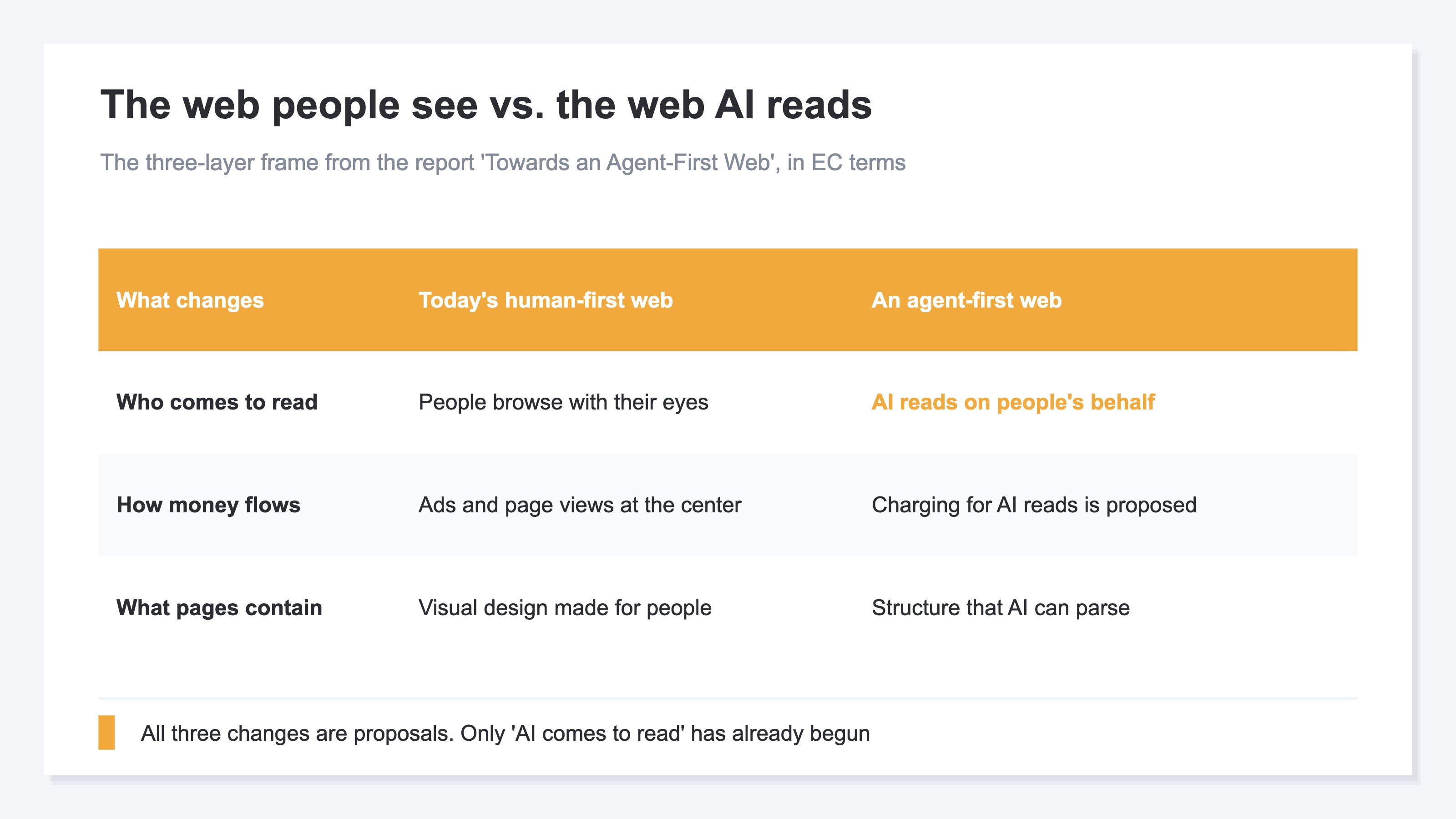
The table above translates the report's three layers into ecommerce terms. Note, though, that all three are still proposals. Which one becomes the standard is undecided. Only one change is moving ahead without waiting: AI is already reading the web.
3. What happens when "AI customers" start visiting your store#
The short version: in ecommerce terms, your store starts receiving "AI customers" alongside human ones.
An AI customer comes to read your product pages and prices, then tells a person "this item at this store fits you." The wallet stays human, but the eyes choosing the store shift to AI. You could also say the way your storefront gets seen is changing.
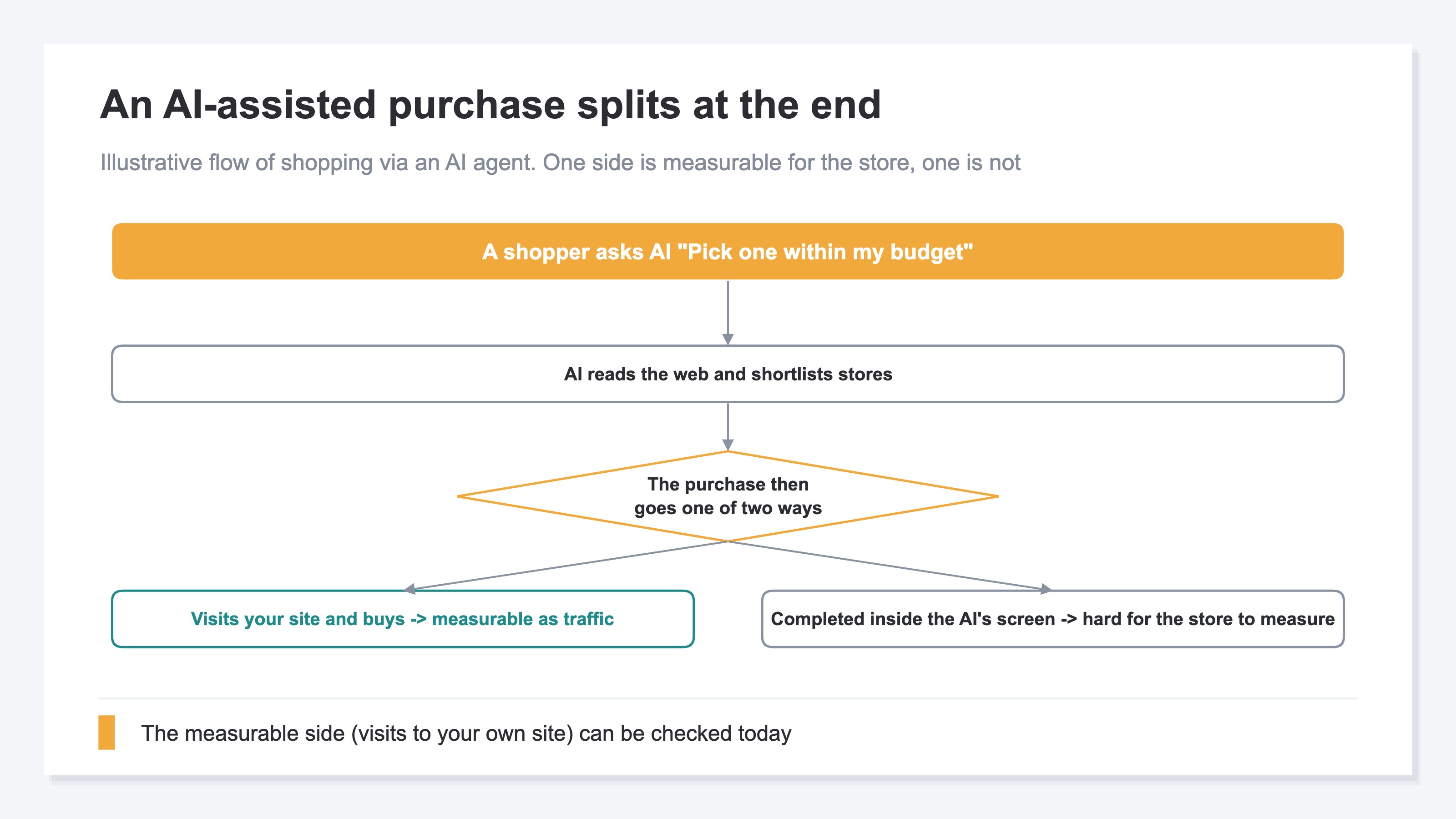
As the diagram shows, a purchase involving an AI customer splits in two at the end. In one path, the person the AI advised visits your site and buys. In the other, the checkout completes inside the AI's screen. The first is traffic to your own site, so you can measure it from the store side. The second never passes through your site, so it's hard to measure. This dividing line is laid out in detail in Revenue in the age of AI agent checkout.
The tricky part is that even the measurable path is, in practice, hard to see. In most analytics tools, AI-referred traffic doesn't show up as its own channel. The referrer often fails to pass through, so the visits scatter and dissolve into buckets like Direct. We cover this in AI traffic hiding inside "Direct". In short, many stores already have AI customers — and don't know it.
4. What not to rush, and what to check first#
The short version: what's urgent now is not rebuilding your site but measuring.
The reason you don't need to hurry is clear: the report's framework is a proposal, and no standard has been settled. A full rebuild into AI-specific formats can wait until the format wars settle. Quick fixes like "place this one file and AI will pick you" carry a lot of misunderstanding; the practical groundwork for getting cited by AI is laid out separately in How to appear in ChatGPT's answers. And the tactics called GEO haven't proven their effect yet — see GEO is not an established practice yet.
What to check first is one thing: are AI customers already visiting your store?
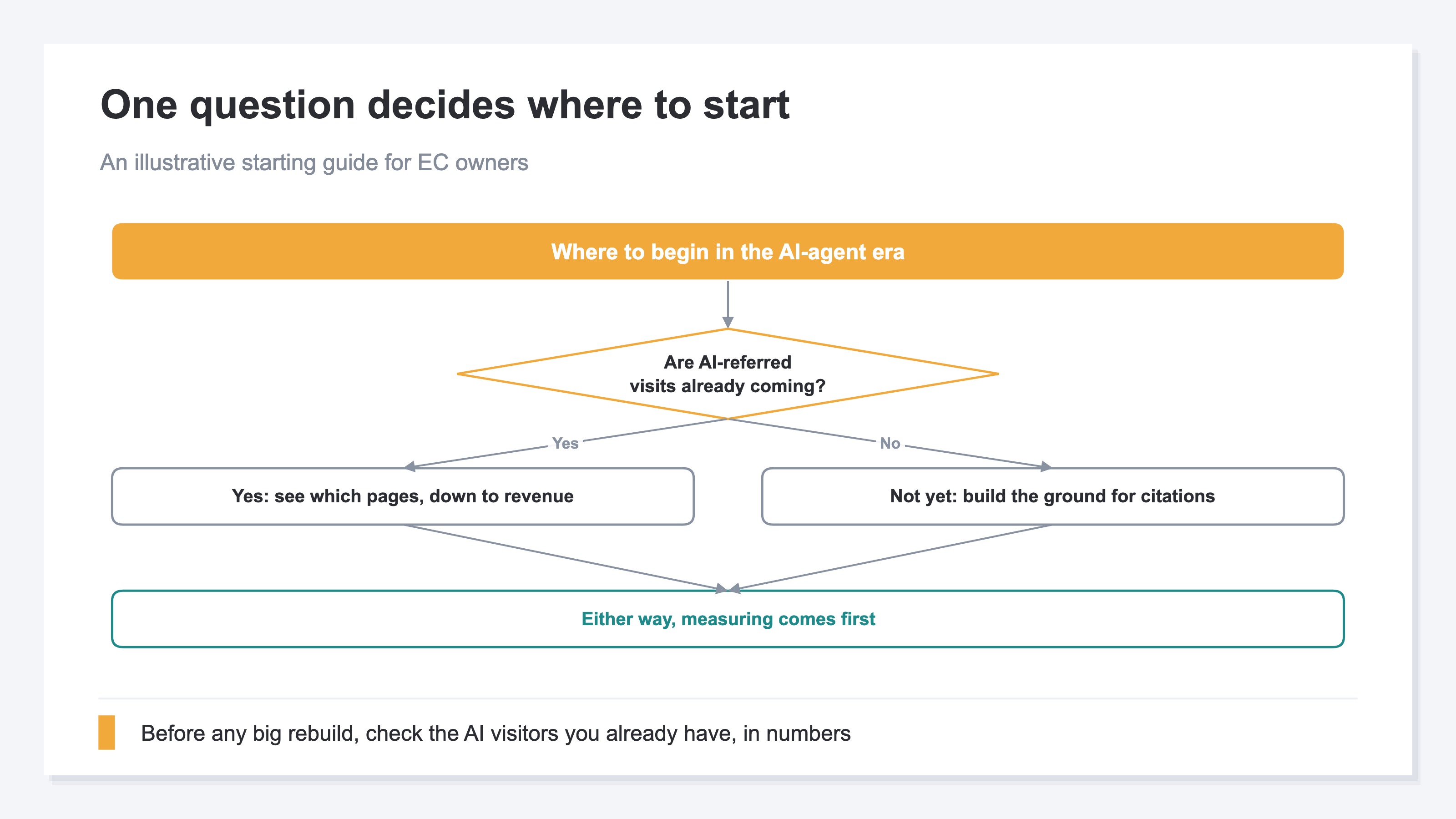
There are free ways to check. GA4 has started rolling out a channel that groups AI-assistant referrals, and you can also eyeball your referrer list. But both miss a lot, and neither easily tells you which pages get read or whether the visits turn into revenue. The caveats on the GA4 side are collected in Don't take GA4's new AI-assistant channel at face value.
The idea itself is simple. What's hard is doing it page by page, tied to revenue, every week. Picking AI-looking referrers out of a list and matching them against pages and revenue — you can do it once, but repeating it by hand every time is heavy work.
RevenueScope's solution
All you want to know is whether AI customers are coming — and GA4 gets structurally stuck. AI-referred traffic scatters into buckets like Direct, and even when you carve it out, it doesn't connect to revenue. Try to watch it page by page, tied to revenue, every week, and you're redoing the same hand-tallying each time.
RevenueScope is a tool with the aggregations an online store needs for revenue decisions already built in. It carves out AI-referred traffic as its own channel and shows, on one screen, which AI sent how many visits and how much revenue. Ask it, and it comes back like this (display uses demo data).
| AI referral source | Visits | Revenue | RPS (Revenue Per Session — revenue per single visit) |
|---|---|---|---|
| ChatGPT | 320 | ¥96,000 | ¥300 |
| Perplexity | 140 | ¥49,000 | ¥350 |
| Gemini | 80 | ¥12,000 | ¥150 |
| Reference: site-wide average | 12,400 | ¥1,488,000 | ¥120 |
The read that matters in this table is the gap between visit counts and efficiency. AI-referred visits are few, yet revenue per visit (RPS) runs above the site-wide average — facts like this surface without any hand-tallying. Alongside, it lists pages AI could plausibly cite but isn't reading — candidates for missed traffic. Connect RevenueScope to ChatGPT or Claude and ask "which pages are my AI customers reading, and how much are they buying?" — and these numbers come back as the answer.
RevenueScope identifies AI-referred traffic from referrers and access patterns, and shows visits, revenue, and RPS (revenue per visit) for each AI — ChatGPT, Perplexity, and the rest — already tallied. Its strength is focus: not profit margins or customer lifetime value (LTV), but revenue-based metrics like RPS and ROAS that bear directly on ecommerce revenue decisions. What RevenueScope does is keep your AI customers visible at all times, page by page and tied to revenue — so you can hold your store's current position in numbers even before a standard settles.
FAQ#
Q1. I run a small online store. Should I rebuild my site for AI agents?
No need to rebuild right now. The report's framework is at the proposal stage, and no standard has been settled. First measure whether AI customers are already coming and whether they turn into revenue. Deciding after you see the numbers is fast enough.
Q2. Is there a free way to check whether AI customers are visiting?
Yes. GA4's AI-assistant channel grouping, or eyeballing your referrer list. Just know the limits: both miss a lot, and tracking it page by page, tied to revenue, every week is heavy by hand.
Q3. Will all revenue from AI agents become measurable?
Not all of it. Purchases that complete inside the AI's screen stay hard to see from the store side. What you can measure is the portion where the AI's recommendation brought someone to your site and they bought. Starting with that measurable side is the realistic move.
Summary#
What the "agent-first web" report points to is a direction: the web's readers will no longer be people alone. In ecommerce terms, AI customers come to your store. But the framework is a pre-peer-review proposal, and there's no need to rush a site rebuild.
What comes first is one thing: whether AI customers are already visiting, which pages they read, and whether that becomes revenue. Hold those numbers, and when a standard does settle, you'll decide your next move from verified facts. You can't steer the web's larger current — but you can measure your own store's position, starting today.
See which ads actually drive revenue, at a glance
Free up to 5,000 sessions/month, AI connection included. No credit card required. Up and running in 5 minutes.


![[Research] GEO Isn't Established Yet: Start by Measuring](/_next/image?url=%2Fimages%2Fnews%2Fgeo-not-yet-established.jpg&w=3840&q=75)