
Ask ChatGPT to "pick a good vacuum within my budget," and the AI narrows the candidates and places the order for you — that kind of shopping is becoming real. From the side that runs an online store, a worry creeps in here. How much did we actually sell through AI, and will that number show up in our analytics, or won't it?
Here's the conclusion first. AI-driven revenue isn't, as a lump, simply "invisible." It splits into two: revenue you can measure and revenue you can't. The measurable part is what someone bought on your own site after the AI recommended you. The unmeasured part is what closed entirely inside the AI's interface, where the person never once opened your site. Hold this line and you avoid tipping either into the resignation of "none of it is visible" or the inflated hope that "drop in a tool and all of it becomes visible." This article works through that boundary in order, and shows a path to start making revenue visible from the half you can move on right now.
Table of contents
Key takeaways#
- AI-driven revenue isn't a single lump labeled "invisible." It splits into a measurable half and an unmeasured half. Draw no line and give up on the whole, and you leave the half you could move on today on the table.
- The measurable part is what came from AI and was bought on your own site. It didn't vanish — it's just buried under "Direct" in GA4. Tell it apart and tie it to revenue, and it shows its face.
- The unmeasured part is what closed inside the AI's interface, where the shopper never touched your site. No on-site analytics can reach that boundary, so you cover it with platform-side reports and start with the measurable half.
1. AI-driven revenue splits in two#
The first thing to make clear: AI-driven revenue isn't one block. Two kinds of different nature are mixed together.
The first is revenue you can measure. Someone the AI recommended you to follows a link, comes to your own site, and buys there — in this case the purchase happens inside your own site. So in principle your own analytics can trace it.
The second is revenue you can't measure. When an AI agent compares on your behalf and settles the payment inside the AI's interface, that person never opened your site once. The order is in, yet no footprint is left on your site. This revenue never appears in your analytics in the first place.
The figure below shows the shape of this split as an illustration. The proportion shifts by store and product, but what matters is the shape itself: AI-driven revenue is not monolithic.
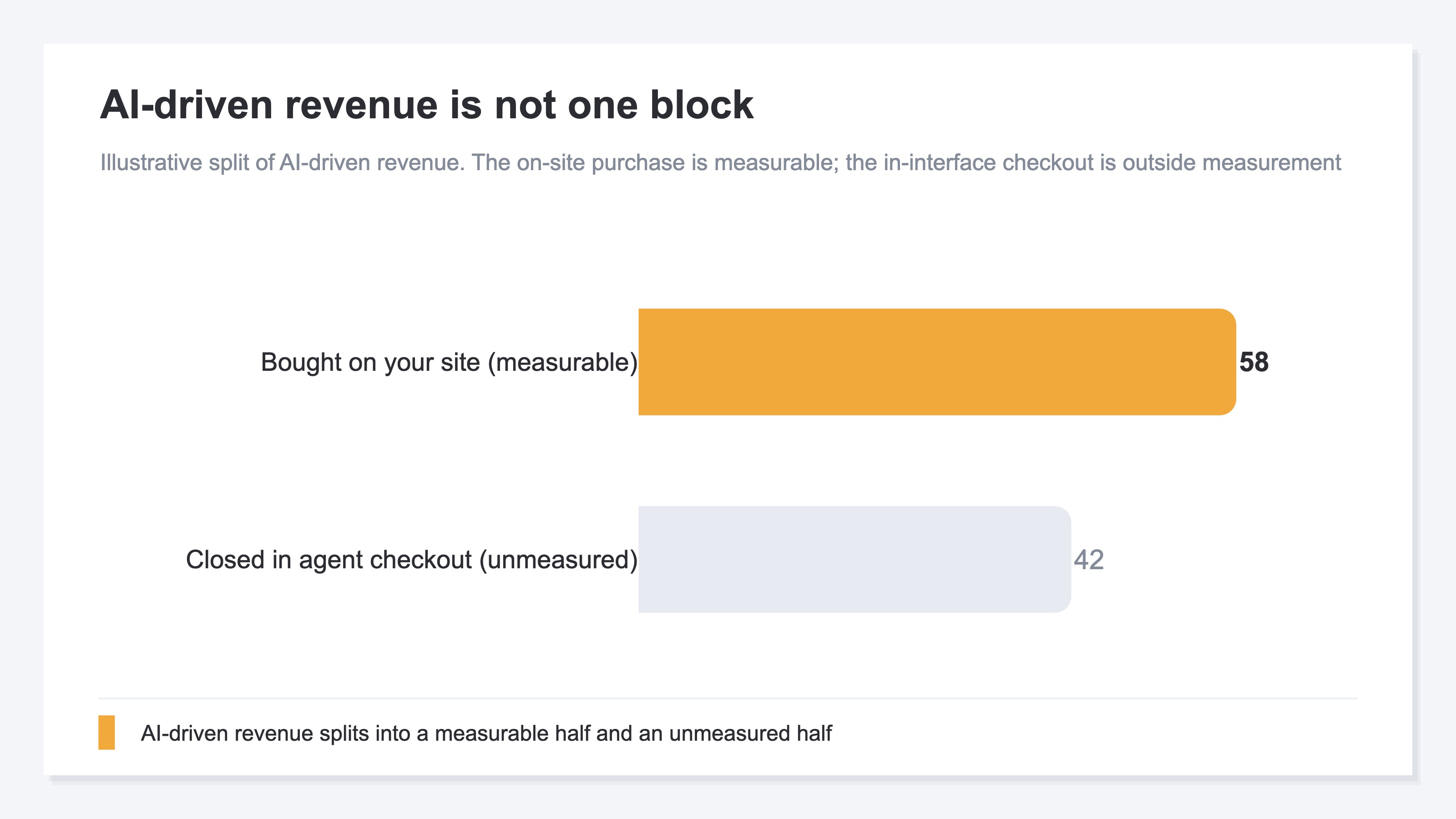
Lump it all together as "AI-driven revenue is totally invisible" and you'll pick the wrong move. The measurable side can be acted on right now, yet you'd give up on it alongside the unmeasured side. So the start is to draw this boundary line.
2. The measurable side: came from AI, bought on your site#
Start with the measurable side. The conclusion up front: this half isn't "invisible" — it's only "buried."
Inflow that arrives at your site from an AI's answer often carries no mark of where it came from (a UTM tag). With no mark, GA4 treats that visit as a visitor of unknown origin and pulls it into the bucket called "Direct." It's really from AI, yet it lands in the same box as bookmarks and direct typing. That's why it feels like "AI-driven traffic is invisible."
This is a structural problem, not vanished revenue. Pick out the AI-derived ones from the inflow tangled inside Direct, tie them to how much revenue they drove, and the measurable side shows its face. The way to tell them apart is laid out in detail in How AI traffic hides inside "Direct". Here, just hold onto this: there's a half that's only buried, and peeling it back makes it visible.
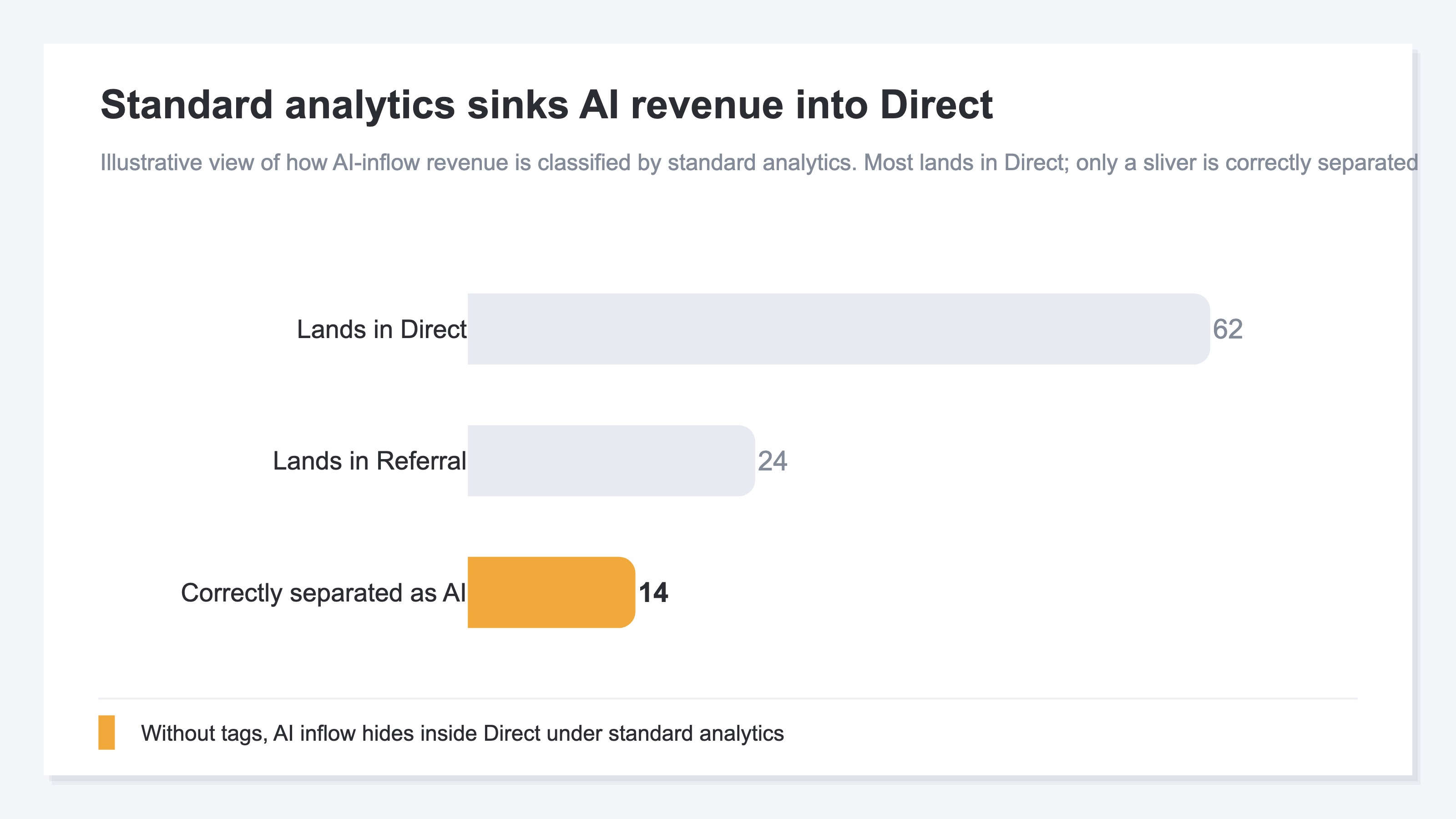
What to watch for is the weight of doing this by hand every time. The idea is simple, yet with every new wave of inflow you have to sort through Direct, judge whether each is AI-derived, and tie it to revenue — that repetition is what wears you down.
3. The unmeasured side: closed in agent checkout#
Next, the unmeasured side. For now, this part sits outside the reach of any analytics tool placed on your own site.
The reason is simple: the purchase happens outside your own site. The mechanism where an AI agent compares products and finishes the payment right inside the AI's interface is being standardized across companies. A leading example is the Agentic Commerce Protocol (ACP) that Stripe and OpenAI are driving. The work by Google and Shopify on what's called the UCP is part of the same current. All of them point toward completing the journey from comparison to checkout inside the AI's interface.
As long as no footprint is left on the site, an analytics tag placed on your own site has no way to catch that purchase. This isn't a question of which tool is better — it's a question of a boundary, the outer edge of where measurement reaches. When you want to know this revenue, you cover it with the merchant-facing reports that the AI platforms or protocols put out.
Market commentary talks up the scale: "agent checkout will reach trillions." But what you need first, on the ground, is the line for how far that revenue is visible as your own number. Honestly admitting that what can't be measured can't be measured — that's the first step to not getting your legs swept out by inflated hopes.
4. Where to start#
Once it splits in two, the next thing is order. The conclusion: make the measurable half visible, correctly, first.
To sort your moves, two axes make it clearer. Put "measurable in-house" on the horizontal and "revenue impact" on the vertical, and place the kinds of inflow on it.
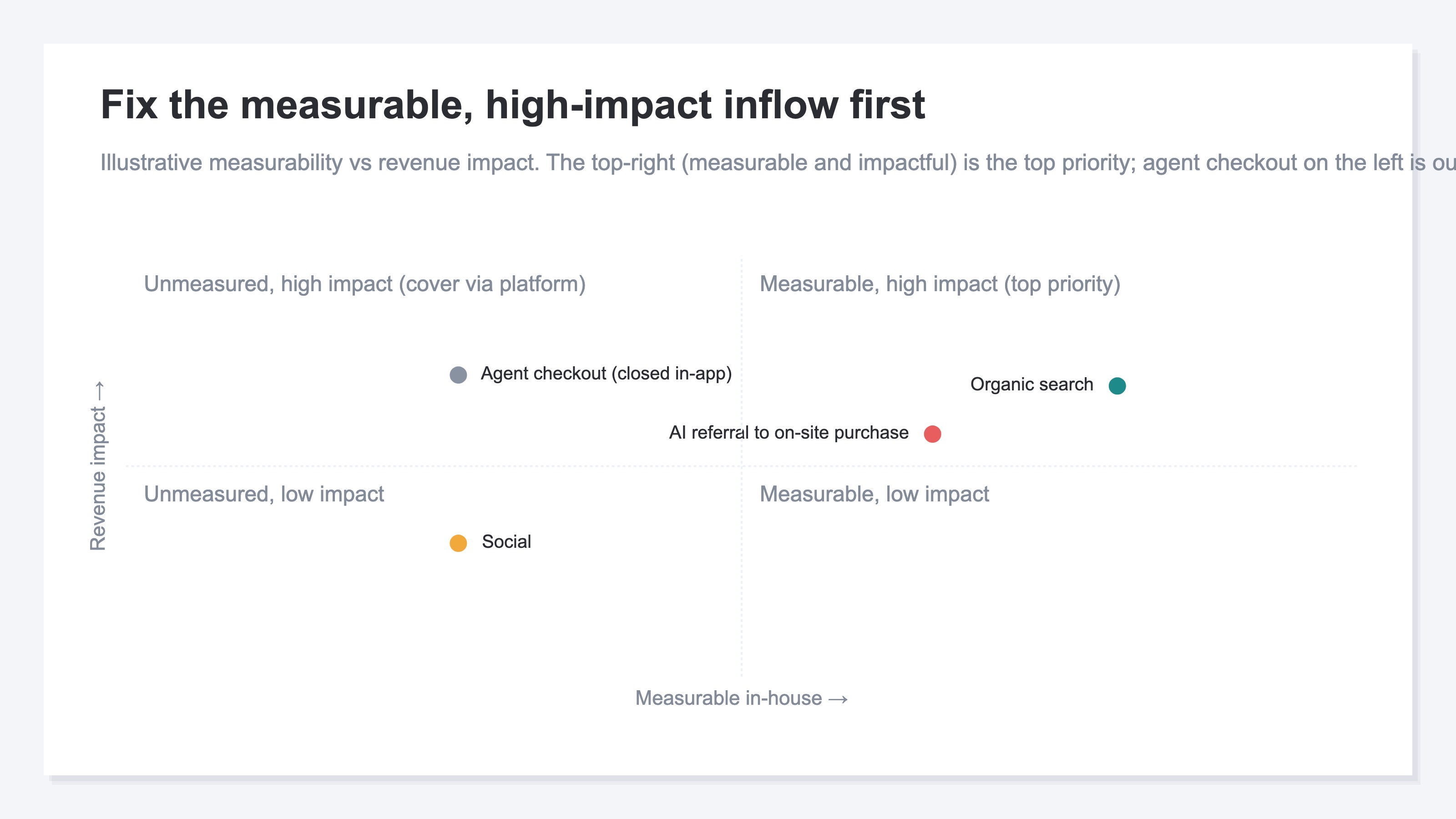
The top-right — "measurable in-house and effective on revenue" — is the top priority. What came from AI and was bought on your own site lands exactly here. It's buried now, but peel it back and it's visible — so it's worth acting on first. Agent checkout, meanwhile, sits on the left, outside measurement. Treat that as a zone to cover with platform-side reports, and don't burn yourself out trying to chase it with on-site analytics.
When you make the measurable side visible, check whether AI is really driving revenue by revenue, not by whether traffic went up. Cheer for inflow counts alone and you'll be fooled by a hollow rise (An increase in AI traffic doesn't equal an effect). If how you show up in search also concerns you, How to read the GSC AI-search report is a starting point; if you want to be on the side that AI picks in the first place, What makes a site AI picks is the entry point.
The wall here is the same. The idea is simple, yet correctly separating AI-derived inflow across channels every single time is heavy. The more angles you want to see, the more by-hand work piles up.
RevenueScope's solution
When you try to chase AI-driven revenue, you end up hitting the same wall. Even knowing there's a measurable half, telling AI-derived inflow apart from what's tangled inside Direct, every time, is hard work. Pile on the by-hand effort of tying it to whether it drove revenue, and you run out of energy before you reach the call that matters.
RevenueScope holds that separation from the start, as an AI channel. get_ai_traffic carves out inflow that came through AI answers — ChatGPT, Claude, and the like — as an independent channel, and returns how much revenue those sessions drove. Ask it, and it comes back like this (display uses demo data).
| AI source | Inflow sessions | Referred revenue | Revenue per session (RPS) |
|---|---|---|---|
| ChatGPT | 340 | ¥306,000 | ¥900 |
| Claude | 120 | ¥132,000 | ¥1,100 |
| Perplexity | 80 | ¥56,000 | ¥700 |
The telling read in this table is that AI inflow once sunk into Direct now comes into view by source, with revenue and revenue per session (RPS). On top of that, it points out pages that AI would likely cite but you're missing, so you get a sense of where to fix next.
RevenueScope makes the measurable half — what came from AI and was bought on your own site — visible as an independent AI channel, with revenue and revenue per session (RPS). It's built for revenue-based measurement, so it treats profit after cost (gross margin) and customer lifetime value (LTV) as a separate axis, and focuses on handing you the material — including where to fix next — for the half you can move on right now.
FAQ#
Q. So AI-agent-driven revenue is, in the end, completely invisible?
No — half of it is visible. What someone bought on your own site after the AI recommended you is, right now, just buried under "Direct," and it shows up once you tell it apart. What's invisible is the part that closed inside the AI's interface, where the shopper never touched your site. Separate these two, and the half you can move on today comes into focus.
Q. Is there a tool that can measure agent-checkout revenue?
In principle, no on-site analytics tool can. The purchase closes outside your own site and leaves no footprint. To know this part, cover it with the merchant-facing reports the AI platforms or protocols put out. What RevenueScope handles is the measurable half in front of it — making what came from AI and was bought on your own site visible all the way to revenue.
Q. What should I start with?
Start with the measurable half. Tell apart what came from AI and was bought on your own site from inside "Direct," and check whether it's driving revenue. Leave the unmeasured side to platform-side reports, and don't wear yourself out trying to chase it with on-site analytics.
Summary#
In the era where AI agents shop on your behalf, revenue isn't, as a lump, simply "invisible." It splits into the measurable revenue — came from AI, bought on your own site — and the unmeasured revenue, which closes inside the AI's interface.
The measurable side is, right now, only buried under "Direct." Tell it apart and tie it to revenue, and it becomes visible today. The unmeasured side — as agent checkout standardizes — you correctly admit as a boundary no on-site analytics can reach, and cover with platform-side reports. Hold this line, and you tip into neither the hope that "all of it is visible" nor the resignation that "none of it is," and you move ahead on visualizing revenue from the half you can move on today. Start by checking how much of your own AI-driven inflow is buried inside "Direct."
See which ads actually drive revenue, at a glance
Free up to 5,000 sessions/month, AI connection included. No credit card required. Up and running in 5 minutes.
References#
- [1] Ministry of Economy, Trade and Industry "Survey on Electronic Commerce" (2024)
- [2] Stripe "Agentic Commerce Protocol" (URL unconfirmed) (2026)
- [3] OpenAI "Instant Checkout / agentic commerce" (URL unconfirmed) (2026)
- [4] Google Analytics Help "Referral / source / medium" (URL unconfirmed) (2026)

![[Research] More AI Traffic Isn't Proof It Worked: Tell the Real Gain by Revenue](/_next/image?url=%2Fimages%2Fnews%2Fai-referral-revenue-real.jpg&w=3840&q=75)

![[Research] What Makes AI Recommend Your Site: It Comes Down to Reviews and Reputation](/_next/image?url=%2Fimages%2Fnews%2Fhow-ai-picks-stores.jpg&w=3840&q=75)