
Whether ChatGPT or Perplexity cites your store. Over the past year, the number of marketers who worry about this has jumped. Some have installed dedicated tools and stare every week at how many times they were mentioned. But when you only watch the citations you received, you miss a far bigger loss.
That loss is the pages that have real demand, yet AI never cites at all. People reach them just fine, they get read, they even sell. And yet, ask ChatGPT a related question and that page or product never comes up once. These are your "best-sellers AI never cites"—what we call missed citations. This article first makes clear what these missed best-sellers are, then walks through why watching only the citations you received won't surface them, the limits of checking by hand, and a way to find high-demand pages by their lack of AI traffic.
Contents
This article in brief#
- Best-sellers AI never cites are pages people reach and read just fine, yet AI never cites at all. Because real demand already exists, the upside if they ever do get cited is large—a genuine loss
- Dedicated tools that track "citations received" have multiplied, but they only reflect what was cited. Pages that weren't cited (the loss) are structurally invisible in that view
- The shortcut to finding the loss is to look from the other side. List the pages people reach often but where AI-driven traffic alone is near zero, ordered by real demand. That's where to act next
1. What best-sellers AI never cites are: the loss on the flip side of "citations received"#
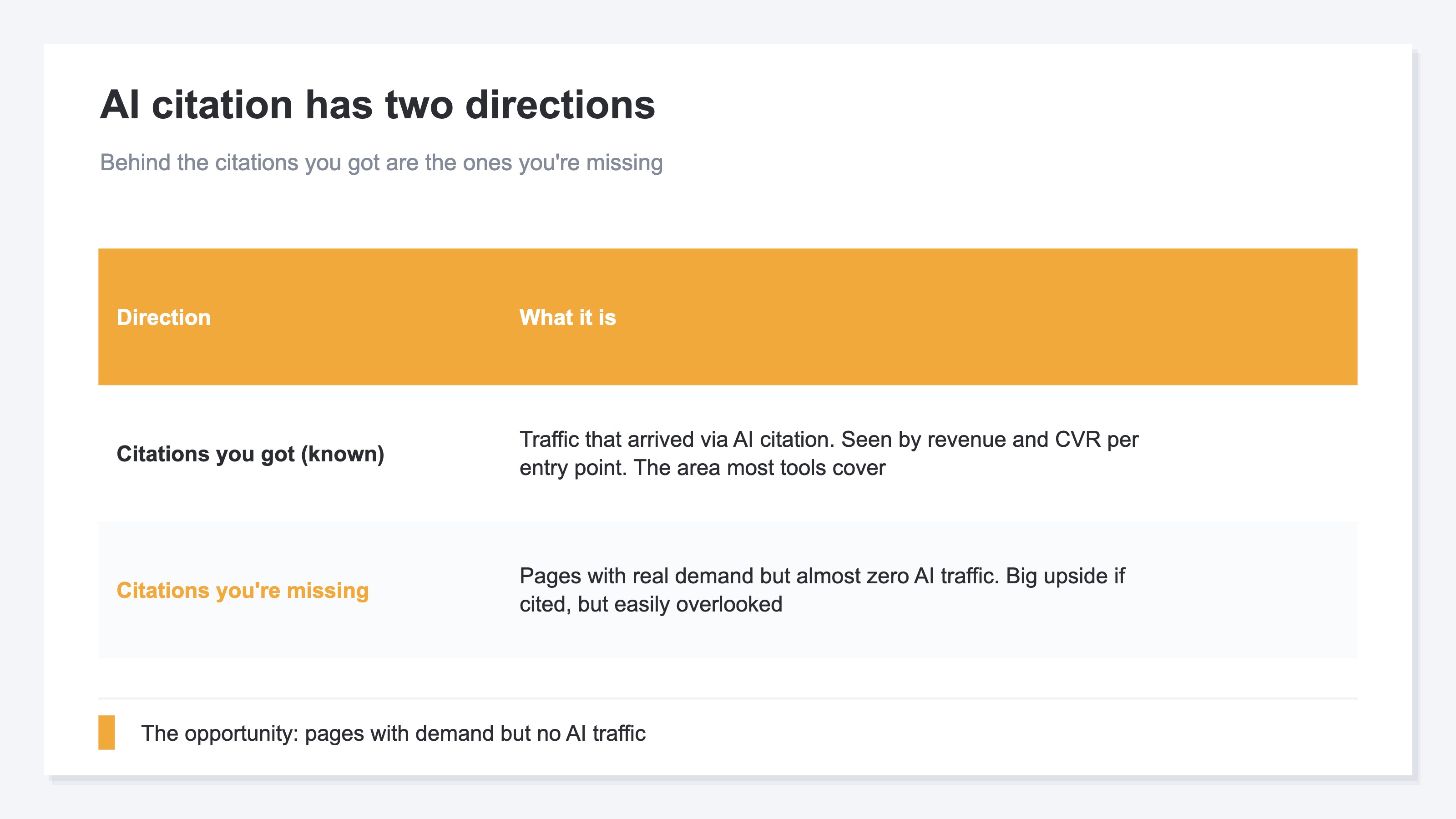
In short, best-sellers AI never cites are pages that have real demand, yet where AI-driven traffic alone is near zero.
AI traffic is usually discussed from the "arrived" side. ChatGPT or Perplexity cited you, people came, and so much revenue followed. That matters. But everything has a flip side. Behind the pages that were cited and "arrived," there are always pages that weren't cited and "didn't arrive." And among the latter, some pages have plenty of human visitors from search or direct, get read well, and sell.
That's the loss. Real demand exists—people already see the value—yet through the new doorway of AI, not a single visitor has been sent your way. There's plenty of room to grow if only it were cited, but AI's light isn't shining there. Conversely, if a page no one visits goes uncited by AI, that doesn't hurt. What hurts is only the loss on pages that have real demand. So listing every "page that wasn't cited" is pointless; the key is to narrow to "pages that have real demand yet weren't cited."
2. Why watching only "citations received" won't surface the loss#
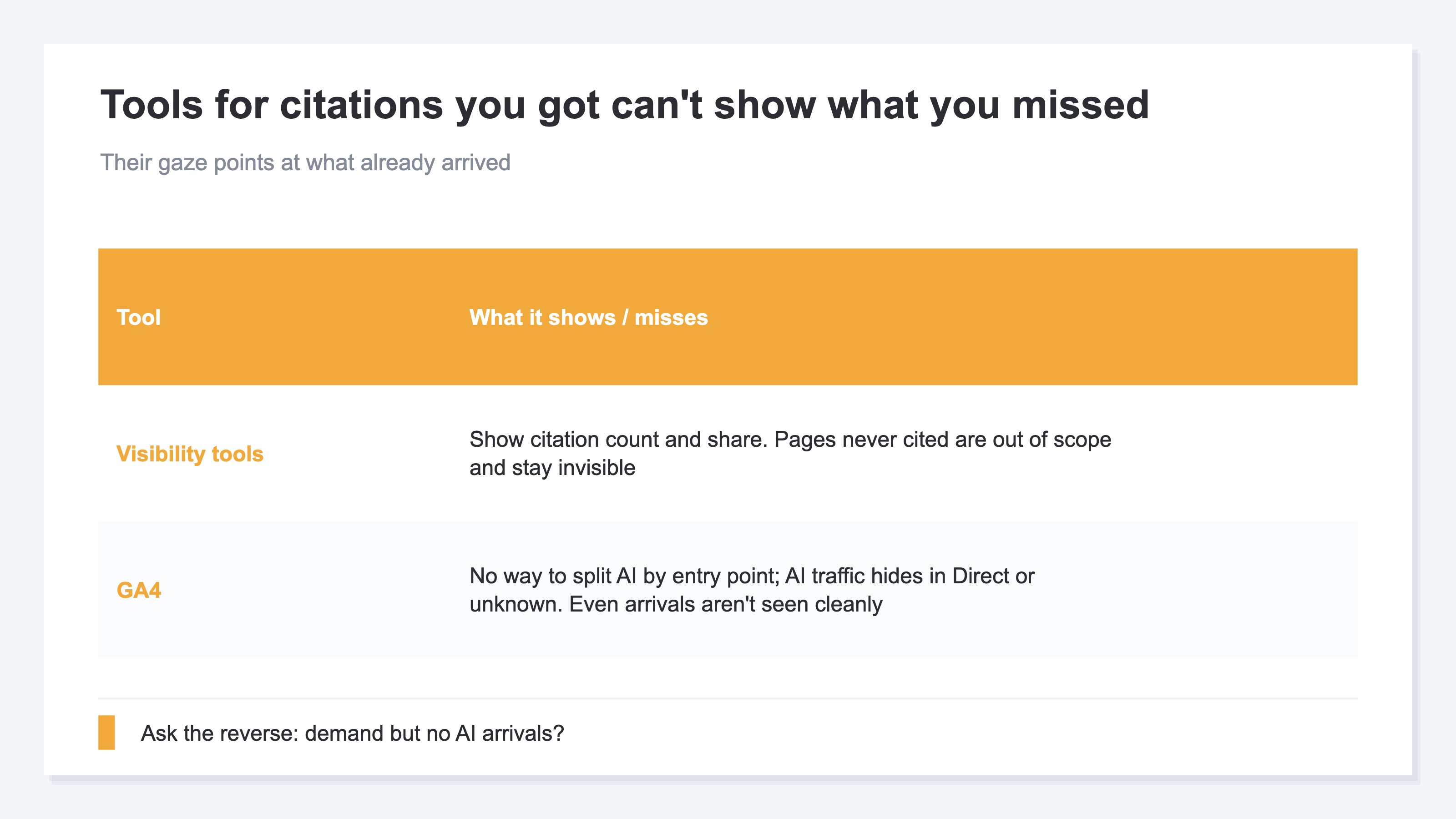
In short, tools that count citations received only reflect "what arrived," so pages that weren't cited are structurally invisible in that view.
Right now, dedicated tools that track how many times AI mentioned you keep appearing. Being able to see your citation share and which AI surfaced you is convenient. But what they show is only the "results that were already cited." What was cited is reflected; what wasn't cited isn't shown at all. It's like a map that only renders where the light falls—pages in the dark were never on it to begin with.
GA4 doesn't change the situation. GA4 has no mechanism to separate AI by entry point, so AI-driven traffic tends to get mixed into "Direct" or unknown source. If even what arrived can't be seen cleanly, listing "pages that didn't arrive" is more than GA4's design can be expected to deliver.
In other words, both visibility tools and GA4 are designed to look at the "arrived" side. To find the loss, you have to turn your gaze the other way. Instead of "which page was cited," ask again: "which pages have real demand yet alone haven't arrived from AI?"
3. Asking AI about every page by hand doesn't last#
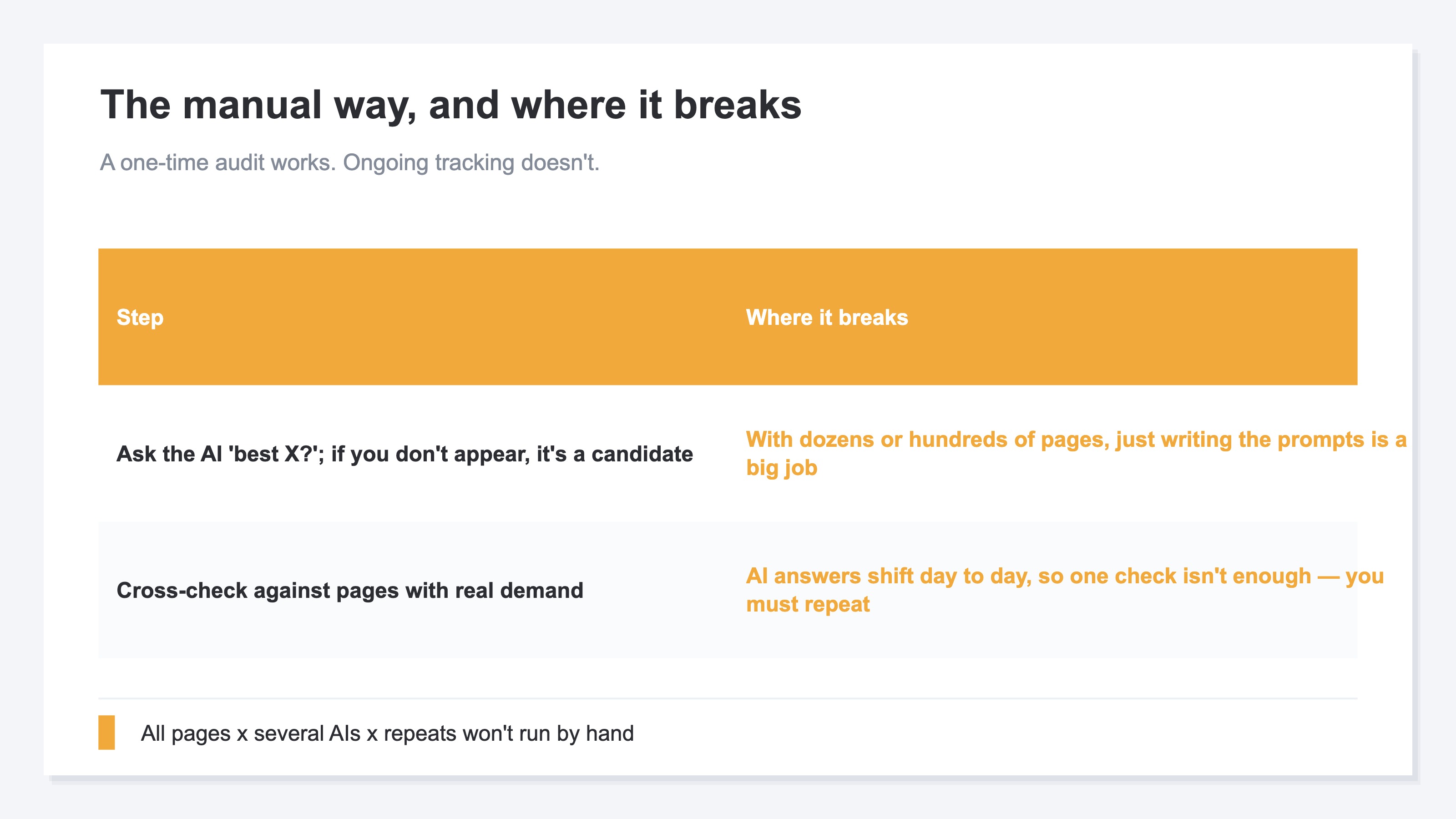
In short, there is a manual way to hunt for the loss, but given the number of pages and AI's day-to-day wobble, it's hard to keep up.
The idea itself isn't difficult. Picture your product categories or article themes, and ask ChatGPT or Perplexity "what's a good ○○?" If you don't come up there, that's a candidate for not being cited. Cross-check those against pages with real demand (well-viewed pages), and the loss starts to appear. Once or twice, that's enough to get a feel for it.
The problem is whether you can keep it up. If you have dozens or hundreds of products or pages, you'd have to compose a question for each one, try several AIs, and record whether you showed or not. And AI answers wobble day to day even for the same question. You show up on Tuesday and there's no trace of you on Thursday—that happens routinely. So one check isn't enough; you have to repeat it many times. On top of that, whether a page that didn't show is truly a "loss with real demand" only becomes clear once you cross-check it against your access data.
In short, even though the task itself is simple, running every page × multiple AIs × many repetitions by hand on an ongoing basis isn't realistic. It works as a one-time inventory, but it's no good for monthly monitoring. That's the limit of doing it by hand.
RevenueScope — the solution
Push the work of finding the loss all the way to the end, and you hit the same wall: can you keep picking out, every single time, "the pages that have real demand yet alone haven't arrived from AI" from among the sheer number of pages and AI's wobble?
RevenueScope answers that question from the other side. It picks out the pages on your site where human real demand (visits and engagement) is high yet AI-driven traffic is near zero, and shows them ordered by the size of the opportunity (the figures shown are demo data).
| Page | Real demand (monthly visits, people) | Engagement | AI-driven traffic | Size of opportunity |
|---|---|---|---|---|
| /blog/ec-kpi-guide | 2,800 | High (3-min dwell) | 0 | Large |
| /products/protein-bar | 3,200 | High (62% read) | 4 | Large |
| /products/yoga-mat | 1,500 | Medium | 1 | Medium |
| /products/new-arrival | 900 | High | 0 | Medium |
The thing to read in this table is the page at the very top. 2,800 people a month reach it and read it for an average of three minutes, yet AI-driven traffic is 0. Demand is plentiful, but the doorway from AI alone isn't open. The opportunity is largest there, in the sense that growth would follow if a citation appeared. Conversely, low-demand pages sink to the bottom, so the ones worth chasing and the ones worth leaving alone separate at a glance. The order is decided not by visit count alone but also by how much each page is read and engaged with (engagement). And to keep the numbers honest, this is real demand after excluding bot traffic.
Let me be clear about one thing. What RevenueScope produces is a list, ordered by opportunity, of "which pages haven't arrived from AI relative to their real demand." It doesn't go as far as "why you aren't cited" or "write it this way and you'll surely be cited." From there, what to do with which page (GEO improvements or tidying up your information) is yours to decide. RevenueScope lines up, in numbers, where to spend your limited time.
FAQ#
Frequently asked questions#
Q. How is this different from a tool that measures "whether you're cited by AI"?
A. The direction is reversed. Visibility tools reflect "what was already cited"—how many times you were mentioned, on which AI you appeared, the arrived side. The loss, on the other hand, is the "pages that weren't cited," and what's more, it's a view narrowed to the ones with real demand. Think of a visibility tool as a map of where the light falls, and hunting for the loss as bringing out where it doesn't, and it makes sense. Looking at both, you can choose your move: grow the citations you received, or go after the loss you didn't.
Q. What exactly are you looking at when you say "real demand"?
A. How much people reach a page and how much they engage with it. On top of monthly visit count, we look at dwell time and degree of reading (engagement) together. A page with many visits but quick bounces is judged to have thin demand. Conversely, a page with moderate visits that's read thoroughly has rich demand. After gauging this "do people already see the value," if AI-driven traffic isn't there to match, we treat it as a loss.
Q. Once I know the missed pages, can I increase citations?
A. There's no guarantee you can, but you can narrow down where to act. To become easier for AI to cite, ways of tidying up are known (GEO): write the conclusion short and first, structure with headings and tables, attach sources. But blindly reworking every page is inefficient. If you start with the pages that have real demand yet are being missed, the same effort tends to go further. The list of losses is the material for deciding "where to start."
Conclusion#
The number of people tracking whether AI cites them has grown. But that's only watching the "citations received," and the real upside is on the flip side. People reach them just fine, read them well, and they even sell—yet from AI alone, not one person comes. That's a loss with real demand.
The tricky part is that both visibility tools and GA4 have their gaze on the "arrived" side. What was cited is reflected, but pages that weren't cited are structurally invisible. There's a manual way to ask AI about every page, but given the number of pages and AI's wobble, it's no good for ongoing monitoring.
The shortcut is to look from the other side. List the pages people reach often but where AI-driven traffic alone is near zero, ordered by real demand. That's where growth would follow if a citation appeared. First glance once at the "citations received," then move your eyes to the "loss you didn't receive." Your move priorities become something you can decide by numbers, not by gut.
See which ads actually drive revenue, at a glance
Free up to 5,000 sessions/month, AI connection included. No credit card required. Up and running in 5 minutes.



![[Research] Why AI Recommends Big Brands: A Single Rating Can Flip It](/_next/image?url=%2Fimages%2Fnews%2Fai-recommends-big-brands.jpg&w=3840&q=75)