
When you open your analytics, a few entry points (channels) line up: organic search, ads, social—and "referral." This referral one may be a term you sort of understand, yet find hard to put into words.
Referral traffic, in a single phrase, is "visits that arrived by following a link from another site." It's one of your entry points, sitting alongside search and ads. This article first makes clear what referral traffic is. Then it sorts out the differences from channels people often confuse it with. And finally, it gets to the important part: counting "how many came" alone won't tell you this entry point's value. What you should really look at is which referrer they came through, and how much actually sold. We'll work through it in order, all the way to valuing it by amount, not count.
Contents
This article in brief#
- Referral traffic is visits that arrived by following a link from another site. It's one of your entry points (channels), alongside search and ads
- It's counted as a separate channel from organic search (from search results), social (from social apps), and unattributed (Direct, where the URL is unknown). Confuse them, and each entry point's value gets blurry
- What matters isn't how many came (traffic volume) but which referrer they came through and how much sold. Look at it through revenue per session (RPS), and the partners worth growing come into view
1. Referral traffic is "visits via another site"#
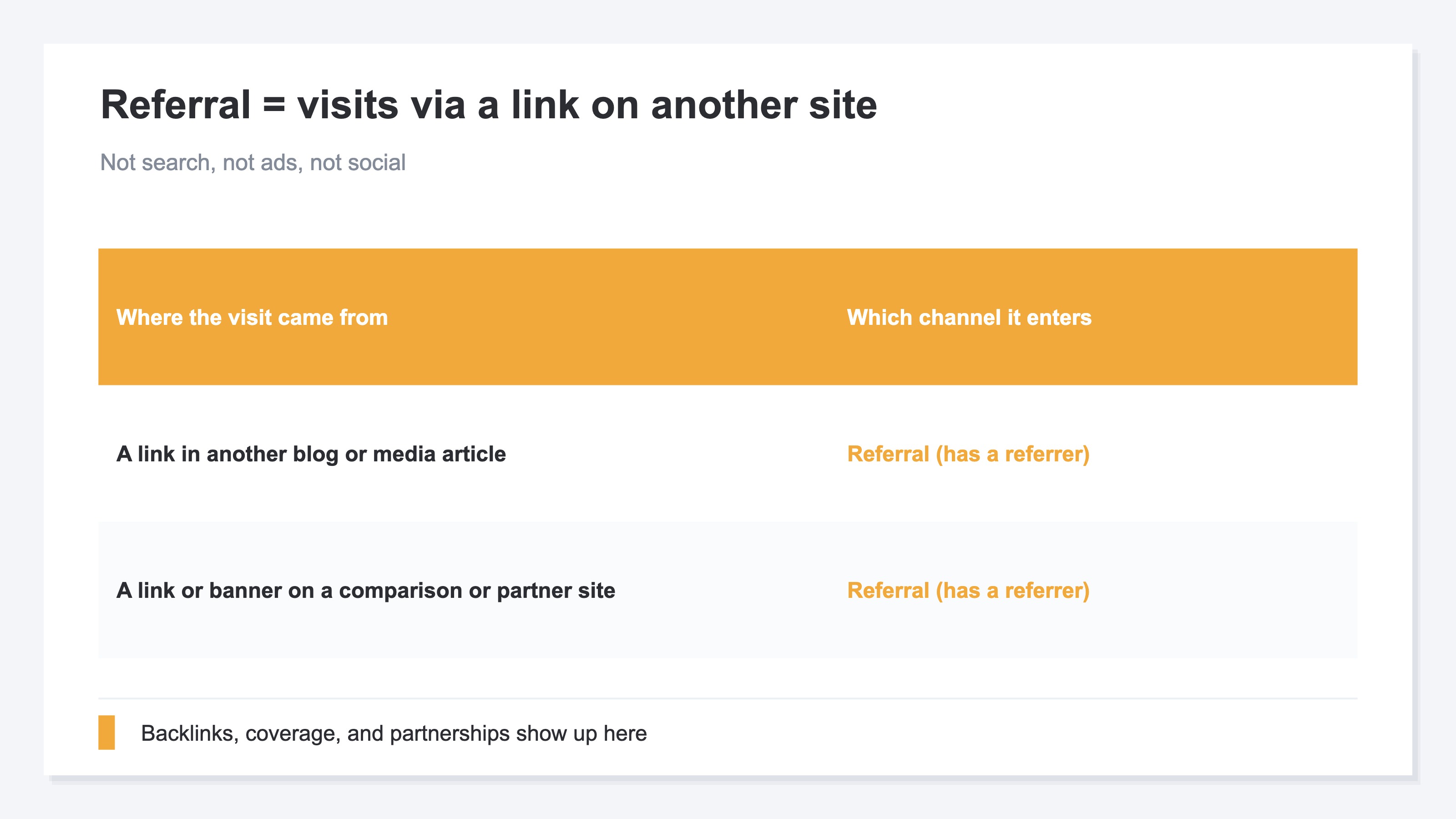
In short, referral traffic is "visits that came to your site by following a link placed on another site."
For example: some blog featured your product, and someone arrived from a link in that article. Your store was listed on a comparison site, and someone came from there. A partner site had a banner, and someone clicked it to arrive. These "visits via a link on another site" are collectively called referral traffic. "Referral" is an English word meaning "introduction" or "directing someone toward." The image is that another site is directing people toward yours.
Analytics tools (like GA4) look at where each visitor came from and sort traffic into entry points. If they came from a search engine's results page, it's organic search; from an ad link, ads—and so on. Visits that came "from a link on another site" get classified as referral. So referral isn't search, ads, or social—it's the entry point for "visits a third-party site brought you." Backlinks (links placed by others), media coverage, and the results of partnerships all show up here.
2. The differences from channels you might confuse it with#
In short, referral means only "via a link on another site," and is counted as a separate entry point from search, social, and unattributed.
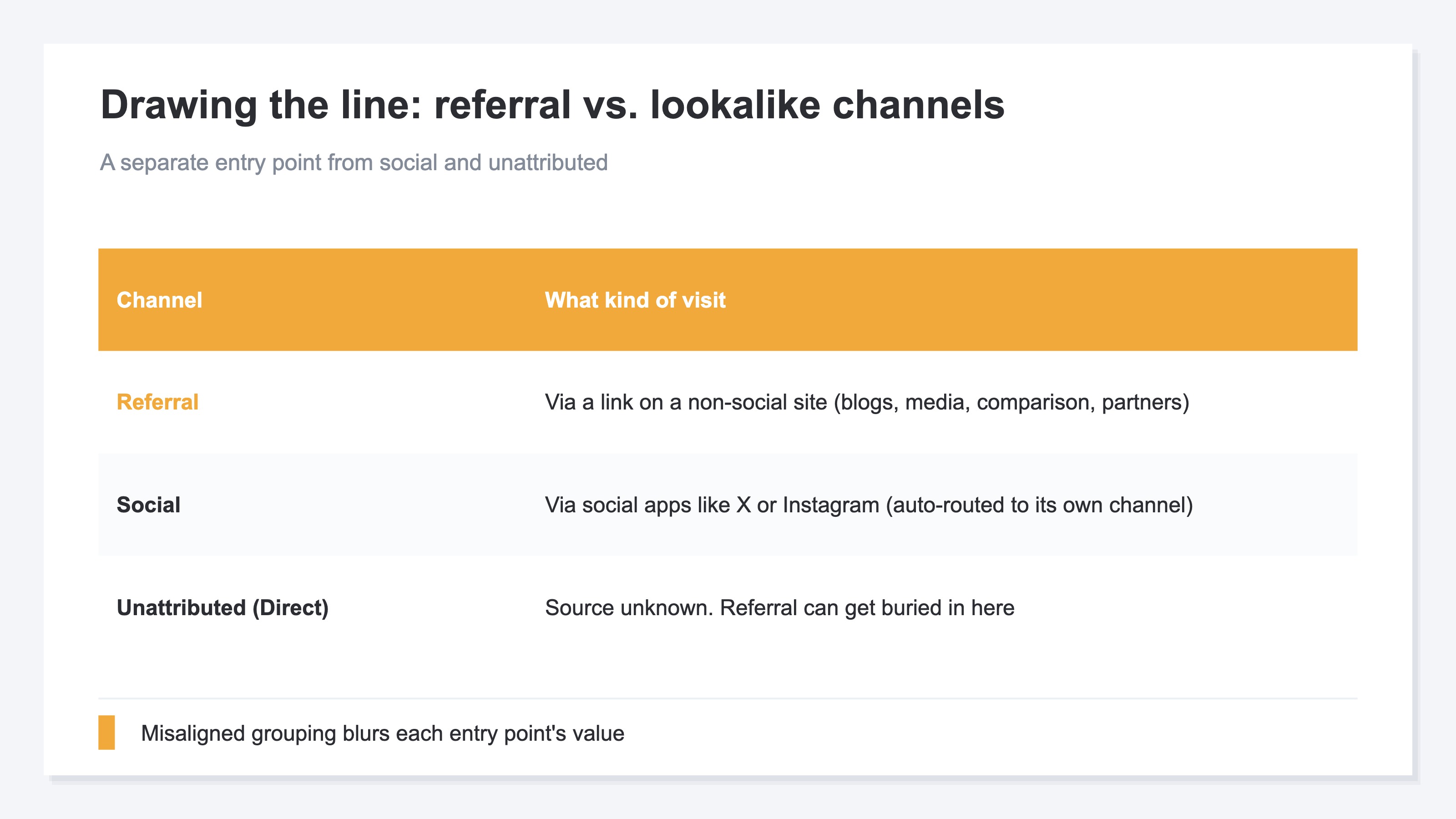
The easy one to confuse is the difference from social. Visits from social platforms like X (formerly Twitter) or Instagram are sorted not into referral but into a separate channel, "social." That's because analytics recognizes the major social platforms and automatically routes them to the social side. So links from sites other than social—personal blogs, media articles, comparison sites, partners—are what remain in referral.
One more important distinction is from unattributed (Direct, no referrer). Even when someone arrives via a link, the "where they came from" information can be lost along the way. For instance, they passed through a payment page on a different domain, or the link wasn't tagged. Then a visit that was really referral gets mixed into unattributed. This is a cause of "referral looking smaller than it is." So to read referral correctly, you need to mind whether "via another site" is being captured properly, and whether it's getting mixed into unattributed. When channel grouping isn't aligned, each entry point's value gets blurry.
3. Counting alone won't tell you the entry point's value#
In short, counting "how many came" alone won't tell you referral traffic's value. What to look at is "which referrer they came through, and how much sold."
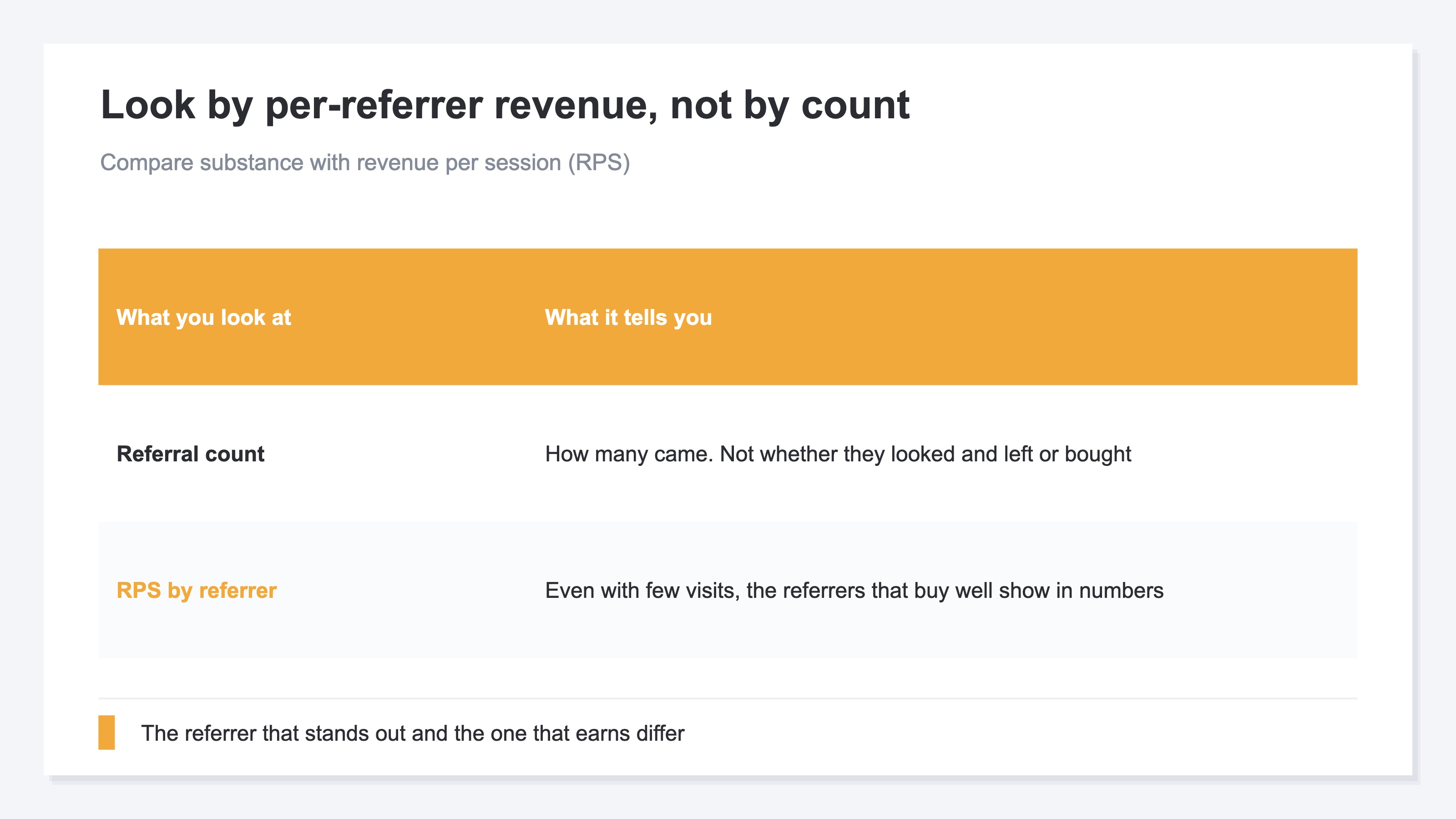
Once you know what referral is, it's tempting to count "how many referral visits came." But a count is "how many came," not "how much sold." Even with lots of visits from referral links, if most just look and leave, there's no revenue. Conversely, even with few visits, if buy-minded people are coming, that referrer might be a goldmine. Looking only at counts, you'd miss this difference.
This is where revenue per session (RPS) helps. RPS stands for Revenue Per Session—the average revenue per visit. The calculation is to divide that referrer's revenue by that referrer's session count. Look at it referrer by referrer, and you can see which sources "bring fewer but better buyers." For example, one media feature has few visits but a high RPS, while a comparison site has many visits but a low RPS. With that, the partners worth growing and the partners worth rethinking become clear through numbers, not gut feeling. Don't lump referral together as a total count—compare it referrer by referrer, on both "count" and "amount." That's the first step to making this entry point work for you.
RevenueScope — the solution
When you try to pin down referral traffic's value, you keep hitting the same wall: can you level out what got mixed into unattributed and the automated-program (bot) traffic, and then compare "which referrer earned how much" by revenue per session (RPS), over and over?
RevenueScope takes that comparison off your hands. It shows each referral source's sessions, revenue, and revenue per session (RPS) together on one screen. The figures are after excluding automated-program (bot) traffic, and revenue that didn't tie to any referrer—"unattributed"—is split out as a separate row (the figures shown are demo data).
| Referrer | Sessions | Revenue | Revenue per session (RPS) |
|---|---|---|---|
| Media A feature | 800 | ¥240,000 | ¥300 |
| Comparison site B | 2,500 | ¥250,000 | ¥100 |
| Partner blog C | 1,200 | ¥60,000 | ¥50 |
| Other referrers | 1,500 | ¥90,000 | ¥60 |
| Unattributed | — | ¥80,000 | — |
The bottom row, "Unattributed," is revenue that didn't tie to any referrer. Splitting it out as a separate row prevents each referral source's revenue from looking smaller than it really is (since it isn't tied to sessions, no revenue per session is shown).
The thing to read in this table is that count and amount are inverted. Comparison site B has the most visits (2,500), yet an RPS of ¥100. Media A's feature, meanwhile, has few visits (800) but stands out with an RPS of ¥300. In other words, "the referrer that stands out in count" and "the referrer that actually earns" are different. Looking only at counts, you might have overlooked Media A's value and overrated comparison site B. Comparing by RPS, the referrer to invest in deepening (Media A) and the one that's thin for its volume (partner blog C) separate clearly.
What RevenueScope shows is the comparison of revenue and RPS by referrer, down to the individual URL. RevenueScope specializes in pinning down, on a revenue basis, which referrer is actually earning. It levels out bots and unknown origin to line up that material, and shows you clearly—through numbers, not gut feeling—which partnerships are worth deepening.
FAQ#
Frequently asked questions#
Q. What's the difference between referral and social?
A. Referral is "via a link on a site other than social"; social is "via a social app." Visits from social platforms like X or Instagram are automatically routed by analytics into a separate channel, social. So links from non-social sites—personal blogs, media articles, comparison sites, partners—remain in referral. Both are "via another site," which makes them feel similar, but the entry points are split by whether or not it's social. Keep that in mind and you won't get confused.
Q. My referral traffic is low—should I grow it?
A. Before you decide whether to grow it, first check whether your current referral traffic is earning. Look at referral not by count (how many came) but by revenue per session (RPS). Even if it's small, a referrer that brings buy-minded people is worth deepening the relationship with. Conversely, a referrer with many visits but almost no sales won't lift revenue much even if you grow it. Rather than blindly increasing counts, finding the referrers that earn and growing those is the shortcut.
Q. Can referral get mixed into "unattributed"?
A. Yes. The common cases are passing through a payment page on a different domain, or a link not being tagged to convey its origin. Then a visit that really came via another site gets mixed into unattributed (Direct), where you can't tell where it came from. When this happens, referral looks smaller than it really is. If you want to evaluate referral correctly, mind whether unattributed is growing and whether referral is getting buried in it—and the accuracy of what you see improves.
Conclusion#
Referral traffic is visits that arrived by following a link from another site. It's one of your entry points (channels), alongside search and ads, where backlinks, media coverage, and partnership results show up. It's counted as a separate channel from social (via social apps) and unattributed (where the URL is unknown).
But referral's true value isn't visible from counting "how many came" alone. What matters is which referrer they came through and how much actually sold. Look at it through revenue per session (RPS), and you'll find that the referrer standing out in count and the one that actually earns are different things. Don't lump it together as a total count—compare it referrer by referrer, on both "count" and "amount." The partners worth growing come into view, through numbers rather than gut feeling.
See which ads actually drive revenue, at a glance
Free up to 5,000 sessions/month, AI connection included. No credit card required. Up and running in 5 minutes.


![[Research] More AI Traffic Isn't Proof It Worked: Tell the Real Gain by Revenue](/_next/image?url=%2Fimages%2Fnews%2Fai-referral-revenue-real.jpg&w=3840&q=75)