Picture an October meeting where you present July's free listings results from the monthly report you filed last month. On the Merchant Center screen in front of you, the numbers don't agree with it. Nothing available at that moment can tell you which one is right. The gap starts with a change that takes effect on August 24, 2026.
Contents
TL;DR#
- On August 24, 2026, Google changes how Merchant Center performance reports are compiled
- YouTube affiliate results move into a traffic value of their own, and the organic numbers can drop sharply, at least once
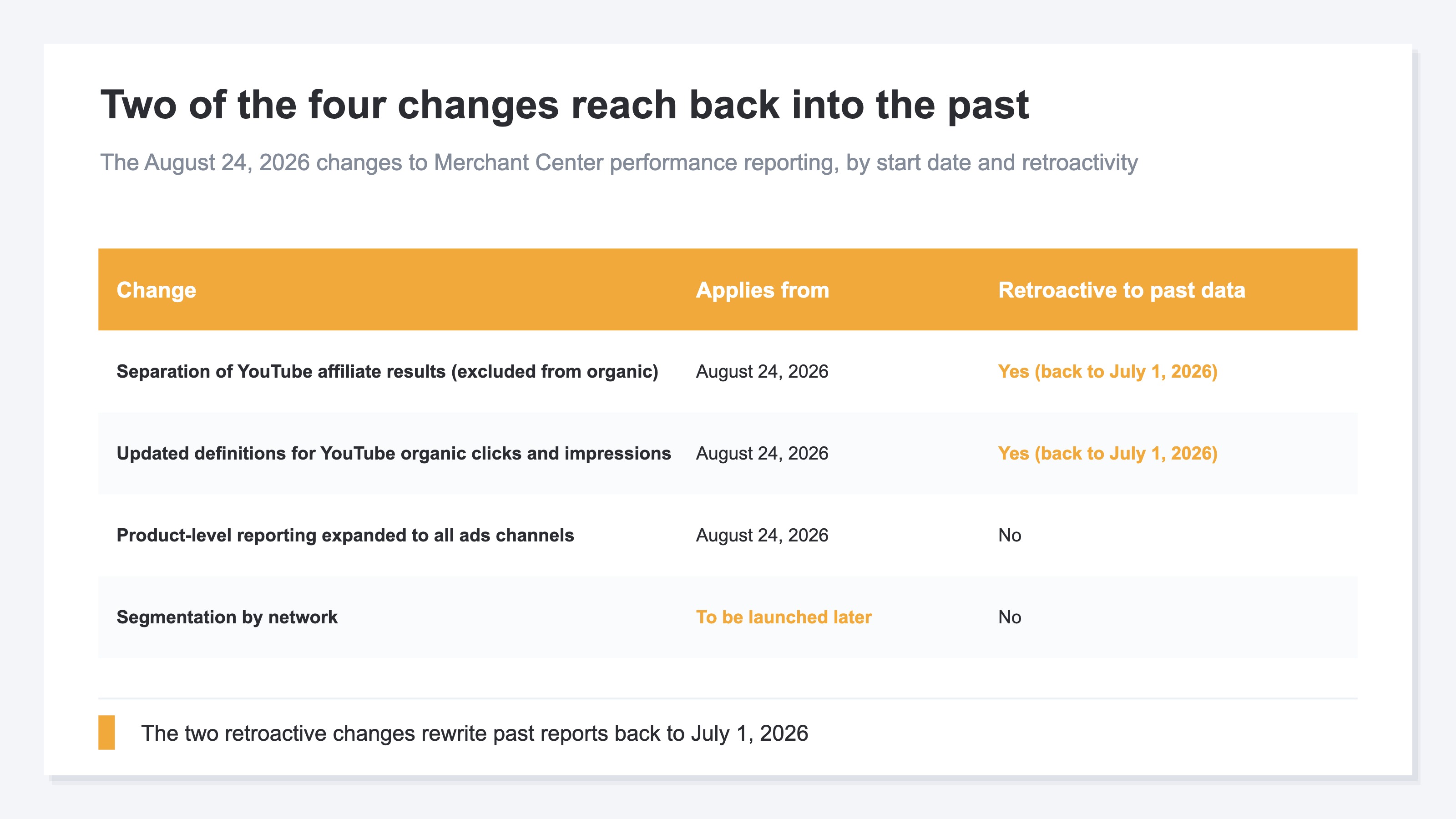
- Two of the four changes reach back to July 1, 2026 and rewrite reports that already exist
- Google's notice says nothing about keeping the pre-replacement values anywhere else, so a gap you didn't save is a gap you can't check later
- Judging a drop takes first-party landing sessions and revenue sitting next to the platform's report
1. What Changes on August 24, 2026#
On August 24, 2026, the way Google Merchant Center performance reports are compiled changes[1]. There are four changes.
- Separation of YouTube affiliate results: results for products eligible for commission are reported as a distinct interaction type, tracked under a new traffic value, "Youtube affiliate"[1]. That volume is excluded from the "Organic" value, and Google states plainly that this can cause a one-time significant drop in organic traffic[1].
- Updated YouTube organic traffic definitions: definitions for organic clicks and impressions related to YouTube traffic are aligned with established YouTube reporting standards[1]. Google states that this one-time change can also lead to a drop in reported organic traffic[1].
- Expanded product-level reporting for Google Ads: product-level reporting on the ads side expands to cover every ads channel and format[1]. That includes all networks in Performance Max campaigns, plus Video, App and Demand Gen campaigns[1].
- New segmentation by network: splitting reports by a new "Network" dimension is not part of the August 24 change. The notice says only that it is to be launched in the future for Merchant Center[1].
On the Merchant Center performance page, traffic sources are narrowed with the Traffic filter, which offers "All", "Ads" and "Organic"[3]. Free listings results are the ones you read through that filter[2]. So what changes on the inside is the very "Organic" value you have been reading as free listings performance.
The new AI exposure reporting arriving in Merchant Center (AI performance insights) is a separate matter, covered in Google moves to measure AI search exposure. This article is about the performance report for free listings that already exists, and how its numbers get compiled.
A temporary drop is behavior Google has announced in advance. The problem is that the drop doesn't stop at figures dated August 24 and later.
2. Past Data Is Rewritten Back to July 1, 2026#
Of the four changes, only two — separating YouTube affiliate results and updating the YouTube organic traffic definitions — are applied retroactively to past data[1]. They reach back to July 1, 2026[1].
Expanded product-level reporting and the new segmentation leave past data alone[1]. Even so, the two that reach back are the ones that hit monthly practice, because July and August results get compiled again under the new definitions.
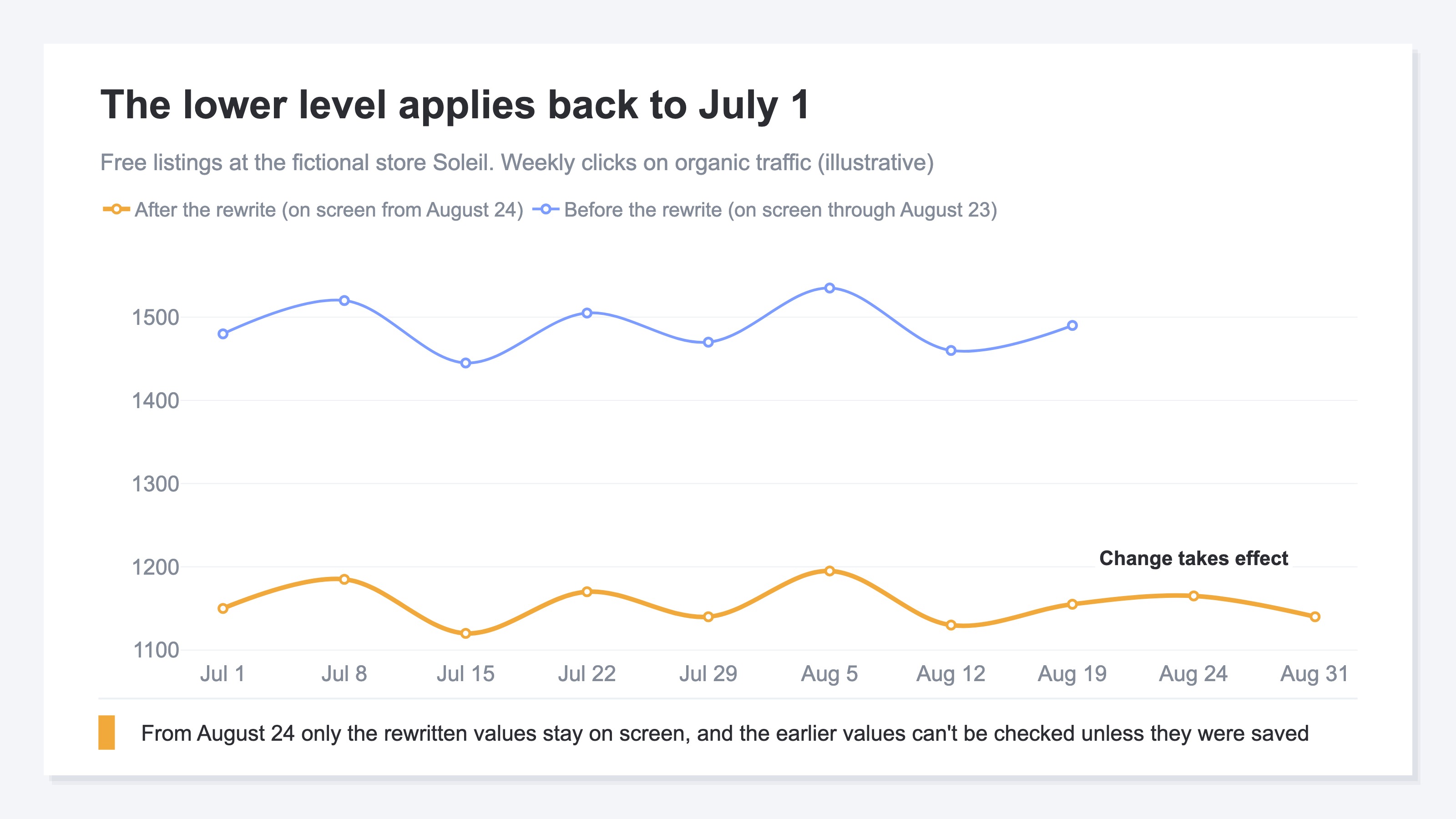
If July's monthly report has already gone out, the free listings figure written in it and the figure the screen displays from August 24 can stop agreeing. Nothing was mistyped. The definition in force when you looked it up and the definition in force when you look again are simply two different things.
The awkward part is that the only clue that a value was replaced is the value itself. What the screen shows is the result of the new definition, and Google's notice says nothing about keeping the pre-replacement value anywhere else. If you didn't save it, how large the difference was is no longer something you can check.
There is one other type of report figure that changes after the fact. The last three days of a report firm up later describes numbers that settle once processing catches up, so waiting is enough. This is the reverse: a past that was already settled stops being settled because a definition moved. A report is not a fixed record; it is a product of the definition in force at the time.
August 23 is the last day you can see numbers under the same definition you were reading in July.
3. How to Read a Number That Dropped#
There is one thing to do before August 24: keep the numbers under the current definition. Beyond that, judging a drop is not something the platform's side can close on its own.
What to save is the daily values of "Organic" traffic from July 1, 2026 onward. July 1 is where the retroactive window starts, so July 1 through August 23 is the stretch that can hold both an old-definition value and a new-definition one. This is a one-time opportunity with a deadline. Nothing published says the old-definition values can be pulled off the screen once August 24 has passed.
What saved data can tell you, though, stops at how much the definition change moved the numbers. Whether revenue past that click actually fell is something the Merchant Center report never carried in the first place. What the report holds is impressions, clicks and purchases — there is no revenue column[3]. Purchases are counted on Google's side too, on a definition that isn't the same as the sales figures you keep. The material for measuring the effect of a definition change and the material for measuring the effect on the business have to be prepared separately.
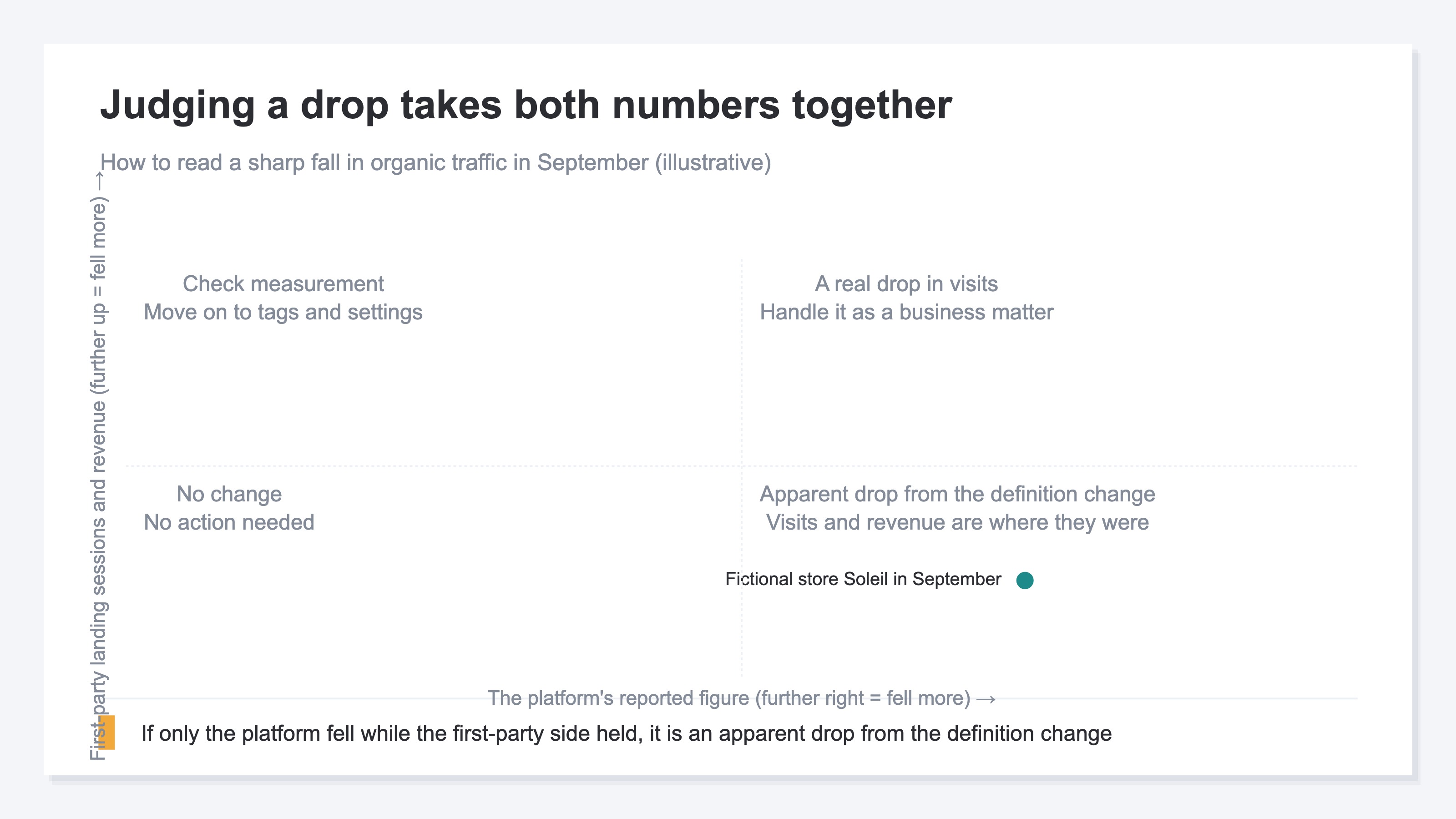
When you see "Organic" traffic fall sharply in September, the platform's numbers alone cannot tell you whether it is an apparent drop caused by the definition change or a real drop in visits. So you put first-party landing sessions and revenue next to them. If only the external number falls while your own side holds, it is an apparent drop; if both fall, it is a real one. A platform's reported figure and first-party measurement producing different numbers is the same shape covered in Google Ads clicks and GA4 sessions don't match.
This separation isn't finished after August 24. Definitions can move again. Setting the axis of verification on your own side ahead of a Google specification change is the same order of operations as in Google's AI Max comes to Shopping. The general procedure for isolating a decline is collected in Traffic down 30% year over year.
One more thing remains, and it is about what the screen shows. As long as the organic filter is open, what appears there is the figure after the exclusion has been applied. The excluded volume simply drops out of view. What is left is the smaller value, and looking at that value cannot settle why it is smaller. The reason gets confirmed by matching it against a separate record.
RevenueScope solution
What RevenueScope compiles is the sessions that landed on your own site and the revenue that followed from them. The figures come from a measurement tag placed on your own site, so a platform changing the definitions in its report leaves values already recorded untouched. The channel breakdown is shown with sessions, revenue and RPS (revenue per session).
Ask an AI assistant such as ChatGPT over MCP, "What are sessions, revenue and RPS by channel for the last 30 days?", and the answer comes back in the shape below. For the sake of explanation, it is written out with rounded figures for the fictional store Soleil.
Fictional store Soleil, breakdown by channel (illustrative)
| Channel | Sessions | Revenue | RPS |
|---|---|---|---|
| Google search | 5,000 | ¥750,000 | ¥150 |
| Google Ads | 2,000 | ¥240,000 | ¥120 |
| Direct | 1,500 | ¥210,000 | ¥140 |
| Referral | 800 | ¥60,000 | ¥75 |
| X | 50 | ¥40,000 | ¥800 |
Note: the table is a fictional example built for explanation, and the figures are rounded. The demo screen is driven by the sample store's sample data, refreshed daily, so neither the channel names nor the amounts appear there exactly as in this table.
X leads on RPS at ¥800, but it has only 50 sessions. At that size, a single larger order is enough to move RPS by hundreds of yen. There is little reason to expect ¥800 again next month, so that row is set aside when allocation is decided.
The four rows that remain are the ones to decide with. If the platform's organic number falls in September, compare the Google search row over the same period against the same table from the month before. If landing sessions and revenue hold, what fell is a compiled figure on the platform's side, and actual visits and revenue are where they were. If both fell, it is handled as a matter of the business rather than a matter of definitions. The two columns used for that judgment keep being recorded under the same definition before and after August 24.
Definitions in external reports will keep changing, with notice, and sometimes retroactively. Holding one baseline on your own side that doesn't move with them is the surest preparation for this change.
FAQ#
Frequently asked questions#
Q. Will the free listings numbers definitely fall because of the August 24, 2026 change?
A. Not definitely. What Google says can bring a temporary drop are two things: separating YouTube affiliate results and updating the YouTube organic traffic definitions[1]. How large the effect is depends on how much weight YouTube-driven results carry in the total.
Q. How far back does past data get rewritten?
A. Back to July 1, 2026[1]. The retroactive part is the separation of YouTube affiliate results and the updated YouTube organic traffic definitions; expanded product-level reporting is not applied to past data[1].
Q. Can the old-definition figures be pulled out after August 24, 2026?
A. The affected values are replaced with the new-definition ones. Google's notice says nothing about keeping the pre-replacement values anywhere else, so if a record under the old definition is needed, it has to be saved daily by August 23.
Q. Which value should I check on the performance page?
A. The "Organic" option in the Traffic filter[3]. Free listings results are read through that filter[2].
Summary#
On August 24, 2026, the way Merchant Center performance reports are compiled changes. Separating YouTube affiliate results and updating the YouTube organic traffic definitions can drive the organic numbers down sharply, at least once[1]. On top of that, those two rewrite past values back to July 1, 2026[1]. Google's notice says nothing about keeping the pre-replacement values, so if a record under the old definition is needed, it has to be saved daily by August 23.
From there, facing a number that has fallen in September or later, the test is a single one. If first-party landing sessions and revenue hold, it is an apparent drop from the definition change. If your own side has fallen too, it is a real drop in visits. Treat report figures as products of the definition in force when they were read, and make the call on first-party records that definitions cannot move.
See which ads actually drive revenue, at a glance
Free up to 2,000 sessions/month, AI connection included. No credit card required. Up and running in 5 minutes.