Would it catch your attention if Google started officially measuring how much your products show up in AI search? In 2026, AI performance insights arrive in Google Merchant Center. The catch is that it starts in five countries including the US, and Japan can't use it yet. This article lays out what the new report shows and what it doesn't, and what stores in Japan can prepare now, from the angle of connecting it through to revenue.
Contents
TL;DR#
- In 2026 Google is adding AI performance insights to Merchant Center, making the exposure of your own brand in AI search officially measurable
- It covers five countries — the US, Canada, Australia, India and New Zealand — and Japan can't use it yet
- What this official report shows stops at exposure in AI search. How much revenue came out of it is not included
- What can be prepared in Japan now is telling apart, page by page and on your own side, which of the pages with heavy AI-referred traffic also reach revenue
1. The Official New Report Shows AI Search Exposure#
Merchant Center's new report shows how much your brand is being seen in AI search. Google announced in 2026 that it is adding AI performance insights to Merchant Center[1]. Stores will be able to check for themselves how their products are found in AI Mode, AI Overviews and the Gemini app.
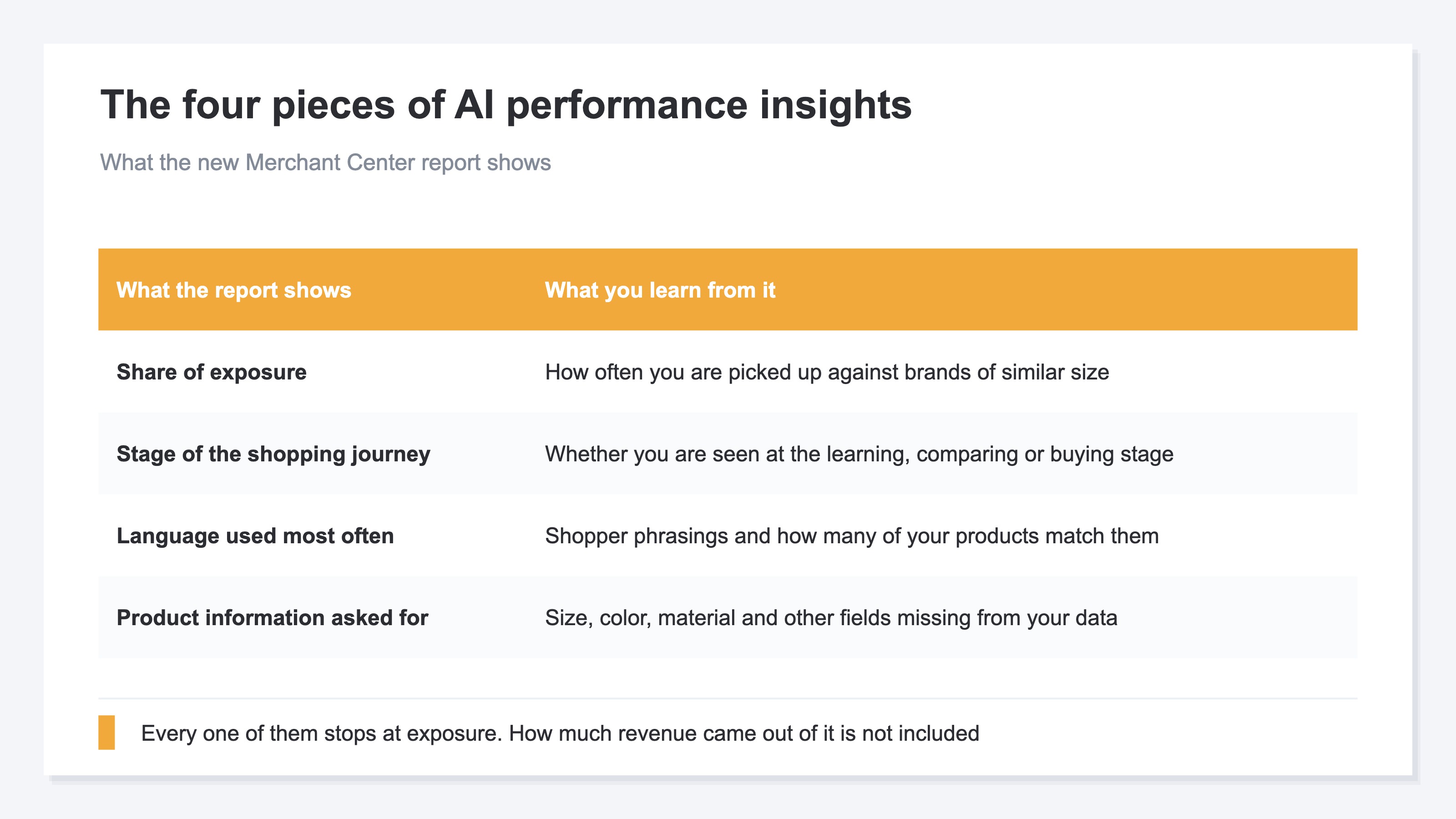
The report is built from four broad pieces. The first is share of exposure against brands of similar size. It compares how often you are picked up inside AI search answers with how often competitors are. The second is which stage of the shopping journey you are seen at. It separates the stage where shoppers learn about a product from the comparing stage and the buying stage.
The third is the language used most often in AI search. You see the feature and attribute phrasings shoppers actually use in conversation, and how many of your products match them. The fourth is the product information most often asked for. Among the items shoppers look for — size, color, material — the ones missing from your own product data become visible.
This report represents how much, and at which moments, you are exposed in AI search. Being able to confirm as official figures what has been hard to see about AI search is a real step forward.
2. Japan Isn't Covered Yet, and the Exposure Report Doesn't Show Revenue#
Useful as the report is, sites in Japan sit at two distances from it. One is where it is offered, the other is what it can show.
Start with where it is offered. AI performance insights begins in five countries: the US, Canada, Australia, India and New Zealand[2]. As of 2026 it is running experimentally on some US accounts, and no release timing has been announced for Japan. Sites in Japan are, for now, in the position of waiting for this report to arrive.
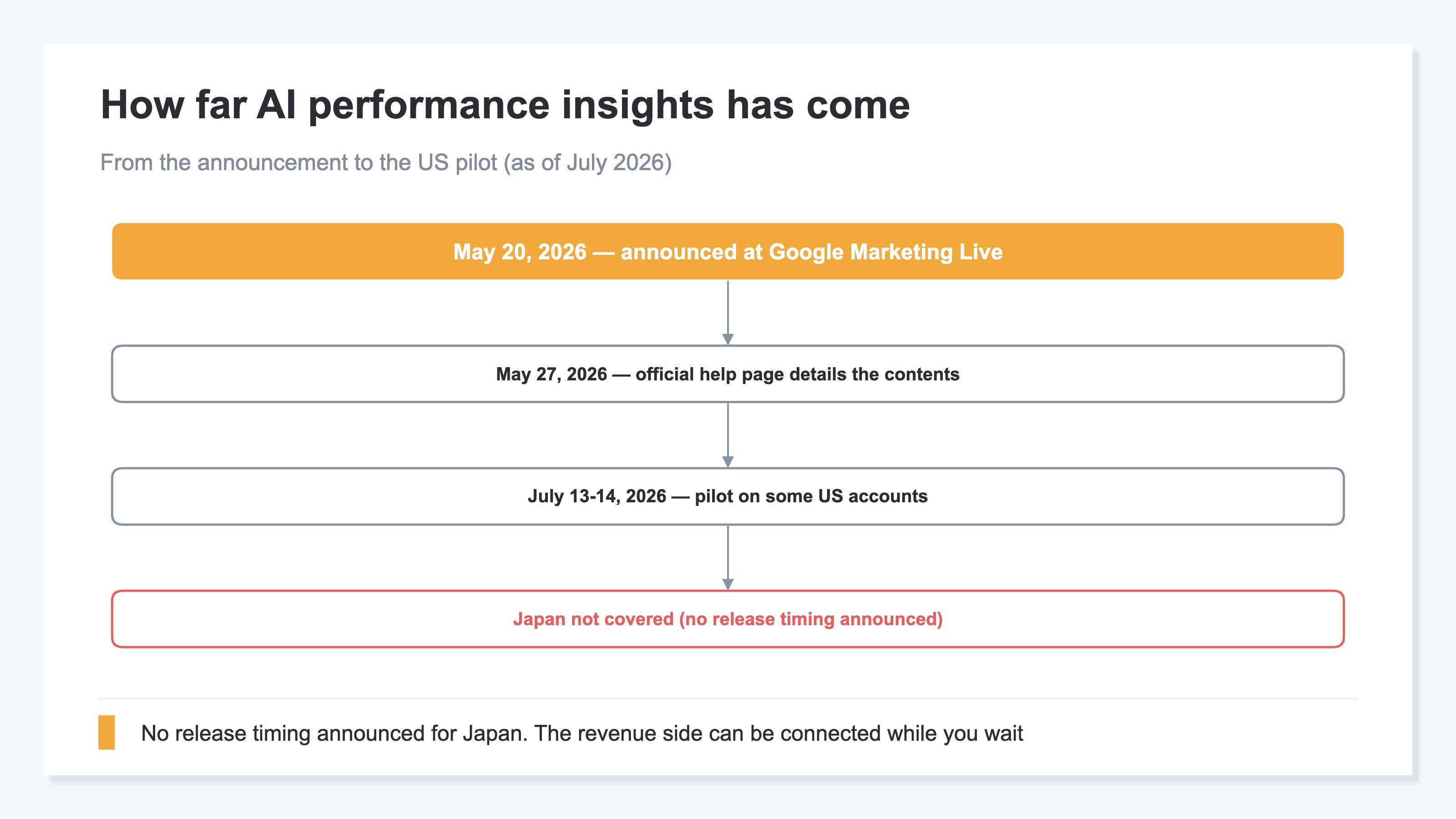
Then what it can show. What this official report shows stops at exposure and share in AI search. How much you were seen, and how that compares with competitors, you can find out. But how much revenue came out of that exposure is not included in the report. Measuring exposure and connecting it to revenue are two separate jobs.
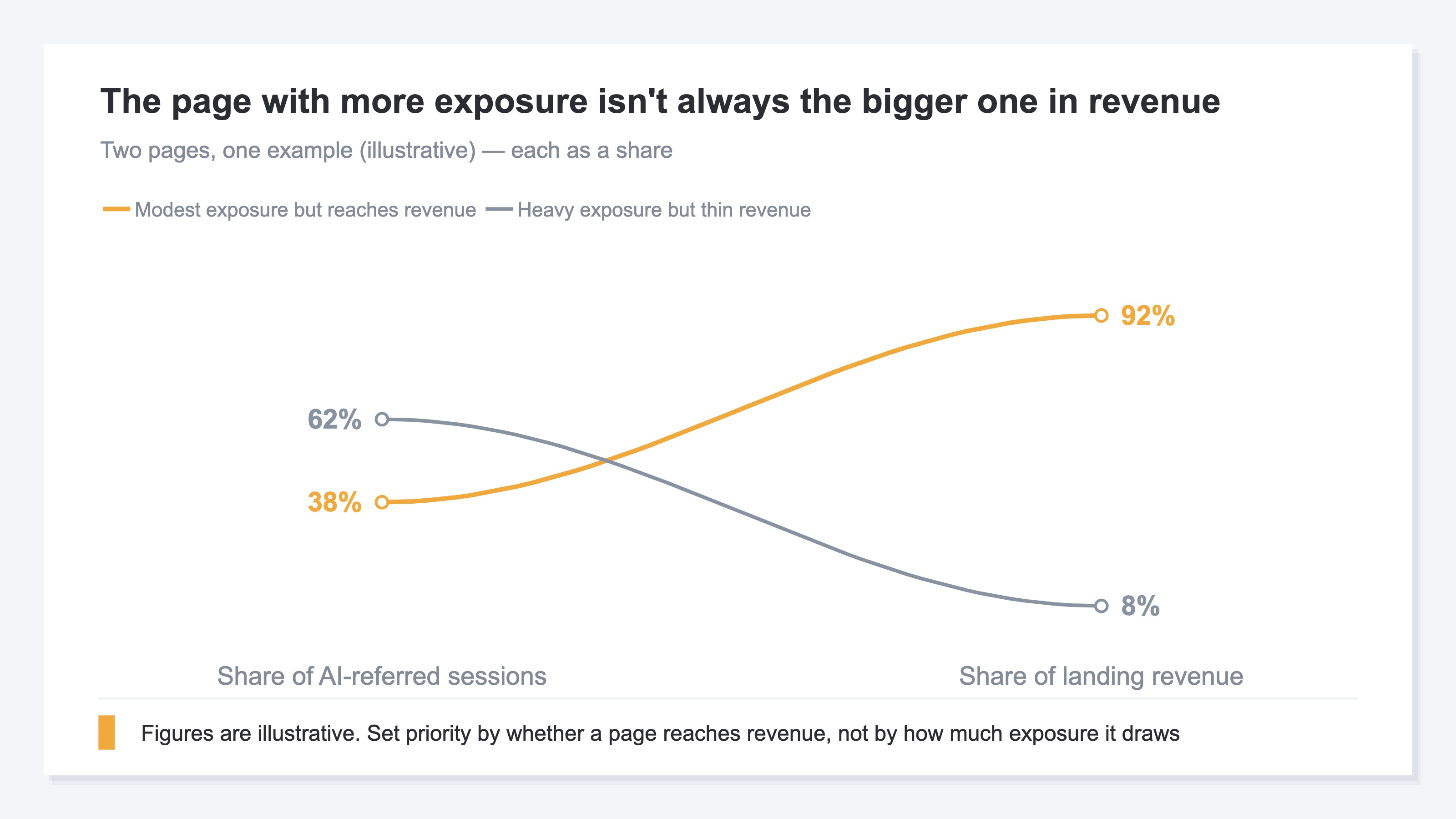
Move on exposure alone and the judgment can go wrong. A page that is exposed often in AI search does not necessarily reach revenue. The reverse happens too: pages with modest exposure that carry all the way through to purchase. The size of the exposure and the size of the revenue are not the same thing.
The movement of the clicks Google itself sends to your site is covered separately in billions of AI search clicks a week. This article is about measuring exposure in AI search, while that one is about the click volume of search as a whole. How to read exposure in AI search is also laid out in why AI search impressions read lower than expected and GSC's AI search report shows impressions, not revenue; put together, they give the full shape of exposure reporting.
3. What You Can Prepare Now Is Connecting AI Traffic to Revenue#
What sites in Japan can prepare while waiting for the official release is to start looking, from today, at pages with a lot of AI-referred traffic alongside the revenue of those pages.
There is no telling when the official exposure report reaches Japan. But traffic arriving from AI search is already happening on sites in Japan. A site gets picked up in a ChatGPT or Gemini answer, and visits follow. If you have already checked, on the pages where this traffic is heavy, whether it also reaches revenue, you can put the official report to use for a decision the moment it lands.
The point of preparing is not to stop at exposure but to follow it through to revenue in one continuous line. Seeing exposure alone does not settle which page to work on. Only once it reaches revenue does an order emerge between the pages to grow and the pages to fix. If the official side takes the exposure half, sites in Japan get stronger by having the revenue half connected first, so that both are ready together.
In terms of order, rather than waiting for exposure to arrive, starting the connection to revenue first is the realistic move. Tying AI-referred traffic through to revenue is the one move available today.
RevenueScope solution
RevenueScope displays the pages with a lot of AI-referred traffic and the landing revenue of those pages together, page by page. It separates AI-referred traffic from ChatGPT, Gemini and others by entry page, and shows that page's landing revenue (all channels combined, last-touch) alongside it.
AI-referred traffic is identified from referrer and browser information. Some AI traffic leaves no mark behind, so the figures are presented plainly as a floor. Landing revenue counts a purchase toward the page it last passed through before that purchase (last-touch). The table below shows how that reads, as one example by page.
| Page | AI-referred sessions | Main AI source | Landing revenue | vs. prior period |
|---|---|---|---|---|
| Product comparison guide | 320 | ChatGPT | ¥148,000 | +36% |
| How-to explainer page | 210 | Gemini | ¥92,400 | +18% |
| Glossary page | 180 | Perplexity | ¥0 | ±0% |
This Merchant Center AI Insights comparison is illustrative. This is how it reads on a fictional site with sample data. Landing revenue is that page's all-channel total (last-touch), not the AI-referred portion alone.
In this example, pages with similar AI-referred traffic come apart on landing revenue. The comparison guide and the explainer page reach revenue, while the glossary page gets visits but not revenue. Priority can be set not by how much AI-referred traffic a page draws, but by whether that page also reaches revenue. GA4 can follow AI-referred traffic too, but separating out the channel and lining it up with that page's landing revenue every week takes work. RevenueScope puts this on one screen by entry page.
Share of exposure against competitors is the ground that Google's official report covers. What RevenueScope can do is tell apart, page by page, which of the pages with heavy AI-referred traffic also reach revenue. While the official exposure report is still on its way to Japan, this connection to revenue can start today.
FAQ#
Frequently asked questions#
Q. Can we use Google Merchant Center's AI performance insights in Japan?
A. Not as of 2026. It covers five countries — the US, Canada, Australia, India and New Zealand — and has started experimentally on some US accounts. No release timing has been announced for Japan.
Q. Will this official report tell us the revenue that came from AI search?
A. No. What the official report shows stops at exposure and share in AI search. How much revenue that produced is not included. The connection to revenue has to be filled in by measurement on your own side.
Q. What should stores in Japan have ready before the official release?
A. On the pages with a lot of AI-referred traffic, start checking now whether they also reach revenue. Following revenue rather than exposure alone puts you in position to act the moment the official report lands.
Summary#
In 2026 Google is adding AI performance insights to Merchant Center, making the exposure of your own brand in AI search officially measurable. It covers five countries including the US, and Japan can't use it yet. And what this official report shows stops at exposure. How much revenue came out of it is not included.
What sites in Japan can prepare now is not waiting for exposure, but starting first to look at the pages with a lot of AI-referred traffic alongside the revenue of those pages. The official side takes exposure; the revenue side gets connected in-house. Have that division ready in advance and you can move straight to a decision the moment the official report lands. Start by confirming which of the pages with heavy AI-referred traffic also reach revenue.
See which ads actually drive revenue, at a glance
Free up to 5,000 sessions/month, AI analyst included. No credit card required. Up and running in 5 minutes.