The front door of search is shifting to AI. Google's results now carry AI Overviews, and the conversational AI Mode has arrived. Along with that, more people are opening Google Search Console to ask, "How often does my site actually show up in AI search?" And then the impression count turns out far lower than expected. "AI answers everything these days — is this really all?" Plenty of people have felt that gap.
Here's the conclusion first. Google Search Console impressions are an "exposure" metric that counts only when a link to your site actually appears on screen. In AI Overviews and AI Mode, your content can be used without a link ever showing — and in that case nothing is counted, so exposure looks lower than you'd expect. More importantly, neither impressions nor clicks show whether that exposure drove revenue. In this article we'll walk through how impressions are counted, and the revenue layer you should be watching outside that number, with real data.
Table of contents
TL;DR#
-
Impressions count only when a link actually appears
AI Overviews and AI Mode follow the same rule. Links in collapsed sections aren't counted until expanded, and if your content is used without a link showing, the count stays zero
-
That's why AI search exposure looks lower than expected
AI reads multiple pages and summarizes them into one answer, linking to only some of them. "Invisible exposure" — being read without showing in the numbers — occurs structurally
-
Neither impressions nor clicks show revenue impact
Exposure, visits, and revenue are separate layers. Sessions can grow while revenue stays at zero. Exposure numbers are no basis for investment decisions
-
Add a layer that shows what the AI traffic you did get contributed to revenue
Break AI-driven traffic down by source and landing page, and connect it through to revenue and RPS. Before chasing exposure, identify the pages that convert and the sources worth your focus
1. How AI search impressions are counted#
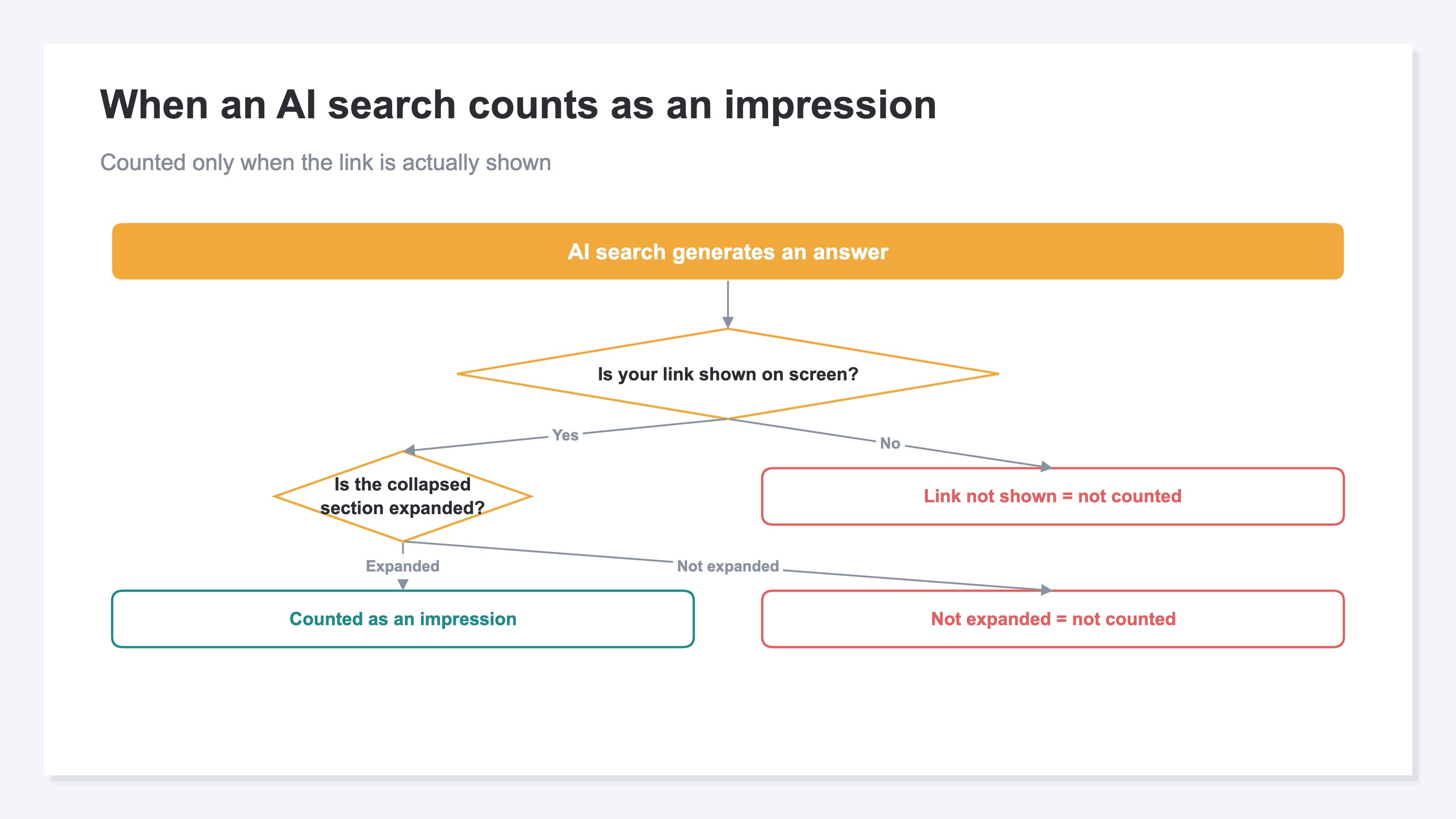
Bottom line: A Google Search Console impression is counted only when a link to your site actually appears on screen. AI Overviews and AI Mode follow the same rule. Even if AI builds its answer using your page as raw material, nothing is counted unless the link is displayed.
First, the terms. An impression is the number of times a link to your site was shown to a user in search results [2]. Google's John Mueller has explained that this principle doesn't change for AI search [1]. If your link visibly appears inside an AI Overview, that counts as one. A link sitting in a collapsed section is counted only once the user expands it. AI Mode works the same way: only when your link is displayed inside the answer.
In other words, the count hinges on one condition — "appearing on screen as a link." If AI uses your page's content in the body of its answer but no link shows, your impression count stays at zero. On top of that, AI search impressions are merged with your regular web search numbers. There's no way to isolate "just the AI portion" inside Google Search Console. We covered what GSC's AI search data fails to show on the revenue side in a separate article (The revenue blind spot in GSC's AI search report). This article stays one step earlier: how the impression number itself is counted.
2. Why impressions look lower than you expect#
Bottom line: In AI search, "your content was used, but no link was displayed" happens structurally and often. As long as the counting condition is a displayed link, felt exposure and counted impressions drift apart — and the number looks lower than you'd expect.
AI reads multiple pages and summarizes them into a single answer. It doesn't link to every page it drew on. Only some citations appear on screen; the rest sit behind a collapsed section, or never appear at all. If the user reads the answer and is satisfied, the collapsed section stays closed. Wherever the process stops, your impression count doesn't move.
This gap matches what practitioners feel on the ground. AI crawlers now read far more of your content than before. Yet almost none of that reading comes back as traffic. The old assumption of the web — publish content, and search sends visits back — is breaking down. Your pages are being read, but it shows up in neither impressions, nor traffic, nor revenue. That's the blind spot in AI search impressions.
One thing to watch here is the reflex of jumping straight to "so let's run tactics to raise impressions." Impressions are about how exposure is counted — raising the number is a separate question from whether it drove revenue. To use it for investment decisions, you need to change where you look. The next section explains why.
3. Neither impressions nor clicks show whether it drove revenue#
Bottom line: Impressions count "exposure"; clicks and sessions count "visits." More exposure, or more visits, doesn't mean more revenue. Exposure, visits, and revenue need to be viewed as separate layers.
It's obvious once you think about it. Appearing in search results earns you nothing by itself. Even a click that becomes a visit produces zero revenue if nothing is bought. Yet in practice, when impressions or sessions rise, it feels like things are "working" — and the checking often stops there. Viewed through RPS (revenue per session), the gap between that feeling and reality becomes a number (RPS basics here).
With AI-driven traffic, this gap runs especially wide. In the sample store data we'll look at shortly, AI-driven visits arrived in similar volumes — yet they split sharply between landing pages that converted to revenue and pages with traffic but zero revenue. Whether AI-driven visits produce revenue at all is something you only learn by measuring (Do AI citations actually contribute to revenue?).
The other practical wall is the breakdown. To decide where to focus, you need a by-source split: "Which AI sends the most traffic — what share is ChatGPT, what share is Perplexity?" But GA4 has no standard channel for AI sources (Caveats for GA4's AI traffic channels). Impressions only reflect exposure on Google search, and GA4 struggles to produce the breakdown. The layer that shows "did the AI traffic that arrived drive revenue?" sits wide open.
RevenueScope Solution
Bottom line: RevenueScope treats AI-driven traffic (ChatGPT, Claude, Perplexity, Gemini, Copilot) as an independent channel. It then connects that traffic — by source and by landing page — through to revenue and RPS. Its role is to add, outside the "exposure counting" that impressions represent, a layer that verifies whether the traffic that arrived drove revenue.
Here's what that actually looks like, using sample store data. Over 90 days, total AI-driven sessions came to 451.
Sample store (90 days): AI sessions and revenue by source
| AI source | Sessions | Revenue (yen) | RPS (yen) |
|---|---|---|---|
| ChatGPT | 210 | 130,633 | 622 |
| Claude | 19 | 44,384 | 2,336 |
| Perplexity | 120 | 34,974 | 291 |
| Gemini | 77 | 33,188 | 431 |
| Copilot | 25 | 9,424 | 376 |
Figures are from a fictional ecommerce store using sample data (the RevenueScope demo).
By volume, ChatGPT is the largest — but RPS changes the picture. Claude sent only 19 sessions, yet its RPS of 2,336 yen is roughly 3.8 times ChatGPT's. Perplexity sent 120 sessions, but its RPS stays at 291 yen. Exposure or traffic volume alone could never set these priorities.
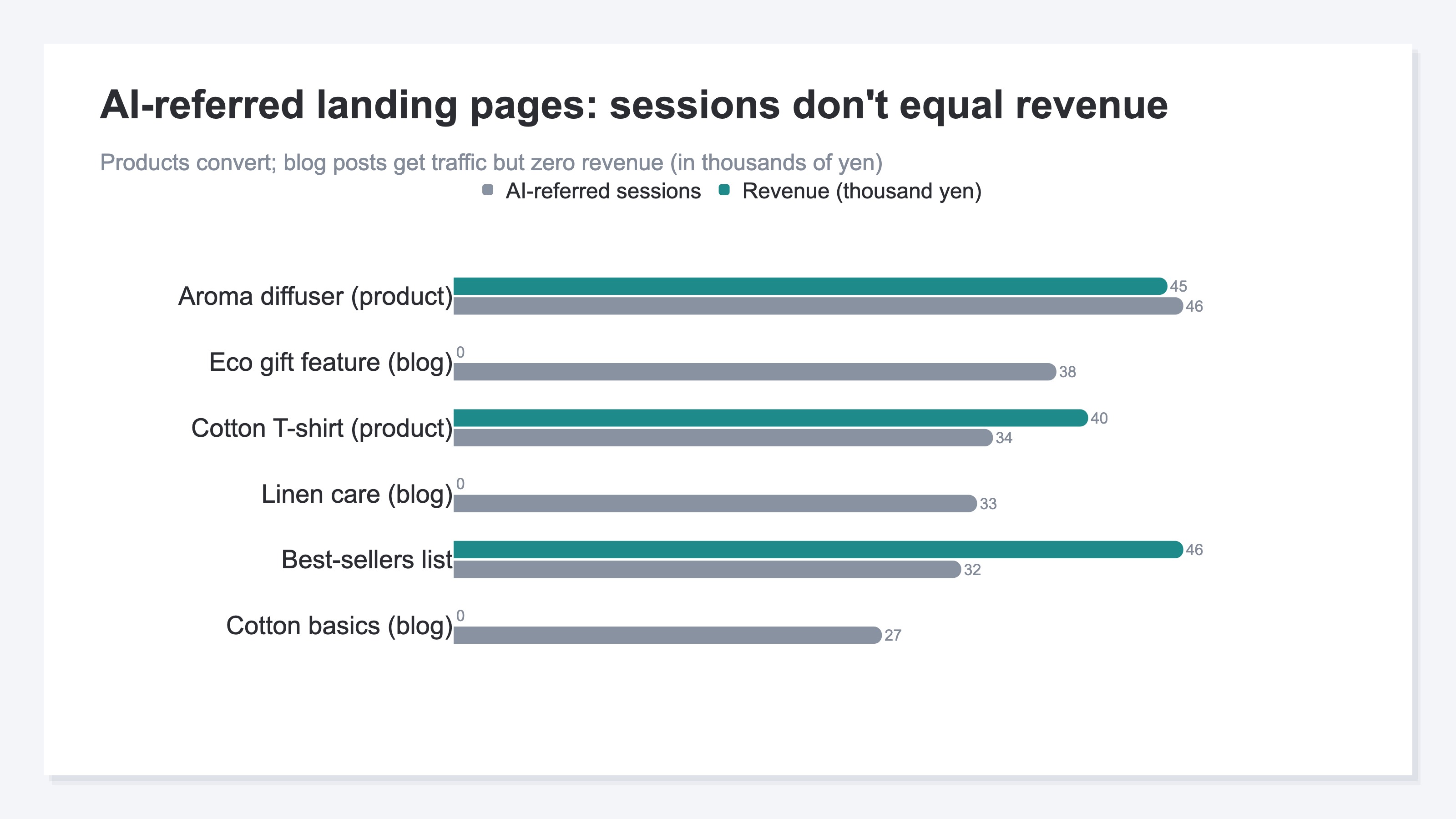
Put the daily trend lines side by side and it becomes even clearer that volume and revenue are different things. In this store's 90 days, there were repeated days where sessions jumped and revenue didn't move.
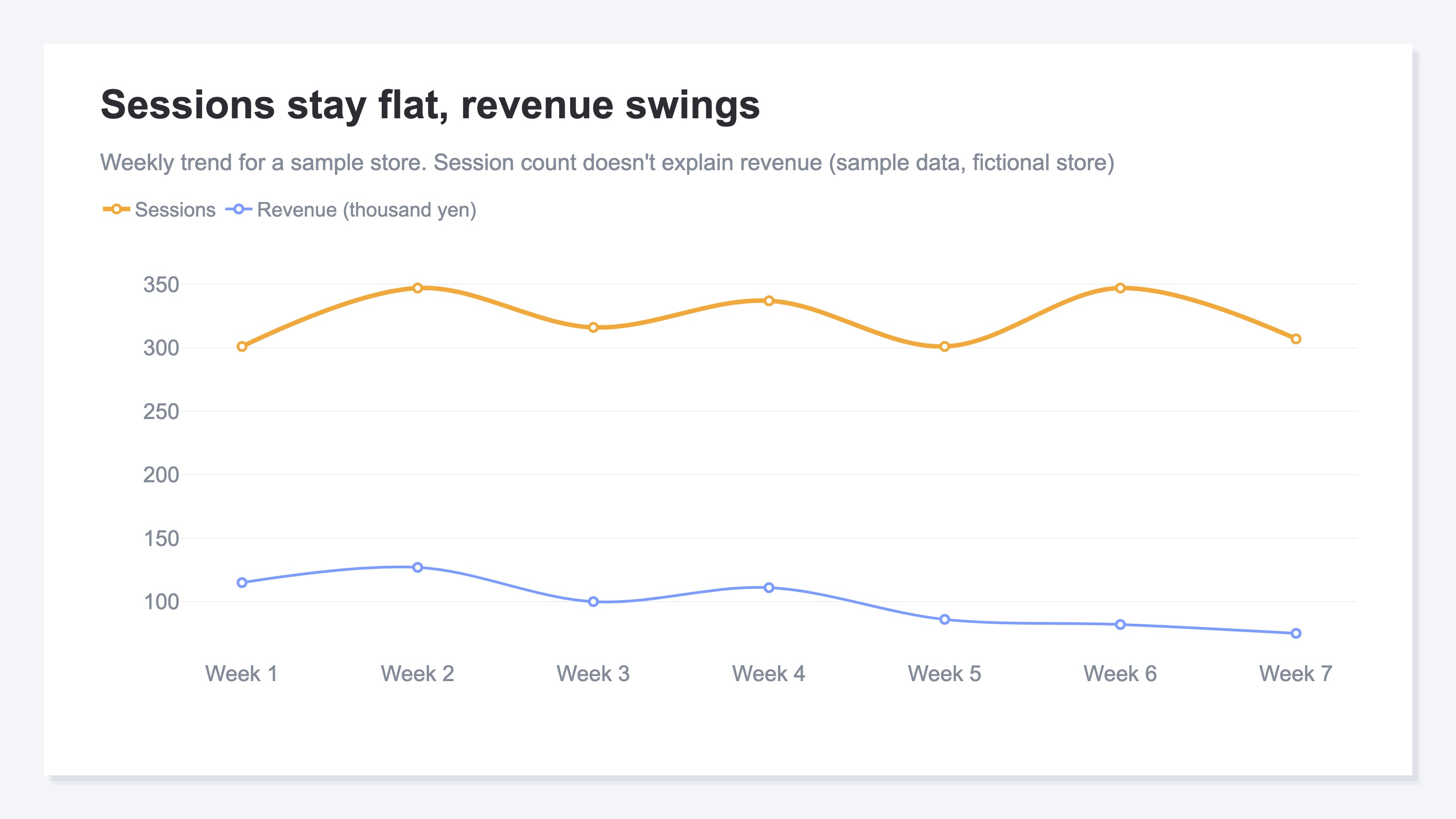
Break it down further by landing page, and the decision gets one level more concrete. Even within ChatGPT traffic, the split was stark. /products/aroma-diffuser earned 45,028 yen from 46 sessions. /products/organic-cotton-tee earned 39,760 yen from 34. /collections/best-sellers earned 45,845 yen from 32 — product and collection pages converted. Blog posts, meanwhile, drew traffic but earned zero across the board: /blog/best-eco-gifts-2026 with 38 sessions, /blog/how-to-care-for-linen with 33, /blog/organic-cotton-guide with 27 — all at zero revenue. Rather than chasing AI exposure and impressions, seeing which pages turned your AI traffic into revenue connects directly to your next move. Note that how revenue gets assigned to touchpoints carries its own trap (The last-click attribution trap).
What RevenueScope takes on is making the revenue impact of the AI traffic that arrived visible: which source it came from, which page it landed on, and how much revenue it produced — in numbers. That revenue layer, the one that sits outside the impression count, is exactly what RevenueScope specializes in.
FAQ#
Q. I'm sure my site is cited in AI Overviews, but impressions aren't rising. Why?
A. Because impressions are counted only when a link actually appears on screen. Links in collapsed sections aren't counted until expanded, and if your content is used without a link showing, the count stays at zero. "Invisible exposure" — being cited without showing in the numbers — occurs structurally.
Q. If I raise my AI search impressions, will revenue rise too?
A. Not directly. Impressions count exposure, and clicks or sessions count visits — neither guarantees revenue. The first move is to check which landing pages are turning your current AI-driven traffic into revenue, and lean into the patterns that are working.
Q. Can I see AI-driven traffic in GA4?
A. Partly. If you pick out individual AI service domains in the referrer reports, you can get a rough view of the traffic. But there's no standard channel by AI source, and visits where the AI passes no referrer can't be picked up. In practice, prioritizing the breakdown and tying it to revenue remains difficult.
Wrap-up: look past the impression count#
AI search impressions are an exposure metric, counted only when a link actually appears. In AI Overviews and AI Mode, content can be used without a link showing — nothing gets counted, and exposure looks lower than expected. But chasing that number must not become the goal. Neither impressions nor clicks show whether anything drove revenue. View exposure, visits, and revenue as separate layers: which source did the AI traffic come from, which page did it land on, and how much revenue did it produce? Only when you connect it that far can you decide, in numbers, how to work with AI search.
See which ads actually drive revenue, at a glance
Free up to 5,000 sessions/month, AI connection included. No credit card required. Up and running in 5 minutes.

![[Research] More AI Traffic Isn't Proof It Worked: Tell the Real Gain by Revenue](/_next/image?url=%2Fimages%2Fnews%2Fai-referral-revenue-real.jpg&w=3840&q=75)