"AI search isn't taking traffic away from sites. It sends billions of clicks every week." In July 2026, Google's head of search said exactly that. On the other side, outside research finds that clicks fall when an AI summary appears. Both are market-wide totals, and neither tells you whether AI-referred traffic to your own site went up or down. The only material you can decide on is your own AI-referred counts and the revenue behind them.
Contents
TL;DR#
-
Google publicly pushed back, saying AI search sends billions of clicks to websites every week (July 17, 2026)
The statement came from Nick Fox, who heads search, and answers the worry that AI search is taking traffic away
-
On the other side, outside research finds that clicks fall when an AI summary appears
In Pew Research's 2025 study, links were clicked on 8% of searches where an AI summary appeared, against 15% of searches where none did
-
Both are market-wide totals, and neither shows your own rise or fall
Billions of clicks and 8% are both industry-wide averages. Whether AI-referred traffic to your own site grew or shrank can't be read out of those averages
-
What you decide on is your own AI-referred sessions and revenue, counted by AI source and by page
How to actually look at that fourth point — putting sessions and revenue by AI source on one screen (How RevenueScope helps) — comes at the end of this article.
1. What Google's "Billions of Clicks a Week" Rebuttal Actually Says#
Google pushed back publicly with "AI search isn't taking traffic away from sites." The figure it offered as grounds is "billions of clicks a week."
On July 17, 2026, Nick Fox, who runs search at Google, posted on LinkedIn and X[1][2]. There were two points. The first: AI features in search alone send billions of clicks to websites every week. The second: search as a whole carries billions of clicks every day, and usage is growing rather than shrinking. Liz Reid, VP of Search, also shared the post[1].
Behind the statement is a worry that had been spreading as AI summaries and AI Mode became common: that AI answers the question, so clicks to sites go down. Google's rebuttal is meant to answer that worry by showing that the total volume of clicks it sends is large, not small.
There is one thing to keep in view, though. The breakdown behind that "billions" — which sites received them, on which searches — has not been published. The figure is the total of clicks Google sends across the whole web, not a split by industry or by individual company. How impressions in AI search are counted in the first place is covered in the blind spot in AI search impressions.
Before going on to the outside study, here is Google's claim, that study, and the limit both of them share.
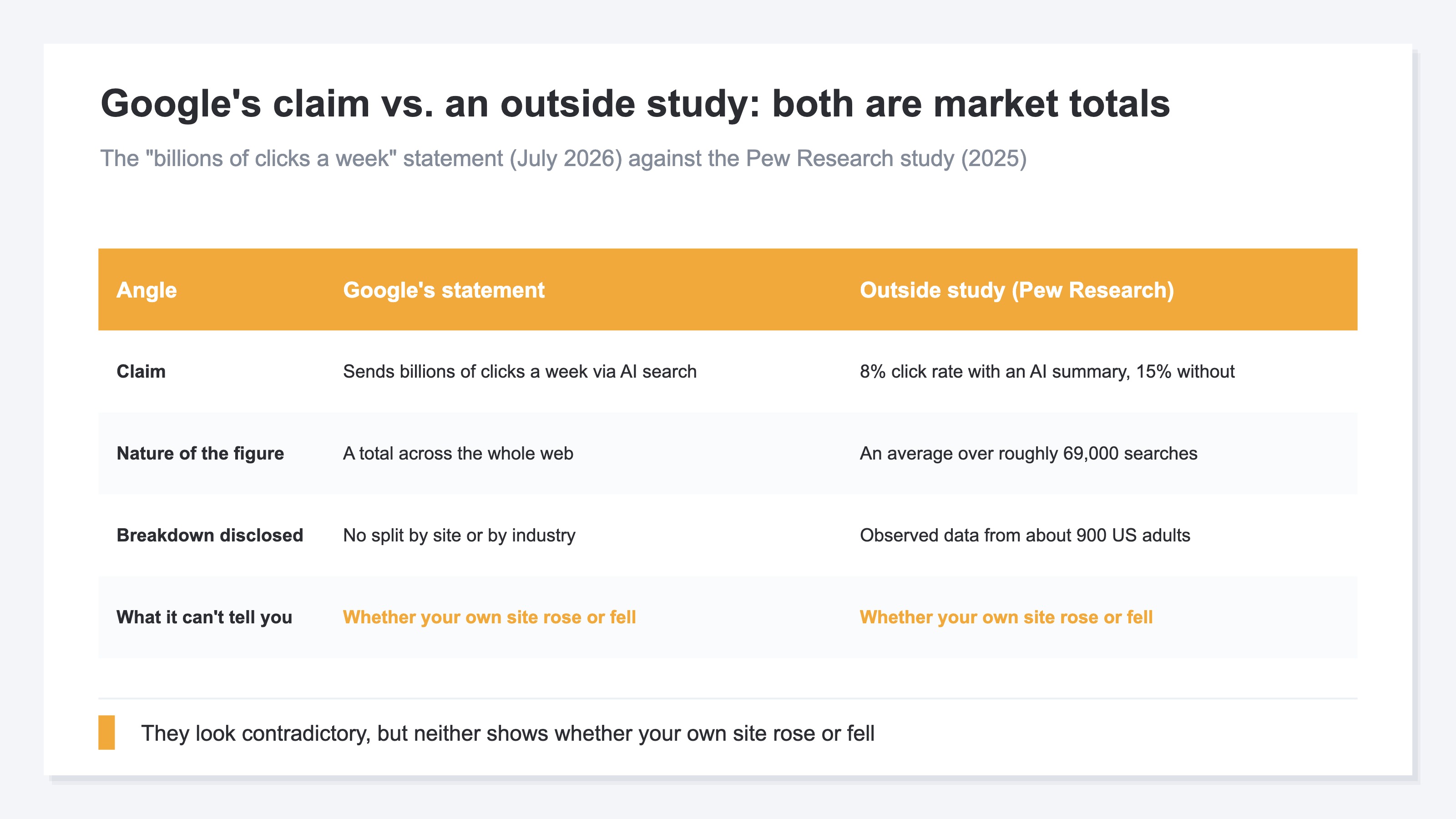
"Billions a week" sounds large. It does not, by itself, mean that AI-referred traffic to your own site is growing too.
2. An Outside Study Says the Opposite — Both Still Describe the Market Total#
There is also outside research pointing the other way from Google's claim. The two look contradictory, but each of them is only describing a market-wide aggregate.
The leading example on the other side is a study Pew Research published in 2025[3]. It analyzed roughly 69,000 searches by about 900 US adults, and found that links were clicked on 8% of searches where an AI summary appeared, against 15% of searches where none did. With a summary present, the click rate falls by roughly half. Further, the sources cited inside an AI summary were clicked on just 1% of searches.
Google says the clicks it sends number in the billions and are growing. Pew says clicks fall when an AI summary appears. Head-on, they look like a contradiction. What causes clicks to fall while the rank itself holds steady is dug into in why clicks fall while your rank holds.
What matters here is the limit both of them share. Even if both are correct, neither of these two numbers tells you whether AI-referred traffic to your own site rose or fell. Google's billions is a total across the whole web, and Pew's 8% is an average over tens of thousands of searches. Both describe an industry-wide tendency; neither describes your revenue or your traffic.
The same point — the market and the individual company are different things — is handled from the visibility side in how to measure AI brand visibility. This article is the sequel to that one, and looks not at visibility but at the actual clicks and traffic that arrived, and the revenue behind them.
3. What to Watch on Your Own Site: AI Traffic Counts and Revenue#
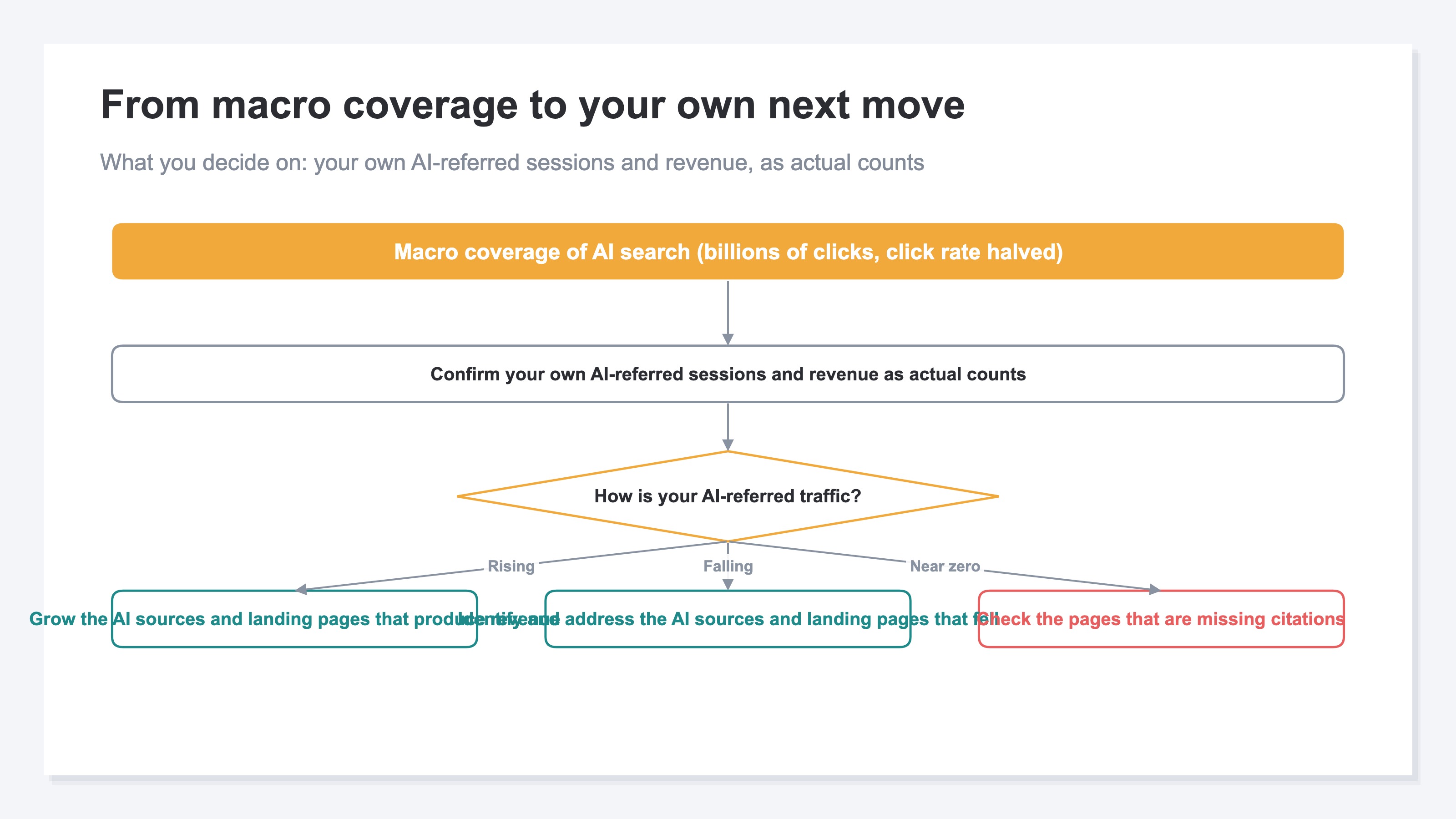
What you should be watching is not the market average but the actual count of AI-referred traffic to your own site. There are three points to look at.
First, whether your AI-referred sessions rose or fell. Second, which AI they came from. Third, how much revenue that traffic produced. On the second point, "AI" here means generative AI such as ChatGPT, Claude, Perplexity, Gemini and Copilot. Macro coverage tells you none of these three. Billions as a total, and 8% as an average, both sit on a different layer from your own three points.
As an entry point for seeing your own AI-referred traffic, GA4 added an "AI Assistant" channel (introduced in 2026). It groups visits arriving from ChatGPT or Gemini into a single category automatically. For getting a grip on how much is arriving, that helps. In the standard view, though, two chores remain. Some AI sends no referrer, which makes that portion of the traffic hard to identify (a constraint that applies to any measurement tool). And tying that traffic to how much revenue it produced means building an exploration report and matching things up by hand every time. The pitfalls of GA4's "AI Assistant" channel are covered in what to watch in GA4's AI Assistant channel. Why Google Search Console's AI search report doesn't show revenue is dug into in reading GSC's AI search report.
The task itself isn't hard. Count your AI-referred sessions by AI source and by page, and connect them through to revenue. What is hard is running it every week. The kinds of AI keep increasing, and the pages they land on keep changing over. Matching AI source against page against revenue by hand, week after week, turns into heavy work.
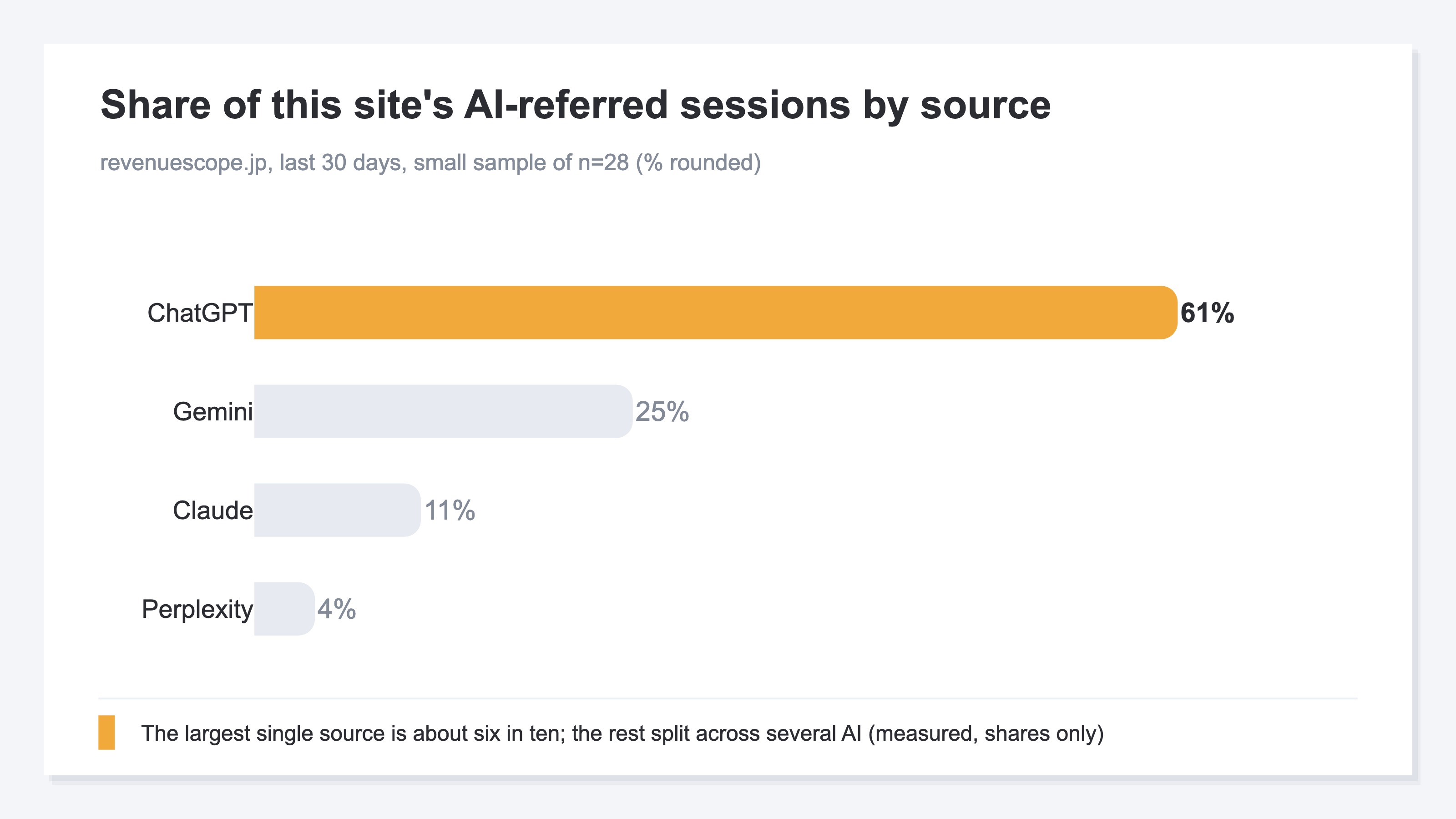
For reference, looking at AI-referred sessions on this site (revenuescope.jp) by source, the single largest one accounts for about six in ten, while the rest split across several AI. Watch only one of them and you will read the shape of the traffic wrong. That is exactly why counting your own traffic by source is the starting point.
RevenueScope solution
RevenueScope solves this state of not being able to see your own counts. It displays AI-referred traffic split by source — ChatGPT, Claude, Perplexity, Gemini, Copilot — down to the page it landed on and the revenue behind it.
A feature called get_ai_traffic displays traffic sessions from those five AI assistants, by page and by AI source. What it observes is traffic that was actually clicked through to the site. The same feature also shows AI-driven revenue, and pages that draw readers but have close to zero AI-referred traffic (candidates for missed citations). Where you actually stand — something market-wide coverage could never tell you — comes from your own site's real data.
| AI assistant | Sessions (30 days) | AI-driven revenue (30 days) | Main landing page |
|---|---|---|---|
| ChatGPT | 612 | ¥584,000 | /blog/summer-care-tips |
| Gemini | 240 | ¥612,000 | /products/brightening-lotion |
| Perplexity | 168 | ¥143,000 | /blog/spf-guide |
| Claude | 92 | ¥201,000 | /products/moisturizing-cream |
| Copilot | 61 | ¥78,000 | /products/face-wash |
An illustrative AI-referral comparison using fictional figures. The numbers model the sample store and are not a real tally.
What marks this example is that the ranking by sessions and the ranking by revenue don't come out the same. ChatGPT is first in sessions, but in revenue it is beaten by Gemini, which has less than half its sessions. That the AI producing traffic and the AI producing revenue are different things only becomes visible when the two counts sit side by side.
What RevenueScope reports is AI-referred traffic sessions and the revenue for the pages those sessions landed on (landing revenue, attributed to the entry page, after bots are excluded). Rather than guessing at the internal logic of any AI, it specializes in measuring what happened: the traffic and revenue that actually reached your site. It puts which AI sent visitors to which page, and where revenue was produced, on one screen, building the ground for choosing what to write next and what to fix from your own data rather than from the news.
FAQ#
Q1. Google says traffic isn't being taken away. Can I take that at face value?
As a market-wide aggregate, yes. The total volume of clicks Google sends across the web is large, and it is growing. Whether that total applies to your own site is a separate matter. Traffic can grow in aggregate while your own AI-referred traffic falls, and the reverse can happen too. Confirming your own AI-referred sessions and revenue as actual counts is the surest route.
Q2. Which is right, Google or the study saying AI summaries cut clicks (Pew)?
Both show a market-wide average, so this isn't a case where only one of them is right. There are searches where a summary present means fewer clicks, and there is also traffic that grows through to revenue via AI. What matters is which way your own data is moving. Aggregate figures won't show your own rise or fall.
Q3. Can AI-referred traffic be seen in GA4 alone?
Part of it. GA4 added an "AI Assistant" channel (introduced in 2026), which groups traffic from ChatGPT and Gemini together. In the standard view, though, traffic from AI that sends no referrer is hard to identify, and matching it against revenue means building an exploration report by hand every time. Keeping that going steadily every week turns into heavy operational work, and having something that aggregates this part automatically makes it easier to sustain.
Summary#
- Google publicly pushed back, saying AI search sends billions of clicks to websites every week (July 17, 2026, in a statement by Nick Fox)
- On the other side, there is outside research (Pew Research 2025) finding that clicks fall when an AI summary appears: 8% with a summary, 15% without
- Both are market-wide totals. Billions and 8% are both industry-wide averages, and neither shows whether AI-referred traffic to your own site rose or fell
- Three things to watch on your own site: whether AI-referred sessions rose or fell, which AI they came from, and how much revenue that traffic produced
- In GA4's standard view, identifying AI that sends no referrer and matching against revenue are both heavy. Look at counts by AI source and by page through to revenue, and decide your next move from there
See which ads actually drive revenue, at a glance
Free up to 5,000 sessions/month, AI analyst included. No credit card required. Up and running in 5 minutes.
References#
- [1] Search Engine Roundtable "Google: We Send Billions Of Clicks To Websites Weekly Through AI Search" (2026)
- [2] Overseas SEO News Blog "Is AI Search Really Taking Traffic Away? Google Claims It Sends Billions of Clicks Every Week" (2026)
- [3] Pew Research Center "Google users are less likely to click on links when an AI summary appears in the results" (2025)