
Have you seen a study titled "we ran 100,000 prompts and here's how brands looked in AI search," and thought about trying it yourself? So you ask ChatGPT and Claude a few times, "for [our brand], what would you recommend?" That's a fine way to feel out the market-wide temperature. But when a mid-market store tries the same trick to learn its own current standing, the answers swing every run and are disconnected from the traffic that actually reaches your site. This article separates the lens that shows the market from the lens that shows one company, and lays out the two lenses a mid-market store needs to measure its own AI brand visibility with real data.
Table of contents
TL;DR#
- Large-scale studies (100,000+ prompts) work for market-wide temperature. For one mid-market store's actual standing, that method doesn't reach.
- Ask ChatGPT or Claude the same question three times and the cited sites and the wording swing every run. On top of that, it's disconnected from the traffic that actually reaches your site.
- To measure your own standing you need two lenses: real AI-referred sessions to your site, and articles that have a real readership yet near-zero AI-referred traffic (missed AI-citation candidates).
- Neither lens can be produced by repeated prompting of a general AI. You have to reach in from the analytics side of your own site. What can be measured is clicked citation traffic; exposure that was cited but never clicked is out of scope.
- In the sample store's real data, the session-share ranking and the revenue-share ranking don't match. Look at revenue rather than volume, and the AI sources worth your attention change.
1. What repeated prompting shows you — and what it can't#
Bottom line: what repeated prompting (asking ChatGPT or Claude the same question a few times) can show you tops out at a rough feel for "would our name come up if someone asked." It isn't enough to judge where you actually stand.
Try it and you'll see: throw the same question three times and the cited sites and the reply wording change every run. Training window, chat session, and time of day all move the answer around, so one try — "we came up today" or "we didn't" — will read differently tomorrow. Large-scale 100,000-prompt studies work because they beat that swing down with sheer volume and average across the market. Running the same design as a mid-market store to measure yourself is not cost-effective.
Beyond that, repeated prompting is structurally blind to three things.
- How many sessions actually reached your site via AI (getting talked about inside an AI and getting a visitor who goes on to buy are two different things)
- Articles that should be getting cited yet get walked past (identifying pages with a real readership but near-zero AI-referred traffic)
- Per-article, per-page citation gaps (where inside your site the "gets cited / doesn't get cited" distribution sits)
In other words, repeated prompting is a lens on "how you look from inside the AI." It isn't a lens on "what's happening on your own site." You need both.
2. Two lenses that show where your own store stands#
When a mid-market store sets out to measure its own AI brand visibility, there is really one fork at the entrance: ask the AI (repeated prompting), or read your own site's data (real-data measurement). The prompting road dead-ends at a feel for "how you look from inside the AI." The real-data road branches into two lenses: the first is the AI-referred sessions actually reaching your site, the second is articles that have a real readership yet near-zero AI-referred traffic — the missed AI-citation candidates.
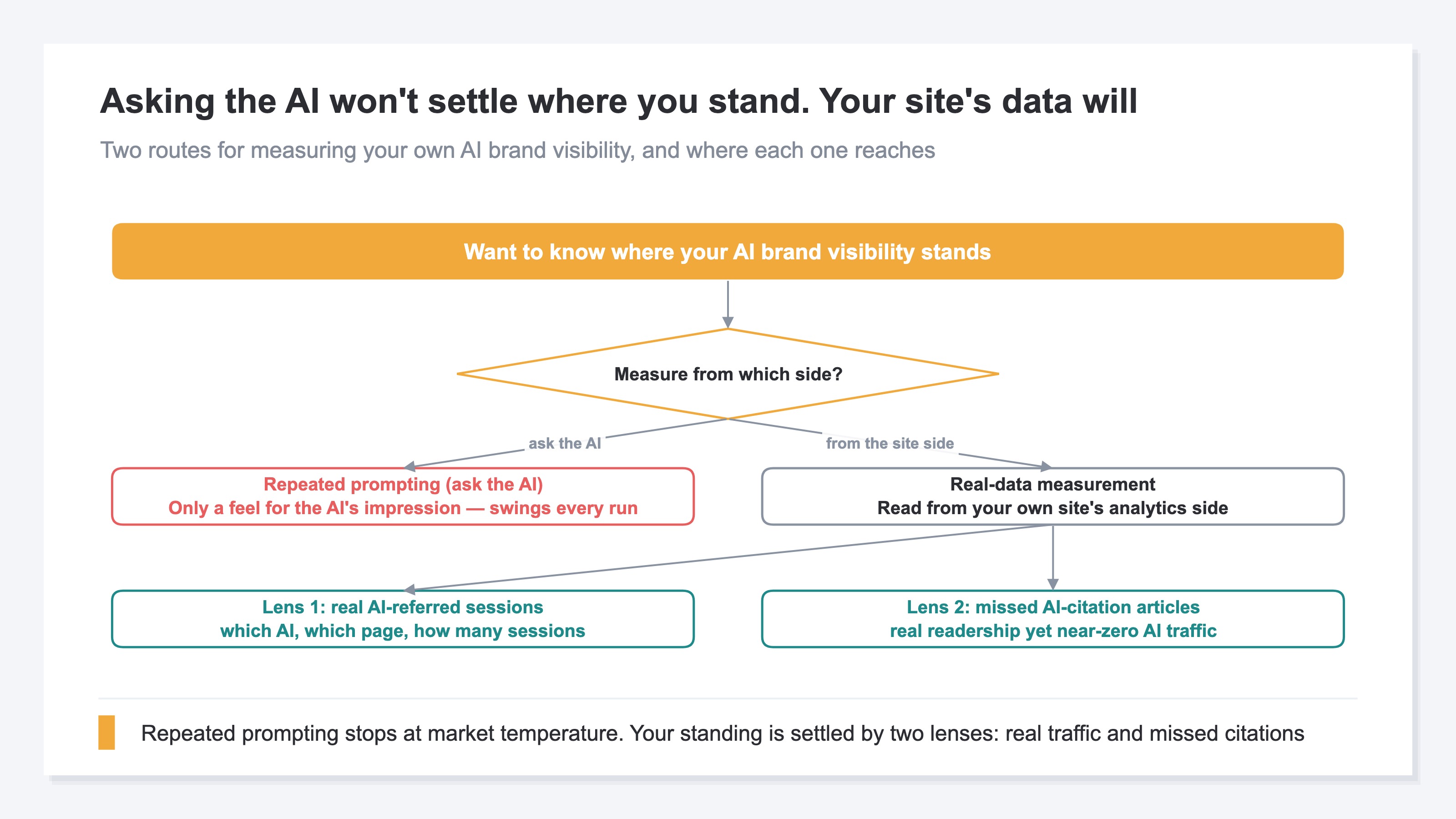
The first lens on the real-data road, real AI-referred sessions, shows you how many sessions arrive at which pages of your site from ChatGPT, Claude, Perplexity, Gemini, and Copilot — per article (page), per AI source. Once you can see this, "the topic comes up inside AI" and "visitors actually reach the site and progress toward revenue" become separable. If your name is being brought up but traffic isn't arriving, the AI is naming you without linking you. If neither is happening, you aren't in the citation candidate pool at all. Different splits, different next moves.
The second lens on the real-data road, missed AI citation, is what surfaces when you line up your articles by "the ones with a real readership yet almost zero AI-referred sessions." To be clear about the limit: what measurement can observe is clicked citation traffic only — exposure that was cited but never clicked can't itself be measured. Even so, lining up real data at the page level lifts specific articles — "should be getting cited yet got walked past" — into the candidate list. That gives you a next-priority signal for rewrites or internal-link work, from a lens SEO metrics can't produce on their own. Once both lenses are in hand, the standing that dead-ended under repeated prompting can be pinned down with real data.
3. What repeated prompting and real-data measurement actually measure#
Both go by the same phrase "AI brand visibility," but they measure different things. Judge by only one and you'll misread where you stand.
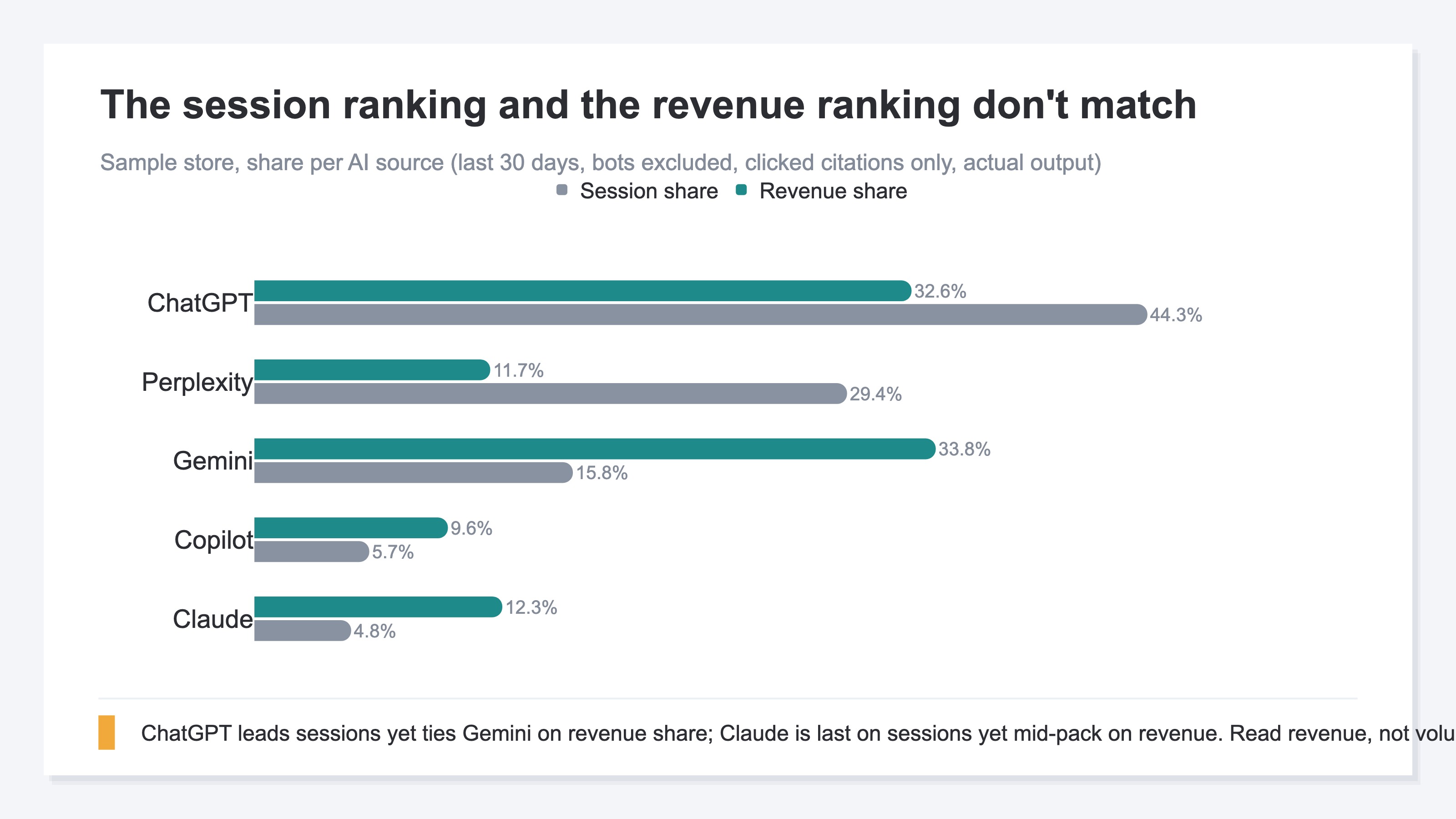
Repeated prompting takes a snapshot of the AI's answer at the moment you ask. What you can capture is "how you look from inside the AI," and it moves with the time, the session, and even the phrasing. You can even things out with enough volume for a market-wide read, but running that same design as one mid-market store is heavy going. On top of that, whether your name shows up in the AI answer and how many people actually reach your site through AI live on different layers. "Comes up but no traffic" happens, and "doesn't come up but traffic arrives" also happens.
Real-data measurement, on the other hand, reads from your own site's access logs. It identifies referrers from ChatGPT, Claude, Perplexity, Gemini, and Copilot, and counts "AI-referred sessions" per article (page), per AI source. Once that's visible, "are they actually arriving," "which AI are they coming from," and "which articles are they landing on" can be pinned down on measured data (some AI clients don't send a referrer, so it isn't fully exhaustive). The chart above is one example of that measurement: in the sample store, ChatGPT leads on session share yet sits neck-and-neck with Gemini on revenue share, while Claude, last on session share, lands mid-pack on revenue share. The volume ranking and the revenue ranking don't match — and that inversion is something repeated prompting can never show you. What repeated prompting reflects is the impression inside the AI; what real-data measurement reflects is what actually happened on your site. For a mid-market store's current standing, building on the "what happened on our site" side is less likely to lead you astray on the next move. Keep repeated prompting as a supplementary lens, only to feel out whether you're in the candidate pool for the keywords you care about. Use both lenses together to separate the market picture from your own standing. How AI-referred traffic interacts with on-site bounce is covered in The bounce-and-landing gap in AI traffic, and the JP/EN citation ratio split is in AI cites the English page more.
RevenueScope helps
By now it's clear a mid-market store needs two lenses — real AI-referred sessions and missed AI-citation articles — to see where it stands. What's left is the labor of getting both lined up yourself. Building referrer detection for ChatGPT, Claude, Perplexity, Gemini, and Copilot; excluding bots; aggregating and ranking per article — try to build all of that in GA4 and you'll spend the week wiring up exploration reports and chasing diffs. For a mid-market store's operator on a weekly cadence, that's heavy work.
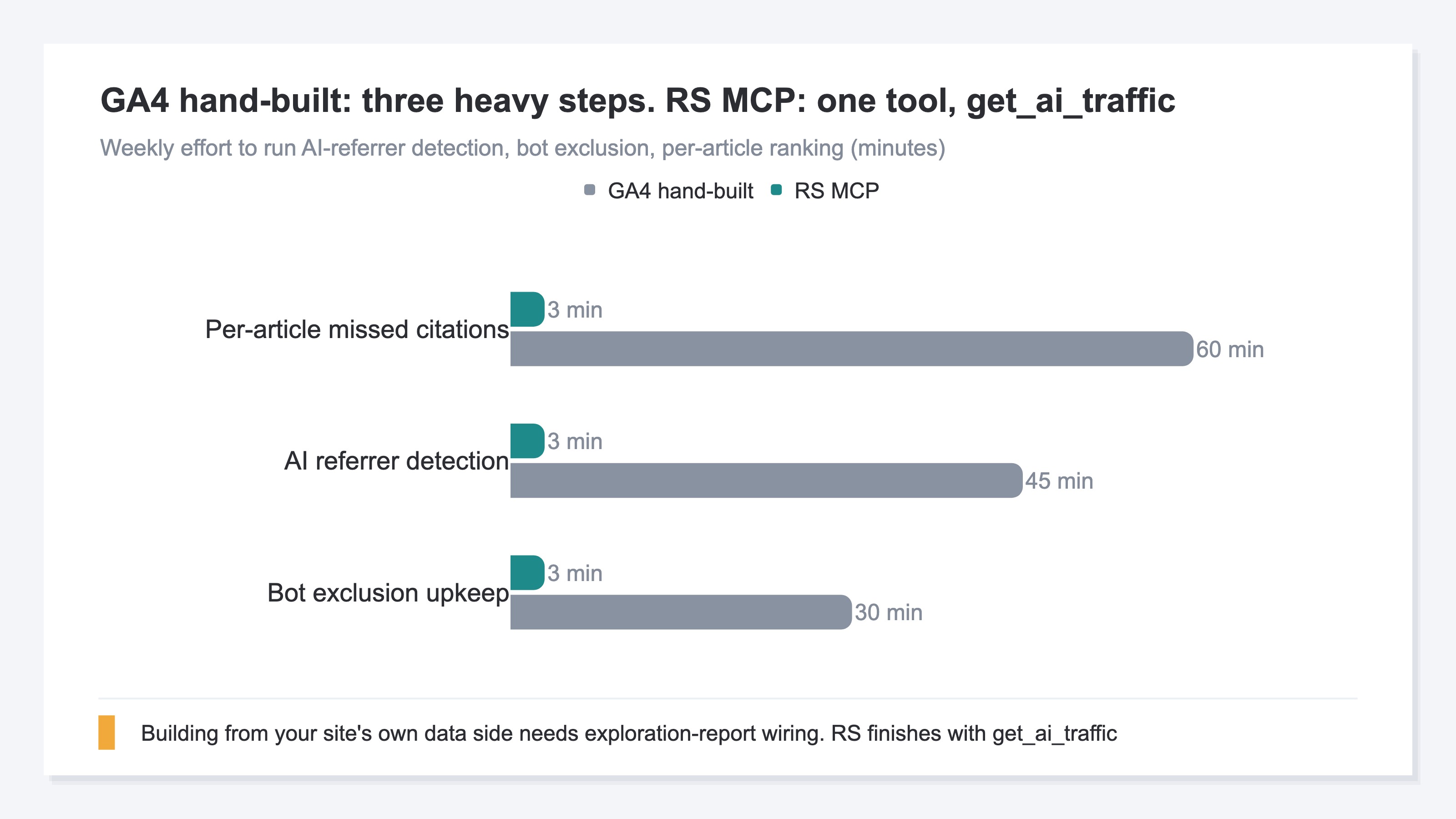
RevenueScope lines both lenses up. get_ai_traffic returns the sessions arriving from all five AI assistants — ChatGPT, Claude, Perplexity, Gemini, and Copilot — per article (page), per AI source. What it observes is clicked citation traffic — the traffic that actually reached your site. The same get_ai_traffic also carries a view that ranks articles with a real readership yet near-zero AI-referred traffic — the missed AI-citation candidates. The current standing you thought only repeated prompting could reach becomes visible from your own site's data side (figures shown are demo data).
| AI assistant | Session share (30d) | Revenue share (30d) | Main landing page |
|---|---|---|---|
| ChatGPT | 44.3% | 32.6% | /blog/best-eco-gifts-2026 |
| Perplexity | 29.4% | 11.7% | /products/organic-cotton-tee |
| Gemini | 15.8% | 33.8% | /products/organic-cotton-tee |
| Copilot | 5.7% | 9.6% | /blog/how-to-care-for-linen |
| Claude | 4.8% | 12.3% | /products/aroma-diffuser |
Actual output from the sample store (a fictional site with sample data). Shares are each source's portion of total AI-referred sessions and total AI-referred landing revenue
What to look at in this table is that the session-share ranking and the revenue-share ranking don't match. ChatGPT is the largest on sessions, yet on revenue share it's neck-and-neck with Gemini. Claude is last on sessions, yet lands mid-pack on revenue share. Which AI source carries volume and which one connects to revenue only becomes visible when you put the two columns of real data side by side.
What RevenueScope gives you is AI-referred sessions and per-article landing revenue (landing revenue is credited to the entry page — all channels, bots excluded). Rather than guessing at how a generative AI internally decided to name you, RevenueScope specializes in measuring what actually happened: the traffic and revenue that reached your own site. It lines up that real data — which AI brought visitors to which page, and where revenue landed — on one screen, giving you the foundation to choose what to write next and where to fix from where you actually stand.
FAQ#
Frequently asked questions#
Q. If I ask ChatGPT my brand name 10 times and it comes up 7, can I say "we have exposure"?
A. As market-wide temperature it's a useful hint, but it isn't enough to judge your own current standing. The answers move with the time window, the session, and the phrasing, so next week the numbers will look different. More importantly, whether your name came up in the AI's answer and how many sessions actually reached your site via AI are on different layers. "Came up 7 times but zero AI-referred sessions this month" is a real possibility. Repeated prompting is a lens on the impression inside the AI; real-data measurement is a lens on what actually happened on your site. Keeping them separate is safer.
Q. Can I count AI-referred sessions in GA4?
A. Source/medium in GA4 can pick some of them up, but some AI clients don't send a referrer, and it's easy to get tangled up with bot detection. Producing "how many sessions came from ChatGPT, Claude, Perplexity, Gemini, and Copilot in the last 30 days, and which articles they landed on" every week reliably means building exploration reports and maintaining bot-exclusion conditions. For a mid-market store's operator on a weekly cadence, that's heavy work; if you want to avoid the weight, you need something that aggregates from your site's own access logs automatically.
Q. How do I find articles missed by AI citation?
A. Line up articles that "look like citation candidates from an AI's view but bring almost zero AI-referred sessions." A hint is: articles with similar per-article impressions and search rank, where one has strikingly fewer AI-referred sessions than the others. Joining Google Search Console and your site's access logs at the article level surfaces "gets exposure but gets walked past" pages. That becomes your next-priority signal for rewrites or internal-link work.
Summary#
Large-scale studies show you the market-wide average — they don't measure one mid-market store's current standing. Repeated prompting is a lens on "how you look from inside the AI." Real-data measurement is a lens on "what actually happened on your own site." They reflect different things.
To measure where a mid-market store stands, you need two lenses. One is real AI-referred sessions (how many sessions from which AI, to which pages). The other is missed AI-citation articles (articles with a real readership yet almost zero AI-referred traffic). Neither can be produced structurally by repeated prompting of a general AI — you have to reach in from your own site's analytics side.
Keep repeated prompting as a supplementary lens, narrowed to a feel for whether you're in the citation pool for the keywords you care about. Build the foundation on real-data measurement. Separate the market lens from your own lens and you can pick what to write next, or what to fix, from the real data of where you actually stand rather than gut feel.
See which ads actually drive revenue, at a glance
Free up to 2,000 sessions/month, AI connection included. No credit card required. Up and running in 5 minutes.




![[Research] How Visible Is Your Brand in AI Search? You Can Measure It](/_next/image?url=%2Fimages%2Fnews%2Fai-search-brand-visibility.jpg&w=3840&q=75)