At RevenueScope we publish every article in both Japanese and English. When we measured 90 days of AI traffic on our own site, an unexpected gap showed up. The traffic that AI (ChatGPT, Claude, and others) cited and sent our way was far larger for the English version than for the Japanese one. Same company, near-identical content — so why did the citations tilt toward English? And when we looked closer, it wasn't the simple story of "English just wins." This article walks through, in order, how AI citations split by language version, and how reading that split lets you decide where to put your GEO (building a site that AI is more likely to cite in its answers) investment.
Table of contents
TL;DR#
- Measuring 90 days of AI traffic across our own JP/EN site, the traffic AI cited and sent us was heavily tilted to the English version — roughly 2.7x the Japanese version.
- But "English just wins" isn't right. On some articles the Japanese version was cited more, so citations split by language.
- Which AI sent the visit differed by language too. The English version was almost all ChatGPT, while Japanese lifted the share of Gemini and Copilot.
- So GEO isn't a coin flip between "thicken the English" and "chase the missed Japanese." The realistic move is to read landing page × language × AI source actuals and allocate from there.
1. Across a JP/EN site, AI cited the English version more#
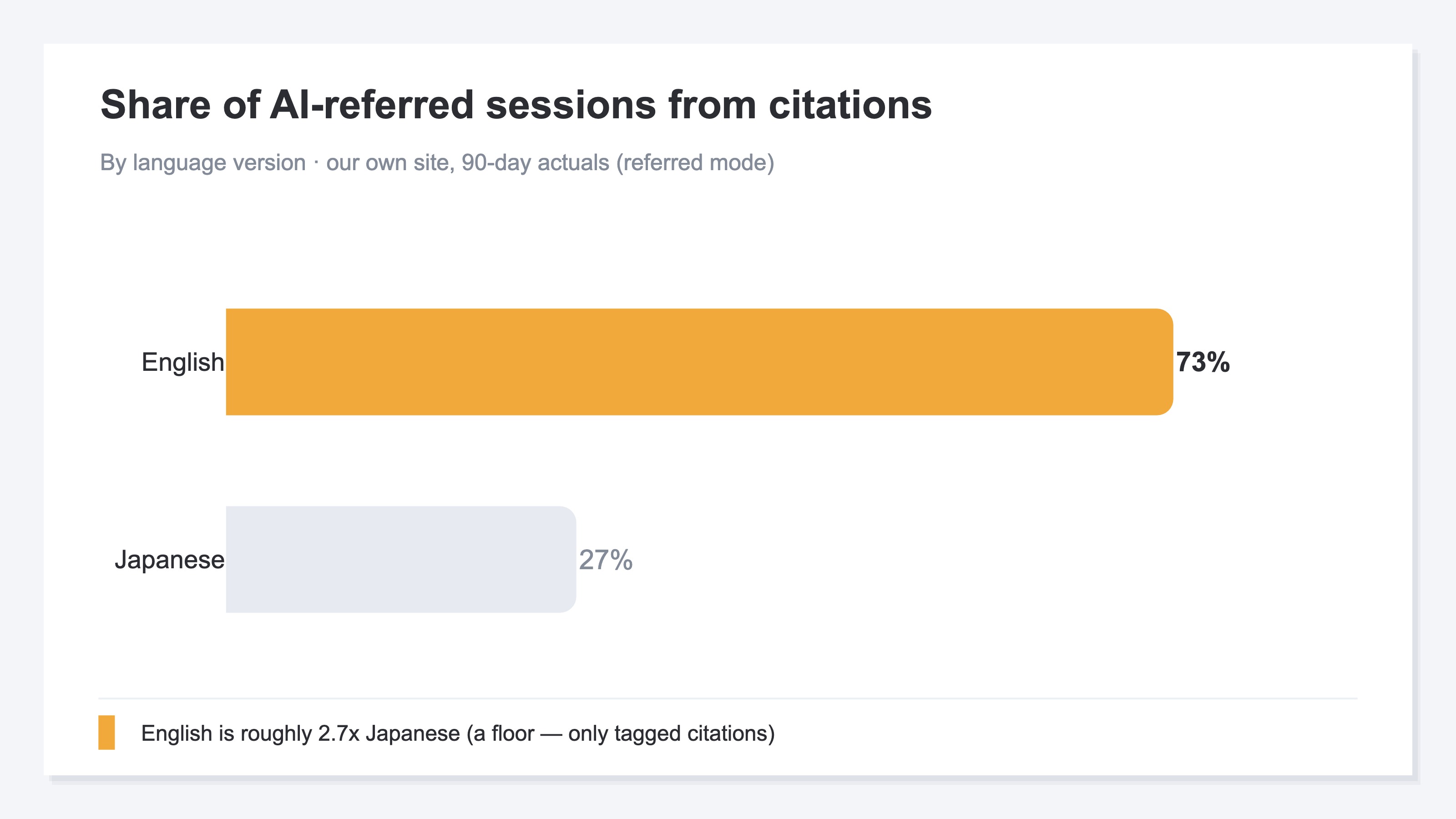
The bottom line first: on our site, the traffic AI cited and sent us was heavily tilted to the English version. In numbers, over 90 days the English version's share of AI-referred sessions was roughly 2.7x the Japanese version's. The number of pages that earned any citation split too — English pages outnumbered Japanese pages by roughly 2 to 1.
The likely reason for the English tilt is that the ground AI stands on when it assembles an answer is thicker in English. AI learns from a huge volume of text and also gathers information through search to build its reply. Both that training and the way information pools are larger in English. So even for the same content, text written in English rises more easily into the pool of citation candidates. For an e-commerce operator, that raises a fair question: "We aren't targeting English-speaking readers, so why prepare an English version at all?" That comes down to whether you view your site as being for humans only, or also set it up on the assumption that AI agents will read it. We dig into that in A store for humans, or for AI agents? Designing EC for what's coming.
Note that this figure covers the AI traffic we could confirm — the visits where a source tag was attached. AI assistants don't always attach one, so read this as a floor: the real AI traffic is at least this level. Even at that floor, a gap this size between the English and Japanese versions is a trend you can't ignore.
2. Even for the same article, citations split by language#
That said, "English just wins" isn't the whole picture. On some articles, the Japanese version was cited more.
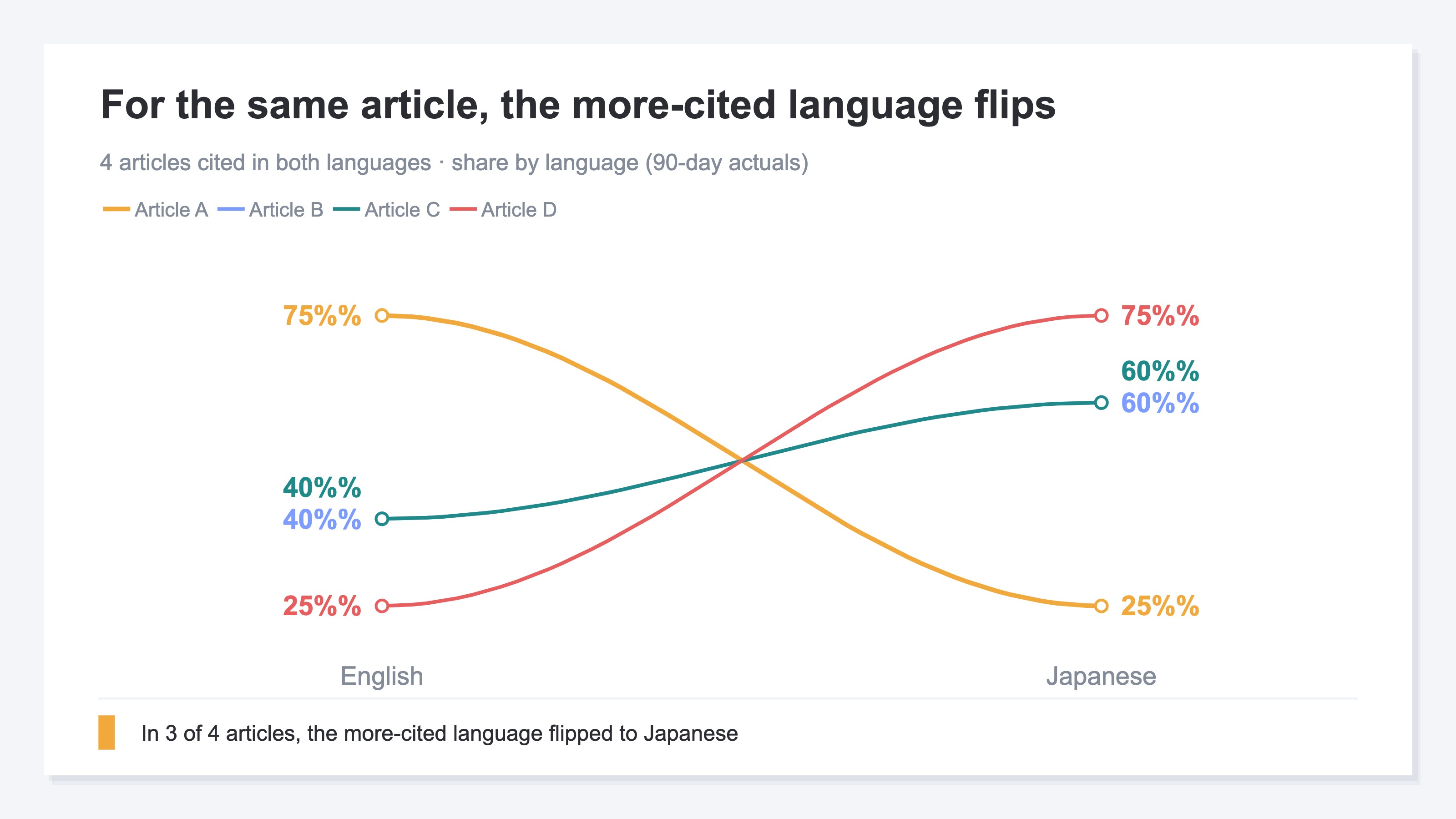
The figure above takes four articles that both language versions were cited for and compares the share of sessions by language. Article A (the cause of GA4's "Direct") led with the English version, roughly 3 to 1. But the other three flip. Article B (ROAS benchmark by industry), Article C (ROAS complete guide), and Article D (GA4 utilization wall) were each cited more in Japanese. In three of the four, the leading language version swapped.
What this tells us is that the citation tilt isn't settled by a single yardstick called "language version." Depending on the theme — and on which language that topic is more searched and discussed in — the language version that gets cited changes. A topic like GA4's Direct, widely discussed in the English-speaking world, gets the English version picked up; a topic Japanese readers wrestle with concretely gets the Japanese version picked up. So it isn't "thicken the English and you win" — the winning language version differs page by page. Because AI answers cite only a handful of sources, it's worth watching, at the page level, which language version made it into the cited set. We lay out this way of thinking in How your brand shows up in AI search: the conditions for being cited.
3. Different AIs tilt the citations differently#
There's more: which AI did the citing also differed by language. Even for the same traffic, the lineup of source AIs changes between the English and Japanese versions.
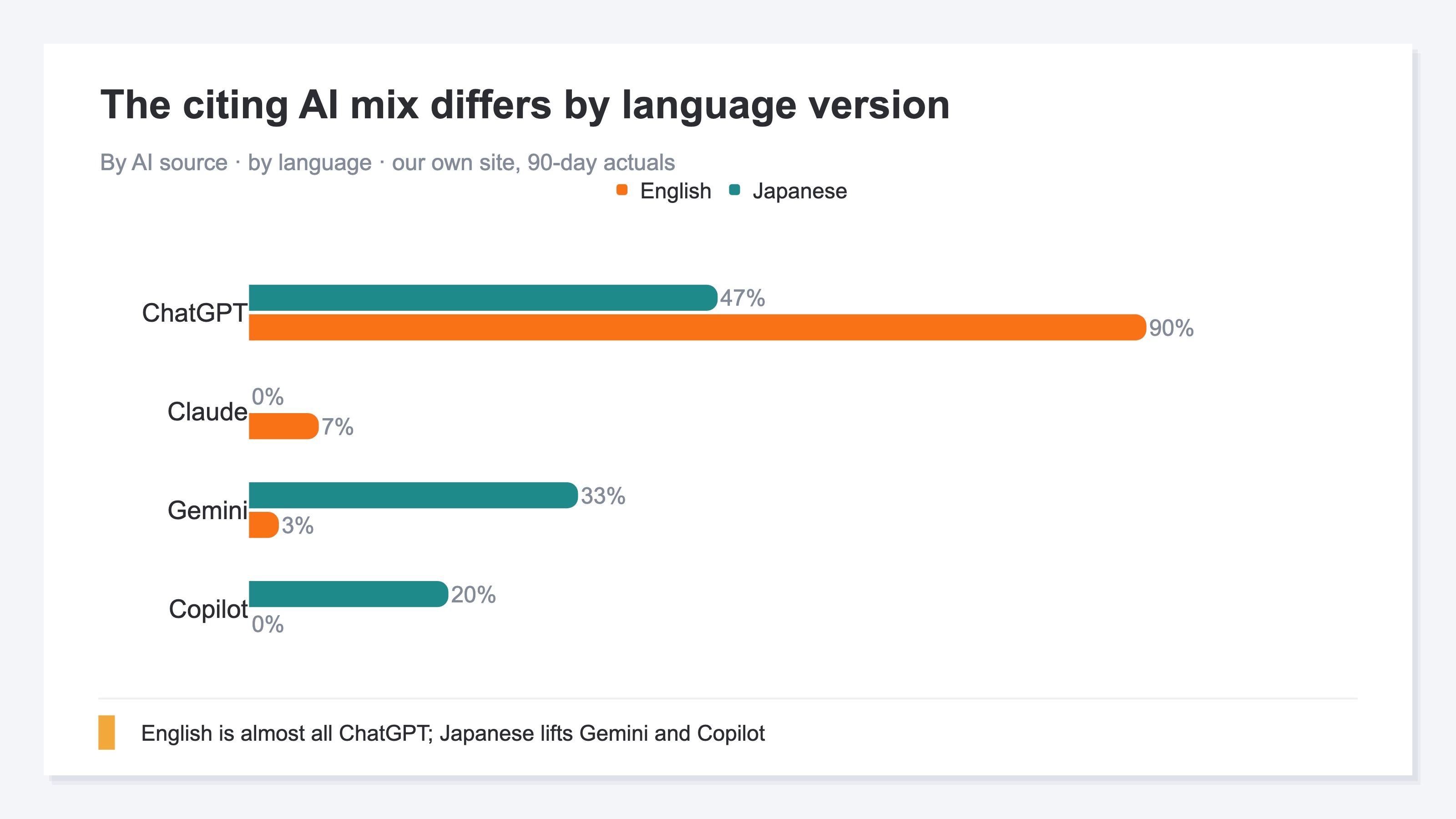
Break the English version's sessions down by source and ChatGPT accounts for roughly 90%, with Claude and Gemini each in the single digits and Copilot near zero — almost entirely ChatGPT. The Japanese version's sessions, though, spread out: ChatGPT roughly 47%, Gemini roughly a third, Copilot roughly a fifth. Gemini and Copilot, which barely showed up on the English version, hold a meaningful share on the Japanese one. Same site, yet which AI "took a liking to you" differs by language version.
This feeds straight into your GEO moves. Look at the English version alone and decide "we just need to optimize for ChatGPT," and you drop the ball on Gemini and Copilot, which are sending traffic to the Japanese version. Judge from the Japanese version alone and you misread the weight of ChatGPT, which is doing the work on the English side. Which AI you set up for, and what you prepare, is best allocated differently by language version. The basics of getting cited by ChatGPT are covered in How to get cited by ChatGPT: GEO basics and your first move, so read that alongside this.
RevenueScope helps
By now it's clear that AI citations tilt toward the English version, yet the Japanese version wins on some pages, and which AI sends the visit differs by language. What's left is the investment call: "So should we thicken the English, or chase the Japanese we're missing?" But trying to confirm this yourself, you hit two walls. One: GA4 carries no breakdown of AI source. It won't split "came from ChatGPT" versus "came from Gemini" out of the box. Two: what GSC (Google Search Console) captures is Google Search exposure only, and AI citations sit outside that scope. So a "landing page × language × AI source" view is, in principle, something these two standard tools can't build. The cost of AI access, and measuring your own traffic first touches on this same difficulty of measuring.
RevenueScope's get_ai_traffic takes over that view. It splits the traffic that clicked through from AI by landing page and by citing AI source, and returns the sessions for each alongside the date that page was last cited (on a site with revenue, revenue per session lines up in the same view too). Here's an image of what actually comes back for our own site (the sessions column is omitted below).
| Landing page | Language | AI source | Last cited |
|---|---|---|---|
| /en/news/ga4-direct-none-causes | English | ChatGPT | 2026-05-16 |
| /en/news/ga4-direct-none-causes | English | Claude | 2026-07-09 |
| /news/ga4-direct-none-causes | Japanese | Copilot | 2026-06-01 |
| /news/roas-benchmark-by-industry | Japanese | ChatGPT | 2026-07-08 |
| /news/ga4-full-utilization-wall | Japanese | Gemini | 2026-06-11 |
The thing to read in this table is that even for the same article, citations attach differently by language version. The article on GA4's Direct is cited from both ChatGPT and Claude on its English version, while its Japanese version is cited from Copilot. Same article, but change the language version and even the source AI changes. The article on the GA4 utilization wall is cited from Gemini on its Japanese version, while that article's English version has too few sessions to make the table. Had you been viewing "are we showing up in AI" bundled under the English version, you might have missed pages growing on the Japanese side and the AI sources doing the work there. Line it up by landing page × language × AI source and you can choose — by actuals, not gut — whether to "thicken the English" or "chase the Japanese," and on which page.
What RevenueScope counts is the AI traffic that clicked through and actually arrived, and its breakdown. Rather than metrics like gross margin or inventory, it splits AI traffic — bots excluded — by landing page, language version, and AI source, and on a site with revenue it lines up revenue per session too. That focus on revenue-based AI traffic is exactly what lets you line it up by landing page × language × AI source and choose — by actuals, not gut — which language version and which page to invest in.
FAQ#
Frequently asked questions#
Q. Does this mean we should create an English version?
A. Not necessarily. On our site, AI citations tilted toward the English version, but this varies by site. And even for the same article, some pages were cited more in Japanese. The first step is to measure, on your own site, which language version is cited on which page. Deciding whether to prepare an English version after seeing those actuals wastes less than mass-translating on gut. If you want a starting point, a free way to check your AI traffic walks through the first read.
Q. Why is the English version cited by AI more easily?
A. Likely because the ground AI stands on to assemble an answer is thicker in English. Both the volume of text it learned from and the volume of information that pools through search are larger in English. So even for the same content, text written in English rises into the candidate pool more easily. But this isn't a law that holds for every page. On topics Japanese readers wrestle with concretely, the Japanese version can be cited more. How strongly it applies depends on the theme.
Q. If AI cites me, does revenue go up?
A. Sometimes, but not always. Being "cited / seen by AI (exposure)" and that traffic "buying (revenue)" are different layers. What we looked at here runs from citation to traffic; revenue needs its own separate measurement. Measure a move by AI-driven traffic or revenue rather than exposure, and you can choose which moves to keep by numbers.
Summary#
Measuring 90 days of AI traffic across our own JP/EN site, the traffic AI cited and sent us was heavily tilted to the English version — roughly 2.7x the Japanese version. The likely reason is that the ground AI stands on to assemble an answer is thicker in English.
But "English just wins" isn't right. On some articles the Japanese version came out ahead, and in three of four the positions swapped. Which AI sent the visit differed by language too: the English version was almost all ChatGPT, while Japanese lifted the share of Gemini and Copilot. The citation tilt isn't settled by a single yardstick called "language version."
So GEO isn't a coin flip between "thicken the English" and "chase the missed Japanese." The realistic move is to line up landing page × language × AI source actuals, see which language version and which AI is working on which page, and allocate from there. Chase exposure alone and you tend to spend time on effort that shows up but doesn't sell. Line up where you stand in numbers and you can judge — not by gut — which moves to keep and which to drop.
See which ads actually drive revenue, at a glance
Free up to 2,000 sessions/month, AI connection included. No credit card required. Up and running in 5 minutes.
References#
- The figures in this article are based on 90 days of actuals from RevenueScope's own site (
get_ai_trafficreferred mode, as of July 2026). Because AI assistants don't always hand over a source tag with the traffic they send, the figures are a floor — the portion we could confirm.

![[Research] How Visible Is Your Brand in AI Search? You Can Measure It](/_next/image?url=%2Fimages%2Fnews%2Fai-search-brand-visibility.jpg&w=3840&q=75)



![[Research] AI Traffic Isn't Growing: Citations Happen Sentence by Sentence](/_next/image?url=%2Fimages%2Fnews%2Fai-mention-no-traffic.jpg&w=3840&q=75)