
The number of times AI comes to read your site has surged over the past year. On top of that, a way to "collect a toll, on the spot, for AI access" has appeared — and AI-referred traffic is entering an era where it no longer comes for free. But before you rush to act — "then let's charge for it" or "let's block the heavy AI" — there are numbers you should measure first: how much traffic AI brings to your store, and how much revenue that traffic generates. In this article, using real data and avoiding jargon, we lay out the two numbers you need to decide with data instead of emotion.
Contents
Summary of this article#
-
AI access is heading toward being paid
A way to charge AI access on a metered basis, on the spot, has appeared. The premise of "let them read all they want, for free" is starting to crumble.
-
Block or charge for everything and you seal off your own front door
Some AI only takes requests; other AI cites you and sends buyers back. Shut them all out uniformly and a growing site injures itself.
-
There are two numbers to measure before deciding
The "volume" of traffic AI brings, and its "revenue contribution (RPS)." Look at volume alone and you misjudge.
-
GA4 has no per-AI-source channel and misses referrers
You can grasp rough volume, but prioritizing by source and tying it to revenue is heavy manual work.
-
Connect the AI traffic that arrived, by source and by landing page, all the way to revenue
Rather than chasing exposure or volume, seeing which AI returns revenue on which page ties directly to your next move.
1. Why access to AI is becoming paid#
Bottom line: AI comes to read your content in large volumes, yet almost none of that reading returns as traffic. Against this imbalance, a way to collect a toll for AI access has appeared.
The trigger was Cloudflare announcing a way to charge AI access on a metered basis (the Monetization Gateway)[1][2]. You put a tollgate at your site's entrance, and when AI comes to read, you can collect a toll on the spot. "An era where you can charge AI" has become real.
Behind it is a shift in the web's premise. Until now, "put out content and visits come back from search" was a round trip that held. But AI reads your page to use as material for its answer, and sends few people back. The volume it reads keeps rising while the traffic that returns stays thin. Only the server load piles up. That frustration is what pushes the idea of charging.
What matters here is to separate the stance question — "should you charge or block?" — from the measurement question — "what do you look at before deciding?" We covered the former in another article (the AI toll Cloudflare started). This article stays one step before that, in the lane of measuring "how much value is arriving" before you decide to charge or block.
2. What happens to online store owners#
Bottom line: Jump on "charge or block every AI" and you also shut out the AI that sends back people who intend to buy, sealing off your own front door for acquisition. AI cannot be lumped together.
AI access mixes two kinds with different natures. One only reads your content and returns no people. The other cites your page and sends back people who are actually interested. For the former alone, the logic of charging or blocking holds. But shut out the latter too, uniformly, and you seal off, with your own hands, the acquisition entrance that is about to grow.
And how AI is used is moving beyond mere "reading." More and more, AI searches for products, compares them, and advances on your behalf right up to the doorstep of a purchase. The points for preparing for this flow are gathered in a separate article (preparing EC for the agent era). And AI acting as a proxy all the way to purchase, versus referral traffic where AI sends people back, work on revenue in completely different ways (AI agent checkout vs. referral traffic revenue).
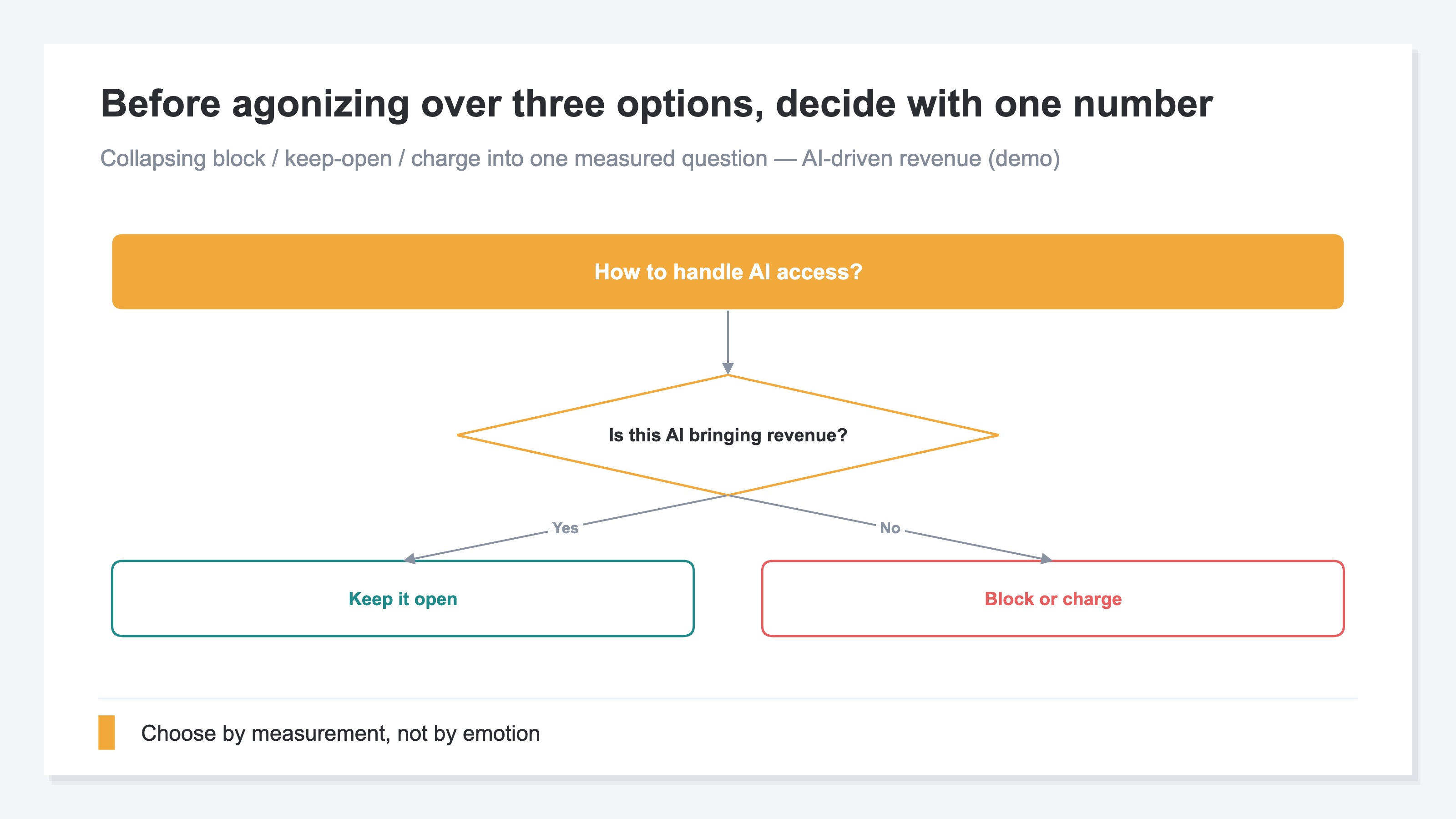
That is exactly why drawing a uniform line by "AI or not" is a risky call. Before you shut anything out, you first need to look — in numbers — at what that AI is bringing to your store.
3. The two numbers to measure before you stop#
Bottom line: Before deciding to charge or block, measure two things: the "volume" of traffic AI brings, and its "revenue contribution." Judge by volume alone and you may shut out the AI that earns for you.
The first number is volume. From which AI, how many visits arrive per month? What share is ChatGPT, what share is Perplexity? Without a per-source breakdown, the "who to stop" discussion cannot even begin.
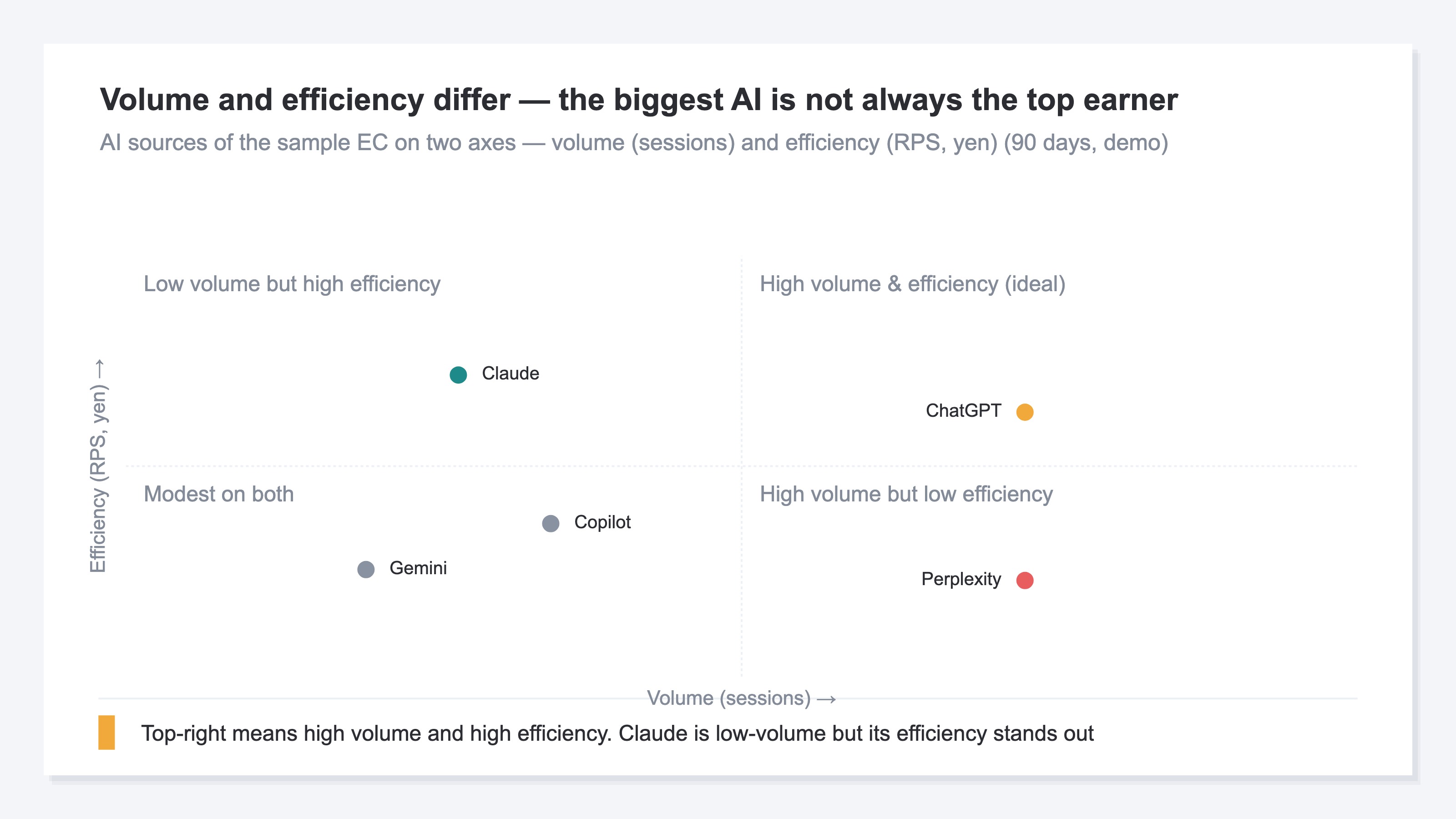
The second number is revenue contribution. This is where RPS (Revenue Per Session — revenue per single visit) comes in. Even with the same 100 visits, if not one is bought, revenue is zero — while some AI gets bought solidly. The AI with the most volume is not necessarily the AI that earns the most. Only by comparing these two can you tell apart "high-volume but thin-revenue AI" from "low-volume but rich AI."
The problem is that assembling these two numbers with GA4 alone is heavy. Pick up AI service domains one by one in GA4's referral report and you get a rough sense of volume. But the limits are clear. There is no standard channel per AI source[3], so the tallying becomes manual. And because the AI side does not always pass a referrer, the numbers can come out lower than reality (undercounted). Bot (automated access) contamination happens too. And above all, tying the traffic you picked up to revenue is work outside GA4 (caveats on GA4's AI traffic channel). The idea is not hard. What is hard is the manual work of reassembling this every month, across every channel.
RevenueScope's solution
Bottom line: RevenueScope treats AI-referred traffic (ChatGPT, Claude, Perplexity, Gemini, Copilot) as an independent channel. On top of that, it connects it by source and by landing page all the way through to revenue and RPS. Its role is to produce, on a single screen, the "map of volume and revenue contribution" that is heavy manual work in GA4.
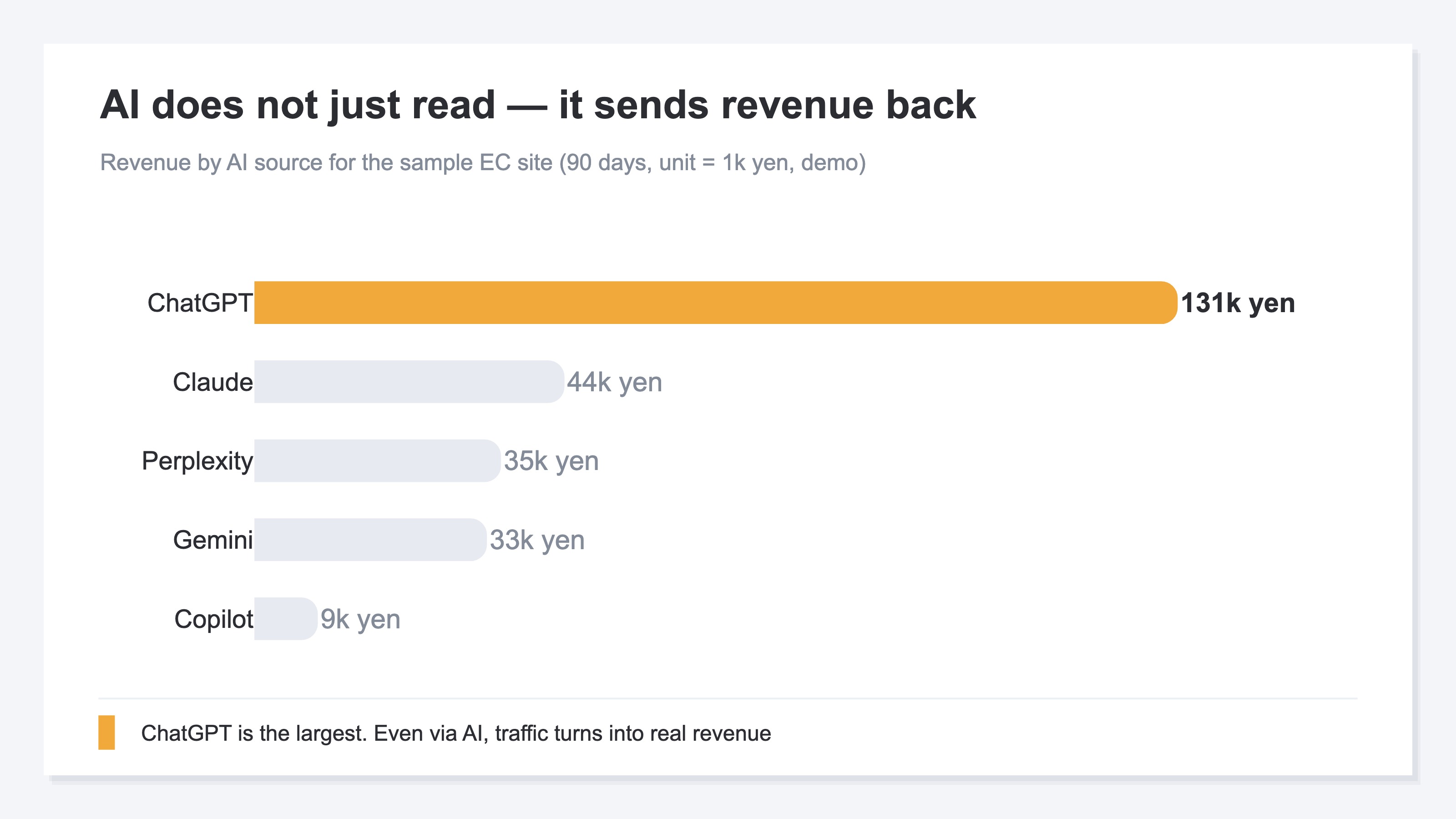
Here is how it actually looks, with the sample EC's data. Over 90 days, total AI-referred sessions were 451 and revenue was about 250,000 yen.
Sample EC (90 days): sessions and revenue by AI source
| AI source | Sessions | Revenue (yen) | RPS (yen) |
|---|---|---|---|
| ChatGPT | 210 | 130,633 | 622 |
| Claude | 19 | 44,384 | 2,336 |
| Perplexity | 120 | 34,974 | 291 |
| Gemini | 77 | 33,188 | 431 |
| Copilot | 25 | 9,424 | 376 |
Figures from a fictional EC with sample data (the RevenueScope demo).
By volume, ChatGPT is the largest. But look at RPS and the scene changes. Claude has only 19 sessions, yet its RPS is 2,336 yen — about 3.8x ChatGPT's. Conversely, Perplexity sends 120 sessions but its RPS stops at 291 yen. Had you judged by volume alone — "Claude is low-volume, cut it" — you would have shut out the richest AI. Comparing this with Google search on the same screen, whose RPS is 304 yen, shows that AI is not just "reading for free" — some of the traffic actually returns revenue. That said, the RPS of a channel with a small base like Claude swings easily on a single large order (n=19), so while numbers are small, don't conclude — verify continuously with your own store's data.
Break it down further by landing page and the decision gets one step more concrete. Even within the same ChatGPT referrals, product pages and collection pages converted to revenue, while blog articles clearly showed traffic but zero revenue. RevenueScope lists out exactly these "pages that are cited but not turning into revenue," so you can head toward a constructive move — how to fix the landing page — rather than blocking. What EC should connect first in the AI era is also laid out in a separate article (the first step for EC to connect its data in the AI era).
RevenueScope specializes in making visible — by source and by landing page — which source the AI traffic that arrived came from, which page it landed on, and how much revenue and RPS it became. It produces, on a single screen, the "map of value" you need before deciding to charge or block. That is what RevenueScope does.
FAQ#
Q. Is it fine to just block all AI access?
A. We don't recommend a blanket block. AI mixes the kind that only takes requests with the kind that cites you and sends back buyers. It's safer to first look at "volume" and "revenue contribution (RPS)" by source, confirm you aren't shutting out an AI that earns for you, and then decide.
Q. Can GA4 show revenue by AI source?
A. Partly. Pick up AI service domains individually in the referral report and you can grasp rough volume. But there is no standard channel per AI source and the tallying is manual, visits where the AI side passes no referrer can't be picked up, and the numbers tend to be undercounted. Reassembling all the way to a revenue tie, every month, is fairly heavy work.
Q. Does RevenueScope predict Cloudflare's charge amount?
A. It does not. RevenueScope does not predict charge amounts or optimize bot billing. Its role is to visualize which source the AI traffic that arrived came from, on which page, and how much revenue it generated. It's a tool that produces the material for judging whether to charge or block — not a tool that handles the charging itself.
Summary#
AI access is ceasing to come for free. But decide whether to charge or block by emotion, and you also shut out the AI that sends back people who intend to buy, sealing off your own front door for acquisition. What you should look at before deciding is two numbers: the "volume" of traffic AI brings, and its "revenue contribution (RPS)." The AI with the most volume is not necessarily the AI that earns the most. Which source the AI traffic that arrived came from, which page it landed on, and how much revenue it became — only when you connect it that far can you decide how to deal with AI by data, not emotion.
See which ads actually drive revenue, at a glance
Free up to 5,000 sessions/month, AI connection included. No credit card required. Up and running in 5 minutes.



![[Research] The Web Is Being Rebuilt for AI Agents: What Online Store Owners Should Know](/_next/image?url=%2Fimages%2Fnews%2Fagent-first-web-ec-preparation.jpg&w=3840&q=75)