
ChatGPT and Perplexity read your site and use what they find in their answers. Over the past year, that kind of access has surged all at once. It's flattering—and, at the same time, a load on your servers. Plenty of site owners have watched it with mixed feelings. Into that, Cloudflare announced a way to charge a toll, on the spot, for AI access. At last, the era of putting a tollbooth at the front door of your site has arrived.
But if you charge in and decide "then let's charge every AI" or "block every heavy crawler," a growing site ends up strangling itself. Some AIs cite your site and send back people who actually intend to buy. This article first pins down the facts of what Cloudflare has started. Then, in order, it works through why shutting everything out makes you thinner, and how—before you decide to charge or block—to tell which AI traffic is sending value back.
Contents
This article in brief#
- Cloudflare announced Monetization Gateway, a way to charge per access to AI. Pages, APIs, datasets, and AI tools behind Cloudflare can be made paid, settled on the spot in tiny amounts
- But for a growing site, shutting out every AI is self-harm. Block the AIs that cite you and send back buyers, and you wall off your own front door for new visitors
- The deciding line isn't "AI or not," but "an AI that sends back engaged people, or a Bot that only takes requests." Before you decide to charge or block, the first job is to tell—from your own data—which AI traffic actually returns revenue
1. Charging AI for access is now real#
The short version: a way to take money, on the spot, for AI access has become real.
Cloudflare's Monetization Gateway is a single control panel for charging per access. It covers the pages of the site you protect, your APIs, your datasets, and even AI tools (MCP—the tools an AI uses). Payment runs on an open scheme called x402. The flow goes like this. An AI (or anything else) comes to access a resource. The server replies, "this is paid, and here's the price" (the HTTP 402 signal, "Payment Required"). The caller pays, attaches proof of payment, and requests again—and the content is handed over. The whole exchange is designed to finish in under a second. Payment is made in stablecoins, a kind of stable digital money, in small amounts and at low fees.
This is the next step beyond Pay Per Crawl, which already existed (charging crawlers for fetching content). Until now it was only "charge the crawler that comes to fetch," but this widens it to "charge any caller for any resource." The pricing can be set in fine detail. A few cents per search. A base fee plus a per-capacity surcharge for an upload endpoint. A flat amount for each resolved support escalation. In other words, you can set a different price tag by type of access. You can also require an authentication check (Web Bot Auth) to confirm the caller is a genuine AI agent. In short: you can now attach a tollbooth and a gate to the access coming in.
2. Shutting out every AI starves your site#
The short version: just because a tollbooth exists, putting up a barrier against every AI will, for a growing site, erode its presence.
The reason is simple. AI is now a new front door for visitors. You get cited in ChatGPT, Perplexity, or Google's AI summaries, introduced as "this store is good," and people are sent your way. Block that door entirely, for the single reason that "it's AI," and you shut out your prospective customers along with everything else. Being cited and whether that traffic contributed to revenue are, admittedly, two different things (Being cited and being bought are not the same). Even so, close the door and that traffic itself disappears. The younger your search ranking and brand, the more precious each one of these doors. Building a tollbooth can wait until the flow is thick.
Of course, there is also access that returns nothing—crawlers that strip your content wholesale and send back not a single person. For those, charging or blocking makes sense. The trouble is that both of these get lumped together under one word: "AI." The moment you lump them, the decision shrinks to "let everything through" or "stop everything." In truth, there is a third path in between: telling them apart.
3. The dividing line is what it sends back#
The short version: the axis for deciding to charge or block isn't "AI or not," it's "what it sends back."
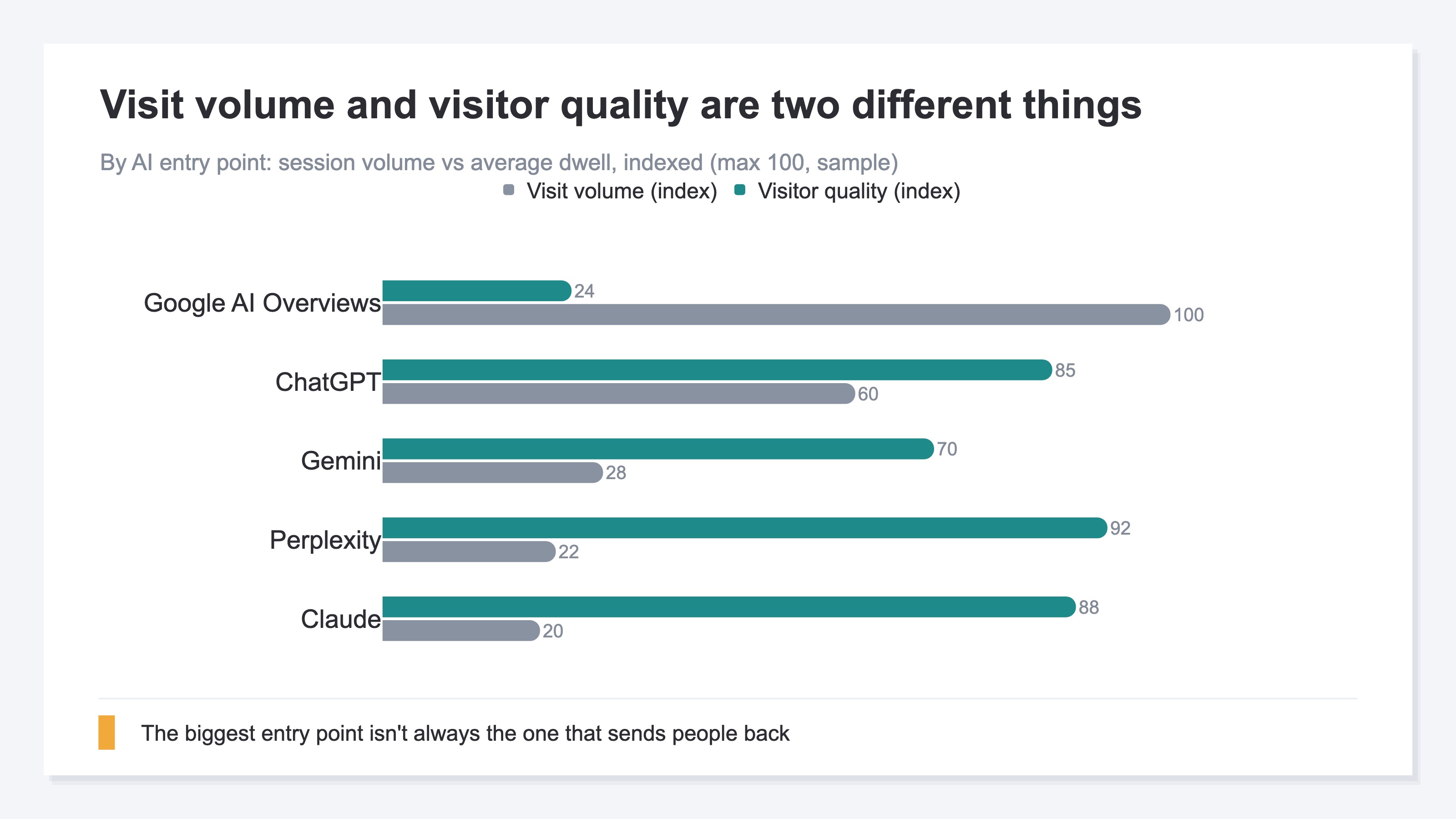
Even within "AI-driven access," the substance differs completely. One kind cites your site and sends back people who mean to buy. The other only throws a mass of requests and returns not a single person. The chart below places, for each AI entry point, "how many people came (visit volume)" against "how much of your content they read (the quality of who comes back)." It shows clearly that the entry point with the most visits can be the one with the lowest quality.
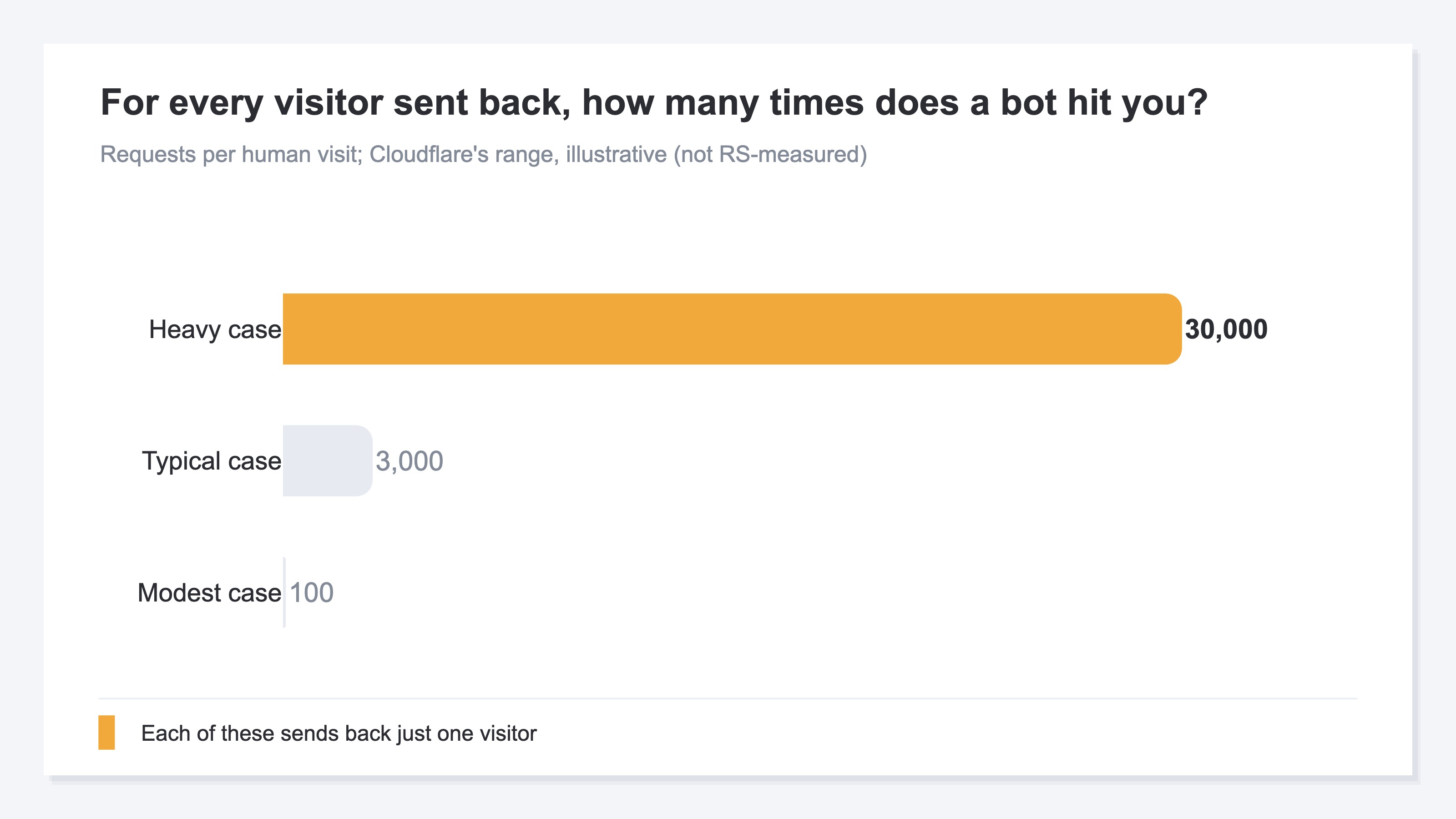
And at the other extreme is access with no intention of giving anything back. Cloudflare reports that AI crawlers make "anywhere from a hundred to tens of thousands of requests for every visitor they send back." That is, to be handed one person, your server gets hit hundreds—sometimes tens of thousands—of times. The chart below shows the size of that asymmetry. Every returning visit is just one person, yet the number of requests running behind the scenes balloons by orders of magnitude.
The awkward part is that if you count traffic with this kind of bot access mixed in, your channel evaluation itself goes wrong (How bots distort channel and ad evaluation). Put these two side by side and you can see how crude it is to draw the line at "AI or not." You want to welcome the AIs that send people back, and put a tollbooth in front of the Bots that only take. The line to draw isn't the boundary of AI-or-not; it's the boundary of whether it returns value.
4. Before charging, see which AI sends value back#
The short version: before you decide to charge or block, you first need to see—from your own data—which AI traffic is returning value.
What helps here is a way of sorting on two axes. One is "the value returned"—how many buyers, and how much revenue, that traffic sends back. The other is "load on your server"—how many requests that access throws at you. Place your access on these two axes and the handling sorts itself out.
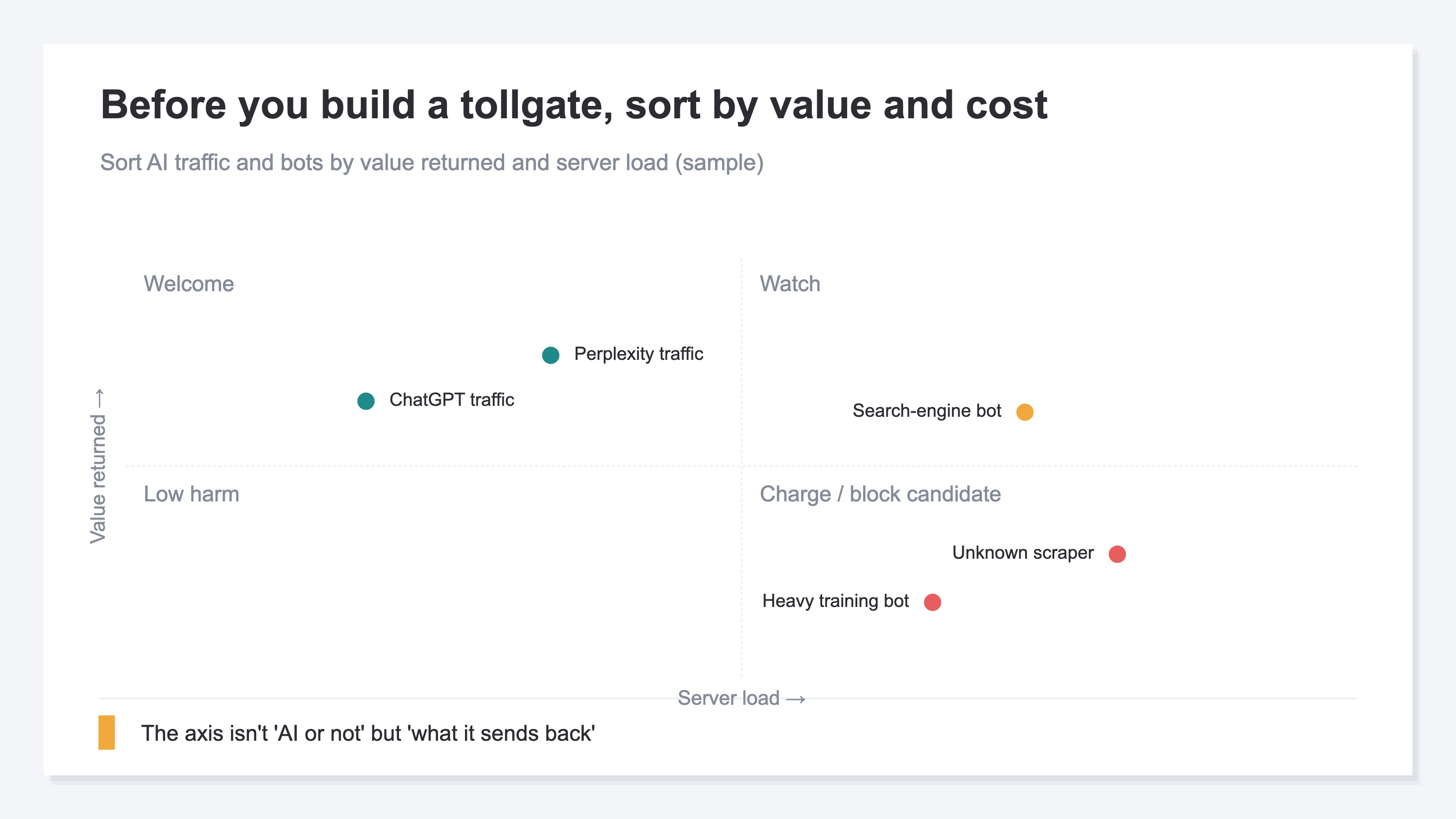
Returns value and is light on load: welcome. Returns value but is heavy on load: watch. Only heavy on load and returns nothing: a candidate for charging or blocking. What matters is not doing this sorting by the gut feeling of "it's probably like this." Which AI entry point actually returns buyers differs by site. At one store ChatGPT works; at another Perplexity does. So applying a generic recipe as-is will miss. What you need is to see, in your own numbers, "which AI returns how much." The trouble is, in GA4 those numbers usually hide inside "Direct" (AI traffic hiding in "Direct") and get buried as revenue of unknown origin (The truth about revenue with no known source). Only once this is visible can you decide, with grounds, where to put a tollbooth and where to leave the door open.
RevenueScope solution
Start thinking about charging or blocking and you keep hitting the same wall: "which AI traffic is returning value at my site" is nowhere to be found in numbers. You have to carve it out to see it.
RevenueScope solves this. It works upstream of charging or blocking itself, specializing in telling which AI traffic is generating value. It carves out AI-driven traffic by entry point (ChatGPT, Perplexity, Google AI Overviews, and so on) and lays out visits, bounce rate (whether the people who came stayed to read rather than leaving at once), and revenue. And these figures are after excluding automated-program (bot) access. AI-related crawlers and bots slip into traffic easily, and not excluding them makes AI's contribution look bigger than it really is.
Ask RS, and this is what comes back (figures shown are demo data).
| Entry point | Visits | Bounce rate | Revenue |
|---|---|---|---|
| ChatGPT | 1,800 | 42% | ¥210,000 |
| Perplexity | 600 | 38% | ¥95,000 |
| Google AI Overviews | 2,400 | 89% | ¥80,000 |
| Search (organic) | 5,000 | 35% | ¥520,000 |
The thing to read in this table is that Google AI Overviews, with the most visits (2,400), has the highest bounce rate at 89%. Many people see just the summarized answer, feel satisfied, and leave without reading the content. ChatGPT and Perplexity, by contrast, have fewer visits but a low bounce rate and solid revenue, because those people arrive with intent. In other words, instead of lumping all AI traffic together, you can tell, entry point by entry point, "who is arriving to buy." And RevenueScope also shows the volume it excluded as bots (the amount of access removed). So the entry points that send no people and only pile on load—the candidates for a tollbooth—surface on the same screen.
As the brain for judgment, RevenueScope specializes in carving out AI traffic by entry point and showing which entry points return value. Building the tollbooth and charging the callers you've identified is the job of a scheme like Cloudflare's. The relationship isn't competition, it's complement: RevenueScope lights up "where to build it," Cloudflare handles "charging there."
What RevenueScope lays out are net figures with bots removed—visits, bounce rate, and revenue for each AI entry point. With that, whether each AI entry point is "arriving to buy" stands up in numbers, so you can sort the callers to charge from the doors to leave open—from your own data, not a guess.
FAQ#
Frequently asked questions#
Q. If I install Cloudflare's charging scheme, does the AI crawler problem get solved?
A. You get the means to build a tollbooth, but the judgment of "where to build it" is a separate need. Charge or block every AI uniformly and you shut out even the AIs that send back people who mean to buy, walling off your own front door. First tell, from your own data, "which AI traffic is returning value," and only then put a tollbooth in front of the ones that don't. Keep the scheme (the tollbooth) and the judgment (where to build it) as separate things.
Q. Isn't it safer to just block all AI crawlers?
A. If you look only at server load, blocking works—but for a growing site the loss tends to be larger. AI citation is now a new front door for visitors. Stop it wholesale for the reason "it's AI," and you erase even the doors that send people back. The axis for judgment isn't "AI or not," it's "what it sends back." Keep the value-returning doors open, and make the ones that only pile on load and return nothing your candidates for charging or blocking—that's the practical split.
Q. Can I tell which AI is returning revenue in GA4?
A. It's hard, in practice. Traffic from the likes of ChatGPT often carries no mark of origin (UTM), so in GA4 it gets bucketed as "Direct" or unknown. The "AI Assistant" channel GA4 has added still lets tag-less AI traffic sink into "Direct," so reading it as-is as a result is risky (GA4's AI assistant traffic). To see bounce rate and revenue by entry point, you need to carve out that buried portion and lay it out by AI entry point. Count (how many visits came) and revenue (how much came back) are different things, so it's best to look at both, separately.
Conclusion#
With Cloudflare's announcement, the era of putting a price tag on AI access has begun. You've got the tollbooth and the gate. But just because the tools are in hand, building a barrier against every AI can, for a growing site, become self-harm.
The AIs that cite you and send back people who mean to buy, and the Bots that only take requests, are entirely different things. The moment you lump them as "both AI," the decision shrinks to "let everything through" or "stop everything." The deciding factor isn't "AI or not," it's "what it sends back."
So decide whether to build a tollbooth only after you've looked at the data. Which AI entry points actually send buyers, and which callers only pile on load. Once this is visible in your own numbers, you can choose both where to build a barrier and which doors to leave open—by grounds, not by guess. Start by carving out "which AI returns how much." Once that's visible, you can use "the era of charging AI" as a move on offense, not just defense.
See which ads actually drive revenue, at a glance
Free up to 5,000 sessions/month, AI connection included. No credit card required. Up and running in 5 minutes.