
"People who arrive via AI bounce fast" — you may have heard it. But when we re-measured our own site with a DB-level look at the dwell-time distribution, the belief turned out to be only half true. Looking at the mean alone, you'd say "they read for a while." But that mean isn't a typical value — the real pattern splits into a fast-leaving group and a deep-reading group. And yet we couldn't relax, because the real wall was somewhere else. This article traces the gap between the belief and the reality using our own measured data, and lays out how to actually read "AI traffic quality."
Contents
TL;DR#
-
"AI-referred traffic bounces fast" is only half true
By bounce rate alone, the belief doesn't hold (AI-referred 82.1% < Google Search 90.3%). But that's one metric taken in isolation.
-
"Average dwell time" was also not a typical value
Our own DB-level direct aggregation (n=26) puts the median at 36 seconds. The 629-second mean is pulled up by a long tail in the top quartile — the real pattern is bimodal: a fast-leaving group and a deep-reading group.
-
The real wall is "finishing on one page and not exploring"
In both groups, over 8 in 10 finished on the page they landed on. Not moving to a next page or the cart is the sticking point.
-
This quality hides in the aggregate and only shows once you carve out AI traffic
Measuring AI-referred traffic on its own is the first step to reading its quality.
1. Are AI-Referred Visitors Really Bouncing Fast?#
Bottom line: by bounce rate alone, "AI-referred visitors bounce fast" did not hold on our site. Bounce rate sat at 82.1% — lower than Google Search's 90.3%. But that's one metric taken in isolation.
First, let's line up the word "bounce rate." Bounce rate is the share of sessions that looked at only the one page they landed on and left without moving to a next page (the wording is sorted out in bounce rate vs exit rate). Read through this definition, AI-referred visitors showed none of the "gone in ten seconds" drive-by we expected.
Over our 90 days, traffic via AI assistants totaled 51 sessions. Of those, ChatGPT accounted for 39, with Gemini, Copilot, and Claude a few each. Only ChatGPT has enough volume; the other AIs sit at a handful of sessions each, so their bounce figures can't be taken at face value. So here we draw a line: only the ChatGPT numbers are large enough to state.
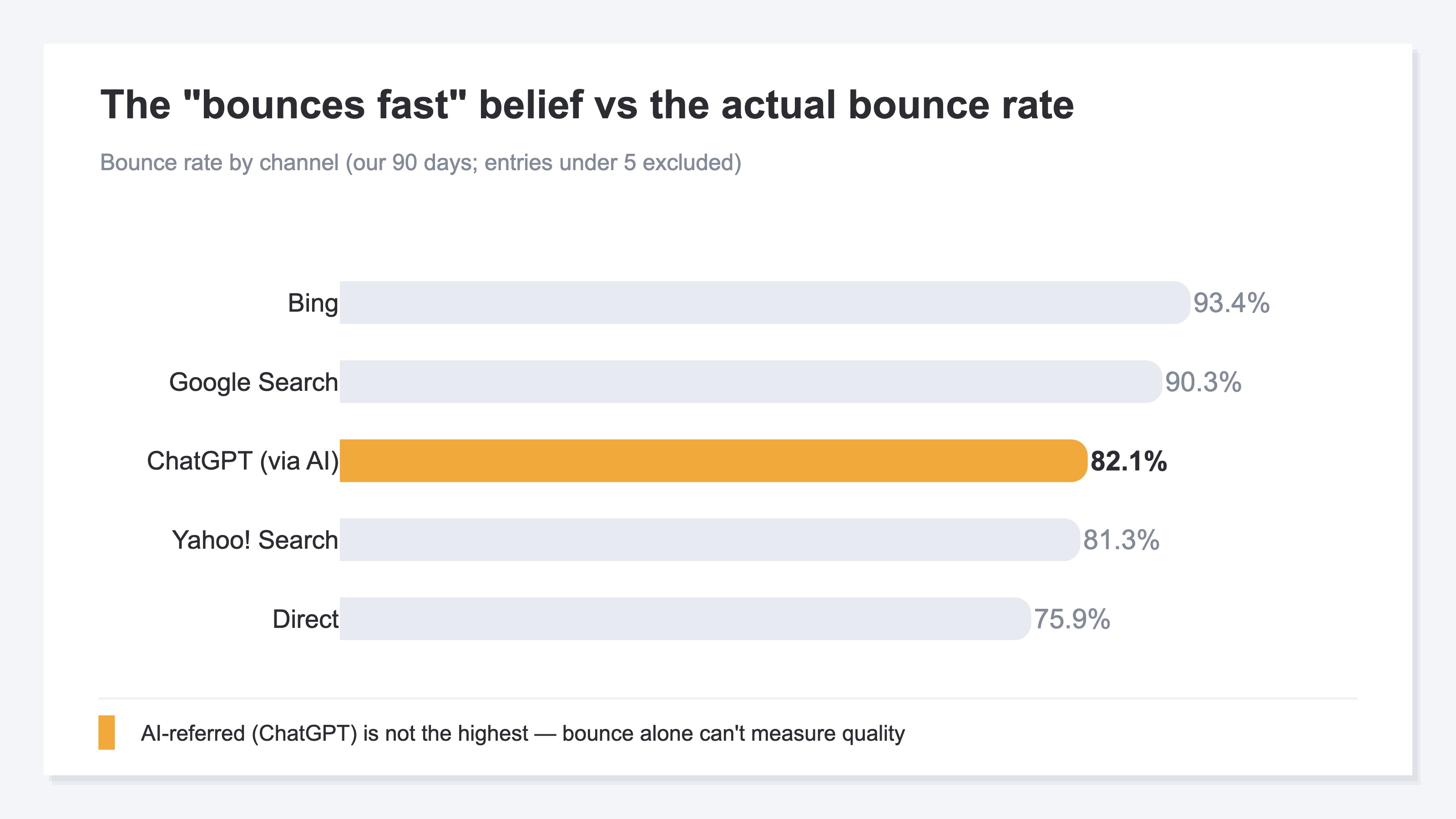
Looking at that ChatGPT traffic, bounce sat below Google Search. In other words, the belief that "people from AI leave without reading" doesn't hold, at least not by bounce rate. It's tempting to jump to "so dwell time is long and quality is high too," but it wasn't that simple. Behind that one bounce-rate number was a deeper layer.
2. "Average Dwell Time" Was Also Not a Typical Value#
Bottom line: reduce dwell time to a single "average" and you fall into the same trap as bounce rate. Our own DB-level direct aggregation (ChatGPT referrer, 90 days, n=26, bots excluded) shows the mean at 629 seconds, but the median is only 36 seconds. The real pattern is bimodal: a fast-leaving group and a deep-reading group.
Hear "629-second (10+ minute) average dwell" and you picture "AI-referred visitors read carefully." But a mean is pulled by extreme values. If just one visitor left a tab open for nearly 87 minutes (5,251 seconds), that alone drags the mean up. The median — the value sitting exactly in the middle — is closer to the typical experience (the pitfalls of dwell time are also touched on in why GA4 dwell time is off).
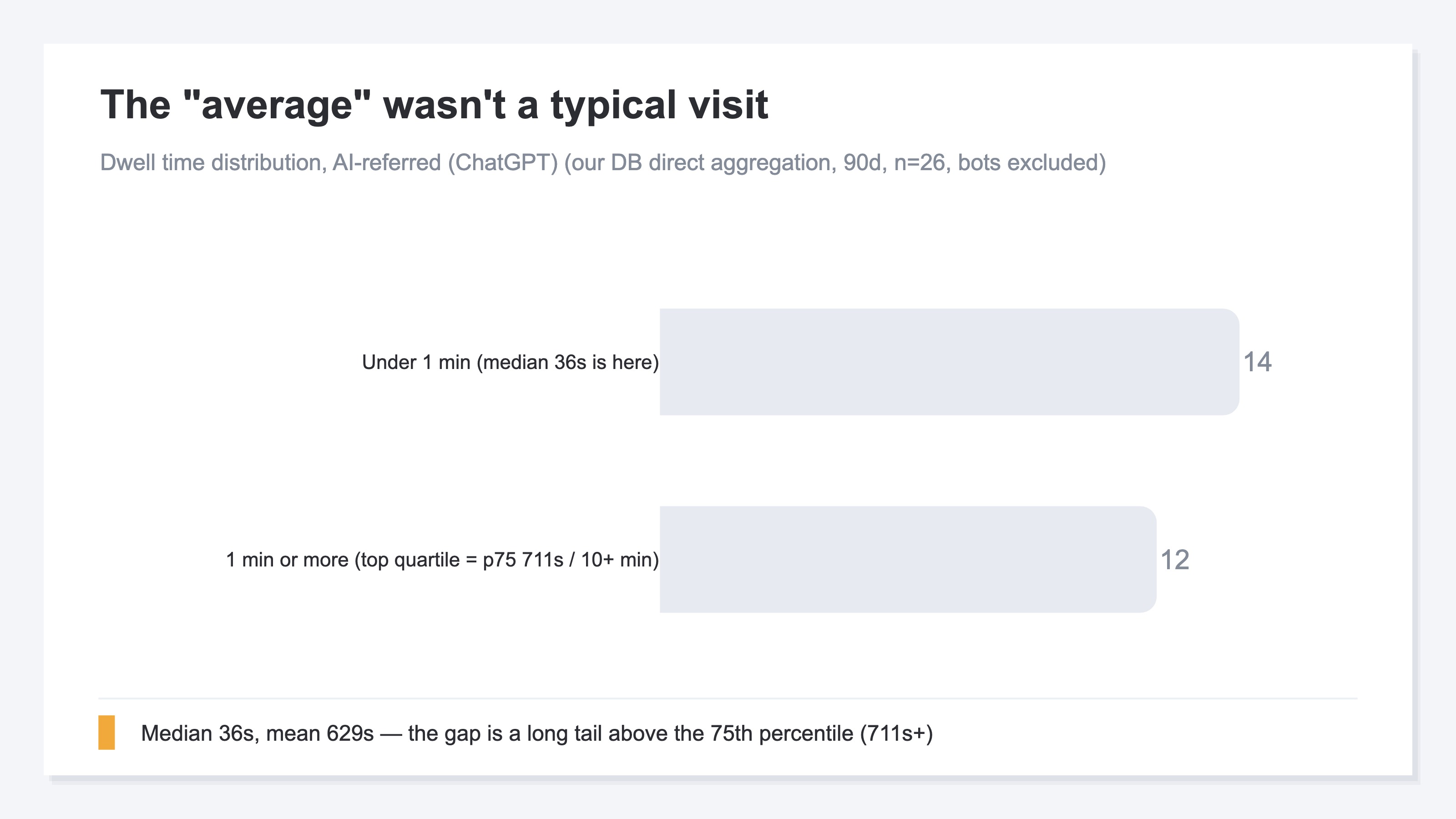
Break the distribution into segments and 14 of the 26 sessions ended in under a minute — that's exactly where the 36-second median sits. The remaining 12 ran a minute or longer, and within that group sits the top quartile of the full 26 (p75 = 711 seconds, about 12 minutes), which runs longer still, with the max reaching 5,251 seconds (about 87 minutes — likely an idle tab). In other words, AI-referred visitors aren't "everyone reading a moderate amount" — most leave quickly, and only a slice reads at length. That bimodal shape disappears the moment you collapse it into a single average. Both bounce rate and dwell time mislead "AI traffic quality" when reduced to one representative number — a layer deeper than the bounce-rate reversal alone.
3. The Real Wall: Finishing on One Page, Not Exploring#
Bottom line: in either group of the bimodal split, the real sticking point for AI-referred traffic isn't the speed of leaving — it's "finishing on one page and not exploring." Over 8 in 10 finished on the page they landed on and didn't move to a next page or the cart.
Let's line the distribution up as metrics again: mean 629 seconds, median 36 seconds, top quartile (p75) 711 seconds and up, max 5,251 seconds. The sheer spread of these numbers is itself the proof that a mean alone can't describe a typical visitor.
![(Our own DB-level direct aggregation, 90 days, n=26, bots excluded. A metrics table for ChatGPT-referred dwell time: mean 629s, median 36s, top quartile [p75] 711s+, max 5,251s [likely idle tab], and share over 1 minute 12/26 [46%].)](/images/news/charts/ai-traffic-bounce-landing-gap/chart3-ai-source-summary-en.jpg)
Look at that 82.1% bounce with a different eye than in section 1. There it was material for overturning the belief ("lower than Google Search"); in absolute terms, it also means over 8 in 10 left on the one page they landed on. Even the "deep-reading group" at the top quartile (p75 = 711s+) mostly ends on one page. In other words, the exploration wall stands on something other than reading duration.
Why they don't explore, we can't conclude from this data alone. Maybe they arrive already satisfied by the AI answer; maybe the path from the landing page to a next step is weak — several readings are possible. What we can say is the fact that "even the deep-reading group ends on one page" is happening, and that separating the cause needs its own work. How to fix pages that finish on one page is in fixing high-view, low-scroll pages.
And this "doesn't explore" quality can't be measured unless you've carved out AI-referred traffic in the first place, because those visitors mostly get lumped into Direct or unknown in GA4 (the mechanism is covered in why AI-referred traffic hides in Direct). Making AI traffic visible on its own is the starting point for measuring its quality.
RevenueScope helps
Bottom line: RevenueScope carves out AI-answer-referred traffic as an independent channel and shows bounce and dwell for each landing page × AI source on one screen. Its job is to carve out the segment GA4 buries in Direct, without the monthly manual work.
RevenueScope's get_ai_traffic carves out, as a single channel, the traffic that arrives via answers from tools like ChatGPT, Claude, Gemini, Perplexity, and Copilot. Combine that with get_breakdown's per-channel view and you can line up AI-referred dwell time and bounce rate on the same screen as your other channels. GA4 struggles to carve out AI-assistant traffic as one channel and to show engagement by AI source in a single view (the caveats of filtering AI channels in GA4 are in pitfalls of viewing AI-assistant traffic in GA4). RevenueScope isn't a replacement for GA4 but a complement that fills that one weak spot. Because the MCP is read-only, letting AI connect and read your data carries no risk of rewriting it.
Here's the actual view, with sample-store data.
Asking the sample store about AI-referred traffic (sample data)
| Landing page | AI source | Traffic | Bounce |
|---|---|---|---|
| Aroma diffuser (product) | ChatGPT | 46 | 34.8% |
| Best eco gifts (blog) | ChatGPT | 38 | 39.5% |
| Best sellers | Perplexity | 24 | 41.7% |
Figures from a fictional EC store with sample data (RevenueScope demo). AI traffic is a classification based on referrer and browser information. Pages with fewer than 5 landing sessions don't get a bounce rate (it swings too much).
Lining up bounce rate by landing page and AI source like this lets you name the pages where "AI traffic arrives well, yet leaves on one page." RevenueScope carves out how much traffic arrived via AI answers and how much of it bounced, channel by channel and page by page. It surfaces the AI traffic GA4 buries in Direct as an independent channel — without the monthly chore of picking it out by eye — so you can name the pages where exploration stalls.
FAQ#
Q. If bounce rate is high, does that mean the AI traffic is low quality?
A. You can't judge from bounce rate alone. Bounce rate measures "did they leave on one page," not how much of that page they read. Dwell time reduced to a single "average" is also not enough to judge from. In our data, AI-referred dwell time had a 629-second mean but only a 36-second median — a bimodal split between a fast-leaving group and a deep-reading group. To read quality, overlay bounce rate with the dwell-time distribution, and add whether they moved to a next page or the cart. The point is not to decide good or bad from a single number pulled out on its own.
Q. AI-referred traffic is still small for us. Is there any point in measuring it?
A. Right now, AI-referred traffic often stays a tiny fraction of the whole. But as the entry point for finding information shifts from search to AI answers, this traffic is trending upward. Building the habit of seeing "which pages exploration stalls on" while the volume is small lets you act faster once it grows. The value of carving it out and making it visible now only grows from here.
Q. Can't I see AI-referred bounce and dwell with GA4 alone?
A. You can get a rough estimate, but there are limits. GA4 struggles to carve out AI-assistant traffic as one channel, and much of it gets lumped into Direct or unknown. You can build a segment by picking out referrers by hand, but AI doesn't always pass a referrer, so misses appear, and having a person keep judging every time a new AI service shows up is heavy to repeat monthly. The idea is simple, but running it by hand is heavy — that's the line where you hand it to a machine.
Summary#
The belief that "visitors from AI bounce fast" didn't hold by bounce rate alone (AI-referred 82.1% < Google Search 90.3%). But that's one metric in isolation. Look at the dwell-time distribution via our own DB-level direct aggregation, and the mean of 629 seconds turns out to hide a median of just 36 seconds — a bimodal split between a fast-leaving group and a deep-reading group, with the mean itself the trap. And the real wall isn't the speed of leaving — it's "finishing on one page and not exploring." Even the deep-reading group mostly doesn't move to a next page. And this quality can't be measured unless AI traffic is carved out. Start by making AI-referred traffic visible on its own, then read the post-landing exploration — one step at a time.
See which ads actually drive revenue, at a glance
Free up to 2,000 sessions/month, AI connection included. No credit card required. Up and running in 5 minutes.