The name Criteo is showing up in your ad report, or in GA4's referral sources. What kind of advertising is it, and how should the results be read? Criteo is not a place where ads are displayed. It is a provider that follows people who have already visited a site and delivers ads to them elsewhere. The standard you read it by is different from the one you use for ads that bring in new customers.
Contents
TL;DR#
- Criteo is not a place where ads run. It is a provider that shows ads again, on other sites, to people who visited once
- In our own survey, 59 of the 265 EC companies in Japan we could confirm were running ads (22%) had Criteo in place
- If either utm_source or the referrer is present, it can be told apart as an independent channel
- Re-contact advertising and new-customer advertising reach different people, so the same ROAS standard cannot decide whether to raise or lower spend
- What the decision needs is Criteo's own-measured revenue and the ad spend put into it sitting in the same table
1. Criteo Is the Provider That Follows Visitors, Not a Place for Ads#
Criteo is not the name of a place where ads appear. It is the provider on the delivery side, showing ads on other sites to people who visited your own site once.
Start by settling what the name points at. What comes to mind with a name like Criteo may be some site the ad happened to sit on. What the report records is not that placement but the provider that delivered the ad. Until what the name points at is settled, whether the results are good or bad cannot be settled either.
Criteo describes itself as a commerce intelligence platform[1]. The way the ads appear works like this. Data on the products a visitor viewed on the advertiser's site, or added to the cart, is tied to an identifier such as a cookie[2]. When that person is browsing a different site, it is shown as an ad[2]. This mechanism of showing ads repeatedly to someone you have had contact with once is called data segments in Google Ads[4].
So how do you tell visits from this advertising apart in your own measurement? There are two clues. One is the utm_source attached to the URL, and the other is the referrer, which shows what site the visit came from. The referrer carries the domains Criteo uses for delivery. How to think about what goes into utm_source is laid out in what to put in utm_source for Meta ads. Which channel group GA4 files a visit under is decided by whether values such as utm_medium match the conditions in the definition[3].
There is one limit here. Clicks from a DSP sometimes carry neither a UTM nor a click ID. Visits with neither fall into Direct or Referral. When Referral grows, the reading of other referral sources such as partner sites and social gets muddied along with it. When you take stock of acquisition channels, check what is mixed into Referral first.
2. 22% of EC Sites That Run Ads Have It#
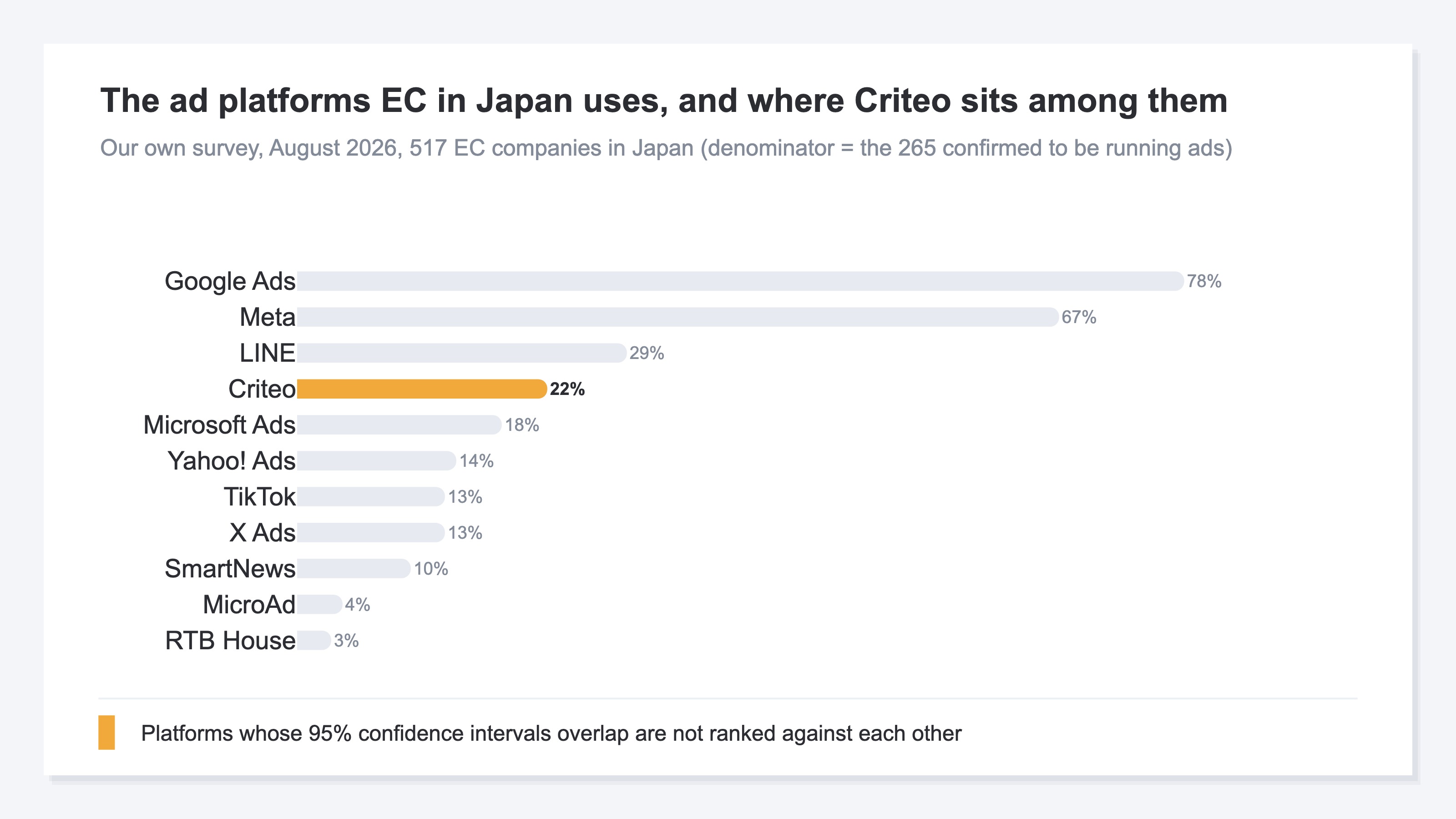
Of the 265 EC companies in Japan we could confirm were running ads, 59 of them, or 22%, were using Criteo.
This figure comes from our own survey. In August 2026 we checked 517 EC companies in Japan. The denominator for the 22% is not the 517 themselves but the 265 we could confirm were running ads. The 95% confidence interval is 18–28%.
The population has limits. The targets are EC sites on their own domains that rank highly in search for their Specified Commercial Transactions Act disclosure. That act requires businesses to display their name, address and phone number in their advertising[5]. Companies that sell only through marketplaces, and EC sites that do not rank highly in search, are not included. Read it on the premise that it is not a representative sample of all EC in Japan.
We do not assert the ordering itself. Among the platforms above and below there are pairs whose 95% confidence intervals overlap, so the arrangement of point estimates alone does not let anyone declare that Criteo is fourth. What can be said reaches only the level that Criteo is not an unfamiliar name in EC in Japan.
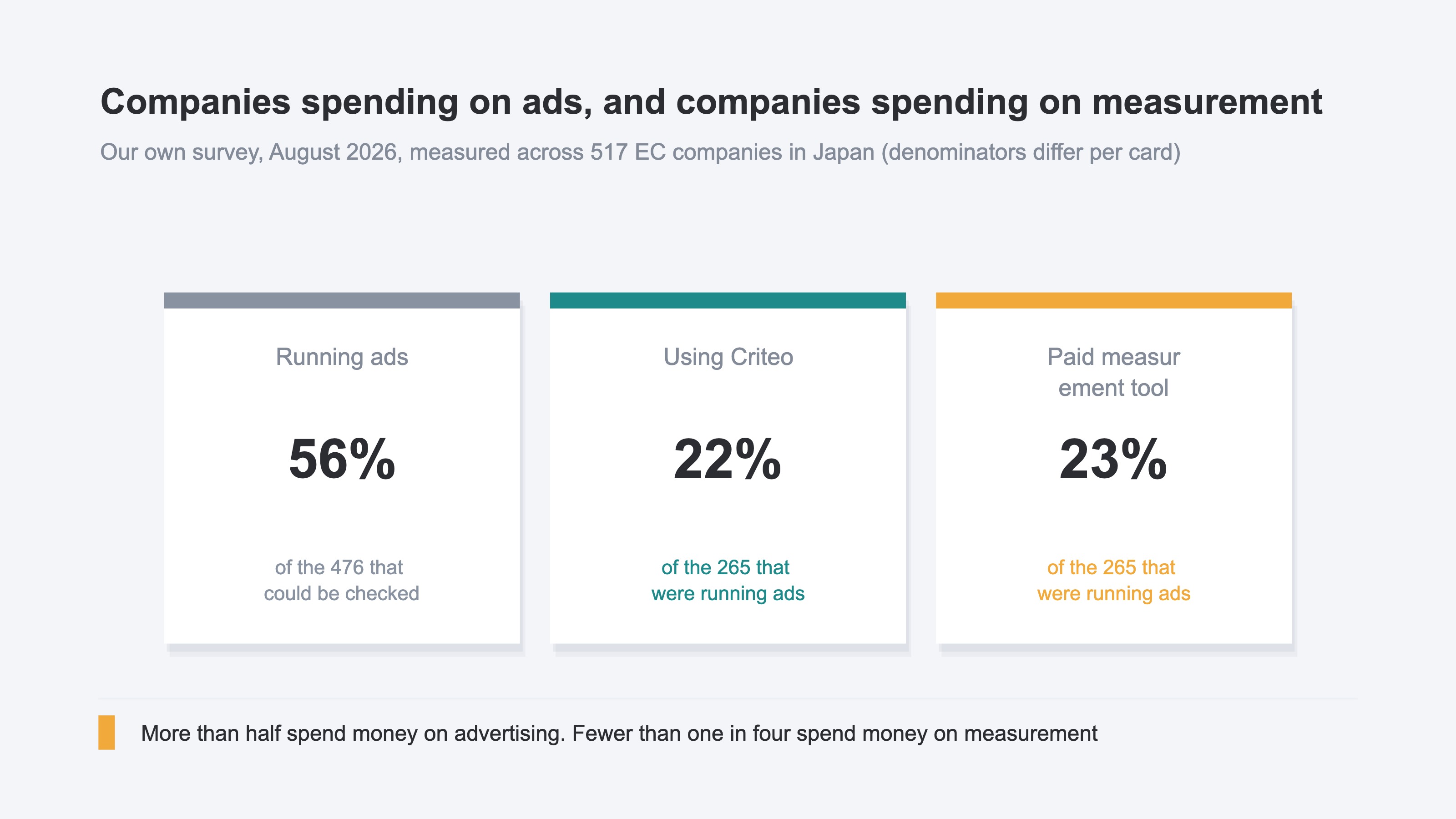
The same survey also brings the measurement side into view. Of the 265 companies running ads, 23% had a paid measurement tool in place (18–28%). The rest are companies spending money on advertising while paying nothing for measurement. The more kinds of platforms a company advertises on, the more traffic it accumulates that free tools cannot tell apart.
There is one more thing about how platforms are combined. Of the 265 companies running ads, 63% were using two or more platforms (57–69%). That means several platforms each reporting the same purchase as their own result. The click counts platforms report and the session counts from your own measurement do not agree either. The reasons are separated out in why Google Ads clicks and GA4 sessions don't match.
3. Listing It in the Results Table Does Not Decide Whether to Scale#
You cannot compare Criteo's results against ads that bring in new customers on the same standard and decide from that whether to scale it. The group of people being reached is different.
Re-contact advertising reaches people who have already come to the site once. New-customer advertising reaches people who have not come yet. That difference shows up directly in the ceiling on additional spend. The number of people re-contact advertising can reach is capped by the number of visitors the other channels brought in. The ceiling for new-customer advertising is set instead by the search volume in the market.
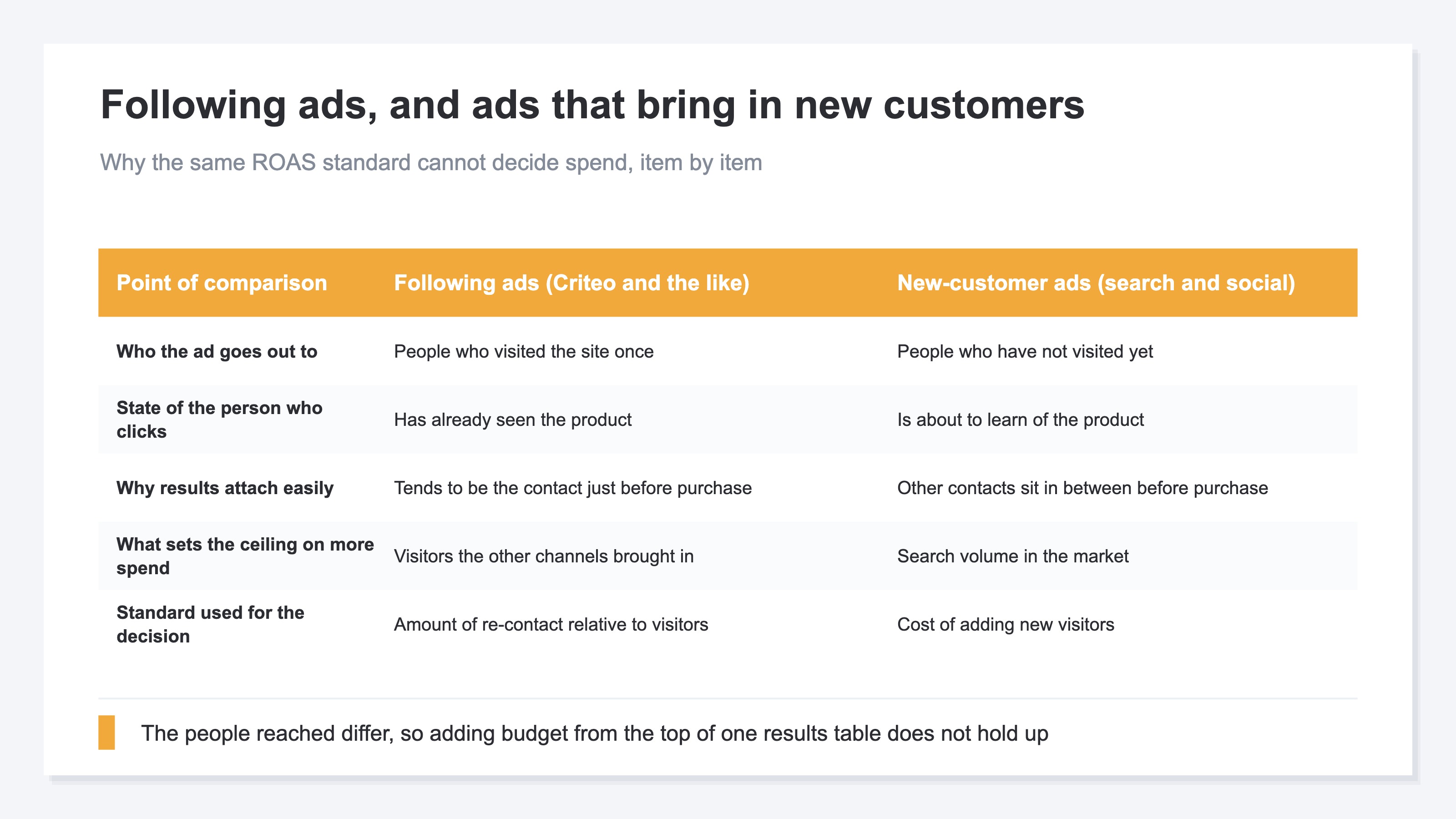
That difference also shows up in the unit of the decision. Add budget from the top down in order of ROAS and Criteo always sits near the top. But the people it reaches carry a ceiling: they have already come once. The more spend goes in, the more of the increase leans toward showing the same people more impressions. As long as the ceiling is set somewhere else, a procedure that puts every platform on one ranking and adds budget in order loses its meaning partway down.
The results also come from separate systems. The CV count a platform's console shows is aggregated by that platform on its own standard. Your own measurement records purchases that happened on the site. Why the two do not agree is handled in ad vs GA4 CV count mismatch. Some measurement counts impressions that were never clicked as results, and how that works is laid out in how Meta's Advantage+ makes results look bigger.
There is one more influence: the number of days you look back. The longer the period you search backward from a purchase for points of contact, the more likely a re-contact that lands just before the purchase is included. How to decide that period is explained in what a lookback window is.
So a way of deciding that adds budget from the top of the same results table does not hold up in the first place. What is needed is to split the groups by role and set a ceiling for each on a separate standard. New-customer advertising is read by how many more visitors it produced and what each one cost. Re-contact advertising is read in a separate frame, by the revenue of the purchases that came back through it and the ad spend put into it. How many people were reached is a value the platform's console holds, so check that there. Even sitting in the same results table, if you settle in advance that the metric you check is different, the decisions about raising and lowering can be kept apart.
RevenueScope solution
The ad console you have open right now records click counts and the results the platform aggregated for itself. Go past that and try to confirm how much actually stayed with you through Criteo, and there is no place prepared for it. The name appears in GA4's referral source report. But you still need a separate place to compare the Criteo ad spend you put in against your own measured revenue in the same table.
RevenueScope classifies Criteo as an independent channel through both routes, utm_source and the referrer. Revenue from the purchases that followed is assigned to that channel too, on attribution based on the last point of contact. Ad spend can be entered by year, month and channel, or imported in bulk from CSV. With both in place, sessions, revenue, RPS (revenue per session) and ad spend for each channel can be viewed side by side in a single table.
Ask ChatGPT or Claude over MCP for revenue and ad spend by channel over the last 30 days, and it comes back in this form.
One example (illustrative) / Fictional Store A, 30 days
| Channel | Sessions | Revenue | RPS | Ad spend |
|---|---|---|---|---|
| Google Ads | 4,000 | ¥600,000 | ¥150 | ¥400,000 |
| Meta | 3,000 | ¥360,000 | ¥120 | ¥200,000 |
| Criteo | 500 | ¥150,000 | ¥300 | ¥30,000 |
| Direct | 2,500 | ¥250,000 | ¥100 | — |
Note: the table above is a construction made to explain how to read it. Both the store identity and the rounded channel figures were created solely for this Criteo example. The demo screen behind the CTA loads sample data that is refreshed daily, so opening it shows figures that do not match these.
Direct, with no ad spend entered, leaves the ad spend cell blank. What gets filled in is only the channels that had ad spend registered for that period.
Criteo comes first in the table on RPS. Divide revenue by ad spend by hand to get ROAS and it still leads, at 5.0 against 1.5 for Google Ads and 1.8 for Meta. There is nothing surprising in that. What Criteo is in contact with are people the other channels brought in once. Being re-contact, it comes out that way structurally. So the way to read this table does not point toward growing the leader. What it settles is one thing: take Criteo out of the decision to raise or lower new-customer acquisition, and manage it on a separate standard. The next move becomes rebuilding the split of the new-customer entry point across Google Ads and Meta, and putting a separate ceiling on Criteo.
FAQ#
Frequently asked questions#
Q. Which channel do visits from Criteo ads land in inside GA4?
A. The filing is decided by whether values such as utm_medium match the conditions in the definition[3]. If a manual tag is present, the visit lands in the channel that value points to. Visits carrying neither a UTM nor a click ID fall into Direct or Referral.
Q. Criteo's ROAS comes out higher than other platforms. Is that a good state to be in?
A. Coming out high is not by itself a judgment of good or bad. What re-contact advertising is in contact with are people the other channels brought in once. Do not compare it against new-customer advertising on the same standard and decide from that whether to raise or lower spend.
Q. Why does the CV count in the platform's console not agree with the CV count from our own measurement?
A. Because they are separate systems of measurement. The platform aggregates people who had contact with its own ads on its own standard, and your own measurement records purchases that happened on the site. Rather than trying to make them agree, settle what each one aggregates before you use it.
Q. How can we check whether Criteo is in place on our own site?
A. Two places will tell you: the list of ad tags installed on the site, and GA4's referral source report. But that only reaches as far as presence or absence. How much sold through Criteo only appears once your own measured revenue is attributed to it.
Summary#
Criteo is not a place where ads are displayed. It is a provider that follows people who have viewed a site once and delivers ads to them on other sites. In our own survey, 22% of the 265 EC companies in Japan we could confirm were running ads had Criteo in place. It is not an unfamiliar name in EC in Japan.
Knowing the name, though, does not settle how to read its results. Re-contact advertising reaches people who have already come, and new-customer advertising reaches people who have not. Since the people reached are different, a way of deciding that adds budget from the top down on the same ROAS standard does not hold up.
Criteo's own-measured revenue and the ad spend put into it, in the same table. Only once that state exists can the decision to manage Criteo in a separate frame be made.
In the ad report you have open right now, where does Criteo rank on efficiency? Or is it something to be read on a different standard from the other platforms?
See which ads actually drive revenue, at a glance
Free up to 2,000 sessions/month, AI connection included. No credit card required. Up and running in 5 minutes.