
"I cannot grow traffic because I do not know marketing." If you run a shop or a side project, you have probably felt this. But the real reason growth stalls is rarely a lack of knowledge. Most of the time, it is not being able to decide what to do next.
Learning the terms and how to use GA4 is hard. And even once you learn them, sitting in front of your numbers does not guarantee an answer to "so, what should I do this week?" A lot of people get stuck right here. You do not have to be an expert to get past this wall. The key is to let AI read your own numbers directly and talk to it — before you memorize any jargon.
This article lays out how non-experts can let AI read their own numbers and receive "this week's actions." The goal is not to memorize clever tactics. It is to reach a state where you can pour your limited time into the move that works.
Table of Contents
TL;DR#
Here are the takeaways up front.
- Stalling is caused less by missing knowledge and more by "I can't see the next move." A wall you can clear before learning jargon
- Connect your own numbers (Google Search Console, revenue) to AI in read-only mode, and a conversation hands you "this week's actions"
- What AI returns is a Top 3 in order of revenue impact. You decide what to start with by numbers, not guesswork
- The trick to the order of growth is demand (impressions) times almost-there (search position). Act on keywords where both line up
- But doing this by hand for free cannot produce estimated revenue, and building a cross-channel Top 3 is heavy every time. Lightening that is the fork in the road
1. Why You Stall: You Just Can't See the Next Move#
Bottom line: traffic does not grow because you lack knowledge — it stalls because you cannot decide what to do next.
"I have to study more before I can do acquisition." Many people start with books and videos in that spirit, and stop partway. The reason is clear: even after studying, they cannot get from their own numbers to an answer for "so what do I do this week?" Knowledge and "the next move" are two different things.
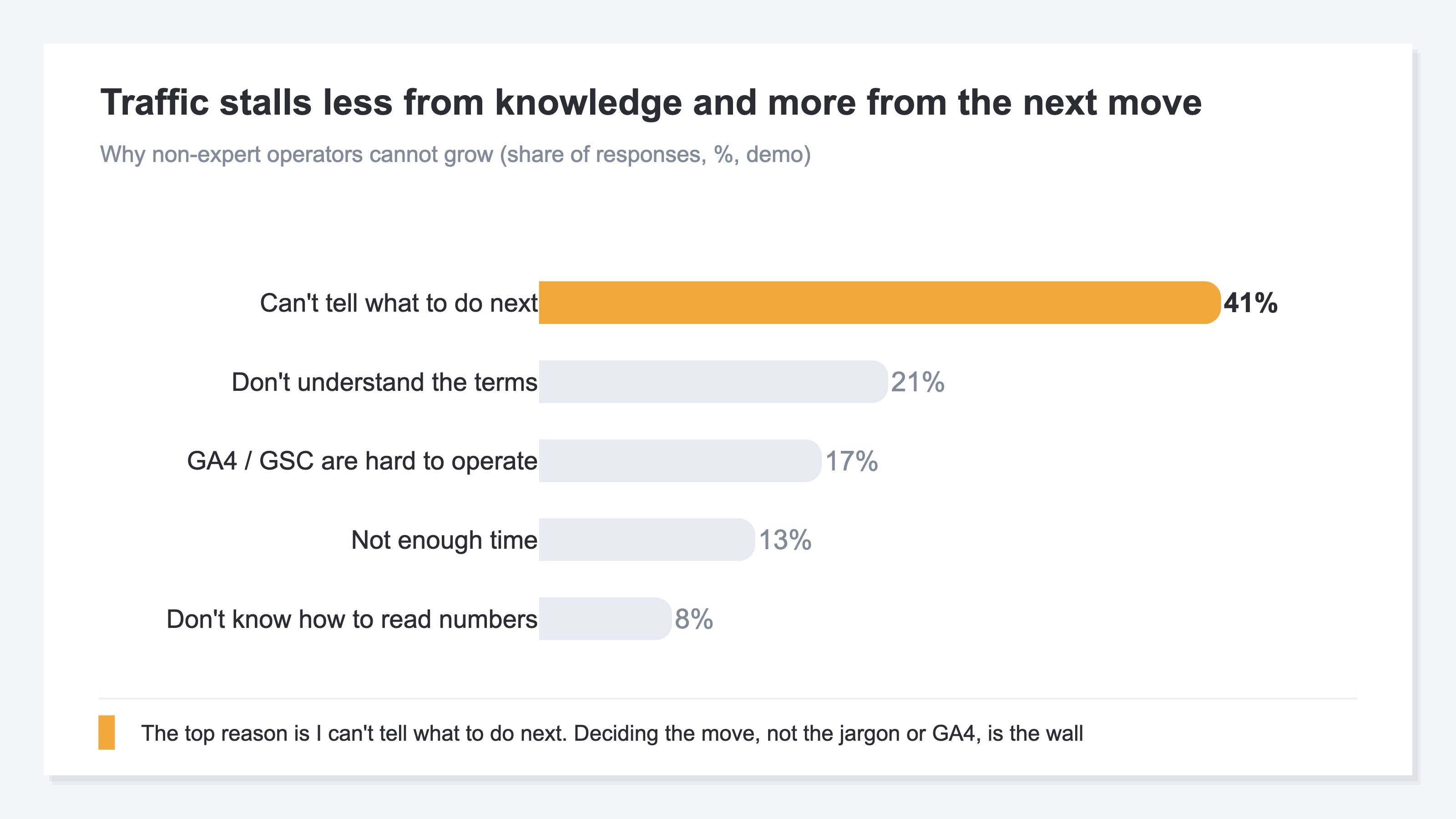
GA4 and Google Search Console do teach you a lot. But both are tools that show "what happened." Impressions rose, rankings fell — they take you that far. What they do not do is hand a non-expert a one-line answer to "in order of revenue impact, where should I touch this week?" This is the structural reason beginners stay stuck for so long.
So we change the order. Instead of moving only after perfectly memorizing jargon and GA4, first let something read "my numbers as they are" now and hand you the moves. Even with small sales, your current position is visible for free. That entry point is laid out in Growing traffic on a zero ad budget: you can see where you stand before any sales. Once you can see where you stand, the next question is how to get the moves.
2. What It Means to Let AI Read Your Numbers#
Bottom line: connect your own numbers to AI in read-only mode and just ask "what should I do this week?" — the moves come back.
Recent AI (ChatGPT, Claude, and others) can read your own numbers directly and answer from them. No hard setup or programming is needed. The point is to "hand your numbers to AI." Because it connects in read-only mode, there is no risk of your data being rewritten. All you do is hand over the numbers you prepared and ask in plain words.
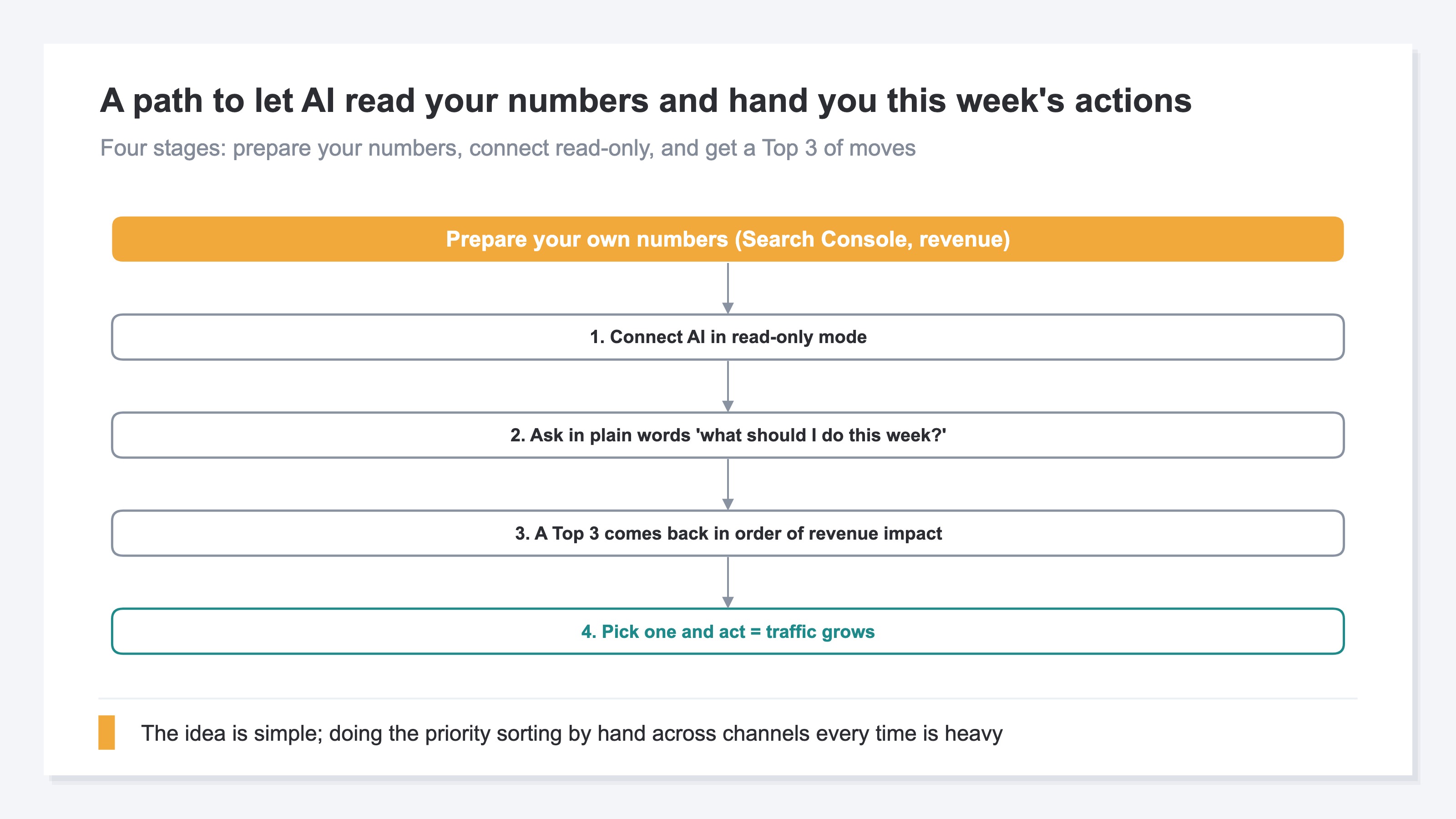
For example, ask "what should my site do this week?" and AI reads the numbers and returns a Top 3 in order of revenue impact. Search terms with many impressions but a ranking that is one step short, or pages that get visits but are not read — it surfaces those "places that work" without you hunting by hand. Even if you do not know the terms, the answer comes back as plain-language moves.
The important part is this: traffic does not grow because AI is smart. It grows because AI is reading "your real numbers." Put the other way: if you only ask for general advice without connecting the numbers, you get bland, one-size-fits-all suggestions. What works is not a clever prompt but the connection to real data.
3. The Order to Grow: Demand and Almost-There#
Bottom line: rather than growing at random, act first on keywords where "high demand" meets "almost-there ranking."
There is a trick to the order in which you grow traffic. Instead of pushing everything at once, touch the highest-impact places first. Two yardsticks help. One is demand (impressions) — how often you were shown in search. The other is almost-there (search position) — whether you sit just short of the top of the results.
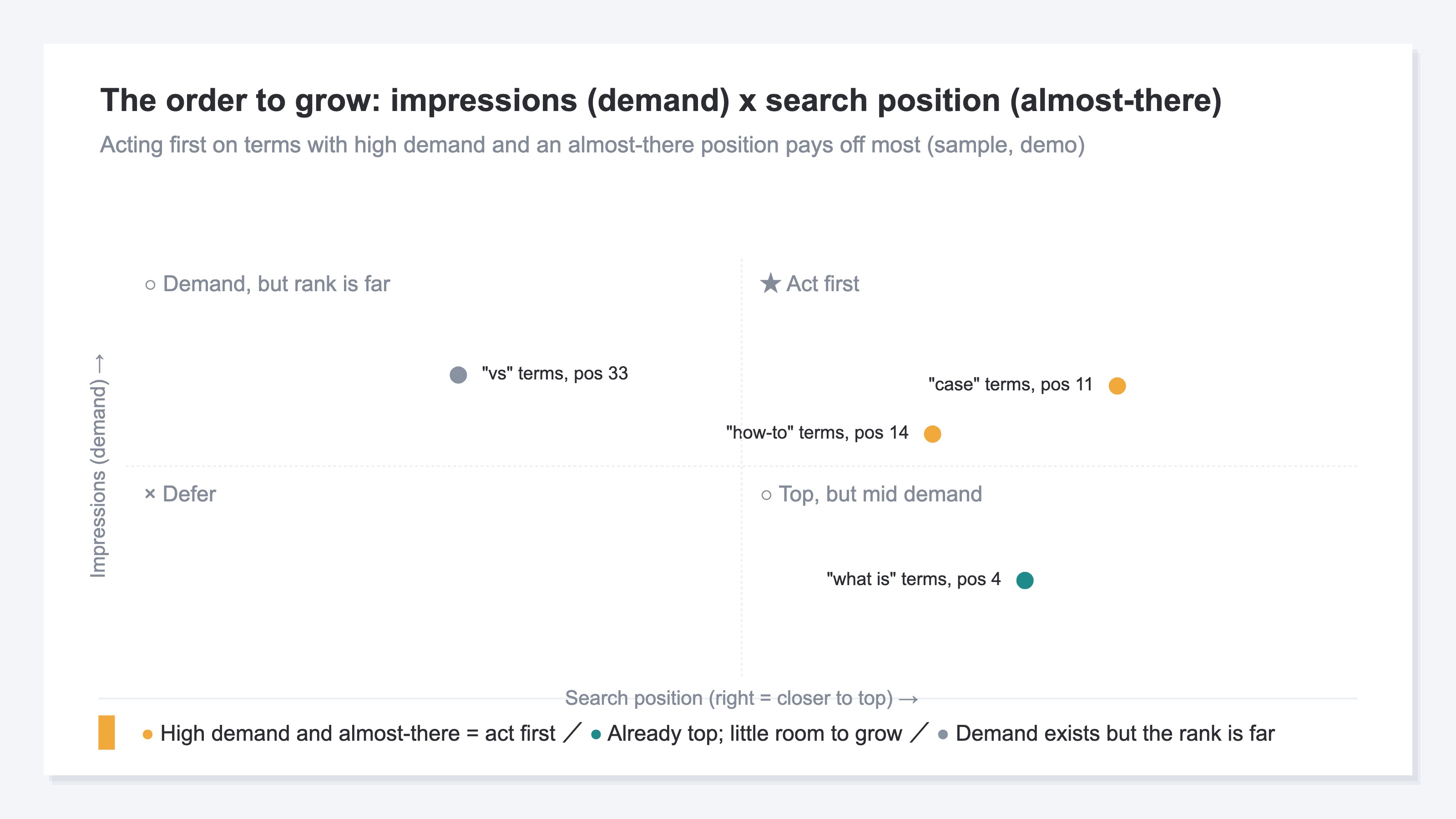
The terms where both line up — "shown often, yet one step from page one" — are the ones most worth acting on. Pages ranking around positions 8 to 20 can jump up with just a small touch-up. This "almost-there" thinking is covered in detail in Striking-distance keywords: turning almost-there terms into revenue.
When you want to compare the sources themselves, start from the breakdown of entry points. Which of search, social, referral, and direct is working is laid out in Comparing 12 main EC acquisition channels. And do not forget the "is this traffic that earns" view. More visits mean little if they do not turn into revenue. How much search traffic actually contributes to revenue is explained in Organic search revenue contribution: seeing traffic in revenue terms. That said, doing this "demand times almost-there" sorting across multiple channels by hand every time — simple as the idea is — becomes a quietly heavy, repetitive task.
RevenueScope's solution
Bottom line: doing it for free by hand is "simple to grasp, but heavy every time." RevenueScope lets AI read your own numbers and returns a Top 3 of moves in order of revenue impact. And it is free to start.
What you have seen so far is that the material for the moves — demand, almost-there, revenue by channel — lives inside your own numbers. The problem is that lining it up across channels and sorting it by revenue impact is heavy when done by hand every time. GA4 and Google Search Console show "what happened," but they do not hand a beginner a one-line answer to "where do I touch this week?"
RevenueScope is a lightweight dashboard you can use by adding a single tag to GA4, with a window (MCP) that lets AI read those numbers. Ask AI "what should I do this week?" and it reads RevenueScope numbers in read-only mode and returns a Top 3 in order of revenue impact. Almost-there search terms, the channels that earn, the pages you are missing — even for a non-expert, the moves come back in words.
| Your question | What AI returns (example) |
|---|---|
| What to do this week? | A Top 3 by revenue impact. E.g. a "how-to" term at position 14 is almost-there with high demand, so start here |
| Which terms can grow? | Almost-there terms (positions 8-20) with large revenue opportunity, from the top down |
| Which entry point to strengthen? | Visits and revenue lined up by channel — search, social, referral — as a breakdown |
Ask AI, and it reads RevenueScope numbers and returns this (demo).
What RevenueScope does is turn your scattered numbers into moves in order of revenue impact. It lines up almost-there search terms, the channels that earn, and the pages you are missing — estimated revenue included, on a revenue basis, on one screen — so you can decide "where to touch this week" by numbers instead of guesswork. Because the estimate leans conservative, you see where you stand without inflating it. And it is free to start — from a free sign-up, you judge your moves with real data.
FAQ#
Q. I barely know any marketing terms. Can I still use this?
Yes. In fact, working before you memorize the jargon is exactly the point of this approach. Let AI read your own numbers, ask "what should I do this week?", and the moves come back in plain words. You can pick up the technical terms little by little, when you actually need them.
Q. Will traffic really grow just by asking AI?
It is not something that "grows automatically just by asking." What AI returns is a Top 3 of moves in order of revenue impact. Whether it grows depends on whether you actually try that move by hand. Treat it as a tool that reduces guesswork and pours your limited time into the move that works.
Q. I have no sales yet. Is there still any point?
Yes. Impressions, search positions, and sources are visible before any sales. Estimated revenue starts from zero, though, so at first it is best to use "demand" and "almost-there" as your cues and start by deciding the order in which to grow.
Summary#
Traffic was not failing to grow because you lacked knowledge. Most of the time, the cause is "I can't decide what to do next." And that wall can be cleared before you memorize the jargon. Let AI read your own numbers in read-only mode, ask "what should I do this week?", and the moves, in order of revenue impact, come back in words.
The trick to the order of growth is demand (impressions) times almost-there (search position). Acting on terms where both line up is the shortcut. But doing that sorting across channels by hand every time — simple as the idea is — becomes a heavy, repetitive task.
So even when you finish this article, it does not end at "just ask AI." What remains is the work of lining up your scattered numbers and turning them into moves in order of revenue impact. Lighten that, and even a non-expert can pour limited time into the move that works. Start for free — start by letting AI read the numbers you have now.
See which ads actually drive revenue, at a glance
Free up to 5,000 sessions/month, AI connection included. No credit card required. Up and running in 5 minutes.