Open the GA4 monthly report and referral is stuck in the negative month over month. Year over year lines up even worse. The dividing line for this symptom sits on May 13, 2026. Before that date and after it, the range of visits the referral row is responsible for is not the same thing. If what you know about that row dates from before May 13, that is the first thing to update.
Contents
TL;DR#
- On May 13, 2026, a channel called AI Assistant was added to GA4[1]
- Visits from assistants like ChatGPT get
ai-assistantattached as the medium automatically, and the volume that used to sit in referral moves to that row[1][2] - Medium is set at the moment a session is measured, so sessions recorded before May 13 stay in the old classification
- Google's AI Overviews and AI Mode are out of scope for this channel and stay inside search[2]
- Over the last 90 days on our own site, the total for AI assistant traffic ran about 1.6 times higher than the total for visits arriving from pages on other sites (video and social counted separately)
1. The Referral Drop Began on May 13#
The starting point of the decline is a change in the spec, not something breaking on the site.
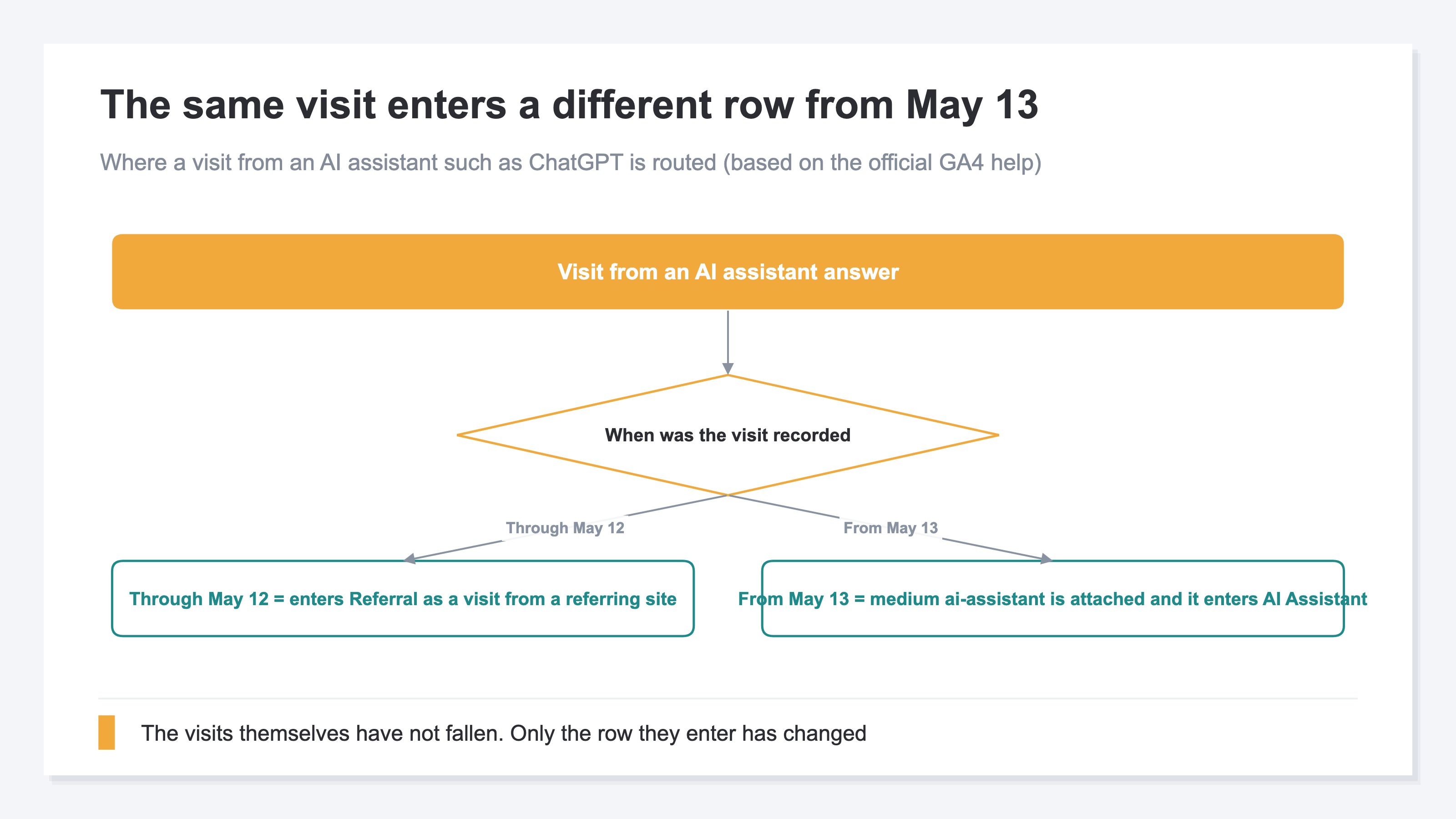
The GA4 release notes carry an entry dated May 13, 2026: "New AI Assistant traffic measurement"[1]. GA4 identifies visits that arrived from an AI assistant such as ChatGPT and automatically attaches ai-assistant as the medium. The channel group reads AI Assistant, and the campaign reads (ai-assistant)[1].
No tag work and no setting change are required. The release notes state that the assignment happens automatically[1]. Even on a site where no tag has been touched, the classification alone switched over from May 13.
The help page for the default channel group carries the matching definition. Visits whose medium is an exact match for ai-assistant enter this channel. When the source falls within the list of AI assistants, GA4 sets the medium and the campaign on its side[2]. The examples given are ChatGPT, Gemini, Deepseek, Copilot and Grok[2]. The release notes also name Claude[1].
As a result, a click from ChatGPT that used to enter referral as a visit from a referring site enters a different row from May 13 onward. The person who visited, the page they landed on, and whether they bought are all unchanged. What changed is the row in the tally.
How far the drop goes differs from site to site. The more ChatGPT traffic a site had grown, the more abrupt the fall looks. The definition of the channel itself is covered in GA4 channel classification.
2. Month over Month Breaks Because the Definition Changed#
April is 30 days all under the old classification. May is 12 days of the old classification followed by 19 days of the new one. June is 30 days all under the new classification.
Medium is attached at the point the session is measured. There is no mechanism that reassigns it afterwards, so sessions recorded before May 13 stay in referral and the other old classifications.
There is no single official sentence stating that it is not retroactive. There is, however, a hint inside the same release notes: the Source Group entry added on June 11, 2026. That one states plainly that past data is populated retroactively[1]. The May 13 entry for AI Assistant carries no such wording. The June 11 change is covered in GA4 adds Source Group.
So a referral comparison that straddles May is a subtraction between two values with different definitions. April's referral includes AI traffic, and June's does not. Year over year is more extreme still, because the comparison point 12 months back sits entirely under the old classification.
Write "down 30% month over month" in a monthly report and the reader takes it as a traffic problem. The discussion then spins on with no target left to fix.
The first move you can make on your own is to cut the period at May 13 and read each side separately. Aggregating the first and second halves apart tells you whether the fall overlaps with the switch in the spec. What it gets you, though, stops at isolating the symptom. It does not reach lining the moved visits back up as a single series on the earlier basis, or comparing how each assistant performs.
3. Where the Traffic That Left Referral Went#
Checking against our own site's data, sessions arriving via AI assistants came to about 4% of the site as a whole. Measured over the last 90 days, April 30 to July 29, 2026.
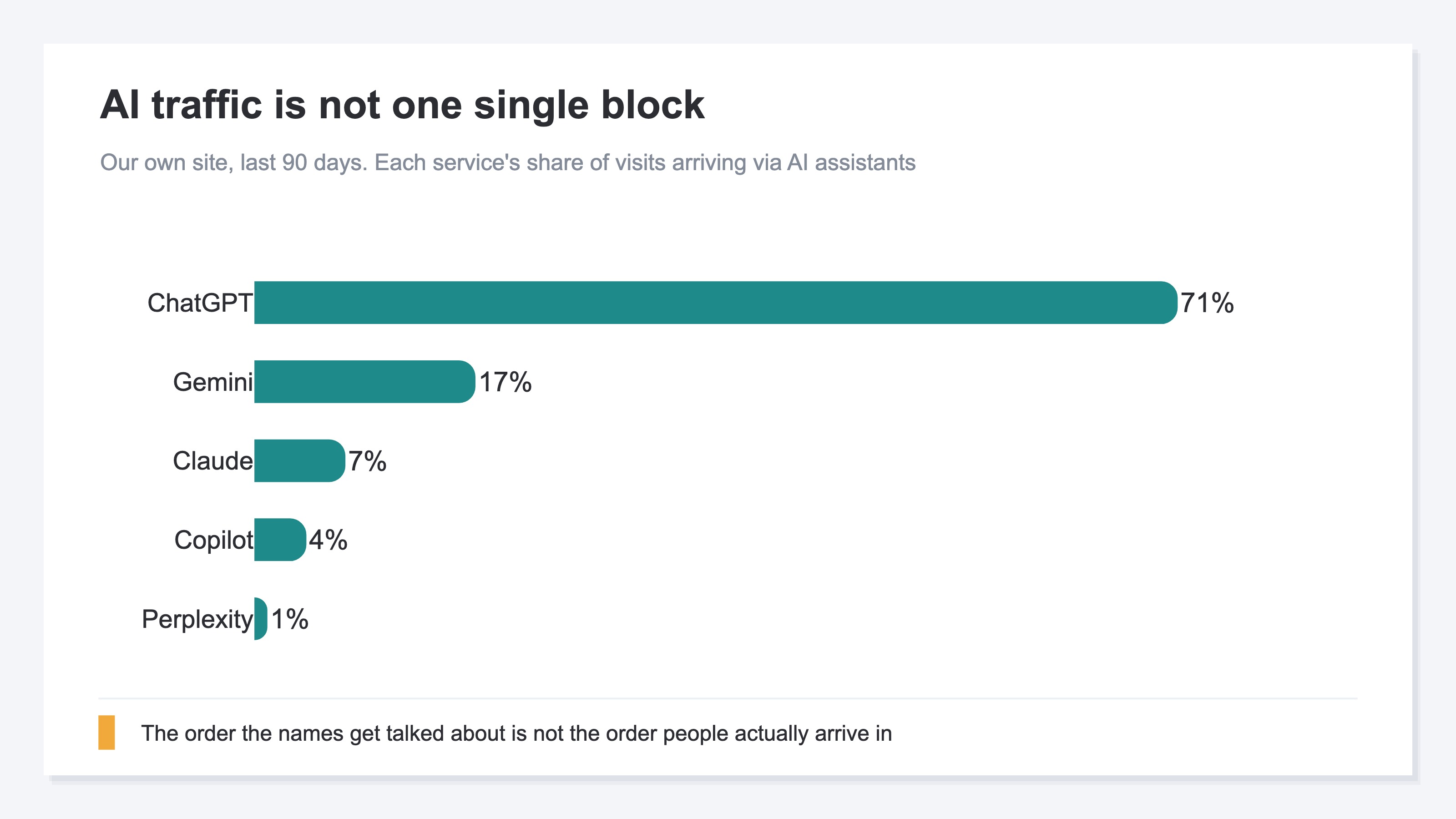
The breakdown is heavily lopsided. About 70% of AI traffic was ChatGPT, followed by Gemini, Claude and Copilot. Perplexity stayed in the 1% range of AI traffic across these 90 days. The order in which the names get talked about is not the order in which people actually arrive.
Change what you compare against and the picture changes with it. The aggregation here is our own source-based classification, and it does not line up with how GA4 cuts its channels. On that basis, take the visits that arrived from pages on other sites (video and social are counted separately), add them together, and set that beside the total for AI assistants. Over the same 90 days, AI traffic came out about 1.6 times higher. Had AI traffic still been sitting in the other-sites bucket the way it used to, that row would be running at more than double its current level. That is what produces the referral drop.
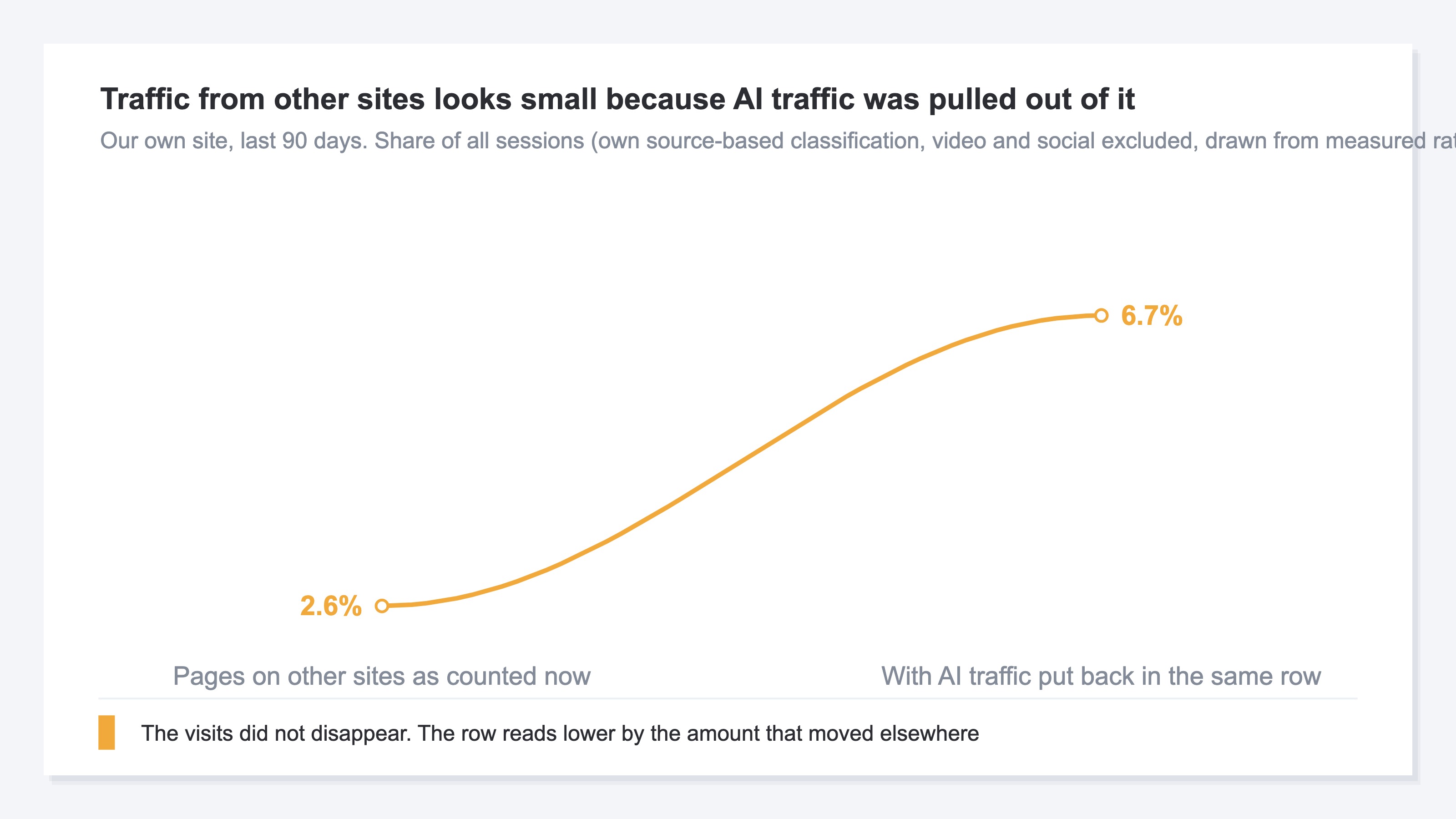
Read only as about 4% of the site as a whole, it feels small. Inside the single referral row, though, that 4% was the lead. Being small against the whole and being able to explain the rise and fall of one particular row are two different things.
One more thing: visits from AI that pass no referrer do not enter this row either, and mix into direct instead (where unlabeled AI traffic goes). In the other direction, automated access can mix in and inflate this row, so the cautions for reading it are collected in GA4's AI Assistant channel.
4. This One Row Does Not Hold All AI Traffic#
So is watching this row enough to capture every visit that came through AI?
It is not. The help page for the default channel group states plainly that Google's AI Overviews and AI Mode are out of scope for this channel[2]. Visits from those two stay inside search. That mechanism is covered in where AI Mode traffic shows up in GA4.
There is a second range that cannot be stated definitively. The list of sources used to make the determination is not published. The names that appear in the help page and the release notes stop at ChatGPT, Gemini, Deepseek, Copilot, Grok and Claude[1][2]. For a service not listed there, all that can be said is that it is not among the official examples. Deciding it is included is as premature as deciding it is not.
With those two in view, reading the AI Assistant row as the full volume of AI traffic does not hold. Conclude that AI traffic is not growing because this row is not growing, and the whole of the change on Google's side goes unseen. Report this row's growth as the growth of AI overall, and this time the estimate runs high. The mistake runs in both directions.
The AI Assistant row from May 13 onward and the referral row from before it are both still inside GA4. What is missing is not the data but the arrangement that reads those two as a single series on the same basis.
RevenueScope solution
Whether comparison survives a row swapping places is decided by where the classification is managed. When the measurement tool's definition changes, past data takes on a different meaning from that day onward.
Visits from ChatGPT, Claude, Gemini, Perplexity and Copilot are shown one row each from the start, in the same list as Referral, Google search and Direct. The determination is held by RevenueScope itself and made from the referrer, so the rows stay put even when the measurement tool's definition moves. Each row carries sessions, revenue and revenue per session (RPS), and the same table also shows visitors, average time on site and bounce rate, along with the count of automated access that was excluded.
One example (illustrative, fictional figures): Fictional Store E in April and July, written out by traffic source.
| Traffic source | April revenue | April RPS | July revenue | July RPS |
|---|---|---|---|---|
| ChatGPT | ¥150,000 | ¥400 | ¥600,000 | ¥500 |
| Referral | ¥500,000 | ¥500 | ¥200,000 | ¥400 |
| Google search | ¥450,000 | ¥300 | ¥480,000 | ¥300 |
| Direct | ¥300,000 | ¥250 | ¥300,000 | ¥250 |
Note: the table above is a teaching example built to explain the mechanism. The screen behind the button runs on the sample store's sample data, refreshed daily, so not only are the values different — the row holding the top position swaps depending on the day it is opened.
April's leader by revenue is Referral, July's is ChatGPT. Total revenue grew by just over a tenth, yet the row at the front changed hands. Look at RPS and ChatGPT was already above Direct back in April. Efficiency was showing while the volume was still small.
Because the leader changes hands once the period is split, fixing allocation on a single month's table means mistaking that swap every time. The next move is to pull the period straddling May 13 again under one classification, and separate whether the AI row is genuinely growing or has only moved across from Referral.
FAQ#
Frequently asked questions#
Q. Will data from before May 13 be reassigned to the new channel?
A. There is no official mention of retroactive assignment. Medium is attached at the point the session is measured, so sessions recorded before May 13 stay in the old classification. The June 11 entry in the same release notes does state that past data is populated too[1]. The AI Assistant entry carries no such wording.
Q. Do visits from Perplexity enter this channel?
A. It is not among the official examples. The help page lists ChatGPT, Gemini, Deepseek, Copilot and Grok[2], and the release notes name Claude[1]. The list of sources used to make the determination is not published, so neither "it enters" nor "it does not" can be stated definitively.
Q. Where do visits from AI Overviews and AI Mode land?
A. Not in this channel. The help page states plainly that Google's AI Overviews and AI Mode are out of scope[2]. Visits from these stay inside search.
Q. Does anything have to be set up for this to be measured?
A. GA4 applies this AI-assistant classification automatically, without additional setup. The release notes state that the determination and the attaching of the medium happen automatically on GA4's side[1]. The flip side is that no method for stopping the automatic medium assignment is documented.
Summary#
If the fall in referral starts in May, the first thing to suspect is not your own campaigns but the change in classification. The AI Assistant channel was added on May 13, 2026, and visits from assistants like ChatGPT get a medium attached automatically[1]. Medium is attached at the point of measurement, so sessions before that date stay in the earlier classification. A month-over-month comparison that straddles May is a subtraction between two values with different definitions.
At the same time, this row is not the full volume of AI traffic. Google's AI Overviews and AI Mode are out of scope and stay inside search[2]. For services whose names do not appear in the official examples, it remains impossible to say either that they are included or that they are not.
The next thing to do is not to patch the month-over-month figure in the monthly report. Pull the period straddling May 13 again under one classification, and separate whether the AI row is growing or has only moved across from Referral. Then confirm whether the visits that moved are reaching revenue. The order is settled here.
See which ads actually drive revenue, at a glance
Free up to 5,000 sessions/month, AI connection included. No credit card required. Up and running in 5 minutes.