Search your own brand name and another company sits above you on the first page. This isn't a story about branded search declining — it's a story about the branded results page being taken by someone else. The loss here costs the most per click, and it is also the loss least likely to surface in your own data.
Contents
TL;DR#
- The branded results page is not yours alone. Comparison sites, your own storefront inside a marketplace and review sites share the same first page
- Average position in Google Search Console is the average of the topmost position attached to your links[2][3]. Who was above you is not part of what it records
- Rare search terms are omitted and the number of rows displayed is capped[1]. The branded loss never comes out as an absolute number
- Aggregating one site of our own, 95.1% of the terms with an average position inside the top ten had zero clicks
- Comparison articles, structured data and the site name are all correct moves. Which one applies depends on what is lined up above you
1. What Is Happening on Your Branded Search Results Page#
A competitor showing up above you on your own brand name does not necessarily mean your ranking fell.
People searching a company name or a product name have all but decided where they are going to buy. If another company occupies the upper part of that screen, the destination changes one step before the purchase. Add up every other term you rank for and it can still fail to cover what a single branded term loses.
It shows up in several forms. Your site is not in the first position. It is first, but comparison sites and review sites surround it. Or the branded term does not appear in the Google Search Console list at all.
Your own data reads as a high position, yet searching the company name on the device in front of you turns up nothing of yours on page one. What occupies the space is not necessarily a competitor — it can be a review site or a video site.
The case where branded search itself is shrinking is covered separately (why branded search is falling). That one is about fewer people searching the name; this one is about the same number of people searching while the share of the results page changes hands.
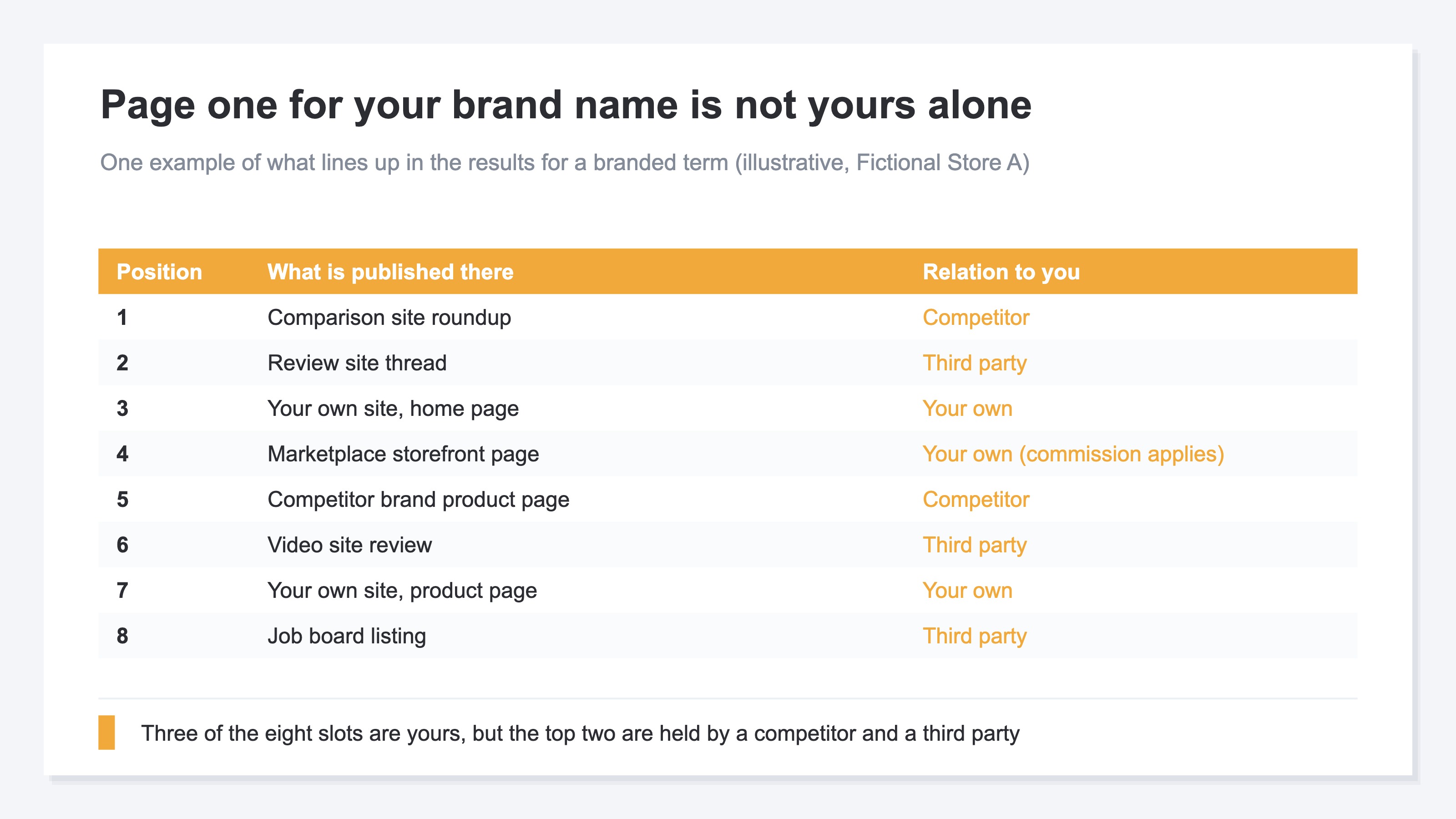
The moves people reach for here are adding a comparison article, adding structured data, or setting the site name. Around branded search all three are correct moves. But pick one before confirming what is lined up above you and you spend months on a move that does not apply. A comparison site above you calls for a comparison article; your own storefront inside a marketplace calls for canonicalization and the site name; a review site above you calls for something else again.
2. How Far the Loss Can Be Measured#
The loss cannot be produced as an absolute number. What can be measured goes as far as prior-period change and ratios.
Average position in Google Search Console is the topmost position attached to your links[2][3]. That figure is then averaged across every search for that term[2]. If your pages appear at positions 2, 4 and 6 in the same set of results, the position recorded is 2[2].
Rare search terms are omitted[1]. Terms issued very few times, and terms that contain personal information, may not be recorded at all[1]. Anonymized terms are not shown in the list[1]. The table itself is capped at 1,000 rows[1]. Terms derived from a company name tend to carry small search counts, so the very terms where the loss is happening are the ones that fall out of the list.
We checked this on one site of our own. For the 30 days from 13 July to 12 August 2026, we pulled the search term list in descending order of clicks, up to 1,000 rows, and aggregated it. That is separate from the 1,000-row cap above — this figure is the row count we asked for.
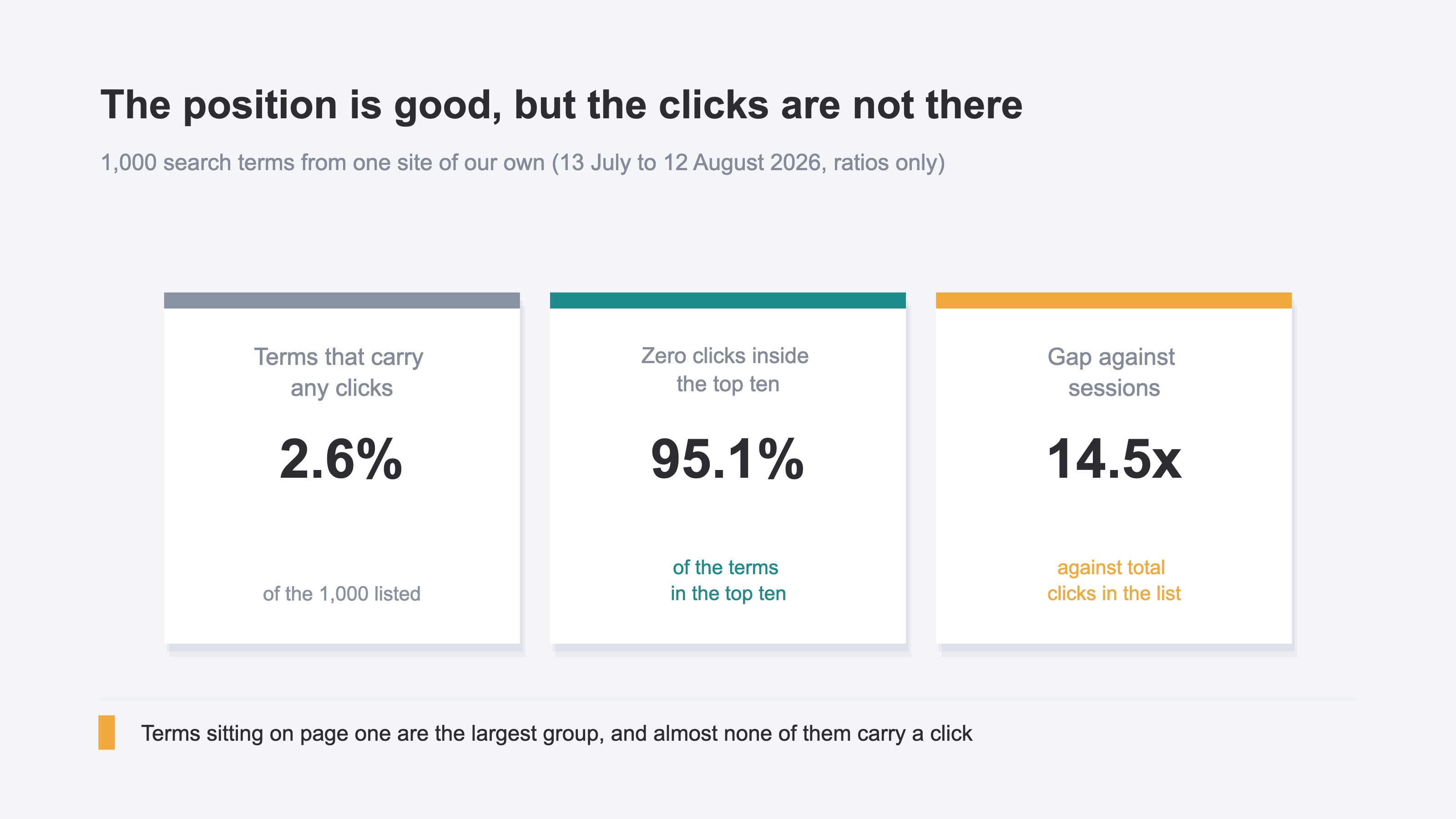
Terms with one or more clicks came to 2.6% of those 1,000 rows. Terms with an average position inside the top ten came to 42.8%, and 95.1% of those had zero clicks. Sessions that landed from Google search over the same period came to 14.5x the total clicks in that list. That multiple itself is covered in detail separately (why your Search Console clicks don't add up).
Most of the terms sitting on page one produce no clicks at all. That pattern shows that position alone cannot account for the loss. There is no route here to an absolute figure for how much was lost.
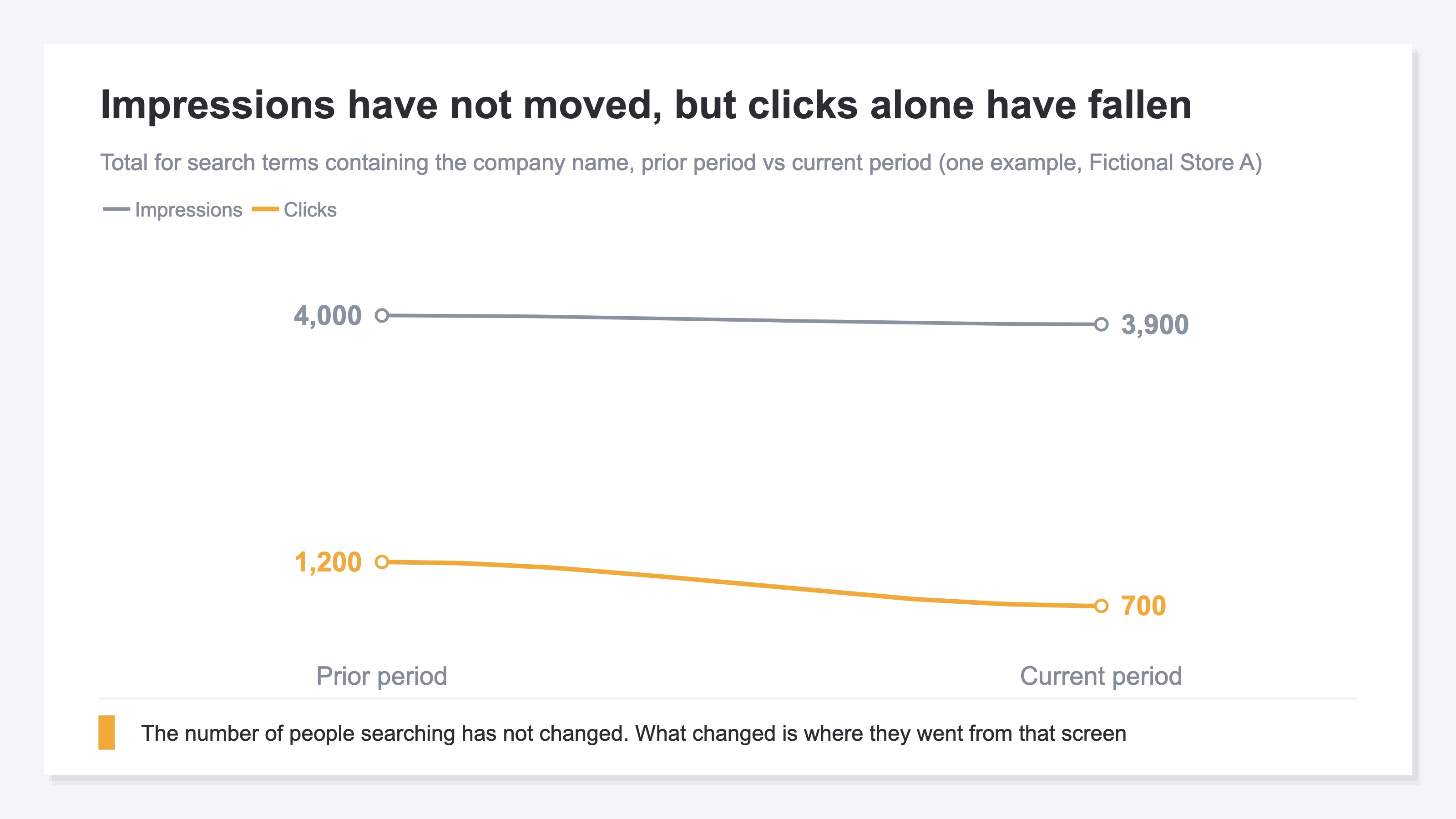
What can be used instead is the rate of change between the prior period and the current period for the same term. If impressions barely move while clicks alone fall, the number of people searching that name has not changed. What changed is who got picked on that screen.
How to read SEO's true strength with branded search taken out is laid out separately (traffic up but no new customers). That one is about reading the numbers with branded terms removed; this one is about the loss inside branded search itself.
3. Your Position Is Recorded but What Sits Above It Is Not#
What remains in your own data is your own position and nothing else. What sat one line above it is recorded nowhere.
What Google Search Console records as position is the location of your link as it appeared in the search results[2]. For a position to be recorded at all, that link has to have actually been displayed[2]. What falls inside the scope of the record is whether your link appeared and, if it did, where. That is all.
What was above it is not inside the scope of that mechanism. Whether the number is 1 or 8, the number is all that remains, and the name of whatever was placed above it appears nowhere.
There is the option of searching the company name by hand and confirming what is visible. As a first pass that is enough. It has three limits.
- Search results differ from person to person. Location and past behavior change the order
- What you saw is one moment, one time
- Unless you repeat it every week, you will not notice when the lineup above you changes hands
The method suits a first check and does not suit continuous measurement.
The site name, one of the moves available, also has a line around what you can write. A site name is generated automatically from the content of the home page and from referring pages on the web, and an automatically generated site name cannot be changed by hand[4]. What you can specify goes as far as an alternate name[4].
Finding the terms a competitor wins that you do not hold is laid out separately (competitor keyword gaps). That one is about the breadth of terms not yet won. This one is about the vertical lineup inside a single term where you already hold a position.
How a brand is handled inside an AI answer is a separate matter again from search results (does ChatGPT name your brand / measuring AI brand visibility for a mid-market store).
What your own measurement can answer goes as far as what position you held. Whatever was placed one line above it never entered the scope of the record. Learning who is above you means going outside your own records: either checking by hand every week, or deciding which domains to track and following their positions in external SERP data.
RevenueScope solution
RevenueScope displays clicks, impressions, click-through rate, average position and estimated revenue for each search term, alongside the prior-period comparison for clicks and for estimated revenue. How far the branded terms have fallen is read from that prior-period comparison.
The same dashboard also carries a list of the terms that tracked competitor domains are winning in Google search. Each term comes with its position, its monthly search volume and the change in position since the previous survey. This side is external SERP data, gathered from a different source than your own Google Search Console. The moment of collection is stated, so it is clear which set of search results is on screen.
The Keyword With the Largest Drop Is Not the Same Every Month#
One example, with the terms around the company name pulled out for Fictional Store A.
| Keyword | Clicks | Position | Clicks vs prior period | Estimated revenue |
|---|---|---|---|---|
| Fictional Store A | 120 | 1.4 | −12% | ¥48,000 |
| Fictional Store A reviews | 90 | 4.2 | −38% | ¥36,000 |
| Fictional Store A shipping | 40 | 2.1 | +5% | ¥16,000 |
Note: estimated revenue is an approximation proportional to click count, so the ordering matches clicks exactly. Which term to work on first is decided by the prior-period change and the position, not by estimated revenue.
Note: this branded-search table is an illustrative example. The demo screen runs on the sample store's sample data, refreshed daily, so opening a table of the same shape returns different values.
What to look at is the prior-period change. The largest drop is not the company name itself but the review-related derivative term. Its position has slipped to 4.2 as well.
In the same table last month, the largest drop was the company name itself. This month it has moved to the review-related term. Decide to build a comparison article from a single month of that table and next month the loss shows up on a different term.
What comes next splits in two. First, check on the external SERP data side whether any tracked competitor domain holds a position on the review-related term. What that side shows covers only the domains registered for tracking, so the full lineup, review sites and video sites included, is confirmed with the manual search described in section 3. Whether what sits above you is a comparison site, a review site or your own storefront inside a marketplace changes which move you choose.
FAQ#
Frequently asked questions#
Q. Our company name does not appear in the query list even though people search it. Does that mean branded search is zero?
A. Google Search Console can omit a branded term even when searches occurred. Terms issued very few times may not be recorded[1], and anonymized terms are not shown in the list[1]. The number of rows displayed is capped as well[1]. Absence from the list is not proof that no one searched.
Q. If we hold the first position, can we take it that there is no loss?
A. First position only describes where your link sits. Other companies are listed on that same first page, so first is not automatically the one that gets picked. If impressions hold steady while clicks alone fall, loss is happening even at first position.
Q. A competitor ranks highly on our own brand term. Is that not a violation?
A. Most of the time it is an ordinary SEO outcome. A comparison article or a roundup ranking on a search that contains a company name is there because its content fits what the searcher wanted. The direction to head is not a complaint but thickening the information on your own side.
Q. Our storefront inside a marketplace ranks above our own site. Does that ranking arrangement require action?
A. As long as the revenue is coming in it is not a loss, though the commission lowers the profit on each order. Sometimes the order has swapped because the information on the owned site is thin. What to check first is not which of the two is on top but which of the two has the falling prior-period comparison.
Summary#
When another company sits above you on your own brand name, what is happening is not a drop in position but a change in the share of the results page. Branded search is the closest point to a purchase, so the loss here costs the most per click.
The absolute figure, though, cannot be produced. Rare search terms are omitted and the number of rows displayed is capped[1]. What can be measured is the rate of change between the prior period and the current period for the same term. If impressions hold while clicks alone fall, it reads as a change in how the pick is made.
Choosing the move comes after that. Add a comparison article, sort out the relationship with the marketplace storefront, or specify an alternate site name[4]. Decide after confirming what is lined up above you and you avoid spending months on a move that does not apply.
Once a month, record the prior-period change in clicks for the terms around your company name. If the term with the largest drop has swapped from last month, that is the next place to look.
See which ads actually drive revenue, at a glance
Free up to 2,000 sessions/month, AI connection included. No credit card required. Up and running in 5 minutes.
References#
- [1] Google Search Console Help "About Search Console data" (2026)
- [2] Google Search Console Help "What are impressions, position, and clicks?" (2026)
- [3] Google Search Console Help "Performance report (Search results): Overview and basic setup" (2026)
- [4] Google Search Central "Site Names in Google Search" (2026)