Filter Google Search Console down to the search terms that contain your brand name, and impressions have fallen three months running. Average position is still first. Click-through rate has barely moved. And yet impressions alone keep sliding — that state exists.
Contents
TL;DR#
- Branded search impressions come close to being a count of how often people searched for your name. If neither position nor click-through rate has moved and impressions alone fall, the act of searching itself is shrinking
- The candidate causes are seasonality, stopping ads tied to brand keywords, a decline in brand recall, and a move from search to AI. Each one is confirmed with different data
- If you suspect the move to AI, put the period-over-period change in branded query impressions next to the rise or fall of GA4's AI Assistant channel
- AI-referred traffic is growing across the market as well. A study analyzing the logs of a single domain reports ChatGPT referrals growing 5.7 times, with most of that growth explained by the platform's own expansion[4]
- Even when your own AI-referred traffic is rising, whether that is market growth or your own name moving over is told apart by revenue per visit, not by volume
1. What Is Happening When Branded Impressions Fall#
An impression in Google Search Console is a count of a page of yours being shown in the search results[1]. Narrow that to branded search — the search terms containing your company or brand name, which Google Search Console calls "queries" — and your page is shown near the top almost every time. That makes impressions a close stand-in for how often that name was searched.
This is where branded terms differ from non-branded ones. For a generic term like "ec analytics tool," impressions rise and fall with position all on their own. Branded search sits at the top from the start, so there is almost no room for position to explain anything. If position hasn't changed and impressions have fallen, the only reading left is that fewer people are searching.
This number also moves before clicks do. When fewer people search, impressions drop first and clicks follow behind. By the time revenue feels it, impressions will have been falling for a while already.
Branded search usually gets treated as the safe number. Repeat visits from existing customers make up much of it, which flatters SEO beyond its real strength, so when you measure that strength you strip it out (Traffic up but no new customers). But stripping it out to measure and never noticing it is falling are two different things.
2. Four Causes Worth Considering#
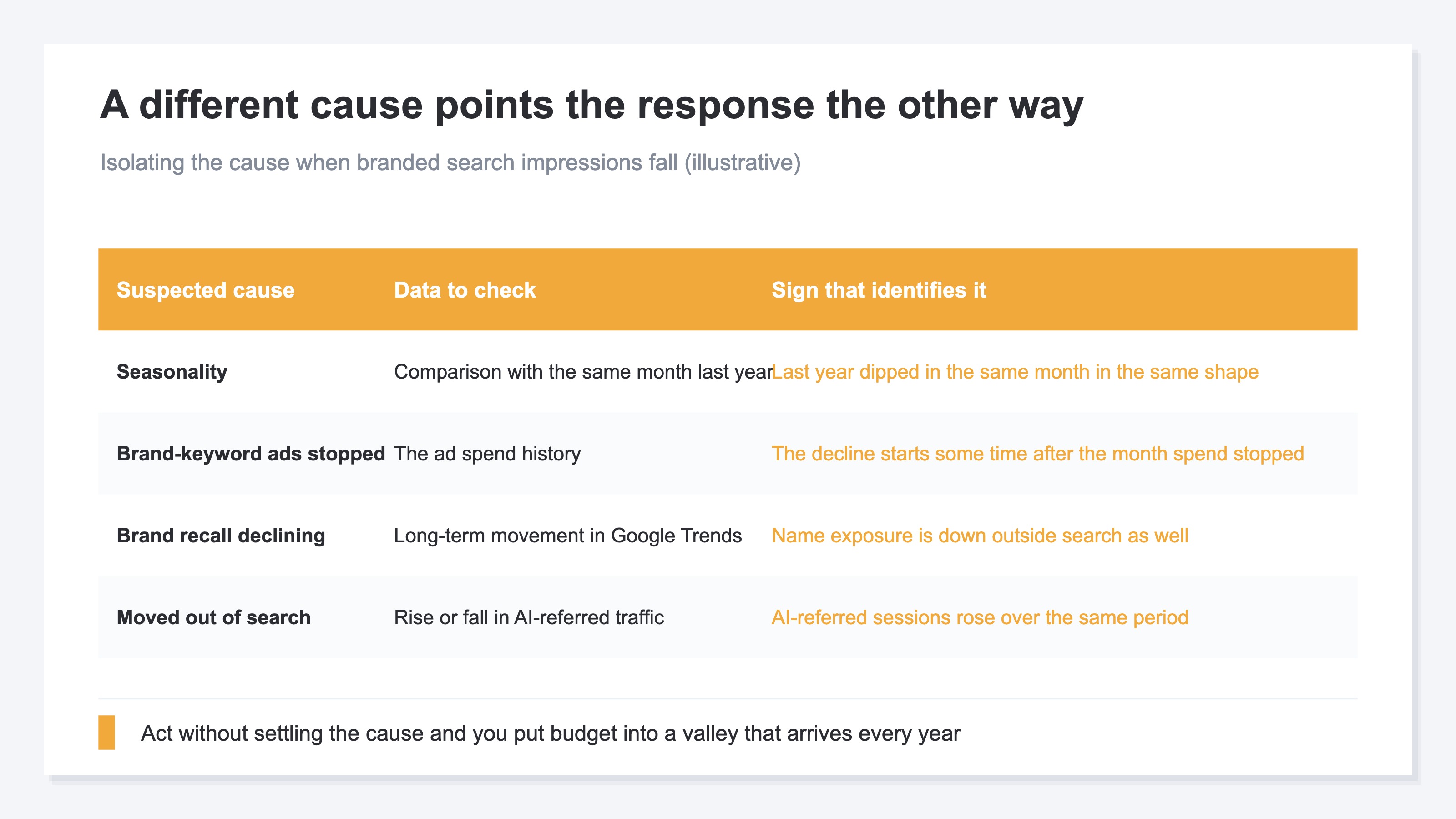
Seasonality comes first. If the same month last year carries a dip of the same shape, this isn't an anomaly unique to this year. Look only at month-over-month and you will treat a valley that arrives every year as a new problem every time.
Ads come next. If there was a period when you ran ads tied to brand keywords, check whether the month you stopped and the month impressions began falling line up. The people who learned the name from those ads and searched for it afterwards keep dropping away for a while after the spend stops.
Third is a decline in brand recall itself. Your own data can't settle this, so look at long-term movement in third-party data such as Google Trends[5]. That source is a sampled relative index, though, so it can't stand as evidence for how large the absolute decline was.
Fourth is the move out of search. People who know the name are asking an AI assistant instead of typing into a search box. The next section is the procedure for checking that possibility.
The response goes the opposite way for each of the four. Seasonality means waiting. A stopped campaign means deciding whether to bring the spend back. Falling recall means work on the brand side. A move to AI means preparing the landing side and the measurement for AI traffic. Act without settling the cause — "branded search is down, so let's run ads" — and you put budget into a valley that arrives every year.
3. Whether the Branded Drop and the AI Rise Happen Together#
When you suspect a move to AI, what you look at is the direction of two numbers. One is branded queries in Google Search Console; the other is sessions on GA4's AI Assistant channel. That channel was added on May 13, 2026[2], and it collects visits whose referral medium matches "ai-assistant"[3]. ChatGPT, Gemini and Claude fall under it.
Impressions are what you read for direction, but use clicks when you compare scale. Impressions run in the tens of thousands while AI-referred sessions run in the hundreds, and put side by side as they are, one of them flattens out of sight.
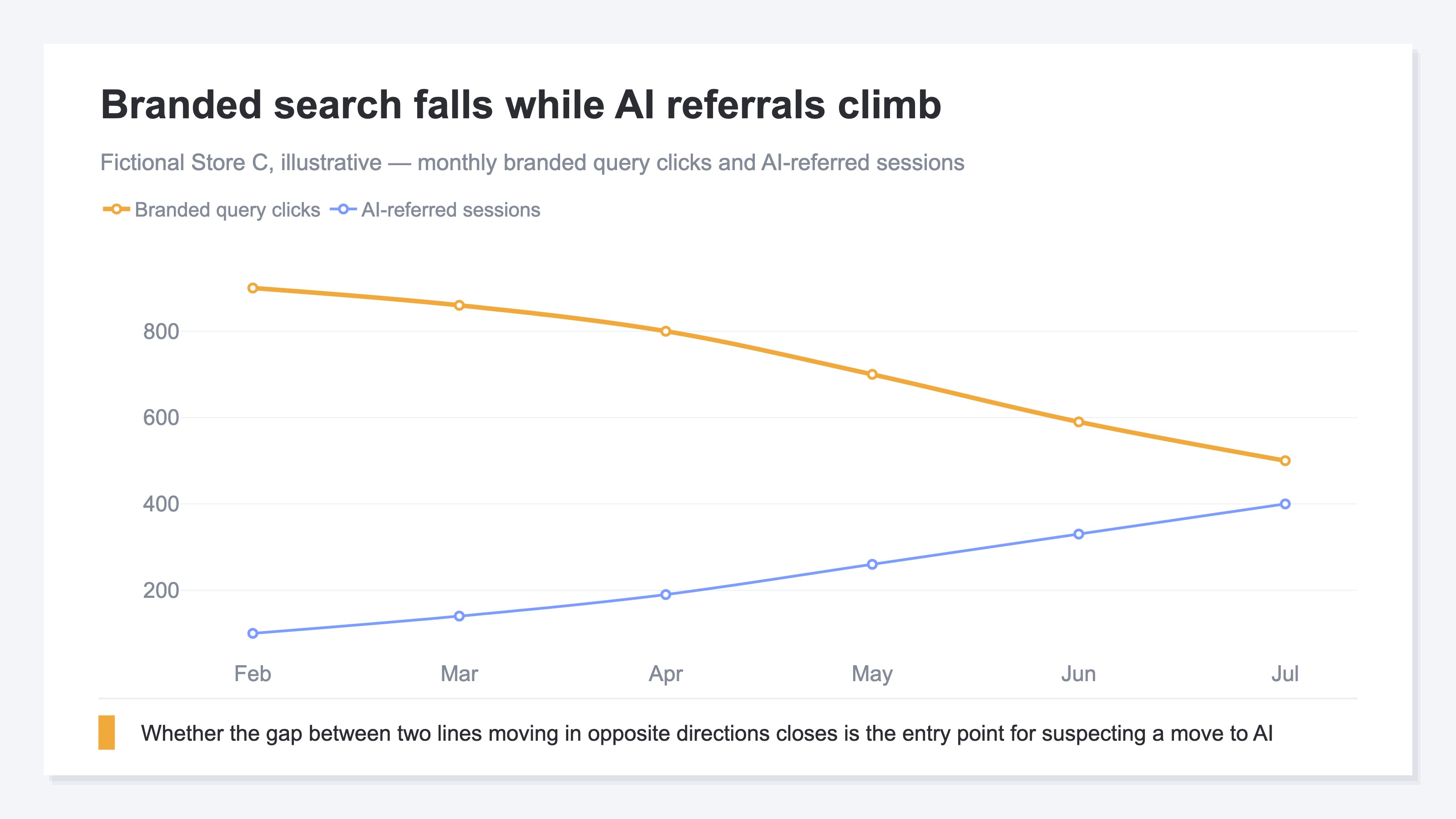
If the first falls while the second rises over the same period, part of the act of looking for the name may have moved to the AI side. But that is correlation, not cause. AI referrals are growing across the market as a whole. A study analyzing the logs of a single domain reports that ChatGPT referral traffic grew 5.7 times, while most of that growth was explained not by anything the site did but by the platform's own expansion[4]. It covers one domain, and the authors themselves call the result suggestive rather than conclusive. So even when your own AI-referred traffic rises, the fact that it rose cannot on its own separate your name moving over from the market growing.
The material you have to check with has limits too. That GA4 channel can carry automated access (GA4's AI Assistant channel: watch the bot and revenue blind spots), and the Google Search Console side runs two to three days behind and covers Google search only.
At this point it is tempting to think "let's just ask the AI and find out," but that check gives a different answer every time (The limits of asking ChatGPT about your brand once). How to measure the way your company is treated inside AI is laid out separately (How visible is your brand in AI search / Measuring AI brand visibility for a mid-market store). What this article covers is the line of reasoning that decides from the records left on your own side, without going and asking.
4. Whether Revenue Is Catching What Moved#
Suppose the move is real. The next thing to check is what is catching it.
People who ask an AI knowing the name already share the character of the people who used to arrive through branded search. They have a clear intent to buy, and they come to confirm price, stock and how to order. Look at session counts alone, though, and AI referrals appear to be a fraction of the size of branded search — small enough to be treated as noise in a monthly report.
What to read is revenue per visit (RPS). If AI-referred RPS matches branded search or runs above it, what moved is being caught. If AI referrals alone show a low RPS, the pages people land on don't hold what someone arriving by name comes looking for.
The problem is that these two never appear on the same screen. Branded query impressions sit in Google Search Console, AI-referred sessions in GA4, and revenue somewhere else again. Running the same reconciliation across three places every month doesn't survive as manual work.
RevenueScope solution
In RevenueScope, AI-assistant traffic appears as its own channel. ChatGPT, Claude, Gemini, Perplexity and Copilot each show as a separate row, and each carries sessions, revenue and RPS. Whether it is catching what branded search used to bring is answered by comparing that row's RPS against the other channels.
On the search-term side, Google Search Console clicks come with a comparison to the prior period. Impressions are shown as a current-period value, so movement in the terms containing your brand name is read with the period-over-period change in clicks as the axis. Per-keyword goes as far as the prior-period comparison; day-by-day movement is followed through the per-page trend.
Where Did the Lost Traffic Go?#
For Fictional Store C, pick up the terms containing the brand name, total them, and put the prior period next to the most recent one.
| What to read | Prior period | Most recent |
|---|---|---|
| Branded query clicks | 900 | 500 |
| AI-referred sessions | 100 | 400 |
| AI-referred RPS | ¥300 | ¥520 |
Note: Fictional Store C's figures are a teaching example, rounded for explanation. The demo runs on the sample store's sample data, refreshed daily, so opening the same view gives different values.
Branded query clicks fall by 400 while AI-referred sessions rise by 300. Counting visits alone, what was lost hasn't been filled yet. But AI-referred RPS has climbed from ¥300 to ¥520, so revenue per visit is up. Fewer visits, and the visitors are buying. What they moved to has started working as a place to land, which makes it worth putting effort into the pages AI referrals arrive on.
FAQ#
Frequently asked questions#
Q. If branded search is falling but revenue isn't, is there really a problem?
A. If it hasn't reached revenue, it isn't urgent as this month's decision. But the order runs impressions first, clicks following, and revenue after that. The stretch where revenue hasn't moved yet is also the most convenient stretch there is for isolating the cause.
Q. How should I pull out the terms that contain the brand name?
A. In the Google Search Console performance report, filter for queries containing your company or brand name[1]. Pick up spelling variants, romanized forms and common misspellings as separate conditions too. Take this too narrowly and you miss part of what is falling.
Q. AI-referred sessions aren't rising. Does that mean no move is happening?
A. A flat AI-referral line does not rule the shift out. AI assistants don't always pass referral information along, so what gets counted as AI-referred is lower than the real figure. Not rising is no proof that the move isn't happening. The judgment carries more confidence in the rising case.
Q. Wouldn't it be faster to ask an AI about the company name and see how it answers?
A. The answer changes every time even for the same question, so one or two checks won't show a trend. The records left on your own side are more usable for a decision, because they can be compared month to month under the same conditions.
Summary#
When branded search impressions are falling, what is falling there is not your ranking but the act of searching for the name. Four causes are worth considering — seasonality, stopping ads tied to brand keywords, a decline in brand recall, and a move from search to AI — and the responses point in opposite directions. Compare against the same month last year, check against the spend history, read long-term movement in third-party data, put AI-referred traffic alongside. The data that confirms each one is different, so responding on a hunch puts you in the wrong place.
Even when a move to AI is the suspect, the fact that it rose cannot on its own separate your name moving over from the market growing[4]. What separates them is revenue per visit, not volume.
Once a month, record the period-over-period change in branded query impressions together with AI-referred traffic and its RPS. The month those two change direction is the month to change what you do.
See which ads actually drive revenue, at a glance
Free up to 5,000 sessions/month, AI connection included. No credit card required. Up and running in 5 minutes.
References#
- [1] Google Search Console Help "Performance report (Search results): Overview and basic setup" (2026)
- [2] Google Analytics Help "What's new in Google Analytics" (2026)
- [3] Google Analytics Help "[GA4] Default channel group" (2026)
- [4] Watanabe, K. & Nakayashiki, K. "Disentangling Answer Engine Optimization from Platform Growth: A Log-Based Natural Experiment on ChatGPT Referral Traffic" arXiv (2026)
- [5] Google Trends Help "FAQ about Google Trends data" (2026)
![[Research] Does ChatGPT Name Your Brand? The Answer Changes Every Time](/_next/image?url=%2Fimages%2Fnews%2Fchatgpt-brand-check-single-try.jpg&w=3840&q=75)