
Look up "what makes an article get cited by AI" and you get writing tactics. Put the definition at the top. Add more bullet points. Attach an FAQ. All of them are worth trying. What's missing is the place where you check whether any of it worked. So we ran 90 days of our own site's logs through RevenueScope and classified AI-referred traffic by article type. Below are the results, and the range they can't be pushed beyond.
Contents
TL;DR#
- In our own site's 90-day logs, the article types AI-referred clicks landed on were led by definition and glossary pieces together with how-to guides, at 42.9%. Neither format was built specially for GEO
- The citing side was concentrated on ChatGPT at 68.8%, and only 3 of 32 pages were cited by more than one AI
- Landings from citations carried a session-weighted bounce rate of 81.8%, and pages sitting at a 100% bounce rate made up 69% of the total
- The base is 32 pages, and the type categories are a subjective split that follows our own article structure, so "only this type gets cited" is not something we can say
- The measure to judge by is not "were we cited" but "did the citation produce revenue"
1. Before You Hunt for a Format That Gets Cited#
When you decide you want AI to cite you, the candidates you reach for are more or less fixed. Put the definition at the top. Add more bullet points. Add FAQ structured data. Turn the headings into questions. Every one of them is a method people actually recommend, and none of them costs you anything to try.
The problem is that lining up those four and ranking them doesn't produce a ranking. None of them comes with a place where you can confirm the result of trying it. Fix an article and no one notifies you how the AI changed its citation decision. If citations rise the following week, you can't tell whether the cause was the heading change or simply more people asking the AI questions.
The first place that comes to mind for confirming is Google Search Console, but the capability isn't there at all. What that screen handles is impressions, clicks, and ranking position in Google search. ChatGPT and Claude sit somewhere unrelated to Google search. A view that tells you "were we cited by AI" was never provided in the first place.
The conditions for citation themselves have been reported by third parties. A controlled experiment running roughly 250,000 trials named the two conditions with the most influence on citation (the two conditions that get you cited by AI). There's also a peer-reviewed paper that measured 5,000 real user search queries. It reports that the overlap between the sources cited in AI overviews and the ordinary search results was only about 18% (the sources cited are not the top-ranked results). What those show is statistics with a large base.
What this article shows is a different kind of data. It is nothing more than a first-person case: 90 days of logs from a single site of our own. The reason we're publishing it anyway is that statistics alone won't tell you what becomes visible, and what stays invisible, when you measure on your own site. What you should settle first isn't how to write. It's what you're going to evaluate AI citations by.
2. How Our Own 90-Day Logs Split by Article Type#
AI-referred clicks landed most often on the definition and glossary format together with how-to guides — 42.9% of the whole.
The aggregation conditions come first. We used the referrer mode of RevenueScope's MCP tool get_ai_traffic. The period covered is the 90 days from 2026-05-01 to 2026-07-30. The base is the landing pages that arrived by click via one of ChatGPT, Claude, Perplexity, Gemini, or Copilot. Classification is based on first-party tracking referrers, with automated access excluded. We then assigned those landing pages to four categories following our own article structure, and aggregated the session share for each category.
The result: definition and glossary pieces together with how-to guides at 42.9%. Symptom and cause diagnosis at 26.0%. Benchmark, comparison, and verification at 18.2%. The remaining 13.0% is other. The top two categories account for close to 70%.
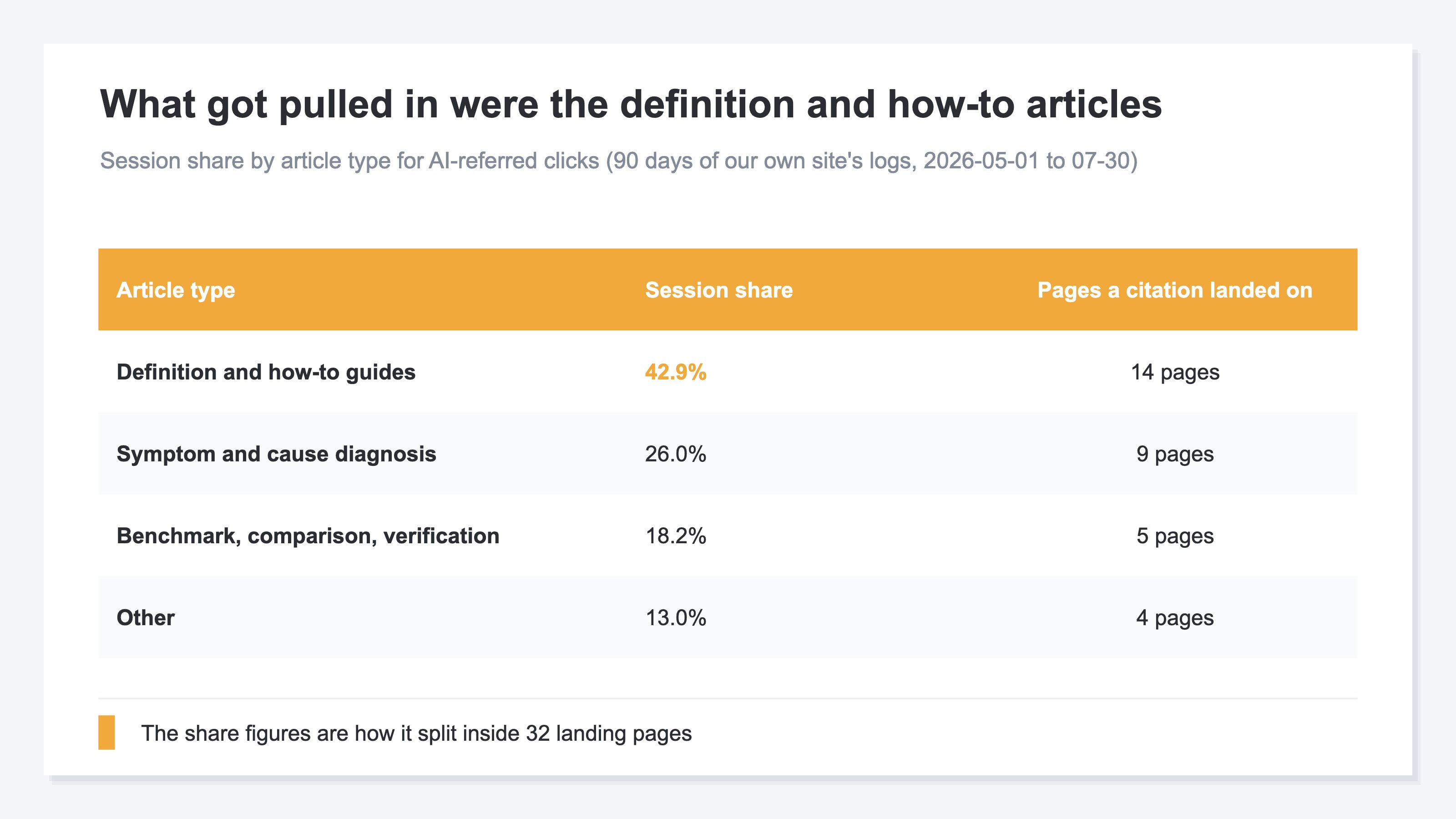
In the same table we also put the number of landing pages that make up each share. Even the largest type is in the low teens.
What came out on top isn't a format we prepared specially for GEO. They're articles that explain what a term means, and articles that write out a procedure in order. Both were being written before we ever thought about AI, and neither contains a device added for the sake of citation. Seen from the citation side too, it wasn't special construction that produced the top spots. That's why we think it's still early to move into a stance of "writing separately for AI."
That said, this aggregation has three limits.
First, the base is small. Over 90 days, citation clicks landed on 32 pages. The 42.9% figure is a statement about the inside of those 32 pages. A change of one page moves the share a lot.
The type categories are subjective too. They were assigned along our own article structure, not an industry standard taxonomy. An article sitting on a boundary lands in a different category if you change how you assign it.
And citations whose referrer we couldn't capture aren't in the aggregation. AI assistants don't always hand over a referrer. Exposure where a citation happened but no click followed is also outside this count. Which means these figures are a floor of what we could confirm.
So we can't say that only these three categories get cited. What we can say stops at "this is how it split in our own site's 90-day logs." Run the same cut on a different site and we'd expect a different order.
3. Both the Citing AI and the Pages Reached Are Skewed#
The breakdown of citing sources was skewed even harder than the formats. ChatGPT at 68.8%. Gemini 19.5%, Claude 6.5%, Copilot 3.9%, Perplexity 1.3%. One name at the top takes close to 70%.
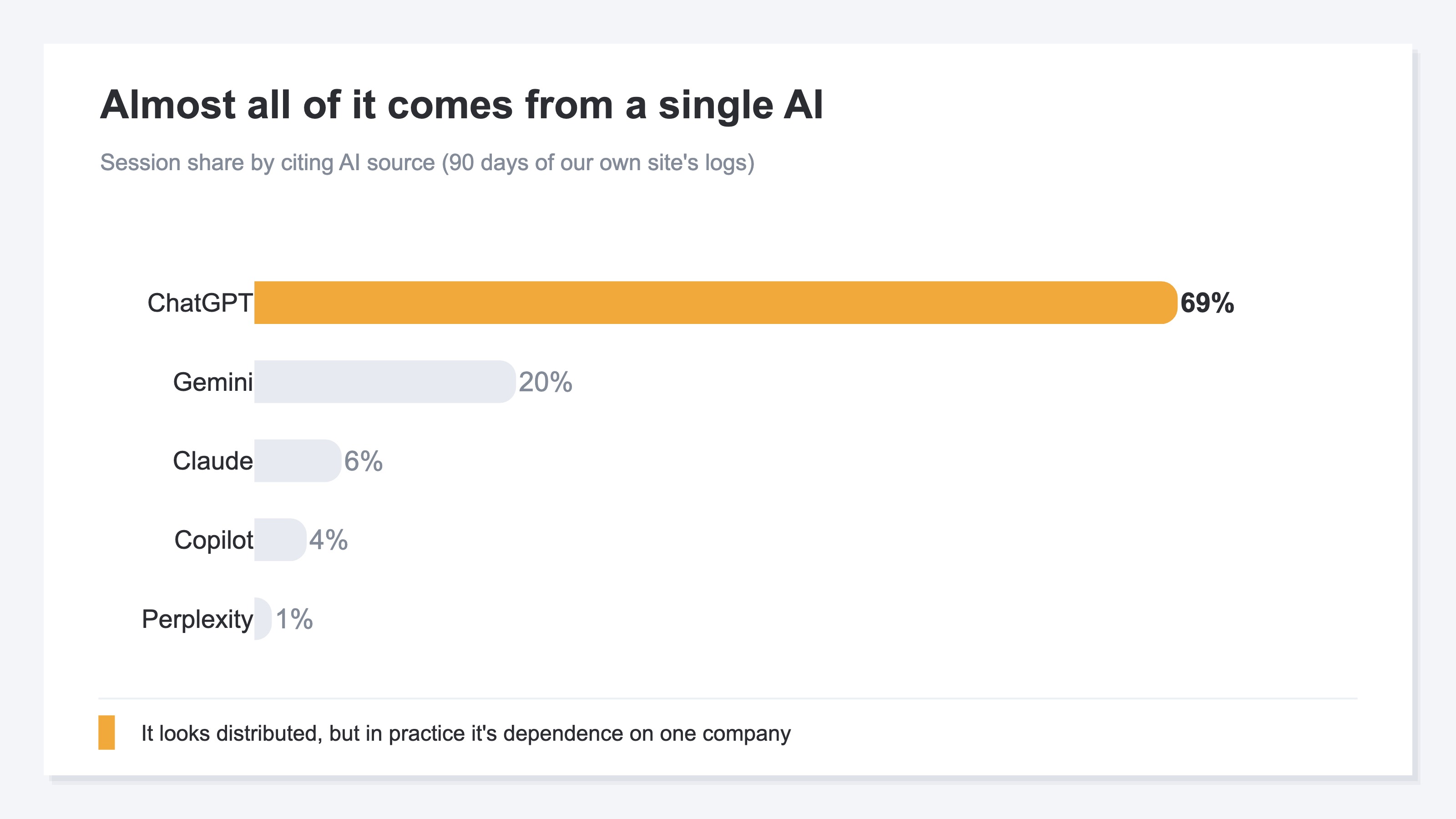
The order in which you hear the names and the order in which they actually send visitors don't line up. This skew feeds back into how any countermeasure works. In a month where ChatGPT stops citing you, the total drops by exactly that much. It looks distributed, but in practice it's dependence on one company.
The pages side was skewed as well. Pages cited by more than one AI came to 3 out of 32. Even the page with the most reached only 3 AI sources, and none reached four or more. The remaining 29 pages sit in a state of being cited by one AI.
That means the premise that "a good article gets picked across different AI" did not hold in our own logs. Most of the pages where citations appeared have a one-to-one relationship with a specific AI. So if the way one AI builds its answers changes, the traffic to those pages disappears in a batch. Only the 3 pages cited by more than one are in a state that can absorb that swing.
We wrote up the same 90-day logs cut by language version separately (AI cited the English version more). That one runs on the axis of whether the Japanese or the English version got cited; this one runs on the axis of article type. For the language question, please use that article.
4. Citations Don't Guarantee the Quality of the Traffic#
Even when visitors arrive on a page that got cited, whether they read the page and left, or never looked at the content at all, is a separate question. In the 90-day logs, landings from citations carried a session-weighted bounce rate of 81.8%. On top of that, pages at a 100% bounce rate account for 69% of all pages. Visits that land and never move a single page further were the majority.
The small base compounds this. The 42.9% top share is made up from a part of those 32 pages. It isn't that dozens of pages of that type existed and were strong on average.
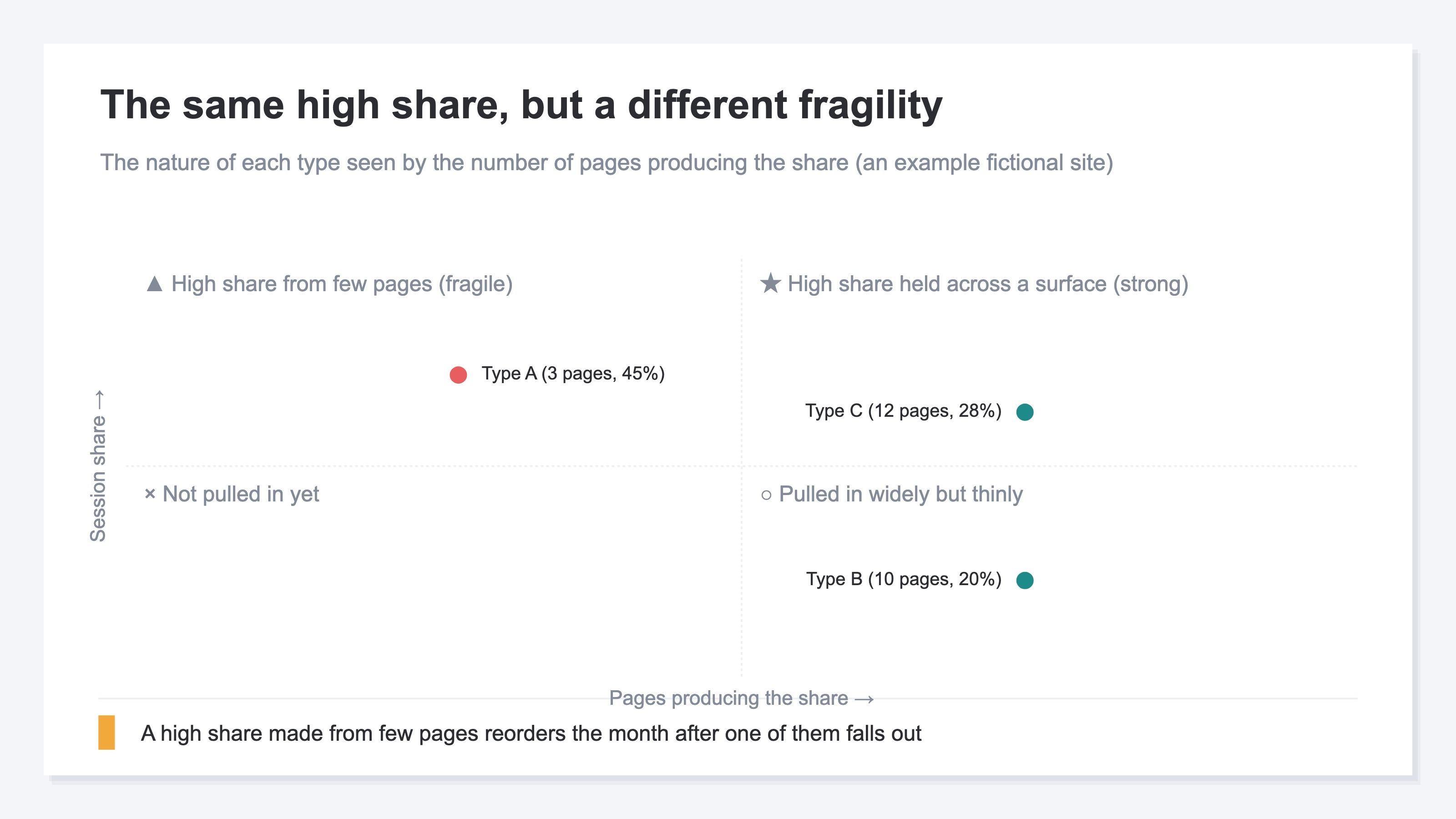
The diagram above is an example fictional site, for illustration. Top-left, Type A has built a 45% share out of just 3 pages. Type C at top-right also has a high share, but that one is 28% across 12 pages. Two things called "a type with a high share," and the insides are completely different. A high share made from a handful of pages reorders the month after one of them falls out of citation. Put "were we cited" in as your measure of results, and you'll read an accident that happened on a few pages as a direction for the whole plan.
Some articles stay at zero search clicks and still bring in visitors through AI citations, so this isn't an argument that citations have no value (the zero-click articles ChatGPT still chooses). What we want to separate is whether a citation happened from whether that traffic produced revenue. As long as we're looking at a bounce rate of 81.8%, there's still distance between having been cited and having earned.
GA4 has data on this side too. On 2026-05-13 an "AI Assistant" channel was added, and traffic arriving via AI assistants became confirmable as a group. The granularity is different, though. Because which AI someone came from depends on how the channel is defined, it doesn't come out in a shape that separates ChatGPT and Gemini as distinct kinds. Share by article type, and the citing source per landing page, can't be decomposed out of that group either.
If you assemble it by hand, the process runs like this. In GA4, filter source and medium by AI assistant names and export by landing page. Match your own type classification against the URLs you exported. Then, to see whether the citations produced revenue, pull landing-page-level revenue separately and join it on the same URL. Where hands stop isn't the classification work. It's the preprocessing that reconciles referrer spellings one by one, and rebuilding the per-AI breakdown. Those two are what drive the time it takes to reach a decision.
RevenueScope solution
To evaluate citations by revenue, the landing page and the citing AI have to be tied together, and revenue has to be attached on top. RevenueScope's MCP tool get_ai_traffic returns exactly that data. One row is a combination of landing page and citing AI source, carrying sessions, bounce rate, revenue, and the date that page was last cited. Classification by referrer and exclusion of automated access are handled on the aggregation side, so the preprocessing that reconciles URL spellings isn't needed.
Here is one example from fictional Site B, for illustration.
| Landing page | Citing AI | Sessions | Bounce rate | Revenue |
|---|---|---|---|---|
| Glossary (what is toner) | ChatGPT | 300 | 95% | ¥0 |
| How-to guide (switching for sensitive skin) | ChatGPT | 100 | 60% | ¥200,000 |
| How-to guide (switching for sensitive skin) | Gemini | 20 | 55% | ¥50,000 |
| Comparison (roundup by industry) | ChatGPT | 10 | 40% | ¥150,000 |
| Glossary index | Copilot | 50 | 100% | ¥0 |
This table is an example fictional site for illustration, not the figures of a real store. The screen behind the button runs on the sample store's sample data (updated daily), so the rows and the numbers you see there will be different from these.
Sort by revenue alone and the comparison article on the fourth row comes second. But its sessions number 10. That's a figure that stands up because a single high-value order came in, and it will be gone next month. This row is dropped from the decision.
What's left is the contrast between the first and second rows. The most sessions belong to the glossary piece, and its revenue is ¥0. The how-to article, with a third of the sessions, is producing ¥200,000. Order by citation share and the glossary piece leads; order by revenue and the how-to article leads. Once you can see that far, the next move changes. Instead of pushing to increase citation share, you shift budget and time toward increasing pages of the type revenue followed. At the same time you keep the glossary side as an entry point for citations, and build a bridge from there to the how-to articles with internal links. The material for the decision moves from the volume of exposure to the way revenue attaches.
FAQ#
Frequently asked questions#
Q. If I write more definition and glossary articles, will I get cited?
A. That's not something we can say. All we have is that this type was the largest in our own site's 90-day logs. The base is 32 pages, and the type categories are a subjective split that follows our own article structure. If you want the conditions for citation examined as statistics, third-party research is better suited (the two conditions that get you cited by AI). If you want to confirm it on your own site, measuring citations and revenue by type comes first.
Q. Can I check citations in Google Search Console?
A. No. ChatGPT and Claude sit outside Google search, so the capability isn't provided. What Google Search Console tells you stops at impressions, clicks, and ranking position in Google search.
Q. Can't GA4 tell me?
A. As a group, yes. With the "AI Assistant" channel added on 2026-05-13, traffic arriving via AI assistants comes out together. The granularity is where it differs. Which AI someone came from depends on how the channel is defined. It doesn't come out in a shape that pulls ChatGPT and Gemini out as separate rows, or that splits the citing source per landing page.
Q. If citations go up, does revenue go up too?
A. Not necessarily in step. In our own 90-day logs, landings from citations carried a session-weighted bounce rate of 81.8%. Visits that land and turn back are the majority. The volume of citations and the revenue have to be measured on separate layers (what AI citation contributes to revenue).
Q. What should I do to get cited by more than one AI?
A. Our own logs can't produce the conditions. Only 3 of 32 pages qualify, which isn't enough to talk about what they have in common. What we can say is only the risk side: a page cited by just one AI loses its traffic in a batch when that AI changes how it builds answers.
Summary#
Using the referrer mode of RevenueScope's get_ai_traffic, we aggregated the 90 days from 2026-05-01 to 2026-07-30. The largest article type AI-referred clicks landed on is definition and glossary pieces together with how-to guides, at 42.9%. Next was symptom and cause diagnosis at 26.0%. Both are types we were writing before we thought about AI, not something prepared for GEO.
The base, though, is 32 pages, and the categories are a subjective split following our own article structure. Citations whose referrer we couldn't capture, and exposure that produced no click, aren't included. So we can't conclude that only these types get cited. What we can say stops at a first-person case: this is how it split in our own site's 90-day logs.
There is one thing that case yields. Citing sources gathered 68.8% on ChatGPT, and pages cited by more than one AI came to 3 out of 32. Bounce rate on landing was 81.8%. AI citations are happening. But having been cited and having earned were separate things.
So the measure to watch isn't citation share. It's whether the pages AI citations land on are tied to revenue. On your site, are the pages citations land on the types revenue is tied to?
See which ads actually drive revenue, at a glance
Free up to 5,000 sessions/month, AI connection included. No credit card required. Up and running in 5 minutes.
References#
- The figures in this article are based on 90 days of first-party measurement on RevenueScope's own site (
get_ai_trafficreferrer mode, 2026-05-01 to 2026-07-30). AI assistants don't always send a referrer with every visit, and citations that produced no click are out of scope, so the figures are a floor of what we could confirm. The article type categories are a subjective classification that follows our own article structure.
![[Research] The Two Conditions That Get You Cited by AI: What a 250K-Trial Study Shows](/_next/image?url=%2Fimages%2Fnews%2Fai-citation-conditions-study.jpg&w=3840&q=75)


![[Research] AI Traffic Isn't Growing: Citations Happen Sentence by Sentence](/_next/image?url=%2Fimages%2Fnews%2Fai-mention-no-traffic.jpg&w=3840&q=75)