![[Research] The Two Conditions That Get You Cited by AI: What a 250K-Trial Study Shows](/_next/image?url=%2Fimages%2Fnews%2Fai-citation-conditions-study.jpg&w=3840&q=75)
Ask ChatGPT or Gemini a question and the AI cites a few sites. So what decides which one gets cited? A controlled study running about 250,000 trials reports that the two biggest drivers are topical relevance — does the page answer the question directly — and search list position. Not special AI-only measures, but an extension of ordinary SEO. This article lays out those two conditions and, just as importantly, how to measure what happens after the citation: whether it actually sold.
Contents
TL;DR#
- A controlled study running about 250,000 trials reports that the two biggest drivers of being cited by AI are topical relevance (does the page answer the question directly) and search list position
- If list position matters, AI citation is grounded in ordinary search (organic SEO) rank. Formatting-only edits had little impact, the study reports — shortcuts barely move the needle
- The "reviews and reputation" that other research points to is a separate mechanism. Content-side signals and external-reputation signals are different axes; the more you have of both, the easier you are to pick
- But the real fork isn't "were you cited" — it's "did that citation turn into revenue." The entry (the conditions) is something a paper can show you; the exit (whether it sold) is something you have to measure yourself
1. What gets cited: the two biggest conditions#
Bottom line first: the biggest drivers of AI citation are topical relevance — does the content answer the question directly — and search list position, according to a controlled study.
This study is "What Gets Cited: Competitive GEO in AI Answer Engines" [1]. It looked at which of two candidate pages an AI cites first when it builds an answer, changing exactly one factor at a time to compare them. Across six large language models it ran about 250,000 (252,000) trials, testing 18 content factors. It anonymized brands and counterbalanced the order the candidates appeared in, so it could separate the effect of content from the effect of display position — a careful design.
One important caveat: this study was released as a preprint, before formal peer review. So we treat it here not as an established fact but as "what is currently reported."
The reported result was simple. What moved citation the most were two things: topical relevance and list position within the candidate set. On top of that, stating an explicit price and being recent (a fresh timestamp) also lifted citation likelihood consistently. Completeness and trust cues added smaller gains, and formatting-only edits had little impact, the study reports.
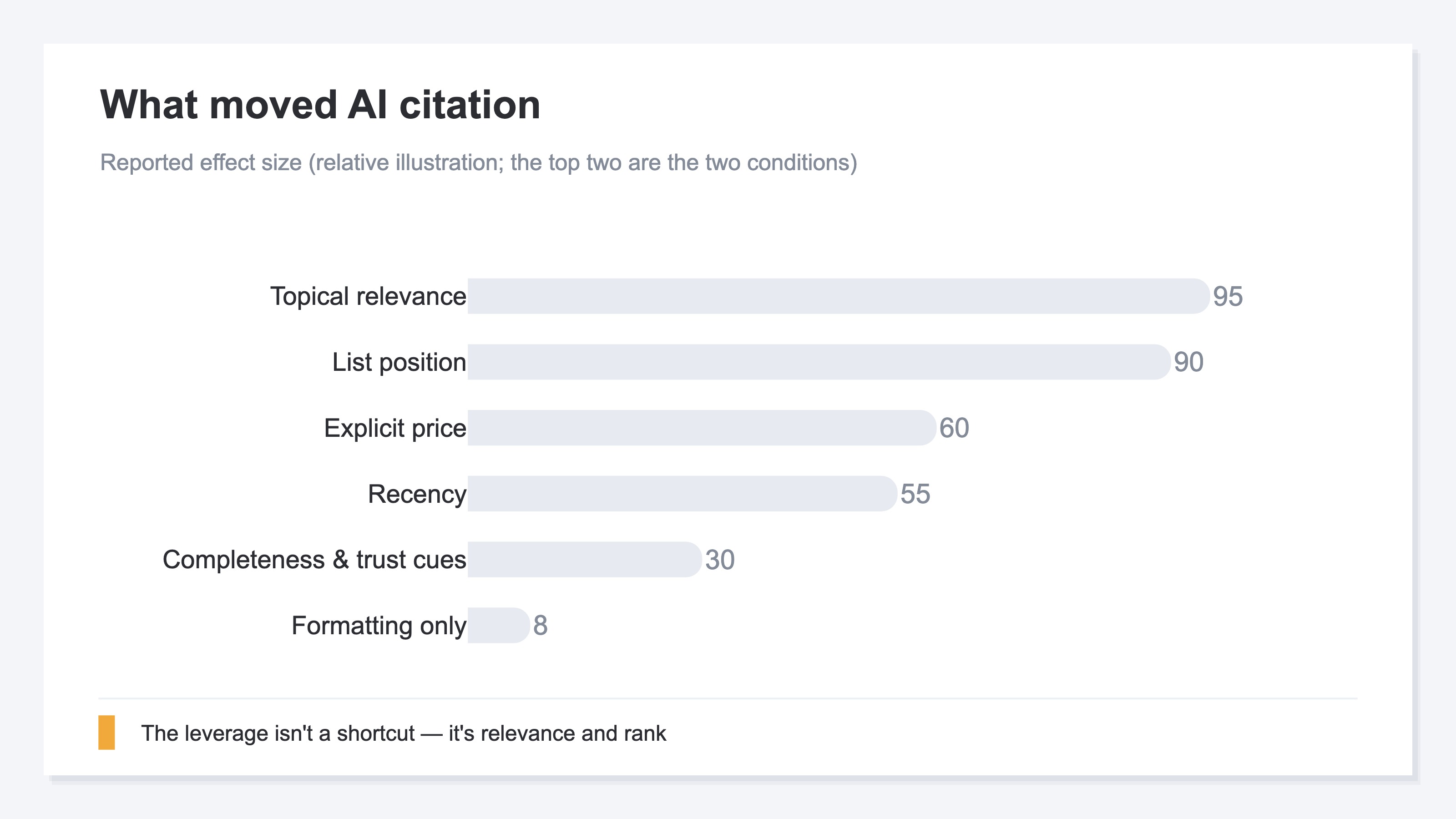
What's worth noticing is what those top two really are. That list position matters means AI citation is grounded in ordinary search (organic SEO) rank. Topical relevance, too, is just plain good writing that answers the question head-on. In other words, the leverage isn't some special AI shortcut — it sits on top of the SEO fundamentals you already know. That formatting-only edits barely helped is the flip side of the same point. Note that this study was run in a general RAG (retrieval-augmented generation, where the AI answers by pulling in external documents) testbed, not one specific to e-commerce, so treat any read-across to EC as a rough guide.
2. How this differs from "reviews and reputation"#
To put it plainly, today's two conditions (content relevance and list position) and the "reviews and reputation" other research points to are separate mechanisms.
When people talk about AI recommendations, review counts and brand reputation come up a lot. Other research argues that such reputation signals influence AI recommendations heavily and tilt the result toward large players (we lay that out in detail in What makes AI recommend your site). "What Gets Cited," by contrast, measured the content itself — relevance to the question, list position, explicit price, recency: page-side, content-side signals.
These two aren't opposites; it's cleaner to see them as different axes. One is "how well-regarded you are out in the world (external reputation signals)," the other is "how well the page itself answers the question (content-side signals)." Viewed on two axes as below, the more you have of both, the easier you are to cite and recommend.
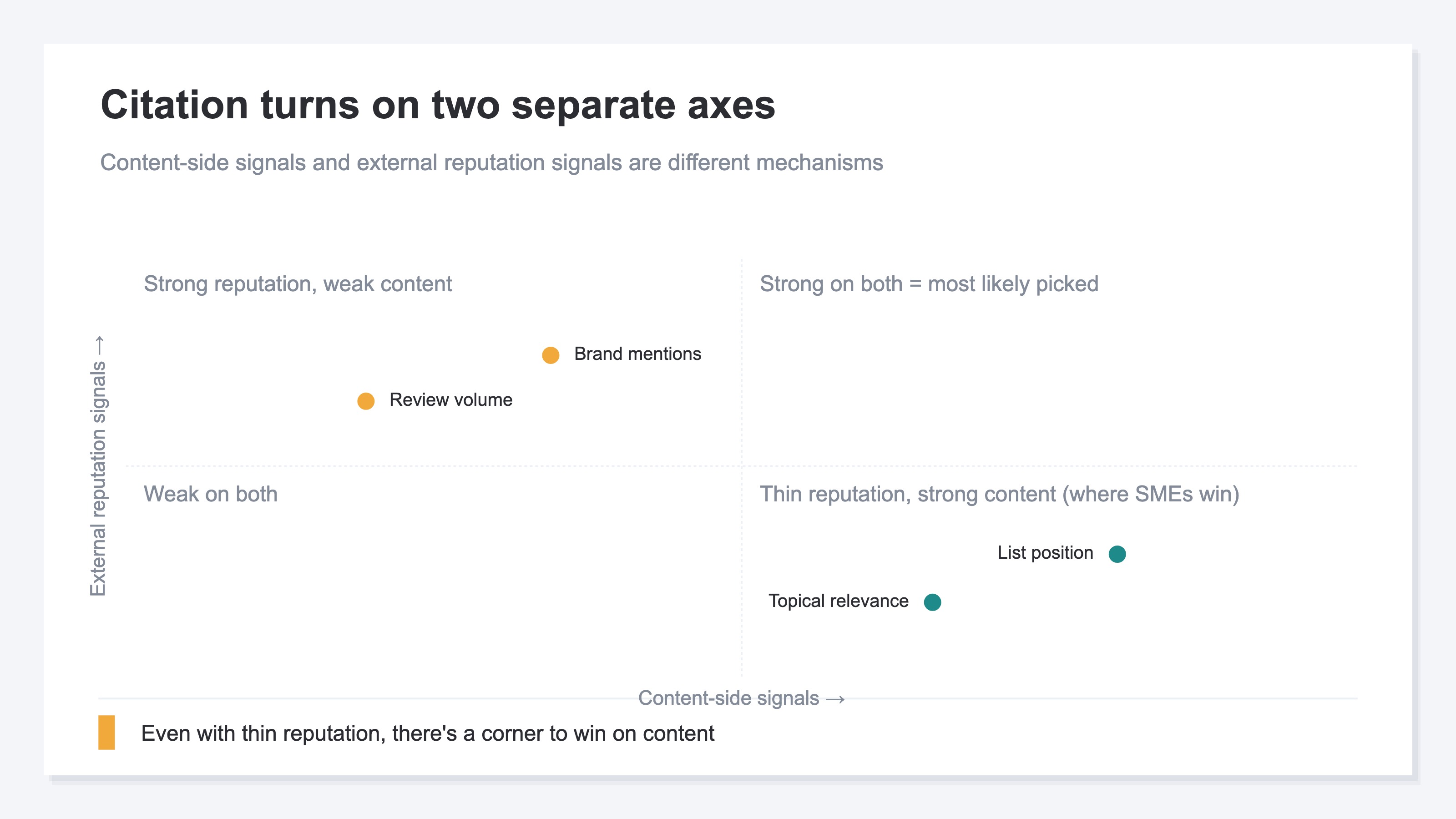
This split holds hope for smaller sites. You may not match the big players on sheer volume of reputation, but content-side signals — answering the question head-on and steadily lifting your search rank — are ground you can build on starting today. On the chart, the bottom-right, "thin reputation but strong content," can be seen as the corner a smaller site can go for first.
3. Checking the paper against our own 90-day log#
Bottom line first: the direction the paper reports shows up the same way in our own site's 90-day log of AI citations.
To avoid deciding on one study alone, we cross-checked the paper's claims against real data from a different angle: the AI-citation log left on our own site over the last 90 days. The table below shows the paper's claim and our own tendency for each condition. Our figures are given as ratios and multiples, not absolute counts.
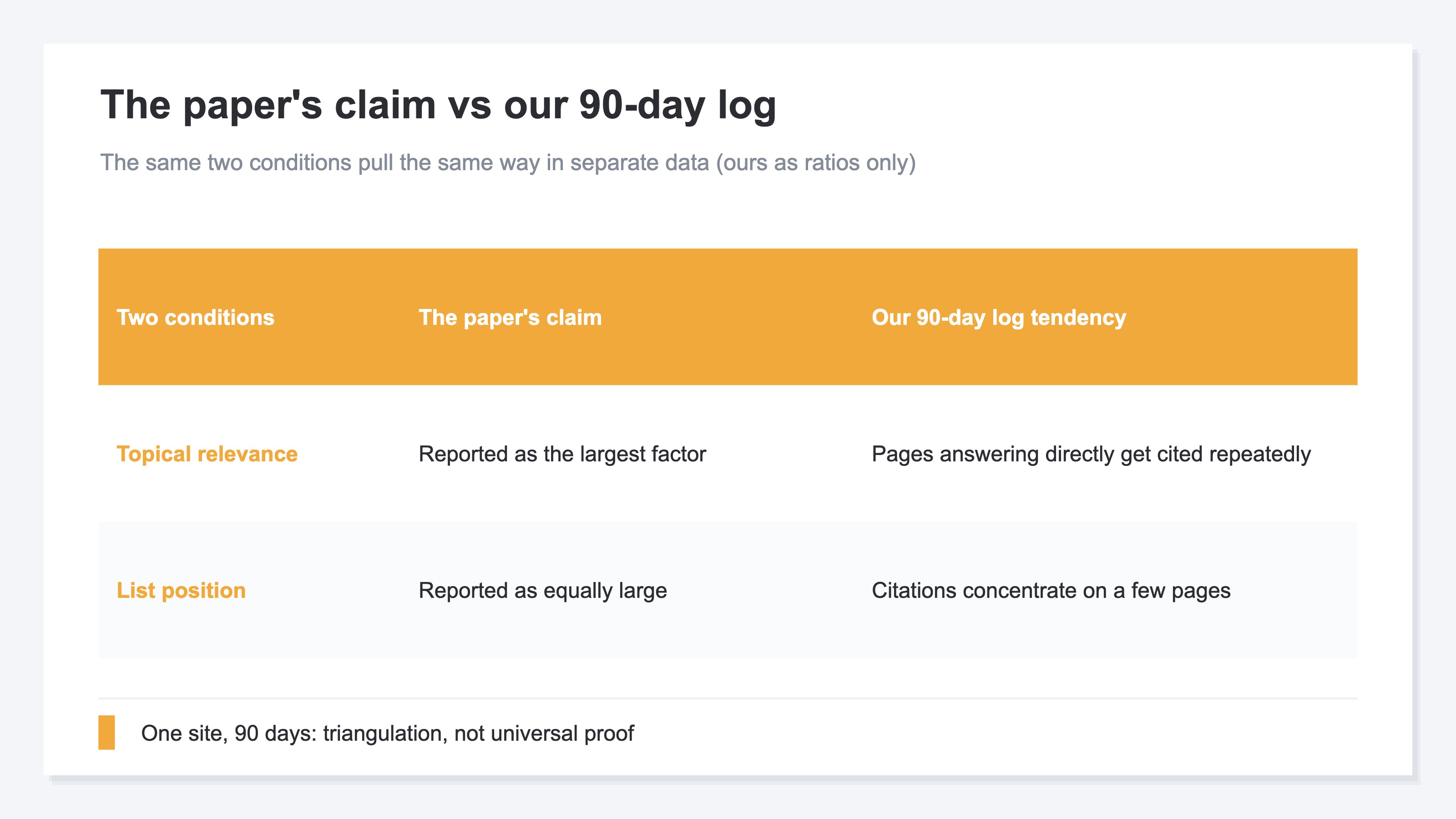
The takeaway is that both conditions point in the same direction even in separate real data. Pages that answer the question directly tended to be cited repeatedly across several AI assistants. Citations skewed by page, concentrating on a handful of pages. That said, this is a single site over just 90 days — not enough volume to assert absolute counts. Read it as confirming that the direction matches the paper's two conditions.
Still, this in-house data isn't the last word either. It's a single site over 90 days, so it isn't universal proof on its own — just one point of triangulation confirming the paper's tendency from another angle. Where your own site stands on "how much AI is seeing you right now" is covered in A mid-size EC's AI brand-visibility check.
4. Beyond being cited: whether it sold is a different layer#
Bottom line first: the real fork isn't "were you cited" but "did that citation turn into revenue" — and that lives on a completely different layer.
Even if you meet the two conditions and citations rise, whether any of them became a click, a purchase, or a certain amount of revenue is something no paper, no direct question to the AI, and no standard tool screen will tell you. Visibility (were you cited) and revenue (did it sell) are different layers, and the latter isn't visible automatically.
Deciding how much to invest in GEO (the work of getting cited by AI) can only be settled at that exit: the people who arrived from a citation, which page they landed on, how much they bought. We leave the how-to of measuring beyond the citation to How to measure the revenue contribution of AI citations, but the point is one thing: a paper can show you the entry (the conditions to get cited), yet the exit (whether it sold) is yours to measure. On the tendency for AI to preferentially cite English-language pages, see Does AI cite the English version.
RevenueScope helps
A paper can show you the conditions for being cited. But "which page that citation became how much revenue on" stays structurally hard to see in GA4's standard reporting. Because many AIs don't pass a source tag (referrer), AI-driven traffic gets buried in Direct or unknown and never ties back to revenue.
RevenueScope solves this exit problem. It splits the AI traffic that actually clicked through by citing engine and by page, and shows AI-driven sessions, bounce rate, and landed revenue (attributed to the last entry point touched) by landing page (figures shown are demo data).
| Landing page | AI sessions | Landed revenue | RPS |
|---|---|---|---|
| /blog/sensitive-skin-routine | 19 | ¥27,348 | ¥1,439 |
| /blog/skincare-order-guide | 30 | ¥28,169 | ¥939 |
| /collections/skincare | 11 | ¥9,584 | ¥871 |
| /blog/pore-care-basics | 24 | ¥16,774 | ¥699 |
| /products/serum-blanc | 15 | ¥8,207 | ¥547 |
| /products/lip-serum-rose | 27 | ¥7,807 | ¥289 |
AI-referred landing pages by AI sessions, landed revenue, and RPS (sorted by RPS; figures are demo data from a fictional store, last 90 days). Landings from ChatGPT, Claude, Perplexity, Gemini, and Copilot.
The takeaway is that AI-referred session count and revenue per session don't rank the same way. /products/lip-serum-rose draws a fair amount of AI traffic at 27 sessions yet sits last on RPS at ¥289, while /blog/sensitive-skin-routine, with just 19 sessions, tops it at ¥1,439. Even /blog/skincare-order-guide, which draws the most traffic at 30 sessions, lands in the middle at ¥939. The volume of citations and the money that sold are different things. Chase counts alone and this gap stays invisible.
RevenueScope focuses on revenue-based metrics. By citing engine and by page, it presents AI-driven sessions and landed revenue together, turns them into revenue per session (RPS), and reconciles revenue on a last-touch basis (the last entry point touched). Beyond meeting the conditions to get cited, it lets you check in numbers whether the GEO investment actually moved revenue.
FAQ#
Frequently asked questions#
Q. What should I do first to get cited by AI?
A. The SEO fundamentals, more than any special trick. The study reports that answering the question directly (topical relevance) and search list position mattered most, while formatting-only edits barely helped. Write pages that answer the question head-on and lift them in search — AI citation sits on top of that.
Q. Do I need special AI-only measures like llms.txt or schema?
A. At least in this study, formatting-only edits had little impact on citation. Before reaching for shortcuts that promise a fast track, investing in relevance and list position is the surer bet.
Q. Is counting whether I get cited enough on its own?
A. It helps for a rough read, but it isn't enough. The AI's answer changes each time, counting by hand isn't realistic, and "how many citations" won't tell you "did it sell." Keep the citation count as a gut check and measure AI-driven revenue on a separate screen to stay accurate.
Conclusion#
A controlled study running about 250,000 trials reports that the two biggest drivers of AI citation are topical relevance (does the page answer the question directly) and search list position. If list position matters, AI citation sits on top of ordinary search. Formatting-only shortcuts barely helped, the study reports. The "reviews and reputation" other research points to is a separate axis, and the more you have of both, the easier you are to pick.
But the real fork isn't whether you were cited — it's whether that citation turned into revenue. A paper can show you the entry (the conditions), yet the exit (whether it sold) is yours to measure. Start by seeing which of your pages get cited and how much they sell from there, reading visibility and revenue as separate layers. Before chasing the conditions, build the eyes to measure what's beyond them — that's the foundation for checking whether GEO investment paid off.
See which ads actually drive revenue, at a glance
Free up to 5,000 sessions/month, AI analyst included. No credit card required. Up and running in 5 minutes.

![[Research] What Makes AI Recommend Your Site: It Comes Down to Reviews and Reputation](/_next/image?url=%2Fimages%2Fnews%2Fhow-ai-picks-stores.jpg&w=3840&q=75)