Are you deleting articles with zero search clicks, judging them worthless? In fact, some articles stay at zero clicks in Google search yet get visits from people arriving via AI like ChatGPT. Before you delete, search clicks aren't the only thing to check. This article lines up search clicks and AI-referred traffic on the same page to sort keep from delete, organized with real data from our own site.
Contents
TL;DR#
-
Even at zero search clicks, some articles get visits via AI citations
Deleting on Google search clicks alone can sweep away articles that were carrying people in via AI
-
Google Search Console reflects only Google search. AI-referred traffic never shows
So articles that get visits via AI still look like "zero clicks" on the Google Search Console screen
-
Zero clicks has three different meanings inside it
Truly idle / the answer completes inside the search result / AI-referred visits substituting for the click — three types are mixed together
-
Before deleting, cross-check search clicks and AI-referred traffic on the same page
Only pages where both are idle become the first candidates for consolidation or deletion
-
Finally, look all the way to revenue
Even if citations bring people, if that doesn't turn into revenue you may just be handing your article's substance to the AI
1. Zero Search Clicks Doesn't Mean Zero Value#
Some articles with zero search clicks are still carrying people in via AI citations. So running your audit on the single move of "zero clicks, so delete it" ends up deleting articles you shouldn't.
We laid out the full picture of deletion decisions — search traffic, landing revenue, and AI citations judged together — in a separate article, three conditions for deleting old content. This article drills into just one slice of that: cross-checking zero-click pages against AI citations.
Zero search clicks doesn't mean the exposure has no value when you're being cited — overseas SEO media make this point too. Inside the search result, AI finishes the answer, so readers don't click. Even so, if your site is cited within that answer, it builds trust and awareness, the argument goes[1][2]. The direction makes sense, but left abstract you can't confirm whether it's actually happening on your own site.
So we looked at our own site's real data. Over the past 90 days, counting the landing pages that were clicked and visited via AI, there were 30 pages and 65 visits in total. What stood out: about 70% were English-version articles. And on the very definition pages ("what is CTR" and the like) that get almost no clicks in Google search, ChatGPT-referred visits were real. The CTR definition page had 4, the impressions definition page had 2, the CPA definition page had 2. Each stayed near zero search clicks while people arrived via AI.
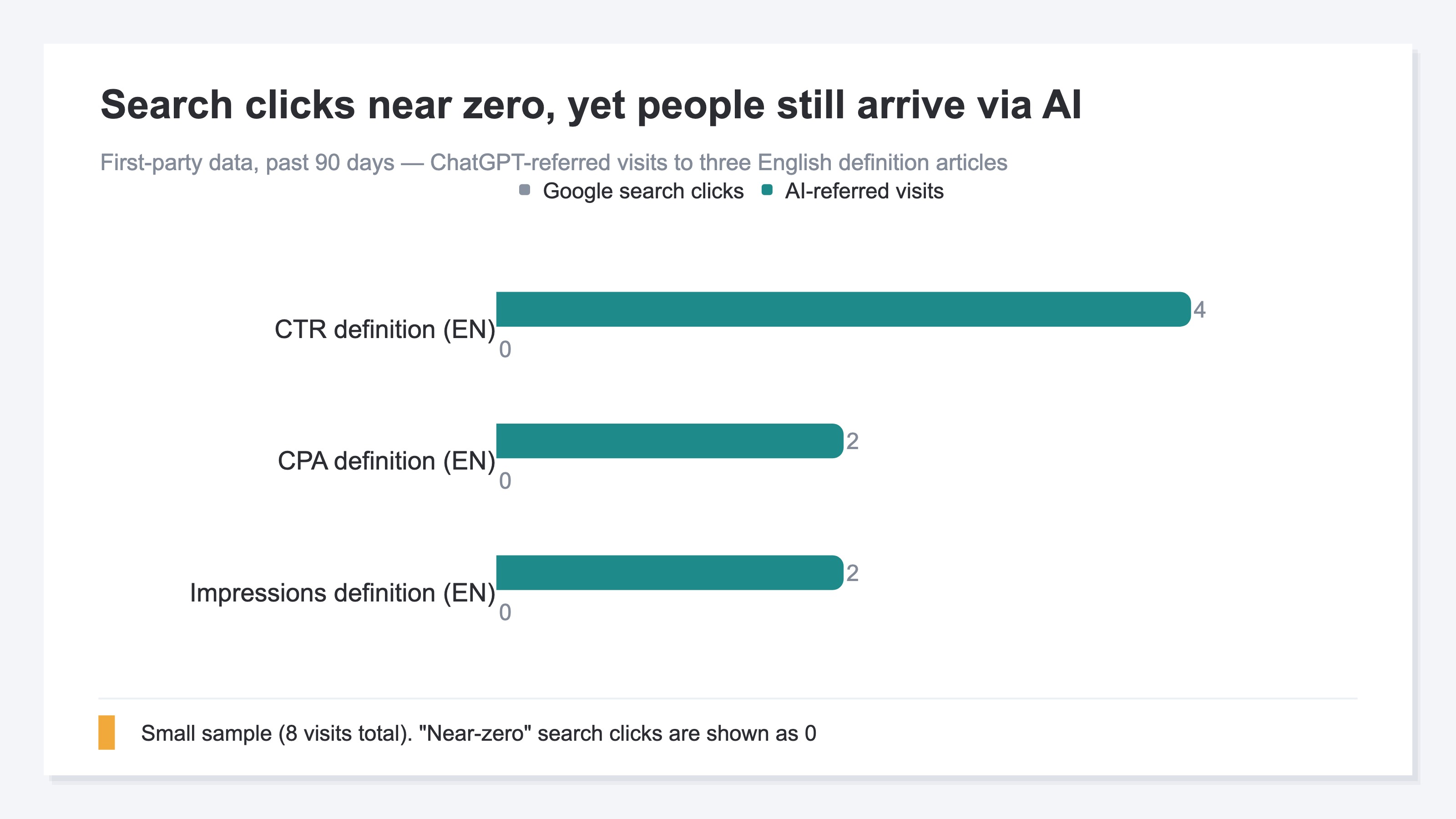
The base is still small — 65 visits over 90 days — so this alone can't be conclusive. Even so, the fact stands: had we bulk-deleted on "zero clicks = dead article," these English definition pages would have gone all at once. Draw your audit line on the single number of search clicks and you drop pages like these.
2. Why Google Search Console Alone Misses It#
Google Search Console shows only what happens in Google search; AI-referred traffic never appears there.
Google Search Console is a handy, free tool for checking impressions, clicks, and ranking in search[3]. But its scope is limited to Google's search results. Clicks that came from a ChatGPT or Gemini answer don't show up in Google Search Console. So an article that's getting visits via AI still looks like nothing but "zero clicks" on this screen. Run your audit on Google Search Console alone and a blind spot opens right here.
AI-referred traffic is grasped by counting the share that still carries a referrer (the information about where a visit came from). Some AI don't send a referrer, so what you can capture is a floor — "at least this many are arriving" — but even a floor means something completely different from zero.
On top of that, pages with zero search clicks mix three types with different insides. The first is a truly idle page: almost no impressions or visits, its job done. The second is a page where the answer completes inside the search result: it's shown, but the need is met on the spot and it isn't clicked. The third is a page where AI-referred visits substitute for the click: zero Google search clicks, yet people arrive from AI answers. The third is, so to speak, a "zero-click page that delivers results" — delete it and you lose the path itself.
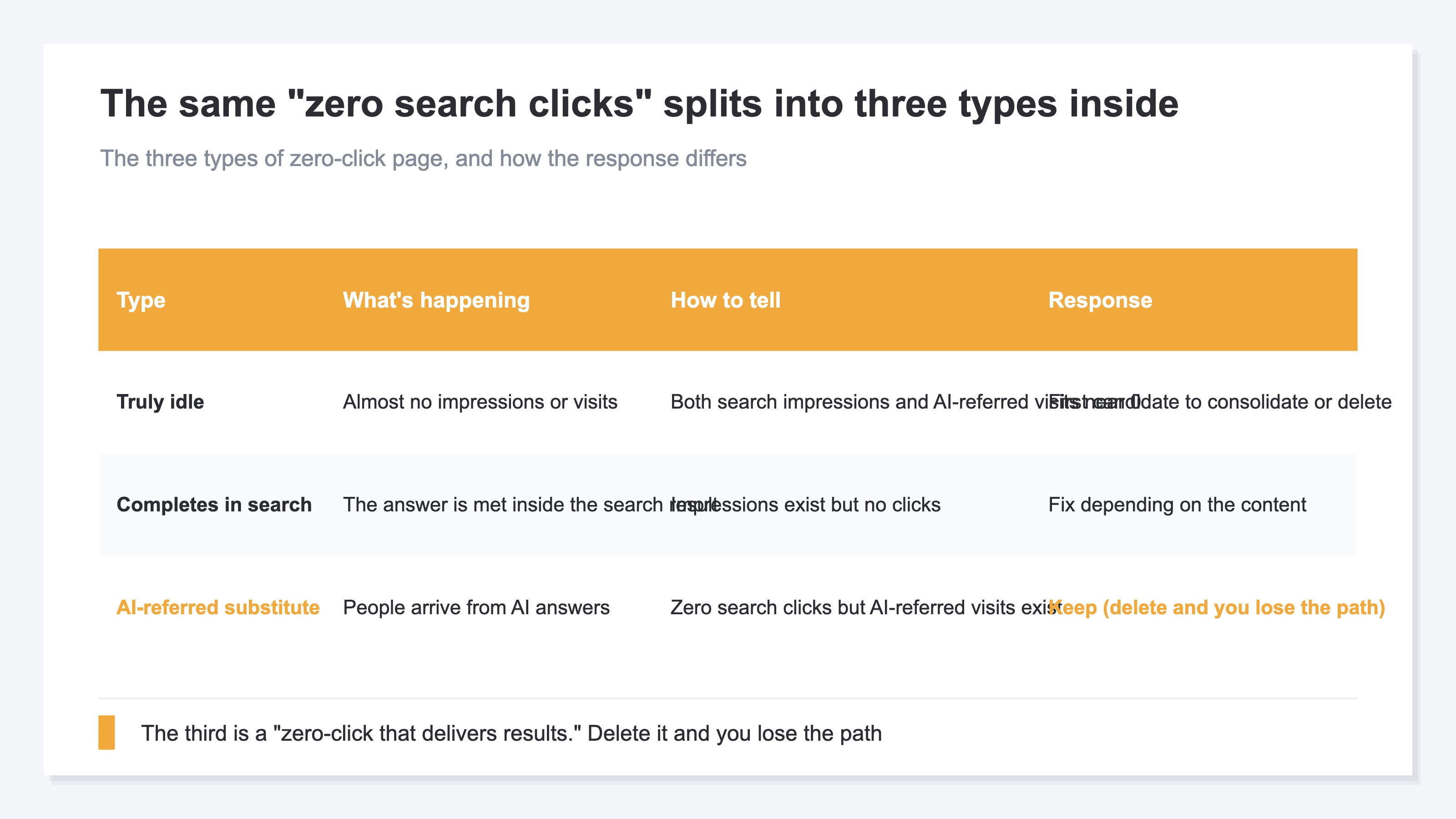
Bundle these three under "zero clicks" without distinction and the third type ends up in the delete list too. The same number, zero, can mean the exact opposite inside. So next we turn this distinction into an actual cross-check.
3. Cross-Check AI Citation Logs Before You Delete#
Before deciding whether to delete, cross-check search clicks and AI-referred traffic on the same page.
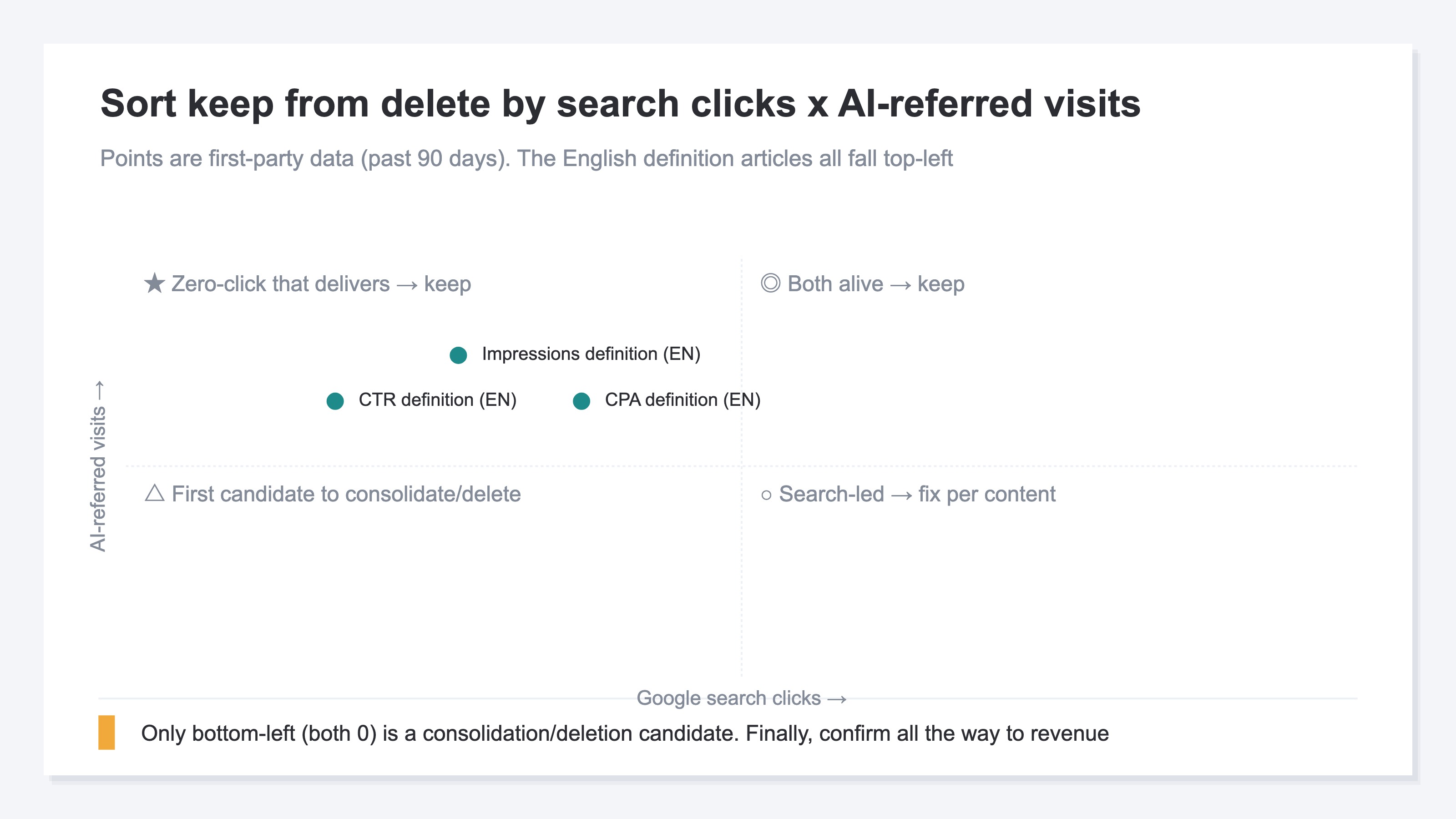
Look at two axes. Horizontally, are there search clicks; vertically, is there AI-referred traffic. Place articles on these two axes and pages split into four quadrants. Pages where both search clicks and AI-referred traffic are alive, keep as they are. Pages at zero search clicks but getting people via AI are the "zero-click pages that deliver results" from earlier — keep these too; they're the do-not-delete side. Pages with search clicks but zero AI-referred traffic are search-led, so depending on the content they become fix targets. And only pages where both search clicks and AI-referred traffic are idle are the first candidates for consolidation or deletion.
The priority order for which articles to rewrite is in which articles to rewrite first. Isolating why clicks fall while ranking holds is covered in same rank but fewer clicks. Across the market you'll hear big numbers like "AI search sends billions of clicks a week," but that's an industry total, not the story of your one article. Separating the total from your own real count is covered in AI search sends billions of clicks a week. In an audit, you read the real count per article, not the industry total.
But there's one more axis at the end of the cross-check: revenue. Even if you're cited by AI and people arrive from it, if that visit doesn't finally turn into revenue, you may just be handing your article's substance to the AI. Don't settle for "we were cited, we got visits"; only when you look further — are they buying — is a page's value to keep truly confirmed.
Our own site is pre-revenue, so how much the people who arrived via AI bought is something we're only about to measure. That's exactly why we recommend that you — readers who already have revenue — cross-check citation to click to revenue in one continuous line on the same page. A way to check AI-referred traffic roughly for free is in check AI traffic for free.
The idea, up to here, is simple. What's hard is repeating it across every article, every week, cross-checking search clicks, AI-referred traffic, and revenue. By hand it gets heavier the more articles you have. This is the line where you hand off to a machine.
RevenueScope solution
RevenueScope displays search clicks and AI-referred traffic per page, together on one screen. Without chasing Google Search Console and AI traffic separately, you can tell which pages are safe to delete and which to keep.
RevenueScope's get_ai_traffic shows the traffic that arrived via AI, per page and by AI source. The AI covered are five: ChatGPT, Claude, Perplexity, Gemini, and Copilot. Even at zero search clicks, you can see the pages where people arrive via AI. Alongside, get_content_actions classifies every content page into five states versus the prior window and lists the pages with near-zero search clicks as out-of-zone exposure. Among those, pages suspected of being cited by AI get an "AI citation" mark. A marked page likely has a live AI-referred path even at zero search clicks, and deleting it carelessly loses the citation along with it — the screen warns you of that danger up front.
What RevenueScope handles is the measurement of what actually happened via AI — which page got people from which AI. It is not a feature for getting you cited by AI. It divides roles with GA4: it complements the part where AI-referred traffic and search clicks split across separate screens and make cross-checking a chore, by showing them on one screen.
Here's how it looks, in one example.
Asking about pages with zero search clicks (one example, illustrative)
| Page | Search clicks | AI-referred traffic | AI citation | Read |
|---|---|---|---|---|
| Shipping estimate guide (article) | 0 | 12 | Yes | Zero search but AI-referred visits → keep |
| How to return an item (article) | 0 | 0 | No | Neither moving → consolidate/delete candidate |
One example (illustrative, fictional figures). The numbers are samples, not a real tally.
Even for the same "zero search clicks," overlay AI-referred traffic and the citation mark and the pages to keep separate clearly from the delete candidates. Judged on Google Search Console clicks alone, both articles above look like delete candidates. But overlay AI-referred traffic and one turns out to be a page you must not delete. RevenueScope brings search clicks and AI-referred traffic per page onto one screen, speeding up telling which pages are safe to delete from which to keep.
FAQ#
Q. Can I bulk-delete old articles with zero search clicks?
A. Not recommended. Even at zero search clicks, some articles mixed in are getting visits via AI answers. First check search clicks and AI-referred traffic on the same page, and make only the pages where both are idle into deletion candidates — that's the safe way.
Q. Can I see AI-referred traffic in Google Search Console?
A. No. Google Search Console shows only impressions, clicks, and ranking in Google search. Traffic that came from AI answers like ChatGPT isn't included. So an article getting visits via AI looks like "zero clicks" on the Google Search Console screen. AI-referred traffic has to be captured another way.
Q. On a site with no revenue yet, how should I decide?
A. On a site where revenue is still zero, you can't measure how much the people who arrived via AI bought. In that case, decide provisionally on the two — search clicks and AI-referred traffic. Once revenue starts, cross-check citation to click to revenue on the same page to confirm the value of keeping it.
Summary#
Delete articles with zero search clicks as worthless and you may delete, along with them, articles that were carrying people in via AI. That's because Google Search Console reflects only what happens in Google search — AI-referred traffic doesn't show there. Pages with zero search clicks mix articles with different insides: truly idle articles, articles where the answer completes inside the search result, and articles where AI-referred visits substitute for the click. So before deleting, cross-check search clicks and AI-referred traffic on the same page, and make only the pages where both are idle into consolidation or deletion candidates. And the end of the cross-check is revenue. Even if citations bring people, it means nothing if that doesn't turn into revenue. In this order, you prevent the mistake of deleting an article that was quietly working out of sight.
See which ads actually drive revenue, at a glance
Free up to 5,000 sessions/month, AI analyst included. No credit card required. Up and running in 5 minutes.