![[Research] AI Traffic Isn't Growing: Citations Happen Sentence by Sentence](/_next/image?url=%2Fimages%2Fnews%2Fai-mention-no-traffic.jpg&w=3840&q=75)
The number of times AI answers say your name keeps climbing, while AI-referred visits stay where they were. Name appears, therefore visit follows — the two are not connected in that order. Two separate events sit in between, and this article works out which of them you are stuck at, using a survey posted in July 2026 that reviewed 45 studies.
Contents
TL;DR#
- More mentions by AI does not mean AI-referred visits arrive later
- Two events sit before the visit: your page gets cited, and the source link gets clicked
- A survey posted in July 2026, reviewing 45 studies, attached conditions to where the citation-rate lift applies
- Citation happens at the level of a sentence inside a page, not at the level of a brand
- The metric to track is not the count of mentions but the visits and revenue that cited sentences carry
1. Two Separate Events Sit Between a Mention and a Visit#
On the screen tracking how often AI answers say your name, the count has doubled in three months. Meanwhile the AI-referred sessions in your analytics sit at a handful a day and do not move. Reading that combination as a failed initiative is too quick a call. The two are not in a relationship where one rising pulls the other up.
"AI says your name" is an event called a mention. The model produces the name from what it learned or from the flow of the conversation, and in most cases no link comes with it. Your company name appears on the reader's screen, but no path to your site is attached to it.
Two further events stand between that and a visit. When the AI assistant composes an answer it fetches your page and uses sentences from it as material for the answer. That is citation. Then the reader clicks the source link attached to the answer. Only there does a session get recorded.
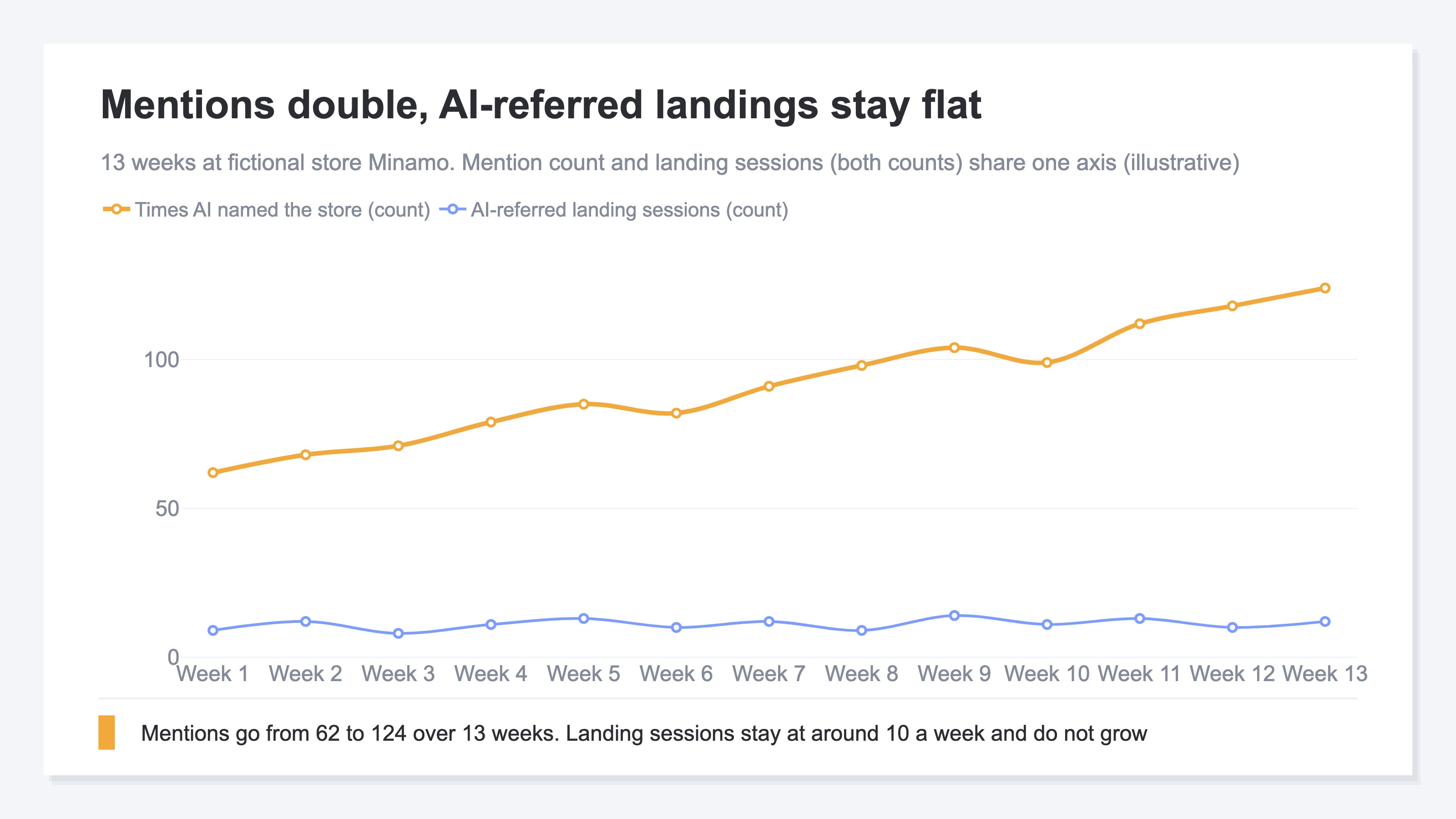
Of the three, the only one you can change by how you write your pages is citation. Mentions depend on the model's internal knowledge, and the click is the reader's call. Citation is settled by whether the page holds a sentence usable as an answer. If the name is appearing and visits are not growing, what is broken is the one in the middle.
2. Where the Citation-Rate Number Applies: Conditions From a July 2026 Survey#
"Lifted citation rate by as much as 40%." Articles introducing GEO carry that number without fail. It comes from a 2023 experiment, and ever since, the number alone has travelled on its own. A survey submitted to arXiv on 15 July 2026 sorts out where that number applies. Before the submission and after it, the same number no longer says the same thing.
The survey is titled "Optimizing Visibility in Generative Engines: A Critical Survey of Generative Engine Optimization (2023-2026)"[1]. It reviews 45 studies published between November 2023 and July 2026. It is a single-author preprint that has not been peer reviewed, so it should be read as one researcher's argument rather than a settled conclusion.
The argument itself is specific. The widely cited lift is correct inside the experiment's own setup. But that number, it says, comes with the condition that the source is already inside the context. Becoming newly discoverable, and traffic that keeps coming — neither of those is established[1].
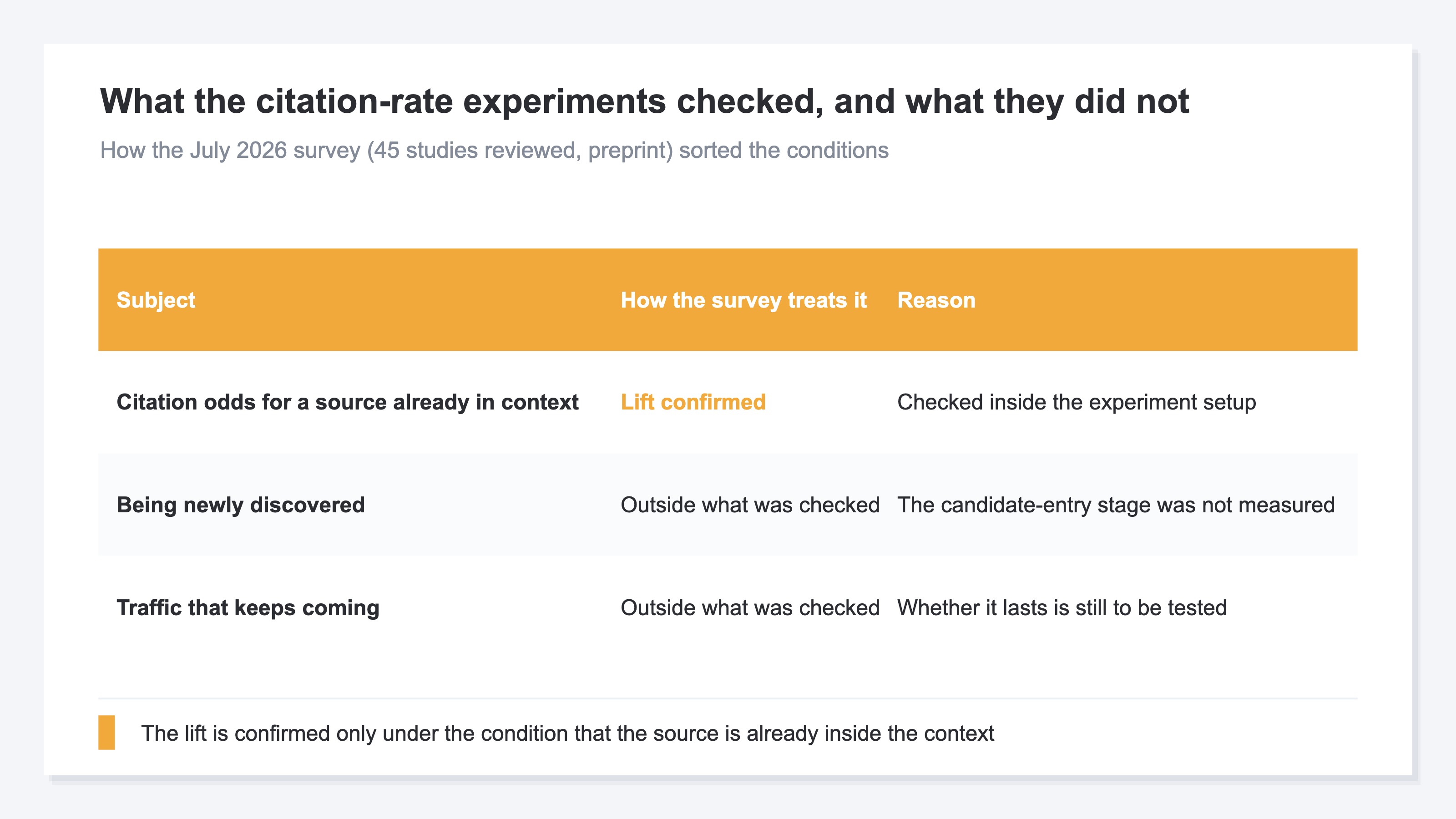
That sorting maps straight onto the breakdown in the previous section. What the experiments measured is the probability that a page already in the fetch candidates has its sentences used. Getting into the candidate set at all — being newly discovered — is a stage the number has not reached yet. The factors the survey lists as reproducible are fit with the subject and position within the context[1]. What those two conditions consist of is covered in the two conditions that get you cited by AI.
Whether to take up GEO as an initiative at all, and how widely the effect varies by technique, is left to GEO isn't established yet. What this article solves is the other thing: the mismatch in what you are watching, when the name is already appearing and traffic is not growing.
3. Replace the Metric You Track: Citation Happens at the Sentence Level#
Look closely at a ChatGPT answer and the source link is attached to one particular sentence inside it. Not to the brand as a whole, and not to the page as a whole. Citation is happening at the level of a sentence. A page with no sentence that can be lifted out as an answer is not a candidate for citation, however well known the name is. In our own 90 days of AI-referral logs, the articles being cited were the ones holding a particular type of sentence. What we checked is written up in the article types AI actually cited.
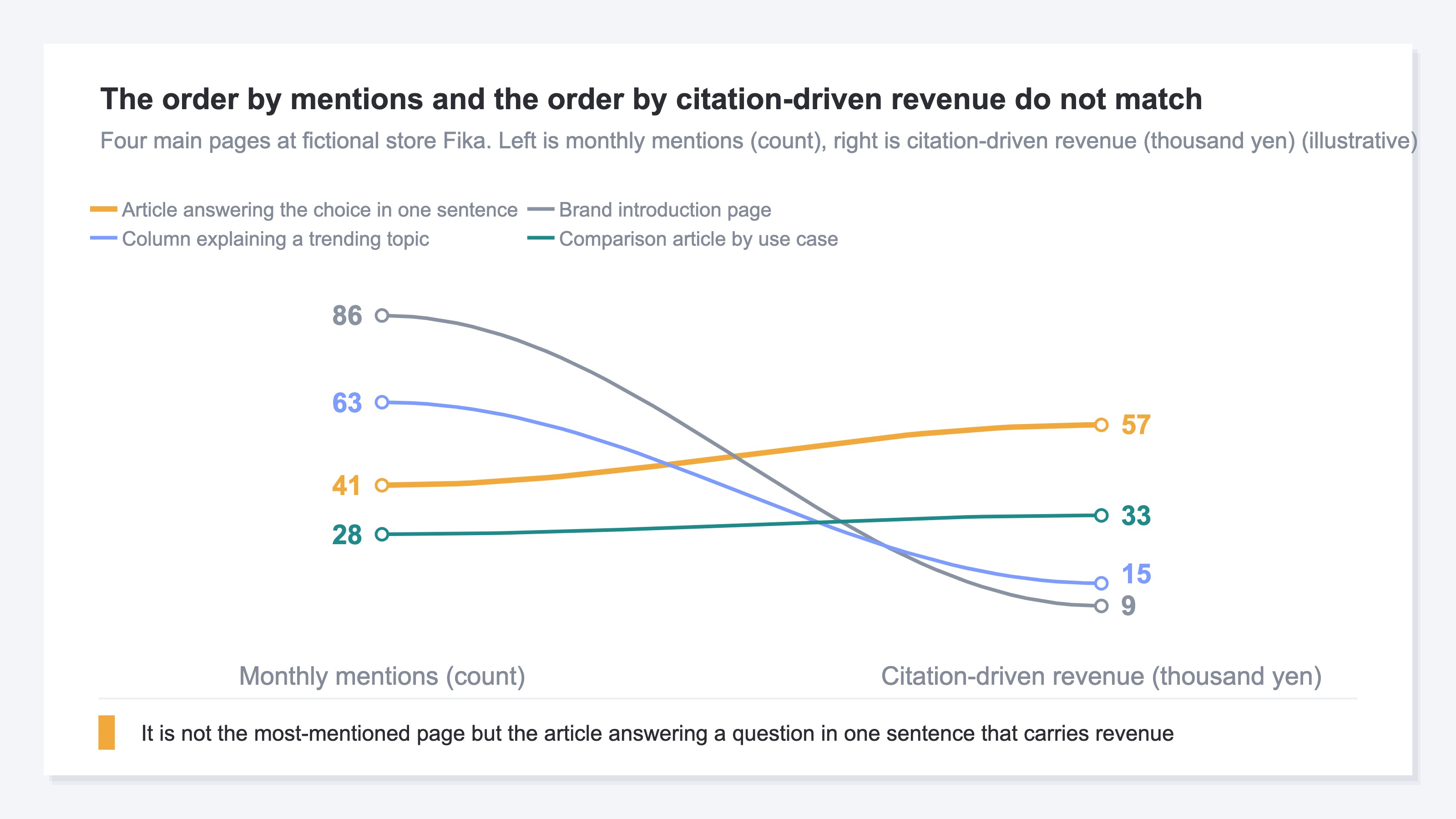
There is a way to check citations yourself. You fix a prompt set of expected questions, send the same questions on a schedule, and record the source URLs that appear in the answers. This routine has two limits, though. AI answers change on every run, so the premise is several engines, several runs each, repeated on a schedule. How unreliable a single check is, we measured in does ChatGPT name your brand. And what the record holds stops at the cited URL: whether that citation carried a visit, or turned into revenue, appears nowhere in it. The survey also reports how large the run-to-run variation is, and cases where rewriting for citations lowered fetching on the search side instead[1].
Taken together, what has to be replaced is the question you chase. Not "is our name showing up in AI?" but "which pages are the cited sentences carrying visits and revenue to?" The first answer wobbles on every run; the second stays as a record of what landed on your own site. Answering it takes AI-referred sessions per page and the revenue those visits produced, visible on one screen.
RevenueScope solution
What the replaced question needs is not a record of citations but a record of landings. RevenueScope aggregates AI-referred traffic at the grain of landing page × AI path. Paths are classified as ChatGPT, Claude, Perplexity, Gemini and Copilot. Each row carries sessions, bounce rate and revenue, together with the last time it was referred through AI.
Ask an AI assistant such as ChatGPT through MCP — "over the last 30 days, which pages did AI-referred visits land on, and how much revenue did they make?" — and the answer comes back at that grain. Written out with fictional store Rivère for illustration.
Fictional Store Rivère's AI-referred landings (one example, illustrative)
| Landing page | AI path | Sessions | Bounce rate | Revenue |
|---|---|---|---|---|
| /blog/ceramide-cream-guide | ChatGPT | 90 | 46% | ¥50,000 |
| /blog/basic-routine-order | ChatGPT | 70 | 85% | ¥0 |
| /blog/ceramide-cream-guide | Perplexity | 25 | 52% | ¥10,000 |
| /products/ceramide-set | Gemini | 15 | 40% | ¥40,000 |
| /blog/sunscreen-reapply | Copilot | 10 | 60% | ¥10,000 |
Note: the figures are a fictional example rounded for explanation. What the demo screen shows is sample data from the sample store (refreshed daily), and both the landing pages and the amounts there are different from this table.
Only /blog/basic-routine-order, second by sessions, sits at ¥0 in revenue. Its bounce rate is 85%, so most of the visits that landed there left again. What was being cited on that page was a sentence answering general knowledge about the order of a skincare routine. What it carries in are visits partway through looking something up, not visits standing just before a purchase. The volume of visits is sufficient. What has to be checked is the quality of the landing — which sentence brings in visits carrying which interest. The reverse also exists: pages that are cited but barely produce clicks. What to weigh before deleting them is laid out in zero search clicks but cited by ChatGPT.
GA4 has had a channel group collecting AI-assistant referrals since May 2026, and session counts can be checked there[2]. Google's AI Overviews and AI Mode are counted on the Organic Search side and do not fall into that grouping. Known bots are excluded automatically, but you can neither turn the exclusion off nor see how much was excluded[3]. To take which page it landed on and how much revenue it made into a decision, you need the grain of landing × path × revenue.
That said, AI assistants do not always pass referrer information, so AI-referred totals are a lower bound. Exposure that was cited but not clicked is outside what can be observed. What RevenueScope provides is the record of visits that actually landed on your site and the revenue those visits produced.
FAQ#
Frequently asked questions#
Q. If the mention count keeps rising, will traffic follow eventually?
A. Mentions and traffic are separate events, with citation and the click sitting in between. However far the mention count climbs, if the page holds no sentence usable as an answer, it stops at the citation stage.
Q. Has the effect of working on citation rate been refuted?
A. It has not. What the July 2026 survey pointed out is where the number applies[1]. The widely known lift was confirmed under the condition that the source is already inside the context, and the effect on being newly discovered, along with traffic that keeps coming, is not yet established.
Q. Can AI-referred traffic be checked with GA4 alone?
A. Session counts can[2]. GA4 has had an AI-assistant channel group since May 2026. Google's AI Overviews and AI Mode are treated as Organic Search and do not fall into that grouping. There is also no connection to revenue by landing page.
Q. Is there a way to check for myself whether I am being cited?
A. You can fix a prompt set of expected questions, run it on a schedule and record the source URLs. But the answers change on every run, and what the record holds stops at the cited URL. Following through to visits and revenue takes measurement on the landing side.
Summary#
Between your name appearing in an AI answer and visits increasing sit two separate events: citation and the click. The July 2026 survey pointed out that the widely known lift in citation rate belongs to the condition that the source is already inside the context[1]. Being newly discovered, and traffic that keeps coming, remain outside that number.
So replace the metric you track. Not the count of mentions, but the visits that landed and the revenue they made, at the level of the cited sentence. Citation happens at the sentence level, so what you do about it is decided at the sentence level too.
The next move is to check which pages AI-referred visits are landing on right now, and how much revenue they are making. Landing pages with revenue attached hold sentences that answer an interest standing just before a purchase. Add more sentences of that type to the articles you write next.
See which ads actually drive revenue, at a glance
Free up to 2,000 sessions/month, AI connection included. No credit card required. Up and running in 5 minutes.
![[Research] GEO Isn't Established Yet: Start by Measuring](/_next/image?url=%2Fimages%2Fnews%2Fgeo-not-yet-established.jpg&w=3840&q=75)