![[Research] AI Overviews on 51% of Searches: Citations Differ From Top Ranks](/_next/image?url=%2Fimages%2Fnews%2Fai-overviews-citation-gap-study.jpg&w=3840&q=75)
Your rankings haven't dropped, yet your page never appears in the AI answer sitting at the top of the search results. A peer-reviewed paper that measured 5,000 search keywords typed by real users reports exactly this mismatch. About half of all searches generate an AI Overview, and the sources it cites barely overlap with the ordinary search results for the same keyword. Line up ten URLs that appeared on either side and fewer than two appear on both. Which is to say: lifting your ranking does not automatically get you cited by AI.
Contents
TL;DR#
- Measured across 5,000 search keywords typed by real users, 51.5% generated an AI Overview. Across 11,500 keywords that include research question sets, it was 65.6%
- The sources an AI Overview cites and the ordinary search results for the same keyword overlap by only about 18%. Fewer than two of ten appear on both sides, so pages rank high without being cited, and pages get cited without ranking high — both happen
- That does not make ranking irrelevant. A separate large-scale study reports that about 38% of citations come from pages in the search top 10. Ranking has an effect but does not decide the outcome on its own, and holding both at once is the accurate reading
- The numbers disagree between studies because the period measured, the target and the counting method differ. These are English-language measurements too, so the safe move is to confirm the ratios against your own data
1. AI Overviews on 51% of Searches: What the Study Measured#
Measured on the search keywords real users actually type, about 51% generated an AI Overview. Search ten times and five of those times an AI answer sits above the ordinary search results.
The study that reported this figure is "How Generative AI Disrupts Search: An Empirical Study of Google Search, Gemini, and AI Overviews"[1]. It sends the same search keywords to Google Search, Gemini and AI Overviews and compares the results, collecting at scale which keywords produce an AI Overview and what it cites when one appears. It has been accepted at SIGIR 2026, an international conference in information retrieval.
Which figure to read: 51.5% or 65.6%#
The study sends a total of 11,500 keywords split into nine sets. Across all of them, an AI Overview was generated 65.6% of the time. But that figure includes question sets built for research purposes. Narrow it to the 5,000 keywords in ORCAS, a dataset of keywords real users typed into a search engine, and the generation rate is 51.5%. The paper itself writes that this is the most appropriate value to represent real user search. So this article puts 51% at the center.
The searches that produce one, and the ones that don't#
The generation rate shifts a lot with the shape of the keyword. Keywords asking for an explanation: 94.6%. Keywords in question form: 86.2%. Keywords that are just words strung together: 76.5%. Split by whether the keyword is a question at all, question forms came to 89.9% against 51.9% for non-questions. The more a keyword takes the shape of a question, the more readily an AI Overview appears.
What affects EC is the other side of that. For keywords taken from Amazon product search, the generation rate falls to 17.4%. For the keywords typed right before buying — product names, model numbers — AI Overviews rarely appear. Conversely, for questions comparing products and question sentences about products, the paper reports that AI Overviews appear at a high rate. But those are question sentences the researchers built, not real user searches themselves. The traffic EC sites collect with articles is usually the latter, the consideration stage. Which means the pages hit hardest by AI Overviews are the ones read before the purchase.
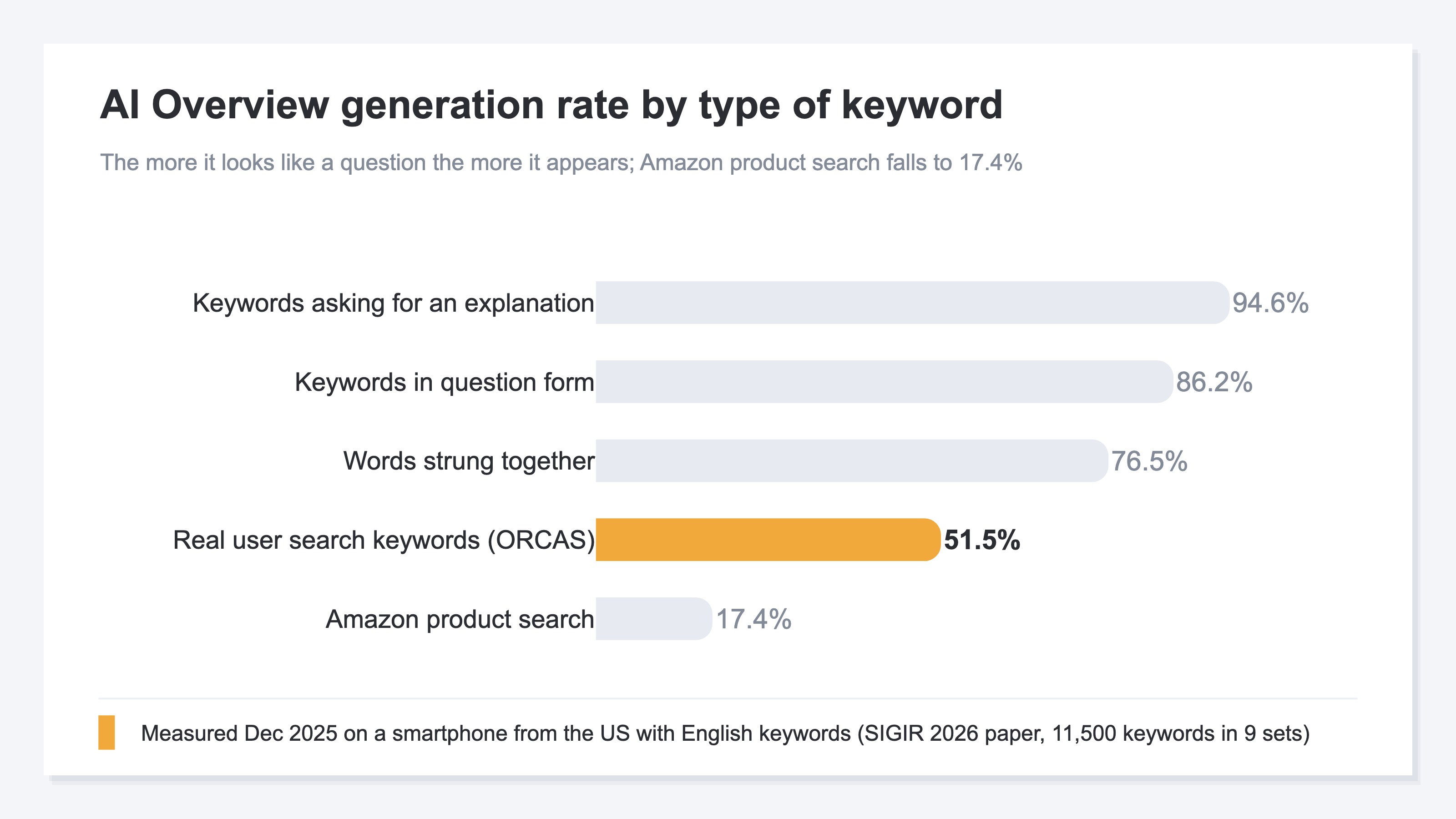
One note on conditions: this measurement was taken on December 7-8, 2025, from New Jersey in the United States, on a smartphone, with English keywords. Whether it carries over to Japanese-language search is handled in section 3.
2. The Cited Sources Are Not the Top Results: Overlap Stops at a Fifth#
The pages an AI Overview cites and the pages listed in the ordinary search results for the same keyword were almost different things. This is the number at the core of the paper.
Fewer than two in ten overlap#
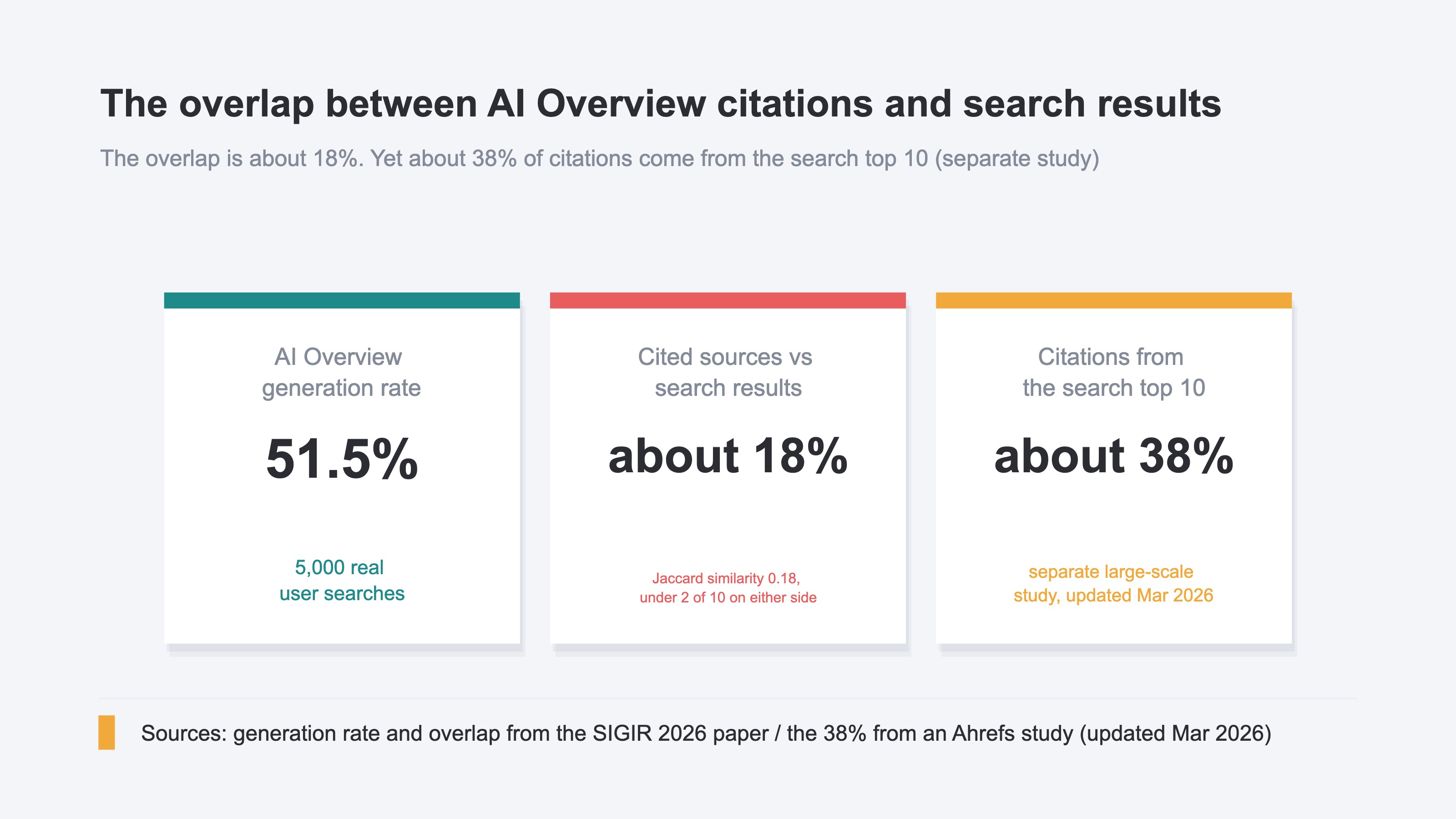
The study measures how much the set of URLs cited by an AI Overview overlaps with the set of URLs that appeared in the search results for the same keyword. The measure used is Jaccard similarity, and the average across the two was 0.18. Line up ten cited sources that appeared on either side and fewer than two appear on both. Everything else appears on one side only. Narrowing to the 5,000 keywords real users typed gives 0.17, nearly the same. There is a spread by keyword type: 0.08 for Amazon product search, 0.24 for questions that divide opinion.
Here is the situation people describe. Rankings haven't fallen, and clicks haven't collapsed either. And yet ask ChatGPT or Gemini the same thing and your own page doesn't come up, while competitors do. No matter how much of the SEO gets reviewed, nothing looks wrong — a complaint we hear often. A measured overlap that stops at a fifth is the structural explanation for that state. Being in the top and not being cited, and being outside the top and being cited, both happen routinely.
"Ranking is irrelevant" goes too far#
But reading this as "ranking is irrelevant" overshoots. A separate large-scale study reports that about 38% of AI Overview citations come from pages in the search top 10[2]. The top ten pages are a tiny slice of the whole web, so having nearly four in ten citations drawn from there is evidence that ranking has an effect.
The two results hold together. Investing in rank is not wasted, and at the same time, lifting a page does not guarantee it gets cited in an AI Overview. In the field, the view that "AI Overviews are based on search rank" and the view that "the selection is a different thing from conventional SEO" are still split. What the measurement showed was neither. Ranking is a required ingredient, but it does not decide the outcome on its own — the middle position.
The conditions on the cited side have been examined separately, by another study running a controlled experiment. The report that topical relevance, whether the content answers the question directly, and list position were the two biggest conditions is covered in The two conditions that get you cited by AI. A different paper from this one, but the direction that ranking matters is consistent.
There are also cases where rankings hold steady and only clicks fall. The procedure for separating whether the cause is AI Overviews or something else is laid out in Same rank, fewer clicks. This article does not go into that separation.
3. Why the Numbers Differ Between Studies: Read Them by How They Measured#
Even studies on the same topic disagree widely. It is because the measurement differs, and quoting the number without looking at that leads to the wrong call.
The figure that moved from 76% to 38% in six months#
That "about 38%" has a sequel. The same source published about 76% in July 2025. In the March 2026 update it has fallen to about 38%. The updated figure was measured across 863,000 keywords and 4 million URLs[2]. Halving in six months is partly because AI Overviews themselves keep changing, and partly because numbers move when the target and the period are different.
On top of that, the paper's "about 18% overlap" and this "about 38%" measure different things in the first place. The 38% is the share you get by counting, for each individual citation, whether it came from a page in the search top 10. The paper's Jaccard looks at how far two sets — the whole citation list and the whole search result list — agree. One tally counts the origin of each citation; the other counts agreement between lists.
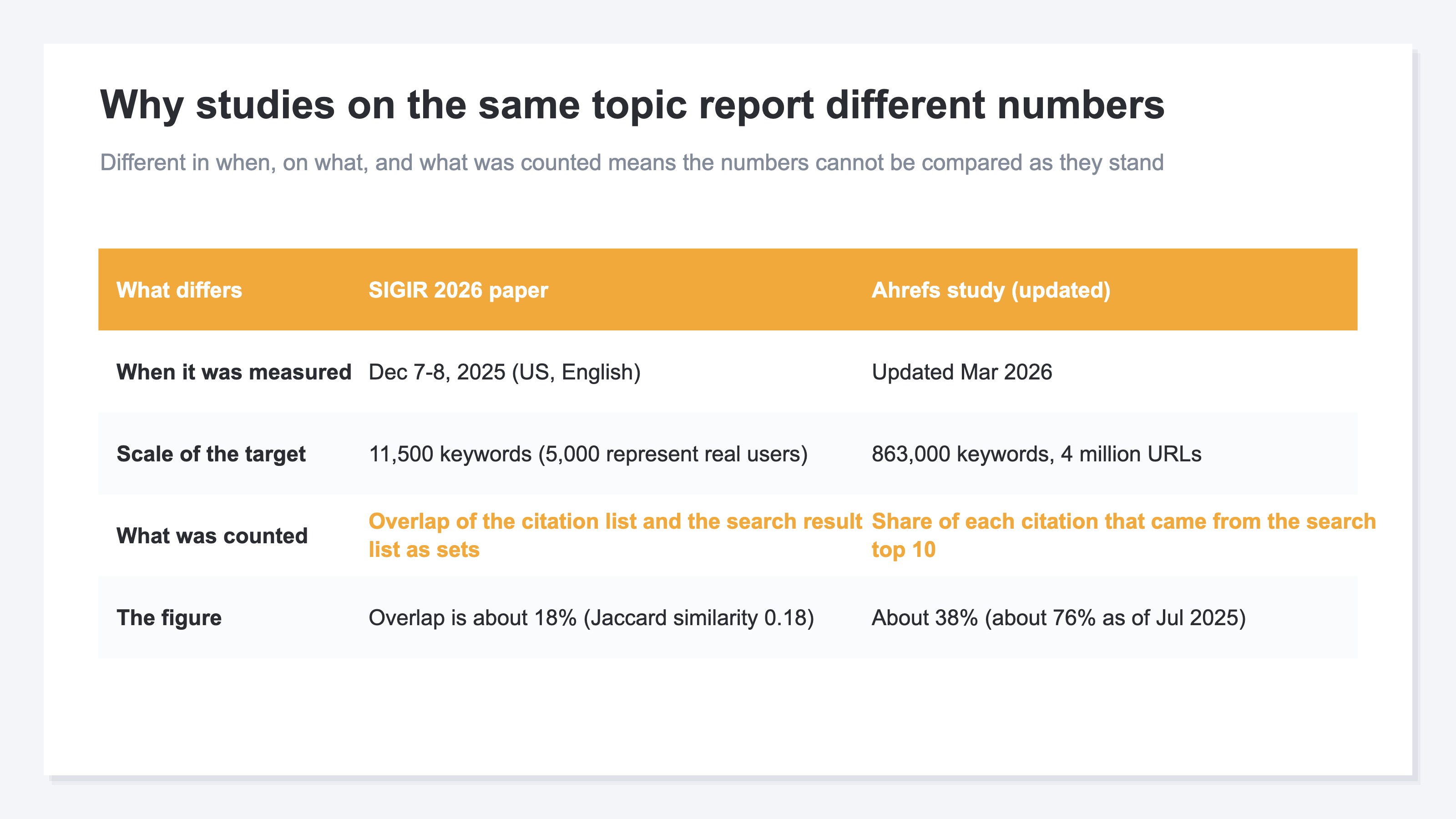
Three things to check when you read an outside study#
Before you quote a number, check when it was measured, which set of keywords was measured, and what the percentage counted. Numbers that don't line up on those three cannot be compared as they stand. This paper too is a measurement under the conditions of December 2025, the United States and English. There is no guarantee the same ratios hold for Japanese-language search, or for the keywords typed at an EC site in Japan.
So outside studies are best treated as something that tells you the direction. Which of your own pages get read via AI, and how much they sell, comes only from your own data.
Where the free routes run out#
Can you confirm it yourself? You hit a wall quickly. Google Search Console's search performance counts impressions and clicks as totals. There is no field that carves out only the portion that appeared inside an AI Overview[3]. What is visible and how far is laid out in Reading GSC's AI search report. The care that impressions themselves need in how they are counted is handled in AI search impressions.
You can try to infer from rank, but since the cited sources differ, rank is not the answer on the AI side. What is left is going to look at the search results yourself. The checking has to be repeated for every combination of page and keyword, though, and the results change. Checking one page-keyword pair is straightforward. It is the weekly re-checking that gets heavy, and that is where it stalls.
RevenueScope solution
RevenueScope measures AI-referred traffic page by page. Sessions actually clicked through from ChatGPT, Claude, Gemini, Perplexity and Copilot are computed for each page they landed on. It shows the revenue that stood up on that page as well (landed revenue — the revenue of sessions that entered through that page; purchases made after moving on are attributed back to the entry page). AI-referred traffic counts the AIs that pass a source tag (referrer). That is a lower-bound way of counting, but it is the premise every tool shares.
On top of that, the page list in the content improvement suggestions carries suspicion badges. "Check the search results" marks pages that have search impressions but few clicks, where the top of the search results is suspected of being taken by something else. "AI citation present" marks pages where AI-referred traffic continues even as search clicks fall. Because the appearance of the search results is not itself observed, these are presented as a suspicion rather than a verdict — material to judge with before you make changes.
To show the shape, here is what it would look like written out for Fictional Store A, an EC site selling skincare.
| Page | Search clicks | AI-referred sessions | Landed revenue | Badge |
|---|---|---|---|---|
| Guide to the order of use | 12 | 34 | ¥40,000 | AI citation present |
| Care routine for sensitive skin | 8 | 21 | ¥30,000 | AI citation present |
| Pore care basics | 96 | 4 | ¥10,000 | None |
| Serum product page | 3 | 2 | ¥6,000 | Check the search results |
Note: the table above is an example built for explanation, for Fictional Store A. The demo runs on the sample store's sample data (refreshed daily), so the pages listed and the figures shown there are different ones.
In this example, the guide to the order of use, with only 12 search clicks, makes the most revenue on 34 AI-referred sessions. Decide what to work on from search clicks alone and that page would have been first in line to be rewritten. The pore care basics page, with 96 search clicks, has almost no AI-referred traffic. The divergence in cited sources that the paper showed can be confirmed as the same tendency at the level of individual pages on one site. Which page makes revenue via AI is not something you can put in priority order by guessing.
FAQ#
Frequently asked questions#
Q. If we lift our search ranking, will we get cited in AI Overviews?
A. Ranking has an effect, but it does not decide it on its own. About 38% of citations come from the search top 10, while the overlap between the set of cited sources and the set of search results stopped at about 18%. Investing in rank raises the chance of being cited, but pages that rank high and still are not cited are perfectly ordinary.
Q. How do we check whether we are being cited in AI Overviews?
A. There are two angles. First, how much traffic actually clicked through from AI there is, page by page. Second, which pages have search impressions but few clicks. The first ties directly to AI-referred revenue; the second gives you grounds to suspect what is happening at the top of the search results. You can also go through the search results one at a time, but the checking is needed for every page-and-keyword pair, and the results change.
Q. Does this 51% apply to Japanese-language search?
A. Not as it stands. The measurement was taken in December 2025 from the United States with English keywords. The direction — AI Overviews appear readily for consideration-stage questions and rarely for product-name searches — is worth taking, but confirm the ratios against your own data.
Q. If we get cited, does revenue go up?
A. Being cited and revenue standing up are separate things. Which page someone who clicked through from a citation landed on, and how much they bought. Only when you see that far can you check the answer on the investment. Whether to delete pages with zero search clicks is handled in Zero search clicks but cited by ChatGPT.
Summary#
Measured on the search keywords real users type, 51.5% generated an AI Overview. And the cited sources overlap with the search results for the same keyword by only about 18%. The bafflement people feel when their rank is good but AI never surfaces them is explained by that divergence. At the same time, a separate study reports that about 38% of citations come from the search top 10, so ranking is an ingredient that has an effect. It has an effect but is not sufficient, and that reading satisfies both.
The numbers disagree between studies because the period, the target and the counting method are not aligned. This paper too is a measurement of English-language search as of December 2025, and the ratios cannot be carried over to your own site as they stand. Outside averages tell you the direction and nothing more. Produce it once, page by page: which of your pages are read via AI and how much they sell. That real figure is where the decision starts.
See which ads actually drive revenue, at a glance
Free up to 5,000 sessions/month, AI analyst included. No credit card required. Up and running in 5 minutes.
References#
- [1] SIGIR 2026 "How Generative AI Disrupts Search: An Empirical Study of Google Search, Gemini, and AI Overviews" (2026)
- [2] Ahrefs "Update: 38% of AI Overview Citations Pull From The Top 10" (2026)
- [3] Google Search Console Help "Performance report (Search results): Overview and basic setup" (2026)
![[Research] The Two Conditions That Get You Cited by AI: What a 250K-Trial Study Shows](/_next/image?url=%2Fimages%2Fnews%2Fai-citation-conditions-study.jpg&w=3840&q=75)