Yahoo! JAPAN Shopping has announced that its store plans will be revamped from September 2026[1]. Two costs are added — a ¥10,000 monthly system usage fee (excluding tax) and a 2.5% sales royalty — and one contribution is no longer required. Whether this reads as a price rise or as no change flips with your monthly revenue and with how much you have been contributing until now.
Contents
TL;DR#
-
The two added items are the monthly system usage fee and the sales royalty
¥10,000 a month (excluding tax) and 2.5% of revenue start from September 2026
-
What is no longer required is the campaign funding contribution
What was being contributed through August 2026 is no longer required from September 2026 onward
-
The monthly fee is flat, so the smaller the monthly revenue the heavier it sits
The share the two added items take of monthly revenue is 12.5% at ¥100,000 a month and 2.83% at ¥3,000,000 a month
-
Which way the net falls comes only from your own record
No rate is stated officially for the removed side, so there is nothing to work from but the amount you have actually been contributing
1. Two Costs Added, One Removed#
Two costs are added under the new pricing, and one contribution is no longer required.
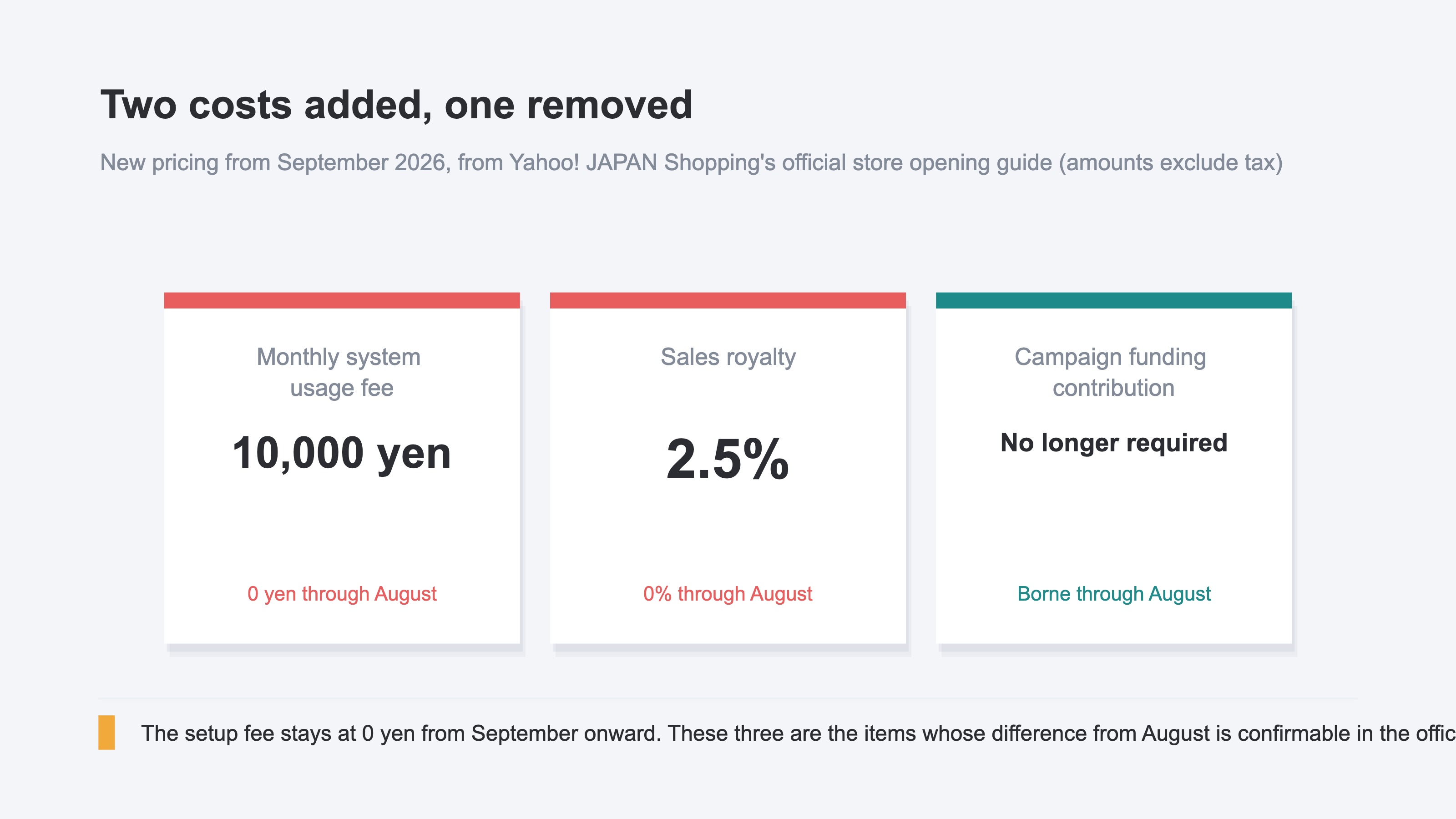
Yahoo! JAPAN Shopping has announced that it will revamp its store plans from September 2026[1]. Under the new pricing the setup fee stays at ¥0[1]. On top of that come a ¥10,000 monthly system usage fee (excluding tax) and a 2.5% sales royalty[1]. The official FAQ states that all three of these are free until September 2026[1].
The added side is these two. The first is the flat monthly system usage fee; the second is the sales royalty, which moves in proportion to revenue. The difference in nature between a flat amount and a rate shows up in the next section as how heavy each sits at different levels of monthly revenue.
Alongside them, the fee table carries a note. The campaign funding contribution borne through August 2026 is no longer required from September 2026 onward[1]. Two items added, one no longer required. What the revision amounts to is the net of these three.
The first thing a seller settles on after reading the announcement is a choice of two: take it as a price rise and reconsider whether to keep the store open at all, or read it as effectively no change and alter nothing. What decides which of the two is right, however, is not inside this fee table. What the official pricing shows is only the amount and the rate on the added side; how much the removed side came to is recorded nowhere but in your own contribution history. The question to ask is which is larger, the added side or the removed side.
Other items listed in the new fee table#
The new fee table lists other items as well[1]. The store points funding contribution is mandatory at 1% and can be set anywhere from 1% to 15%[1]. The affiliate partner reward is mandatory at 2% to 4% and differs by category[1]. The affiliate fee is 30% of the partner reward, and the payment service fee differs by payment method[1]. Their values through August 2026 are not stated officially, though, so they cannot be read as newly introduced in September. The items whose difference from August is confirmable are the three named at the top of this section: the monthly system usage fee, the sales royalty and the campaign funding contribution.
Note that this is not about the ad platform, even though the Yahoo! name is shared. Yahoo! Ads measurement blending into organic search in GA4 is a separate topic; what this article covers is marketplace store pricing.
2. How Heavy the Monthly Fee Is Depends on Monthly Revenue#
Between a store at ¥100,000 in monthly revenue and a store at ¥3,000,000, the weight of the added burden differs by 4.4x.
The monthly system usage fee is a flat amount. It does not move with revenue, so the smaller the monthly revenue, the larger the share it takes. The added burden here means the two items that start from September 2026 — the monthly system usage fee and the sales royalty. Since the new fee table also lists the store points funding contribution and the affiliate partner reward, it is not the total of what you pay.
The calculation is simple. Add 2.5% of revenue to ¥10,000 a month (excluding tax) and divide by monthly revenue. At ¥100,000 a month that is ¥12,500, or 12.5%; at ¥300,000 a month, ¥17,500, or 5.83%. At ¥1,000,000 a month it is ¥35,000, or 3.5%, and at ¥3,000,000 a month, ¥85,000, or 2.83%. The larger the monthly revenue, the closer the share moves to 2.5%.
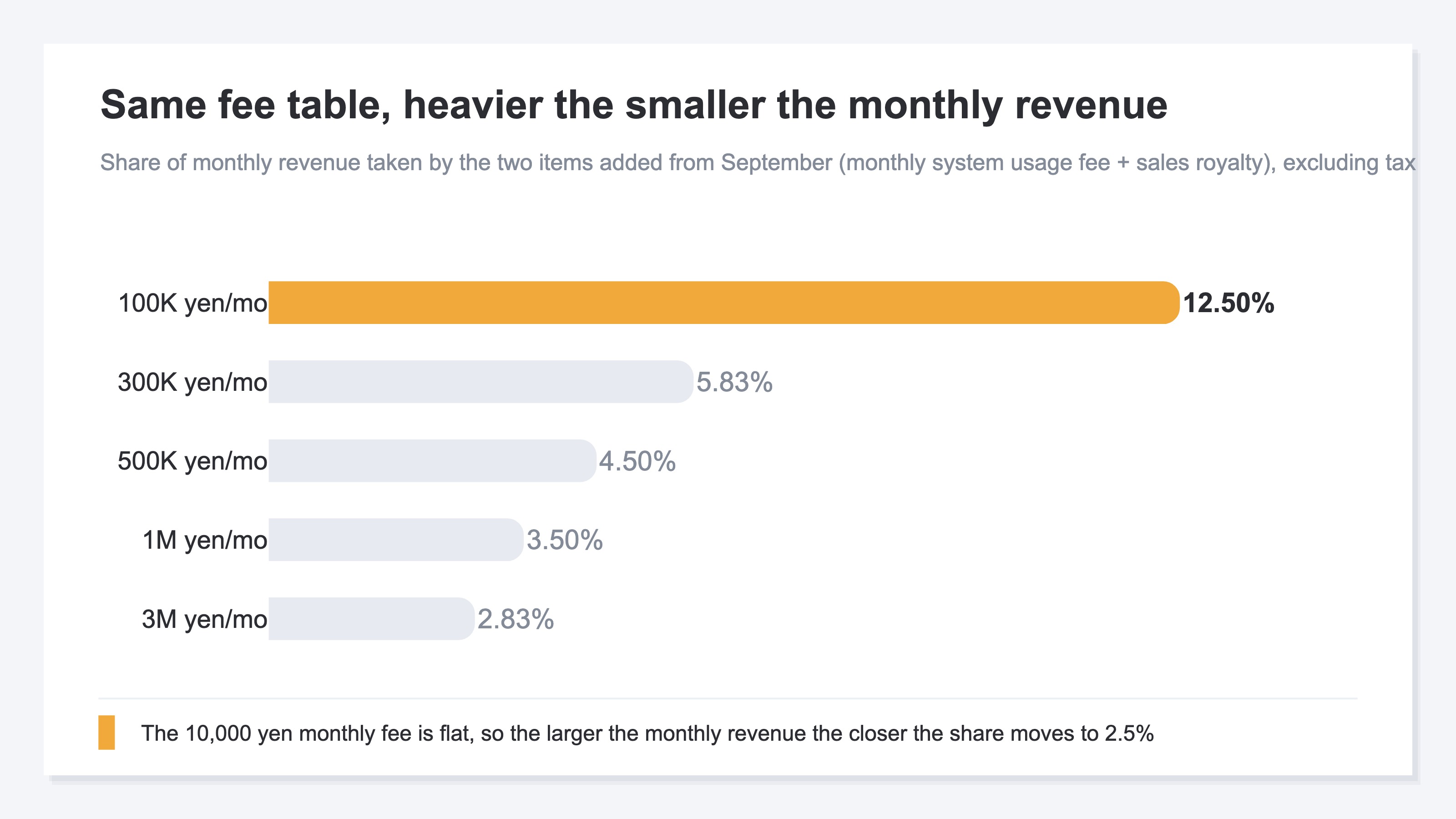
This spread is why the revision lands differently from store to store. For a store at ¥3,000,000 a month, ¥10,000 is 0.33% of revenue; for a store at ¥100,000 a month it is 10%. The same ¥10,000 sits inside the margin of error on one side and moves the profit on the other. The first thing to confirm is what the share comes to when applied to your own monthly revenue.
3. Which Way the Net Falls Is Decided by Your Own Record#
How much the removed side came to cannot be worked out from the official fee table.
What the note in the fee table shows is one thing only: that the campaign funding contribution is no longer required[1]. It covers what was borne through August 2026, and from September 2026 onward it is no longer required[1]. No rate is given. Which means this article cannot estimate the amount on the removed side on the reader's behalf.
The added side is the share calculated in the previous section. The removed side is the amount you have actually been contributing. If the added side is larger the burden rises; if the removed side is larger it falls. Of the information the judgement needs, one half sits in the official pricing and the other half exists only in your own records.
The more actively a store has joined campaigns, the larger its removed side. For a store whose participation was limited, the removed side is small and the added side stays almost as it is. The larger the funding a store spent on campaigns, the larger the amount freed up from September onward.
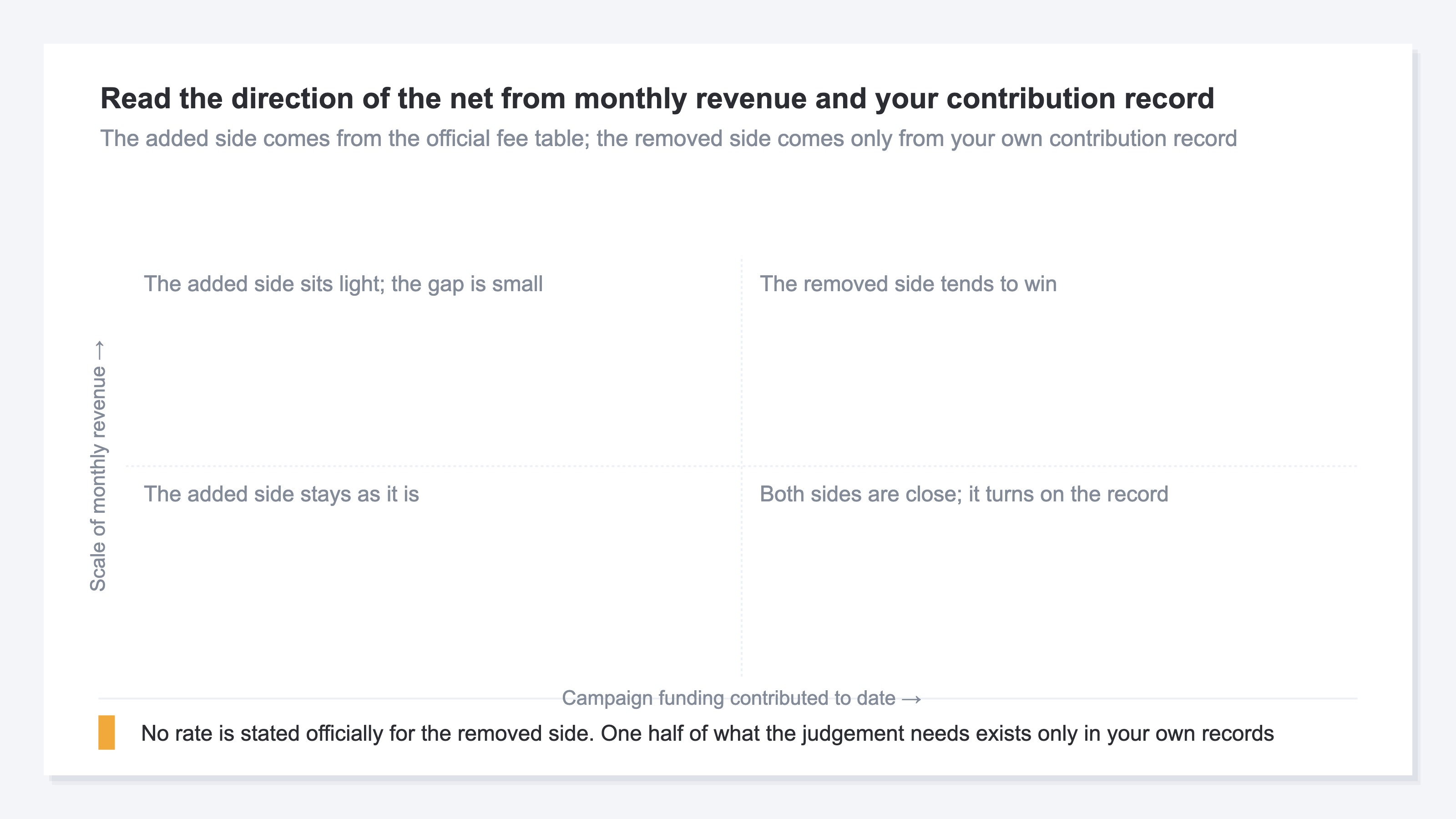
If you keep revenue tallied separately for each campaign, the same judgement works the next time the pricing is revised. The idea of comparing revenue efficiency campaign by campaign is covered in revenue efficiency by campaign. Until the direction is settled, the height of a rate on its own cannot produce a conclusion.
4. What You Decide Is Not the Rate but Where You Put Revenue#
What remains once the net is out is a decision about how much of total revenue to leave sitting on the marketplace.
There are two moments of impact. The first is the switch in September 2026, the second is the invoice. The official pricing states that for stores opened from September 2026 onward, the monthly system usage fee is charged from the month of opening[1]. For the month of opening it is prorated by day and is debited together with the monthly invoice[1]. What the official pricing shows reaches as far as the proration in the opening month and the addition to the monthly invoice[1]. The actual amount reaches your hands with the invoice after that.
If you weigh the allocation only after checking the invoice amount, the decision starts after the burden has already been incurred. By that point September's revenue is already fixed, and it is the time of month when October's ad plan is decided too. The period when the decision has to be made and the period when the material arrives sit in the wrong order.
On top of that, what to examine is not the height of the rate. You cannot change the marketplace's rate yourself, but you can choose how much of total revenue to place there. You can choose, though, only if there is somewhere to move it to.
Selling on marketplaces while your own store does not sell is not unusual. The structure where the cause lies in the channel rather than the product was covered in sells on marketplaces, not on your own store. Which acquisition routes to prepare on your own store is laid out as a list of candidates in comparing 12 EC acquisition channels.
Getting revenue by traffic source is, in itself, a matter of matching order data against where the visit came from. What this decision needs, though, is revenue by traffic source lined up under the same definition across two points in time — the September switch and the invoice. Tallying by hand gets heavier from the moment you have to hold one definition steady across periods with five or six sources in play. Google Analytics 4 can tally sessions too. It is not designed, though, to display revenue per session as the leading metric. Whether you can choose somewhere to move revenue to comes down to whether your own store has a second pillar.
RevenueScope solution
Whether you can choose where to move revenue when a marketplace's rate changes comes down to whether the ranking of channels on your own store is settled. RevenueScope uses a tag placed on your own site to display sessions, revenue and revenue per session (RPS) for each channel on one screen. What it tallies is the amount for which a purchase completed on your own site, not the conversion value an ad platform reports. The definition of RPS and its formula are covered in what RPS is.
Asking an AI assistant through MCP returns this#
Ask for the most recent 30 days by channel, and this comes back.
| Channel | Sessions | Revenue | RPS |
|---|---|---|---|
| 3,200 | ¥768,000 | ¥240 | |
| Google search | 1,500 | ¥270,000 | ¥180 |
| Direct | 900 | ¥144,000 | ¥160 |
| 400 | ¥120,000 | ¥300 | |
| Total | 6,000 | ¥1,302,000 | ¥217 |
Note: one teaching example built on the fictional store Komorebi (illustrative).
Of ¥1,302,000 in revenue, ¥768,000 came through Instagram — a single channel holding close to three-fifths of the whole. In sessions too, 3,200 is more than half. This state is not proof of good health; it is dependence. If traffic from Instagram falls, revenue on the store's own site falls in the same proportion. Whether you can choose where to move revenue when a marketplace's rate changes comes down to whether that dependence has been undone.
If each channel is tagged separately with UTM (the markers appended to the end of a link so the traffic source can be told apart), it goes further. Revenue, RPS, AOV (average order value) and CVR (purchase rate) are displayed for each campaign. What is displayed is a snapshot of the period specified. For periods where ad spend has been registered by entry or imported in bulk from CSV, ad spend by channel appears on the same screen, alongside the corresponding channel's revenue. You can calculate ROAS by hand as the revenue measured by RevenueScope divided by ad spend.
FAQ#
Frequently asked questions#
Q. From when is the monthly system usage fee charged?
A. From September 2026 onward, from the month the store opens[1]. The monthly system usage fee for the month of opening is prorated by day and is debited together with the monthly invoice[1].
Q. Are there no costs through August 2026?
A. The official FAQ states that everything is free (¥0) until September 2026[1]. That covers three items: the setup fee, the monthly system usage fee and the sales royalty[1]. From September 2026 onward the setup fee stays at ¥0[1]. A ¥10,000 monthly system usage fee (excluding tax) and a 2.5% sales royalty do arise, though[1].
Q. From when does the listing fee via the LINE Shopping tab arise?
A. The official FAQ states that it does not arise through the end of 2026[1]. From January 2027, every order purchased through the cart on the LINE Shopping tab is covered[1]. What is charged is 2% to 4% of the product selling price (excluding tax)[1].
Summary#
What is added from September 2026 is a ¥10,000 monthly system usage fee (excluding tax) and a 2.5% sales royalty[1]. The campaign funding contribution borne through August 2026 is no longer required[1]. The rate on the added side is stated officially, but the amount on the removed side is recorded nowhere but in your own contribution history.
The basis for the judgement is the share the two added items take of your own monthly revenue, and the amount of campaign funding you have been contributing until now. The former, since the monthly fee is flat, grows larger the smaller the monthly revenue. The latter can be worked out only from your own records. The relative size of these two settles whether the burden rises or falls.
What remains on top of that is the decision of how much of total revenue to leave sitting on the marketplace. This is not settled by rates. What separates a store that can choose where to move revenue from one that cannot is whether revenue by channel on its own store is settled.
See which ads actually drive revenue, at a glance
Free up to 2,000 sessions/month, AI connection included. No credit card required. Up and running in 5 minutes.