On October 1, 2026, additional message pricing for LINE Official Account changes. Only the Standard plan is affected. The new rate is ¥3 per message up to 200,000 messages, and ¥2.5 per message above that. Set it against the current tiered rates and the only volume where the amount is unchanged turns out to be 50,000 messages or fewer. How much more you pay is set by how many messages you send.
Contents
TL;DR#
-
The change lands on October 1, 2026, and only the Standard plan is affected
The Communication plan and the Light plan cannot send additional messages at all
-
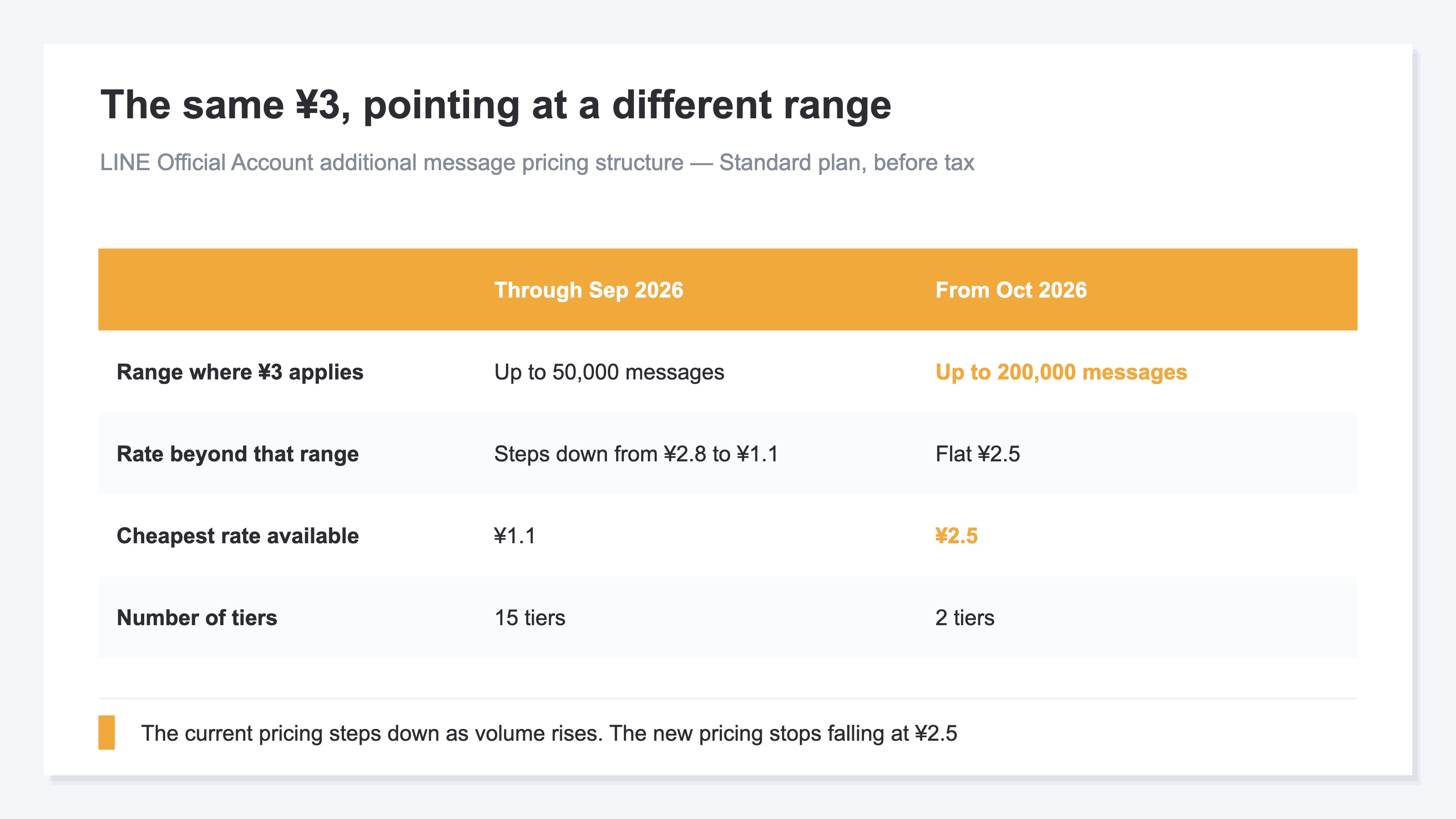
The same "¥3 per message" points at a different range
The current ¥3 is the first tier, covering up to 50,000 messages. The new ¥3 is a flat rate covering up to 200,000 messages
-
The only volume where the amount is unchanged is 50,000 messages or fewer
3.4% at 100,000 messages, 56% at 3 million — the more you send, the larger the increase
-
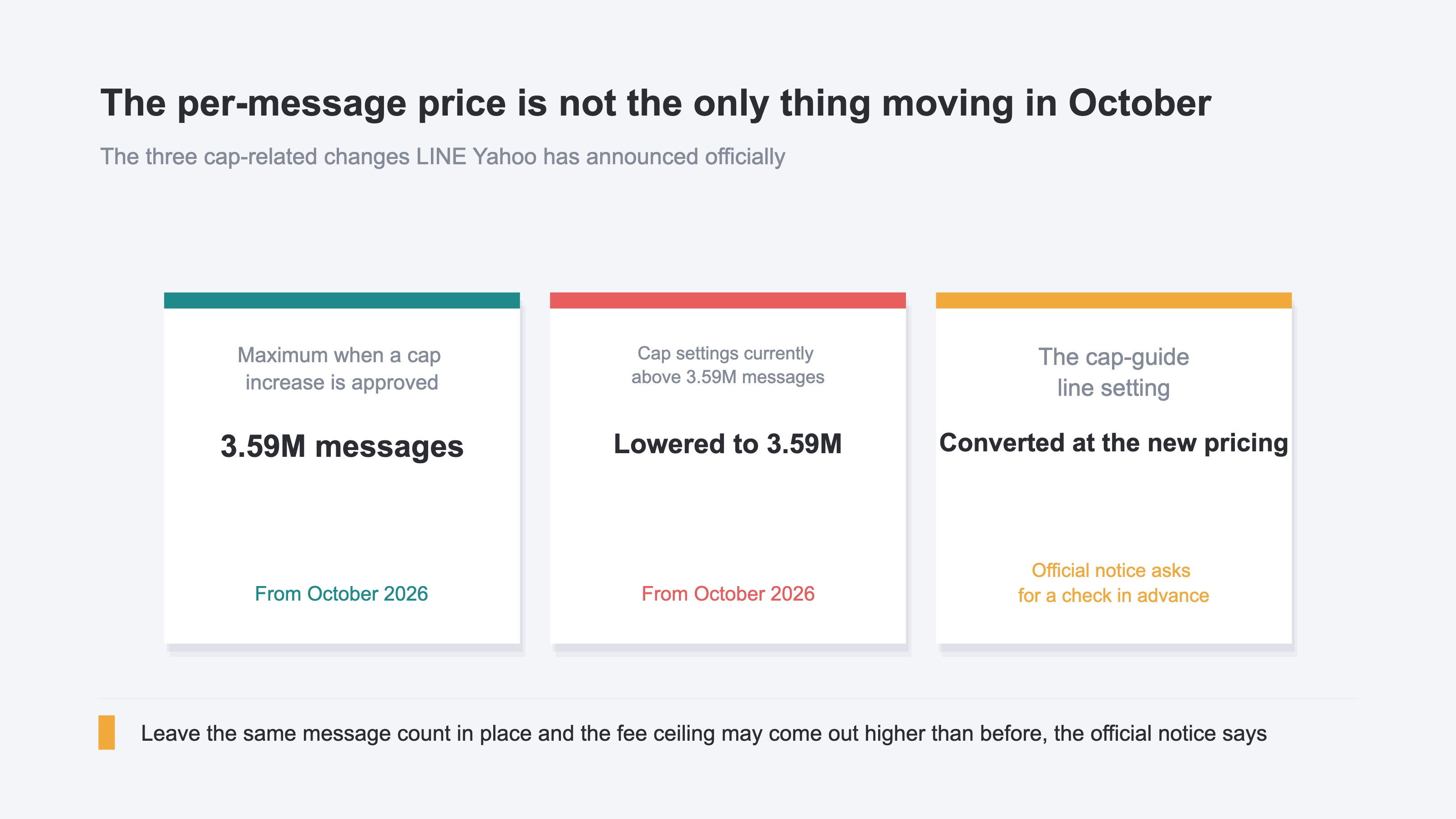
On the same day, the maximum that applies when a cap increase is approved also moves to 3.59 million messages
The cap-guideline setting is converted at the new pricing too, so the ceiling on the fee may come out higher than it did before the change
-
The amount paid can be worked out, but the revenue that delivery produced is not on the same screen
Pulling revenue per delivery out by campaign takes utm
1. The Same ¥3 Rate Now Covers a Different Range#
The "¥3 per message" in the new pricing applies to a different range than the current ¥3 does.
¥3 appears on the official pricing plan page as well. There, though, it is the rate for additional messages up to 50,000. Above 50,000 it drops to ¥2.8, above 100,000 to ¥2.6 — it is the first step of a tiered structure that keeps stepping down[2]. The ¥3 in the new pricing is a flat rate up to 200,000 messages, and everything above 200,000 becomes ¥2.5[1]. The notation is identical, but the range it points at has been swapped. Read it as "the same ¥3 as now" and the swap goes unnoticed.
Before comparing, line up three premises. First, the message counts here are counts of additional messages. An additional message is a message sent beyond the free message allowance included in the plan[1]. Mistake it for total messages sent and every calculation that follows is off. Second, only the Standard plan can send additional messages. The Communication plan and the Light plan cannot send additional messages at all[2]. Third, every amount in this article is before tax[1][2].
2. Every Volume Band Goes Up. Only 50,000 Messages or Fewer Stays the Same#
Except at 50,000 messages or fewer, the amount paid rises at every delivery volume.
The current tiered rates work so that the per-message price falls as the volume rises. The cheapest band is ¥1.1 per message, and the official page describes it as a rate that gets better the more you send[2]. The new pricing carries no such taper. ¥3 up to 200,000 messages, ¥2.5 above that, and no rate cheaper than ¥2.5 exists[1]. In other words, the mechanism that lowers the per-message price as volume rises is itself gone.
Here are six representative volumes, with the amount paid under the current and the new pricing.
| Additional messages | Current (yen, before tax) | New (yen, before tax) |
|---|---|---|
| 50,000 | 150,000 | 150,000 |
| 100,000 | 290,000 | 300,000 |
| 200,000 | 550,000 | 600,000 |
| 500,000 | 1,210,000 | 1,350,000 |
| 3,000,000 | 4,860,000 | 7,600,000 |
| 10,000,000 | 13,160,000 | 25,100,000 |
Here is where the official figures stop and mine start. The current 550,000 at 200,000 messages is exactly the worked example the official page publishes[2]. The new-pricing figures at 200,000, 500,000, 3 million and 10 million messages are the values in the use-case table the official notice carries[1]. The remaining seven amounts are values I calculated from the tiered rate table[2]. The new-pricing figures at 50,000 and 100,000 messages are likewise calculated from the flat ¥3 that applies up to 200,000[1].
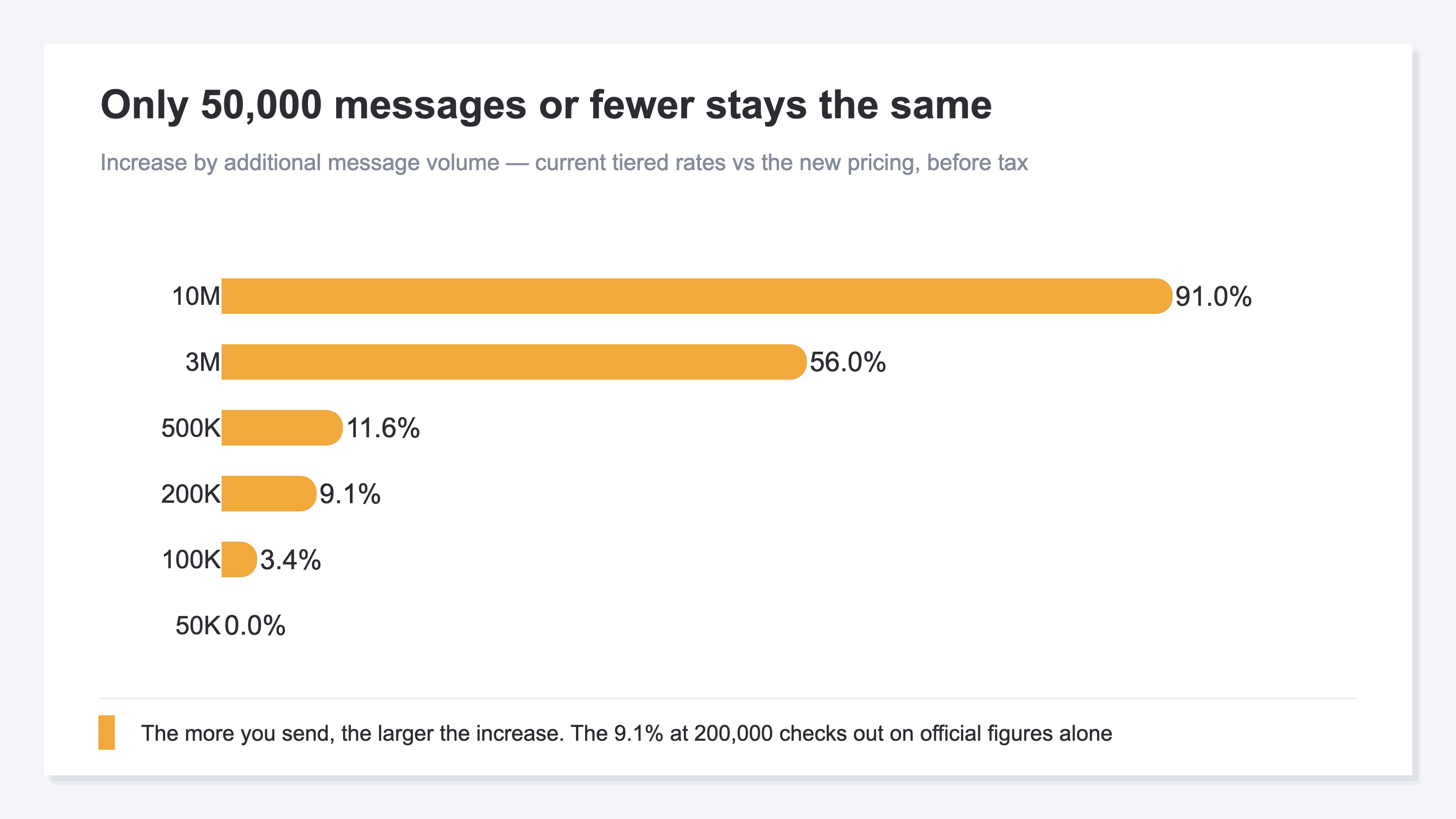
Working out your own amount is not hard. The current pricing is a 15-step staircase, the new pricing computes in two steps — up to 200,000 and above it — and you take the difference. What comes out of it, though, is the amount paid, not the revenue that delivery produced. And every time the delivery plan changes, the same calculation has to be run again.
3. The Cap Changes on the Same Day, Too#
October 1 moves more than the per-message price: the cap setting for additional messages changes as well. Additional messages carry a cap setting, and the maximum that applies when a request to raise it is approved changes to 3.59 million messages[1]. Where a cap above 3.59 million messages is currently applied, it is lowered to 3.59 million from October 2026[1]. The more an account has secured a high cap on the assumption of large-volume delivery, the sooner this bites — ahead of the per-message price.
The second one is the cap-guideline setting. The feature for setting a guideline cap on the number of additional messages is converted at the new pricing from October 2026 onward. Because of that, the notice says the ceiling on the fee may come out higher than it did before the change even if the same message count is left in place[1]. Where a fee ceiling close to the previous one is wanted, the official notice asks that the settings be checked and changed in advance[1]. Follow the per-message price story alone and leave the settings sitting there, and October arrives with a fee ceiling nobody intended.
4. After the Increase Is Calculated, the Revenue Question Remains#
The amount paid you can work out yourself, but the revenue that delivery produced does not exist on the same screen. The measurement mechanism itself is covered in the revenue effect of LINE Official Account, so it isn't repeated here. The point in short: what the LINE Official Account admin console shows you stops at clicks. Whether a visitor who moved from a chat to the site went on to buy is measured on the site side. That is where utm comes in — the marker appended to the end of a link so the source of a visit can be told apart. If the destination link carries no utm, that session either lands in Direct, or the referrer alone is passed and it is classified as Referral. The destination splits two ways, and that is all; it never comes together into a single line as LINE.
Payment timing feeds into the decision too. The monthly fixed fee is paid in advance at the start of the month, but additional message fees close at month end and are paid afterwards, around the 10th of the following month[2]. So the actual amount is fixed a month after the delivery. Without last month's revenue per delivery to hand, a confirmed invoice gives you nothing to decide delivery volume with.
The decision forced after the change comes down to two options: cut delivery or keep it. That decision is not a conversation about message counts — it is a conversation about RPS, revenue per session. How to compare RPS per delivery is covered in campaign-level revenue efficiency. How to judge non-ad channels on RPS is in how to measure non-ad channel efficiency. Reading coupon and sale effect by revenue rather than by units sold is in how to measure coupon and sale effect.
After the change, this is the process that comes round every month. Receive the amount confirmed around the 10th of the following month, recall what was delivered that month, and match it one by one against the revenue for each delivery. Ten deliveries in a month means ten rounds; split them by campaign and it grows further. What sets the speed of the decision is not the arithmetic on the increase — it is this matching step.
RevenueScope solution
A LINE delivery that carries utm is classified as LINE in the channel breakdown. RevenueScope expands that channel and shows revenue, sessions, RPS and CVR for each utm_campaign. Revenue here is not the click count that appears in the LINE admin console — it is the amount for which a purchase completed on the site itself. What is shown is a snapshot of the most recent period. Message counts and delivery fees are data RevenueScope does not hold, so the amount paid comes from the figures in the official admin console.
Ask an AI assistant through MCP and this is what comes back#
Ask for LINE traffic over the past 30 days broken out by campaign, and this is the answer.
| Campaign | Sessions | Revenue | RPS | CVR |
|---|---|---|---|---|
| New product early access | 1,240 | ¥446,000 | ¥360 | 4.6% |
| Weekend coupon delivery | 1,180 | ¥417,000 | ¥353 | 4.5% |
Note: one illustrative example built on a fictional store.
The RPS difference is 2%, and this table on its own does not settle which delivery is the better one. What settles it is the message count, which the table does not carry. Even with revenue almost level, if one of them used twice the messages, the amount it adds from October is twice as large as well. Message counts are visible in the official admin console, so reading them alongside the revenue in this table settles which delivery to weight.
The next move is to get this comparison working in the August and September deliveries, without waiting for October. Revenue per campaign can only be pulled from the month utm started being attached, so panicking after the change gets you nothing retroactive.
FAQ#
Frequently asked questions#
Q. We're on the Light plan. Will this change increase what we pay?
A. Only the Standard plan can send additional messages[2]. The Communication plan and the Light plan cannot send additional messages at all[2]. So no additional payment arises from this change either[2]. If sending beyond the free message allowance becomes necessary, moving to the Standard plan is the prerequisite[2].
Q. If additional messages stay at 50,000 or fewer, does the amount paid stay the same?
A. At 50,000 additional messages or fewer, both the current and the new pricing are ¥3 per message, so the amount is the same[1][2]. That said, the cap-guideline setting switches to conversion at the new pricing from October 2026 onward, so the settings still need to be checked[1].
Q. What does traffic from LINE get classified as in GA4?
A. If the link in the chat carries no utm, that session either lands in Direct, or the referrer alone is passed and it is classified as Referral. The revenue from a delivery cannot be read as a single LINE total. How GA4 decides the classification is covered in GA4 channel classification.
Summary#
From October 1, 2026, additional messages are ¥3 per message up to 200,000[1]. Anything above 200,000 is ¥2.5 per message, before tax[1]. That figure alone cannot tell you whether this is an increase. Set it against the tiered rates published on the official pricing plan page and something becomes visible for the first time[2]. The only volume where the amount is unchanged is 50,000 messages or fewer; everywhere else, across every band, the amount paid rises[2]. The increase is 3.4% at 100,000 messages and 56% at 3 million.
On the same day, the maximum that applies when a cap increase is approved changes to 3.59 million messages, and the cap-guideline setting is converted at the new pricing[1]. With both the per-message price and the cap checked, two things are left to do before October. One is to calculate this month's additional message count at the new pricing. The other is to get into a state where revenue per delivery can be pulled out by campaign in advance. With those two in place, the delivery volume can be decided whatever the increase turns out to be.
See which ads actually drive revenue, at a glance
Free up to 2,000 sessions/month, AI connection included. No credit card required. Up and running in 5 minutes.