Are you setting your prices by just adding a small markup to cost, or by matching competitors? Price is the single biggest lever on revenue and profit. With the same product, profit changes dramatically depending on how you price it.
But the more-overlooked hard part comes after. Even if you look only at "revenue went up or down" after a price change, if traffic happened to grow that month, the price effect hides inside the traffic and disappears from view.
This guide covers the three basic approaches to setting prices, pricing benchmarks by EC industry, and a four-step process to maximize profit. On top of that, it lays out how to isolate the effect of a price change with channel-level revenue per session (RPS) and average order value (AOV), so you can inform your next pricing decision.
Table of Contents
Key takeaways#
- There are three ways to set prices: cost-based (build up from cost), competitor-based (match the going rate), and value-based (work back from the value customers feel). The basic move is to layer them — set the floor with cost, grasp the range with competitors, and aim for the ceiling with value
- Pricing freedom varies widely by industry. The stronger your brand and uniqueness, the higher you can price using the value-based approach. Even in low-freedom industries, you can add value beyond price itself through bundle purchases and peripheral services
- The real hard part is how you measure the effect afterward. Because total revenue also moves with traffic, you have to isolate the price effect with channel-level revenue per session (RPS) and average order value (AOV) — or you'll misjudge your next pricing move
1. What pricing is: why it matters most in EC#
Bottom line: Pricing is the activity of setting the price of a product or service. It is the management decision with the largest impact on profit.
Pricing sits alongside controlling cost and driving traffic as one of the three big levers of EC operations.
Why does it matter most? Because price has the most direct and largest impact on profit. Sell a product that costs 600 yen for 1,000 yen, and your gross profit is 400 yen. Raise it to 1,100 yen, and since cost is unchanged, the extra 100 yen drops straight to profit, so profit climbs sharply. It's not unusual for adjusting price by 10% to deliver the same effect with far less effort than growing traffic by 10%. Yet many EC stores leave their prices set by gut feel.
There are three inputs for setting a price: your own cost, competitor prices, and the value customers perceive. The next section walks through these three approaches.
2. Three basic approaches to setting prices#
Bottom line: Prices are set using cost-based, competitor-based, and value-based approaches. In practice, you layer all three rather than using just one.
There are three basic approaches to setting prices, the same the world over.
The first is cost-based, building up from cost. You add the profit you want on top of cost — for example, "cost 600 ÷ (1 − target margin 40%) = 1,000 yen." It guarantees a profit, but it doesn't consider whether customers find that price high. It's the method for knowing your floor.
The second is competitor-based, matching the going rate for similar products. It avoids suddenly standing out on price, but if a competitor starts discounting, you get dragged along too. It's useful for sensing the range, but decide on this alone and it becomes a war of attrition.
The third is value-based, working back from how much customers feel the product is worth. Of the three it grows profit the most, but it assumes the branding and explanation that convey the value. The more unique your product, the better this works.
In practice, you set the floor with cost-based, grasp the range with competitor-based, and aim for the ceiling with value-based. The chart below splits products into four groups by perceived value and price level. The zone to aim for is the premium one — high value and high price.
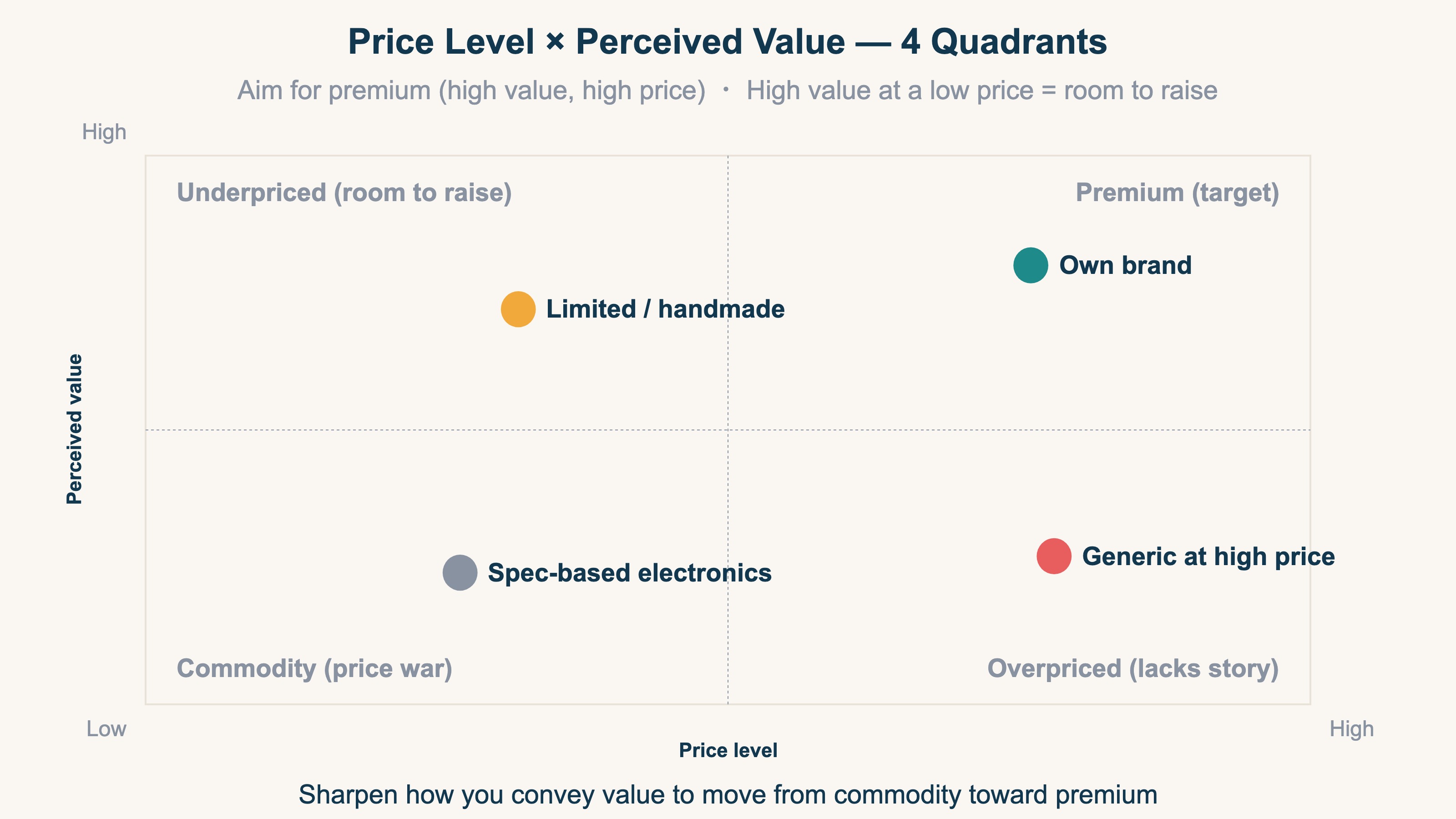
Products in the underpriced zone — high value sold cheaply — have room to raise. Conversely, the overpriced zone — high price with value that hasn't landed — needs more explanation or a price review.
3. Pricing freedom by EC industry#
Bottom line: Pricing freedom varies widely by industry. The stronger the brand and uniqueness, the higher you can price using the value-based approach.
Even with the same pricing approaches, the strategy you can take changes by industry. How easy products are to differentiate, and how easily customers can compare prices, decide your pricing freedom.
Cosmetics and supplements differentiate on brand and ingredient uniqueness, making value-based premium pricing easier. Electronics, on the other hand, are lined up and compared by model number, so they're tied to competitor pricing and hard to raise.
The chart below maps how much pricing freedom each major EC industry has. The higher the freedom, the more you can grow profit with value-based pricing.
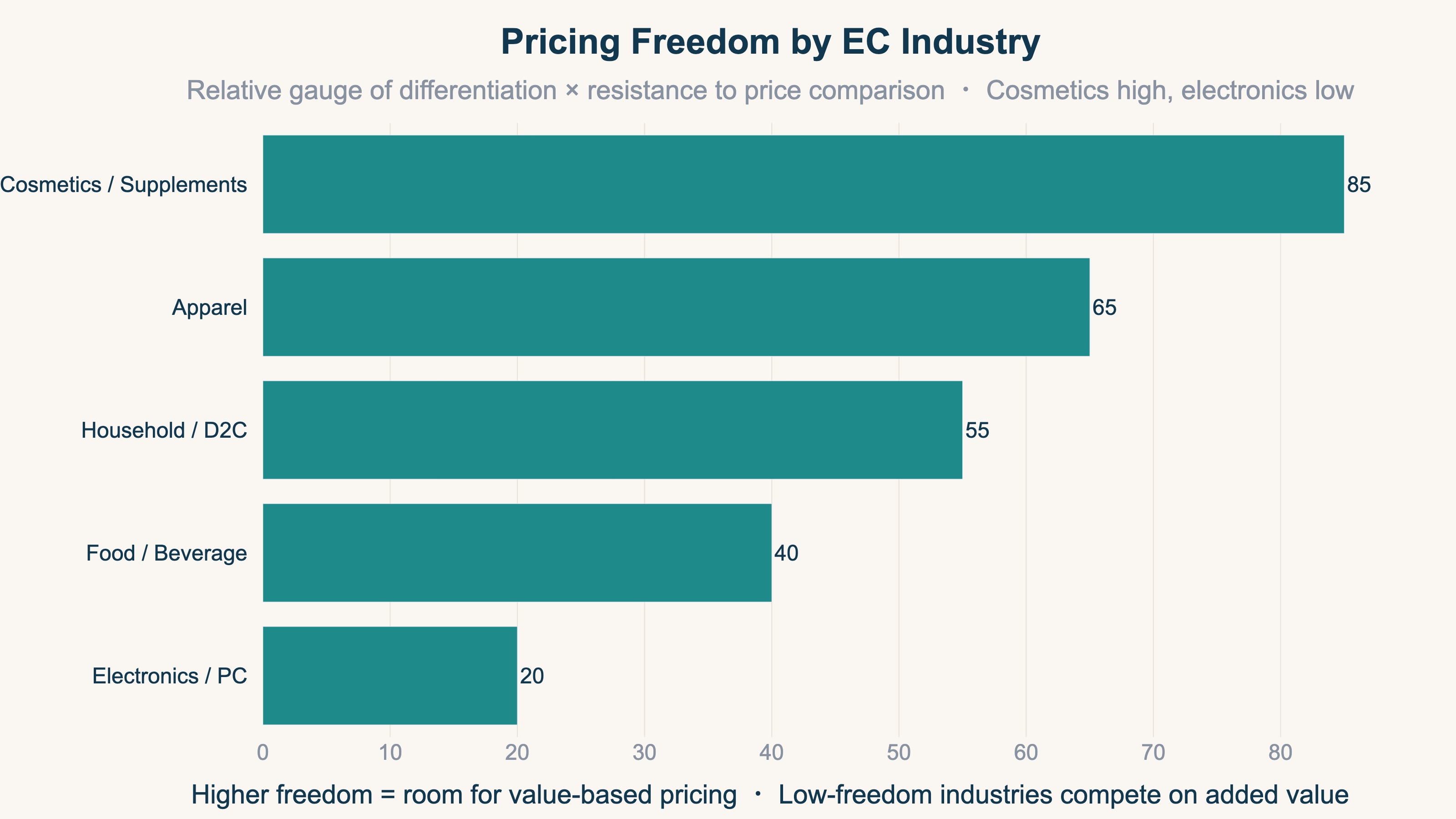
Even low-freedom industries aren't out of moves. Shipping-included framing, bundle-purchase design, and peripheral services such as warranty and setup add value beyond price itself. Margin benchmarks by industry are detailed in our gross margin guide.
4. A four-step process to maximize profit#
Bottom line: Profit-maximizing pricing runs in four steps: know your true cost → articulate value → design price tiers → test and adjust.
Raising prices sounds intimidating, but it isn't scary if you follow the steps. You proceed in four.
Step 1 is to know your true cost accurately. Beyond the purchase price, work out the real cost including shipping, payment fees, and packaging materials. This becomes your price floor.
Step 2 is to put your value into words. Spell out why your product is chosen — in terms of quality, experience, support. If value isn't articulated, customers can only compare on price.
Step 3 is to design price tiers. Instead of a single price, offer three tiers; the middle one tends to be chosen. This is the "decoy effect," a standard technique for lifting AOV.
Step 4 is to test and adjust. Try a price increase on a few products and watch how sales and profit change. Even if units dip a little after a raise, it's a win as long as profit grows. Conversely, an easy discount shaves both AOV and brand at once, so keep it as a last resort. Ways to protect profit without leaning on discounts are laid out in how to think about discount strategy and the risks and defenses of AOV tactics.
For moves that lift AOV itself, reading our AOV guide, along with cross-selling for add-on purchases and upselling for recommending higher-tier items, widens your options.
5. Isolate the price-change effect with RPS and AOV#
Bottom line: Judge a pricing move by channel-level revenue per session (RPS) and average order value (AOV). Total revenue also moves with traffic, so on its own it can't isolate the price effect.
By here you have the ways to set prices. But the real hard part comes after the change. Looking only at "revenue went up or down" after a price change is dangerous. Total revenue moves not only with price but with that month's traffic (sessions). If you happened to increase ads the month you raised prices, the price effect hides inside the traffic and disappears.
To isolate the effect of a pricing move, use two metrics. One is average order value (AOV) — revenue ÷ orders — how much was bought per order. If a price increase or tier design is working, AOV rises. The other is revenue per session (RPS) — revenue ÷ sessions — how much revenue stood up per visit. Because changing price also moves the purchase rate, RPS, which includes both AOV and conversion, captures the real effect of a pricing move. The concept of RPS is covered in detail in our RPS guide.
What's more, the effect varies by channel. RPS may grow on search and the newsletter, where people buy because they're convinced by the price, while a channel where people move on impulse rather than price stays flat. That's exactly why you can't look at the overall average — you need to line up before-and-after RPS and AOV by channel and compare them side by side.
The chart below shows, as an index, how RPS moved by channel before and after a price change. Rather than lumping it into total revenue, split it by channel and the channels where the price change worked and the ones where it didn't separate clearly.
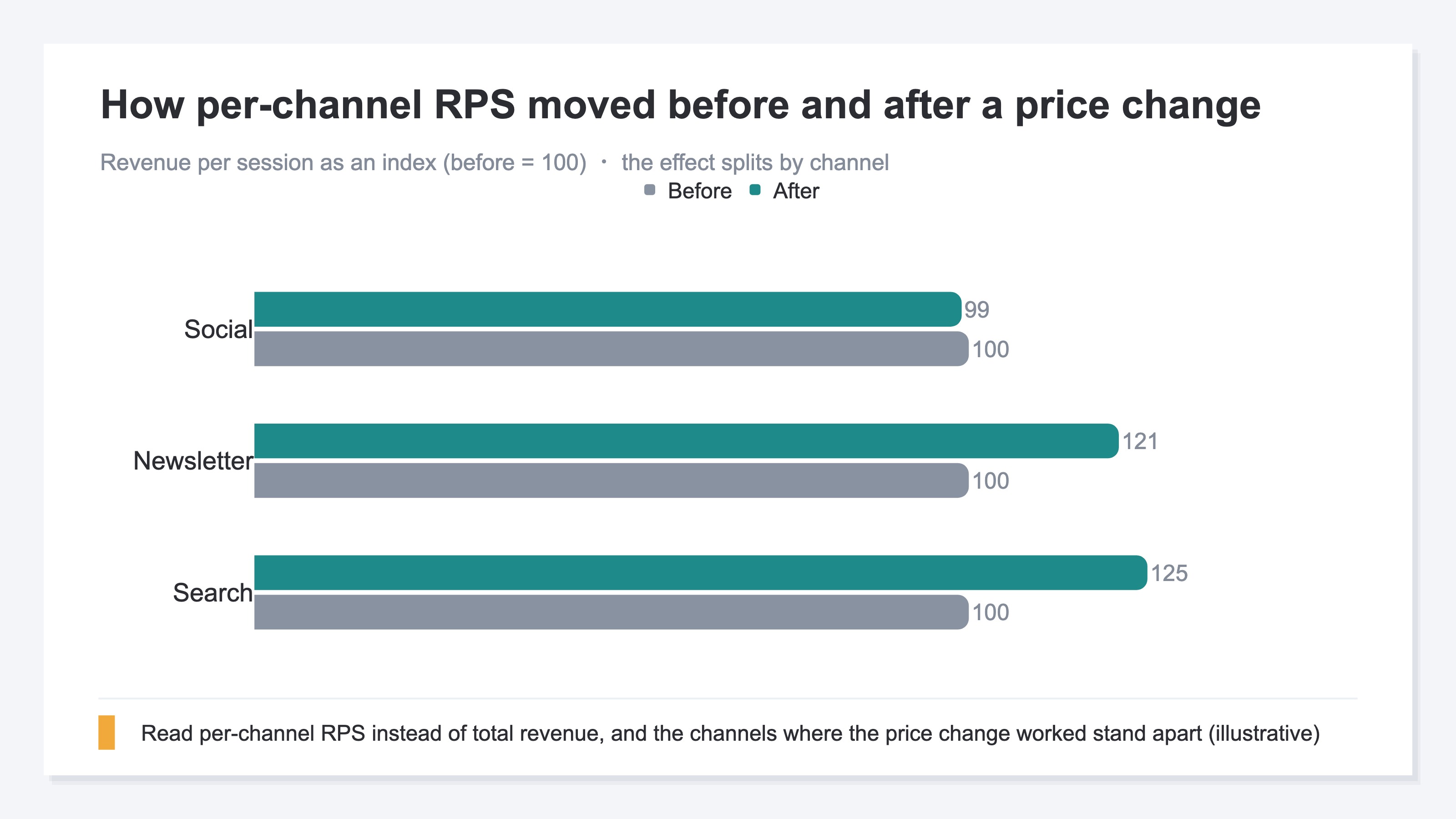
The concept itself is simple. What's hard is keeping up the work — removing bots, then lining up before-and-after RPS and AOV by channel and by new versus returning customers — every single time you move a price. This is the point where doing it by hand in a spreadsheet gets heavy.
RevenueScope solution
When you try to measure the effect of a price change properly, two walls remain. One is that standard tools, GA4 included, are built session-first, so there's no standard screen that lines up "how RPS moved on the channel where we changed price" across traffic sources side by side. The other is that the work of removing bots and lining up before-and-after RPS and AOV by channel and by new versus returning customers is heavy as a recurring manual task.
RevenueScope takes this comparison off your hands. It splits traffic by channel and, with bots removed, lets you line up revenue per session (RPS) and average order value (AOV) before and after a price change on the same screen (the display is demo data). You can confirm which channel the price change worked on, without it being blurred into total revenue.
| Channel | RPS (before → after) | AOV (before → after) |
|---|---|---|
| Search | ¥240 → ¥300 | ¥5,600 → ¥6,300 |
| Email newsletter | ¥420 → ¥510 | ¥6,400 → ¥7,100 |
| Social | ¥150 → ¥149 | ¥5,200 → ¥5,200 |
There are two things to read in this table. One is that on search and the newsletter, both RPS and AOV grew after the price change — pricing works on the channels where people buy because they're convinced by the price. The other is that social is flat, telling you this is a place to move with presentation or a different lever rather than price. Look only at the total revenue that lumps channels together and this difference gets buried. On top of that, you can switch from the view that credits only the last click to one that also allocates to the first spark and the steps along the way, and compare the same revenue from a different angle.
RevenueScope prepares the material for your pricing decision. It focuses on revenue, RPS, AOV, purchase rate, and sessions, and their breakdown by channel, showing how the effect of a raise or cut played out on each channel so you can inform your next pricing move. Gross margin, profit margin, LTV (lifetime value), and inventory belong on the accounting and cost-management side; RevenueScope concentrates on measuring the revenue-based effect.
FAQ#
Q. Should I set price by cost or by value?
Both. Set the floor with cost-based ("below this, we lose money") and aim for the ceiling with value-based ("they'll pay up to here"). Competitor-based tells you the range in between. Rather than picking one, layering all three to land the final price is how it works in practice.
Q. Won't a price increase drive customers away?
Some will leave. What matters is the profit from those who stay, not the number who leave. Even if units dip slightly after a small raise, profit usually grows. Test on a few products first, confirm the profit change, then roll it out.
Q. After a price change, which number do I check to confirm the effect?
Don't judge by total revenue alone. Revenue also moves with that month's traffic, so the price effect gets mixed in. By channel, line up before-and-after revenue per session (RPS) and average order value (AOV) and compare them side by side to confirm where it worked. The idea is simple, but keeping it up every time you move a price is heavy work.
Summary#
Price is the biggest lever on revenue and profit. Set the floor with cost-based, grasp the range with competitor-based, and aim for the ceiling with value-based — that layering is the foundation. Pricing freedom varies by industry, but reviewing how you communicate value lets you grow profit without leaning on discounts.
Still, getting the way you set prices in order is only half of it. Once you change a price, isolate the effect with channel-level revenue per session (RPS) and average order value (AOV), not total revenue. Only then can you see which channel the price change worked on, and choose your next price from your own numbers rather than a hunch. That is how to run pricing without relying on gut feel.
See which ads actually drive revenue, at a glance
Free up to 5,000 sessions/month, AI connection included. No credit card required. Up and running in 5 minutes.
References#
- Ministry of Economy, Trade and Industry (METI), E-Commerce Market Survey (2024)
- Small and Medium Enterprise Agency, White Paper on Small and Medium Enterprises in Japan (2024)