You ran a sale, the products sold — but at month-end, no profit is left. It is one of the most common traps in EC. Discounts lift revenue fast, but a poorly designed one erodes both profit and brand at the same time. This guide walks through how discounts eat into profit, the discount types that protect your average order value, how to stay out of price wars, and how to measure the real effect — all with simple math and charts.
Table of Contents
Summary#
-
Check the break-even with "extra sales needed"
For a product at 40% gross margin, a 20% discount means you must double your unit sales just to keep the same profit
-
Pick a discount type that protects AOV
Instead of an across-the-board cut, use bulk discounts, bundles, and member-only prices to protect average order value
-
Beat price wars with how you convey value
A pure price fight is a war of attrition. Reviews and scarcity build "worth it at this price"
-
A designed discount keeps profit
Knee-jerk markdowns erode profit; a designed discount grows revenue while protecting AOV
-
Measure with RPS and AOV, not total revenue
Revenue also moves with traffic, so isolate the discount's effect with RPS and AOV
1. How discounts eat into profit: the break-even math#
Bottom line: recovering the profit a discount gives away takes far more sales than you would guess. Start by calculating the "extra sales needed."
The danger of discounting is that the volume needed to make up the lost profit is far higher than instinct suggests.
The formula is simple: "extra sales needed = discount ÷ (gross margin − discount)." Take a product at 40% gross margin. A 10% discount needs a 33% jump in sales to hold profit. A 20% discount needs 100% — you must sell twice as many units. A 30% discount needs 300%, meaning four times the volume just to reach the original profit.
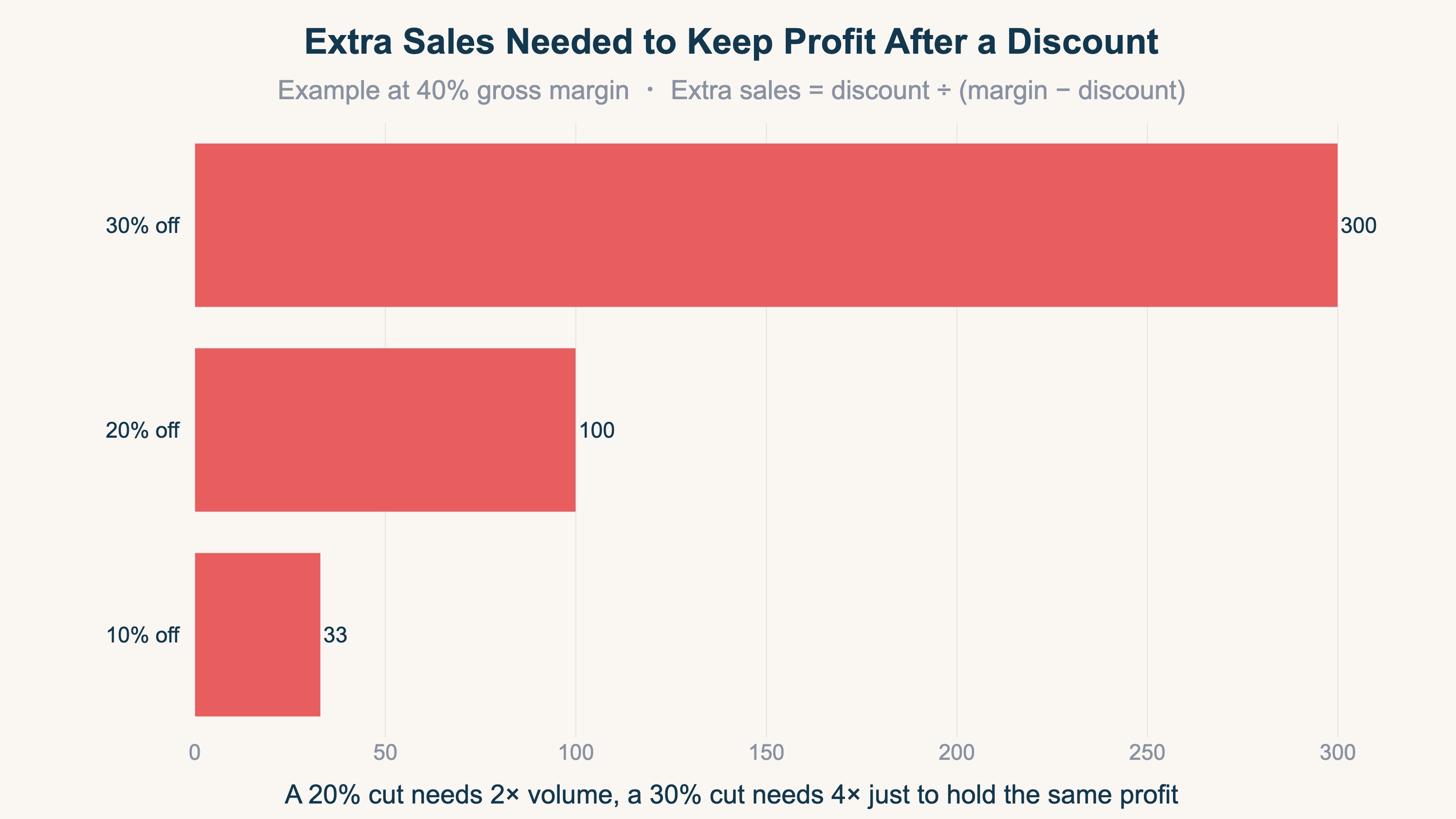
In other words, the lower the gross margin, the more a small discount sends the required volume soaring. For how to calculate gross margin, see our gross margin guide. When you consider a discount, don't decide "just a little" by feel — confirm the break-even with this formula first.
2. Discount types that protect AOV: four choices#
Bottom line: even with the same discount, choosing a type that protects AOV limits the impact on profit. The one to avoid is the unjustified across-the-board cut.
Discounts come in types, and the type you choose changes how it hits average order value (AOV).
First, the bulk discount — "10% off when you buy three," getting cheaper the more you buy. Because each order grows, AOV rises. Next, the bundle deal, selling related items together. It encourages add-on purchases and lifts AOV; we cover the design in cross-selling.
Third, the member-only price, discounting only for repeat buyers rather than newcomers. It keeps the list-price brand intact while retaining your best customers. Fourth, the limited-time sale, fenced off to a short window so shoppers don't learn to "just wait for it cheaper," limiting the hit to full-price sales.
The one to avoid is the across-the-board cut — lowering the list price itself for no reason, which erodes AOV and brand at once.
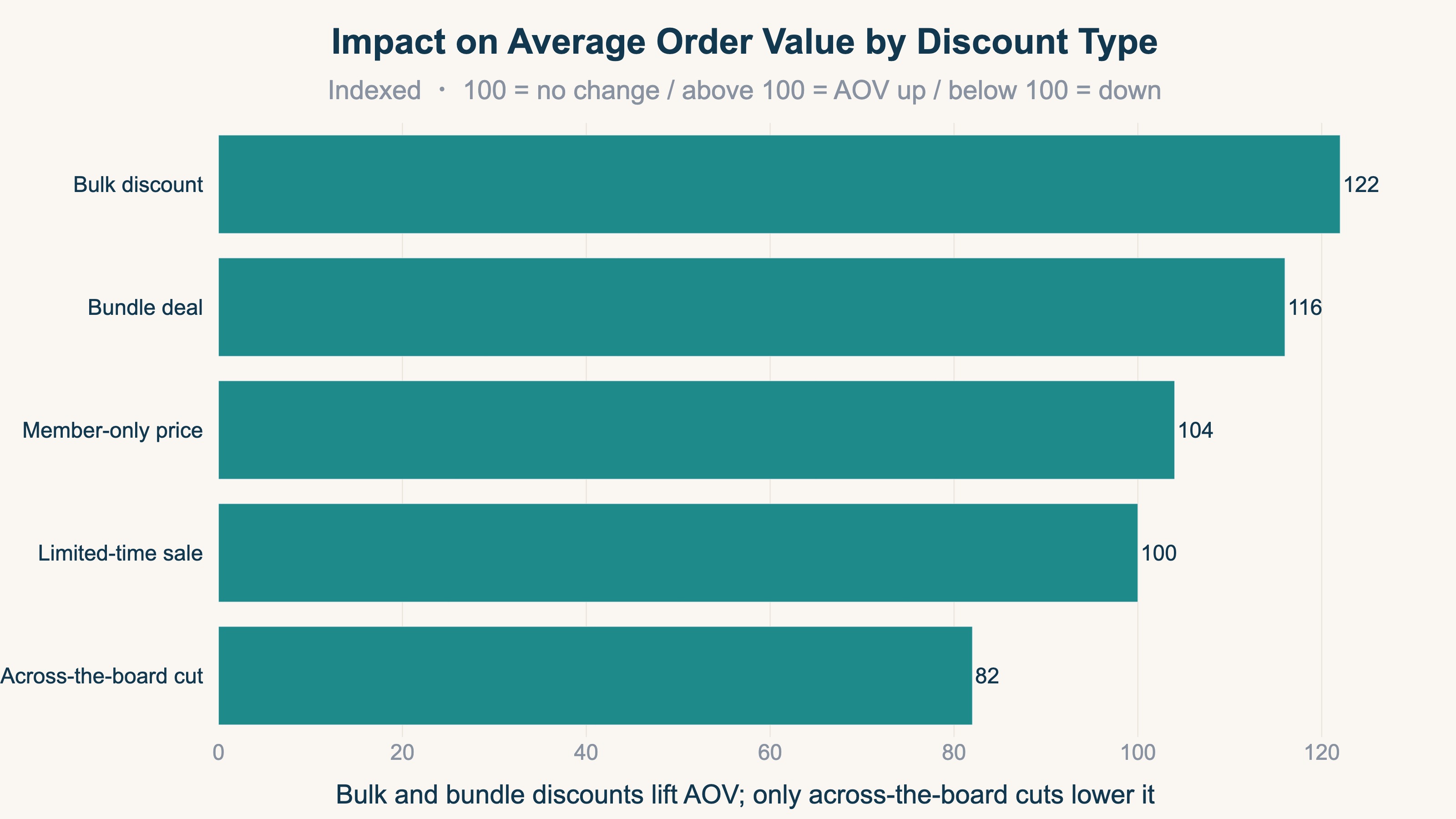
As the chart shows, bulk and bundle discounts lift AOV, while only the across-the-board cut drags it down. If you discount, choose a type that protects AOV.
3. Three ways to avoid price wars#
Bottom line: before cutting price, compete on how you convey value. A price war is a war of attrition that only the deepest pockets survive.
When a competitor starts slashing prices, you feel the pull to follow. But a pure price fight is a war of attrition, and the player with the most capital wins in the end. What a small or mid-sized EC should do is earn the choice on something other than price.
First, add to how you show value — reviews, in-use photos, and a clearly stated warranty build "worth it at this price." At the same price, presentation changes how well something sells. Second, build in scarcity — quantity-limited or member-only offers get chosen for reasons other than price. Third, bundle value beyond price — shipping included, setup service, longer warranties; differentiate on total cost or peace of mind.
The side effects of discounting reach beyond AOV to conversion rate (CVR) and inventory. See the risks and defenses of AOV tactics for details.
4. Designed vs. knee-jerk discounting#
Bottom line: a discount done on impulse erodes profit; a designed one keeps it. The gap shows up clearly in the numbers.
Even the same act of "running a discount" produces wildly different results depending on whether it is designed.
An undesigned discount cuts the list price uniformly. AOV drops, the required extra sales never materialize, and profit declines. A designed discount, by contrast, protects AOV through bulk deals and bundles while moving only the volume you need. Getting conversions to climb without giving back unit price is the same both-at-once balance laid out in how to raise CVR and AOV together.
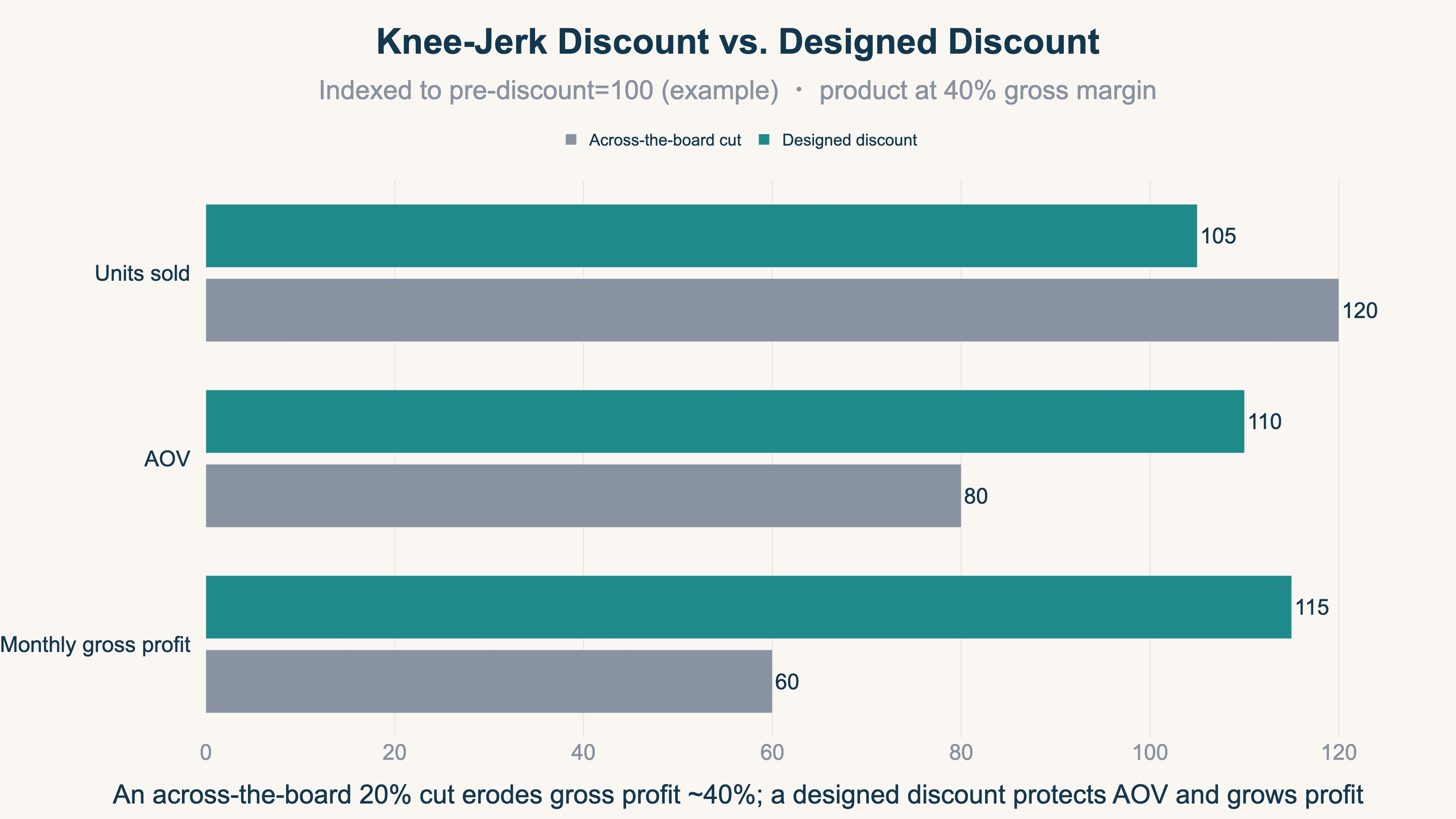
The chart compares a "knee-jerk across-the-board 20% cut" with a "bulk-purchase design" for a product at 40% gross margin. The former loses profit even as units rise; the latter grows profit while holding AOV. A discount is not a yes-or-no question — the difference comes from how you design it. Pricing freedom by industry is covered in our related article, EC pricing strategy.
5. How to measure discount impact: RPS and AOV#
Bottom line: judge a discount by RPS and AOV, not total revenue. Revenue also moves with traffic, so you can't isolate the discount's effect alone.
After a discount campaign, judging it by "revenue went up, so it worked" is risky. Total revenue moves not only with the discount but with the traffic (sessions) over that period. If you happened to spend more on ads during the sale, the discount's effect hides inside the traffic.
Two metrics let you separate them. One is AOV (average order value) = revenue ÷ orders. It tells you whether the discount raised or lowered the value of each order. The other is RPS (revenue per session) = revenue ÷ sessions. It captures revenue per visit, including both conversion rate and AOV. See our RPS guide for the full concept.
The catch is that GA4 makes this split a chore. GA4 is built around visits (sessions), so comparing how RPS moved by traffic source on the channel where you discounted takes real effort. The idea itself is simple — output RPS and AOV by source and compare before and after — but the prep work (standardizing channel definitions, excluding bots, splitting out unknown-origin traffic) is heavy to repeat by hand every month.
RevenueScope's solution
A discount's effect hides inside your traffic. RevenueScope uses its own tracking to exclude bots and route unknown-origin traffic back to its real channel, then lets you compare the change in RPS and AOV by source on a single screen.
The hard part of discounting was that even when revenue rose, you couldn't tell whether it was the discount or simply more traffic. Because GA4 is built around visits (sessions), getting RPS (revenue per session) by source for the channel you discounted means heavy manual work each month. RevenueScope is revenue-first, so it shows the before-and-after change in RPS/AOV per channel directly.
For example, ask the generative AI you already use — connected via MCP — before and after a discount campaign, and it returns this:
| Channel | RPS before | RPS after | AOV change |
|---|---|---|---|
| Search ads | ¥42 | ¥58 | +12% |
| Social ads | ¥21 | ¥19 | −8% |
| ¥66 | ¥71 | +4% |
RevenueScope's by-channel view (figures are demo data). The same discount grew revenue per visit on Search and Email, while Social lost AOV outright — so you can tell, in revenue, which channel's discount actually worked.
Only once it is split this far can you judge "discounts to keep running" versus "discounts to stop" by revenue efficiency per source, not the swing in total revenue. Note that gross-margin and inventory management are outside RS's scope: confirm the break-even and extra-sales-needed math by hand using the steps in this article, and use RS to verify which channel a discount actually grew revenue on. For the concept of revenue per visit, see What is RPS (revenue per session).
FAQ#
Q. What discount percentage is safe?
There is no universal safe line; it depends on gross margin. Use "discount ÷ (gross margin − discount)" to get the extra sales needed, then judge by whether you can realistically sell that much more.
Q. Which is better, coupons or bulk discounts?
For protecting AOV, bulk discounts have the edge. Coupons are closer to an across-the-board cut and tend to lower AOV, so narrow down who gets them and on what terms.
Q. Won't ending sales drop revenue?
It can dip temporarily. But running sales constantly shrinks the pool of people who buy at full price. Fencing sales by period and scope, and returning to full-price selling as the base, keeps long-run profit more stable.
7. Three steps to review your discounts#
Bottom line: review discounts in three steps — confirm the break-even, switch to AOV-protecting types, then verify with RPS and AOV.
Step 1: confirm the break-even of your current discounts
Calculate your flagship product's gross margin, then compute the extra sales needed at its current discount. Any discount not hitting that volume is a candidate for review.
Step 2: switch to AOV-protecting types
Move products under an across-the-board cut over to bulk discounts, bundles, and member-only prices — toward forms that don't erode AOV.
Step 3: verify the effect with RPS and AOV
Compare RPS and AOV by channel before and after the discount. With RevenueScope, you can see how revenue per visit moved by traffic source — isolating the discount's effect rather than the swing in total revenue.
Summary#
A discount is a powerful lever that moves revenue instantly. But get the design wrong, and it erodes profit and brand at once.
First, confirm the break-even with "extra sales needed." Choose a type that protects AOV instead of an across-the-board cut. Beat price wars with how you convey value, and measure the effect with RPS and AOV rather than total revenue. That order is how you discount while keeping profit.
See which ads actually drive revenue, at a glance
Free up to 5,000 sessions/month, AI connection included. No credit card required. Up and running in 5 minutes.
References#
- Ministry of Economy, Trade and Industry (METI), FY2024 Survey on Electronic Commerce, August 2025
- Small and Medium Enterprise Agency, White Paper on Small and Medium Enterprises in Japan, 2024 edition