"We ran a coupon and CVR went up, but revenue did not." "We raised the free-shipping threshold and AOV went up, but order count dropped." EC operators hear these almost every month. The cause is usually the same: CVR and AOV tend to move in opposite directions, and the team is only watching one of them.
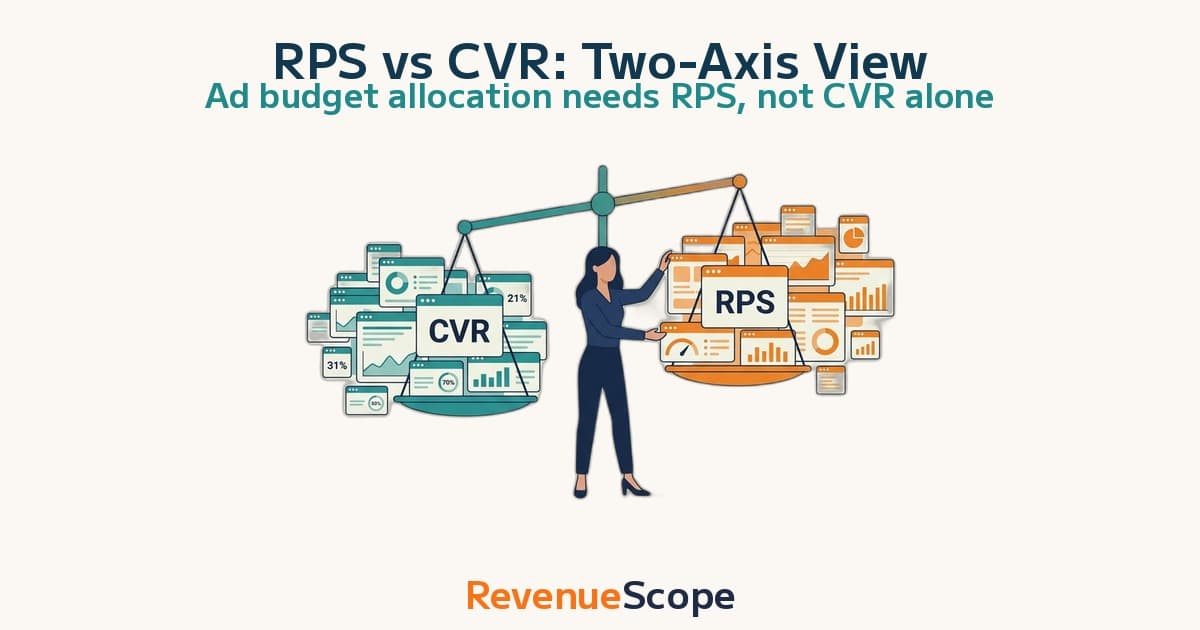
This article focuses on lifting CVR and AOV at the same time, covering the trade-off structure, four compatible domains, phase-based priorities, and measurement pitfalls. But even once you grasp the four domains and the phase design, which channel to lift for real revenue growth never shows up until you aggregate sales across channels every time. Beyond the tactics, this article connects to the next-step judgment of "which channel gets the next budget." For single-metric improvements, see How to Calculate and Raise AOV and the judgment-axis discussion in RPS vs CVR: A Two-Axis Framework for EC Ad Budget Allocation.
Table of Contents
TL;DR#
-
CVR and AOV are two factors in the revenue decomposition, and pushing one usually drops the other
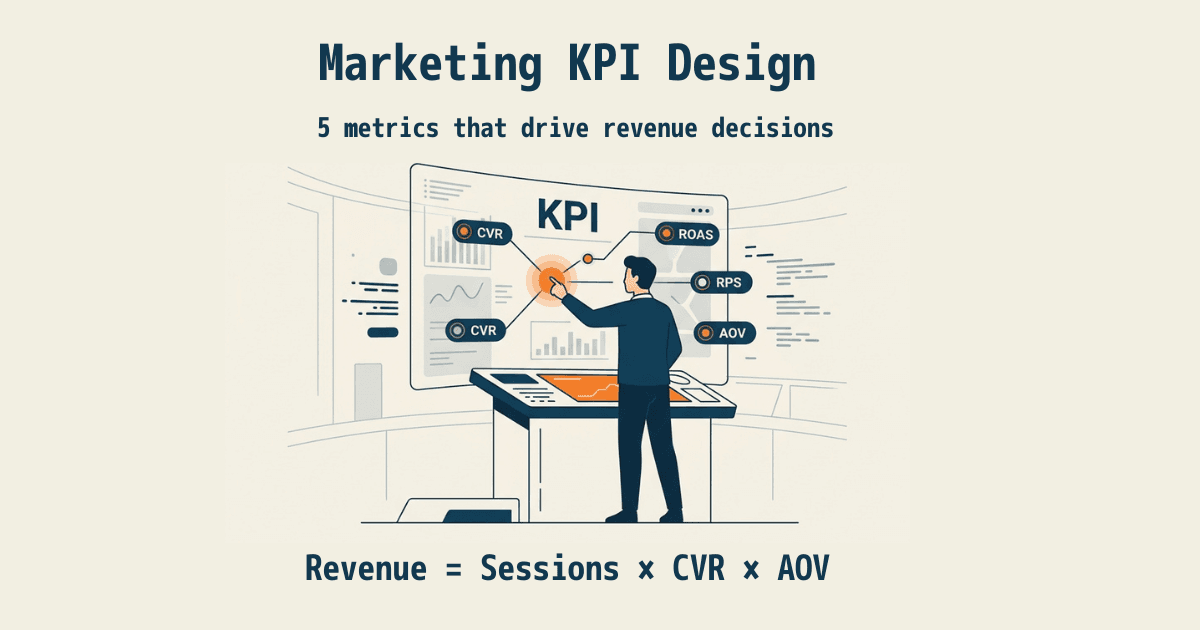
Revenue = Sessions × CVR × AOV. Coupons push CVR up but drop AOV. Free-shipping thresholds push AOV up but drop CVR
-
Compatible tactics fall into four domains that lift both at once
Recommendation accuracy, value-bundle design, pre-purchase information, post-purchase follow. Each adds per-order value without blocking purchase intent
-
Priorities shift by business phase: early-stage protects CVR, scale-up adds AOV, mature drives LTV
Running AOV tactics before traffic stabilizes drops CVR and shrinks revenue
1. CVR and AOV — Two Factors in the Revenue Decomposition#
Bottom line: Revenue = Sessions × CVR × AOV. Both CVR and AOV are on-site experience metrics, and because their tactical levers overlap, pushing one hard moves the other in the opposite direction.
CVR is the share of visitors who buy. AOV is the per-order revenue. EC revenue decomposes into these plus session count[1].
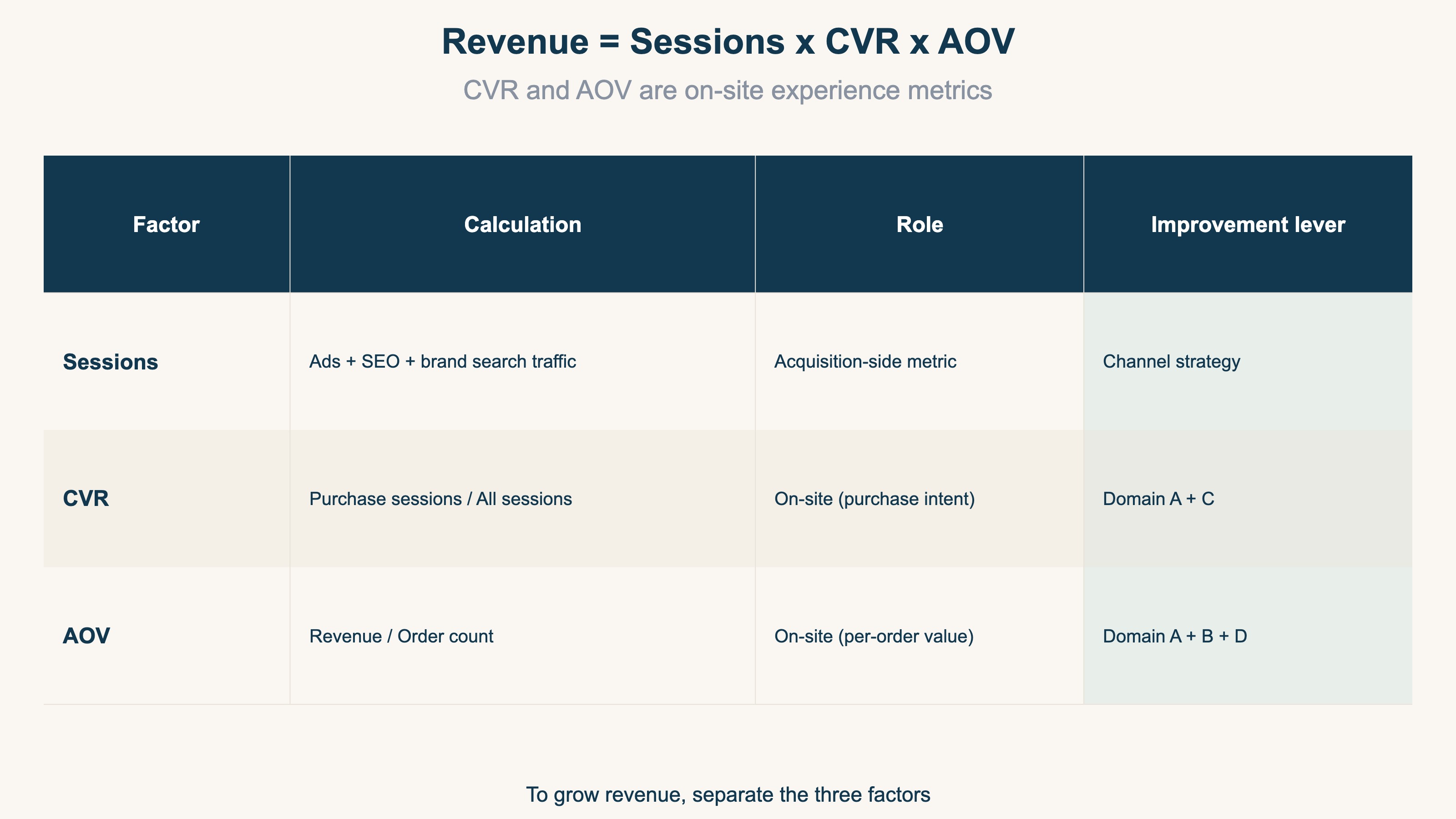
Sessions sit on the acquisition side (ads, SEO, brand search). CVR and AOV are on-site experience metrics, and their tactical levers overlap. That overlap is why pushing one usually moves the other in the opposite direction.
2. Why Joint Lift Is Hard — Four Trade-offs#
Bottom line: CVR and AOV resist rising together because buyer psychology pulls in opposite directions for most easy tactics — discounts lift CVR but drop AOV, free-ship thresholds lift AOV but drop CVR.
CVR and AOV resist moving together because buyer psychology pulls in opposite directions for most easy tactics.
| # | Tactic | CVR | AOV | Why it conflicts |
|---|---|---|---|---|
| 1 | Heavy discount coupons | up | down | Lower buy threshold but smaller per-order revenue |
| 2 | Raise free-ship threshold | down | up | Visitors who fall short of the threshold drop |
| 3 | Push high-price bundles | down | up | Single-item buyers drop, only buyers spend more |
| 4 | Push low-price items | up | down | Easier to convert but average order shrinks |
Baymard Institute research shows cart-abandonment reason #1 is "extra costs like shipping are too high" (48%)[3]. Shopify's official guide defines AOV as "net revenue (after discount) / order count"[1], so heavy coupon use drops AOV directly. Most "lift one metric" tactics drop the other; joint lift needs a different category.
3. Tactics That Lift Both — Four Domains#
Bottom line: To lift both without a trade-off, work the four domains — recommendation accuracy, value-bundle design, pre-purchase information, post-purchase follow — that "keep ready buyers and grow the add-on value."
Tactics that lift CVR and AOV together share one shape: they do not block purchase intent and they add per-order value.
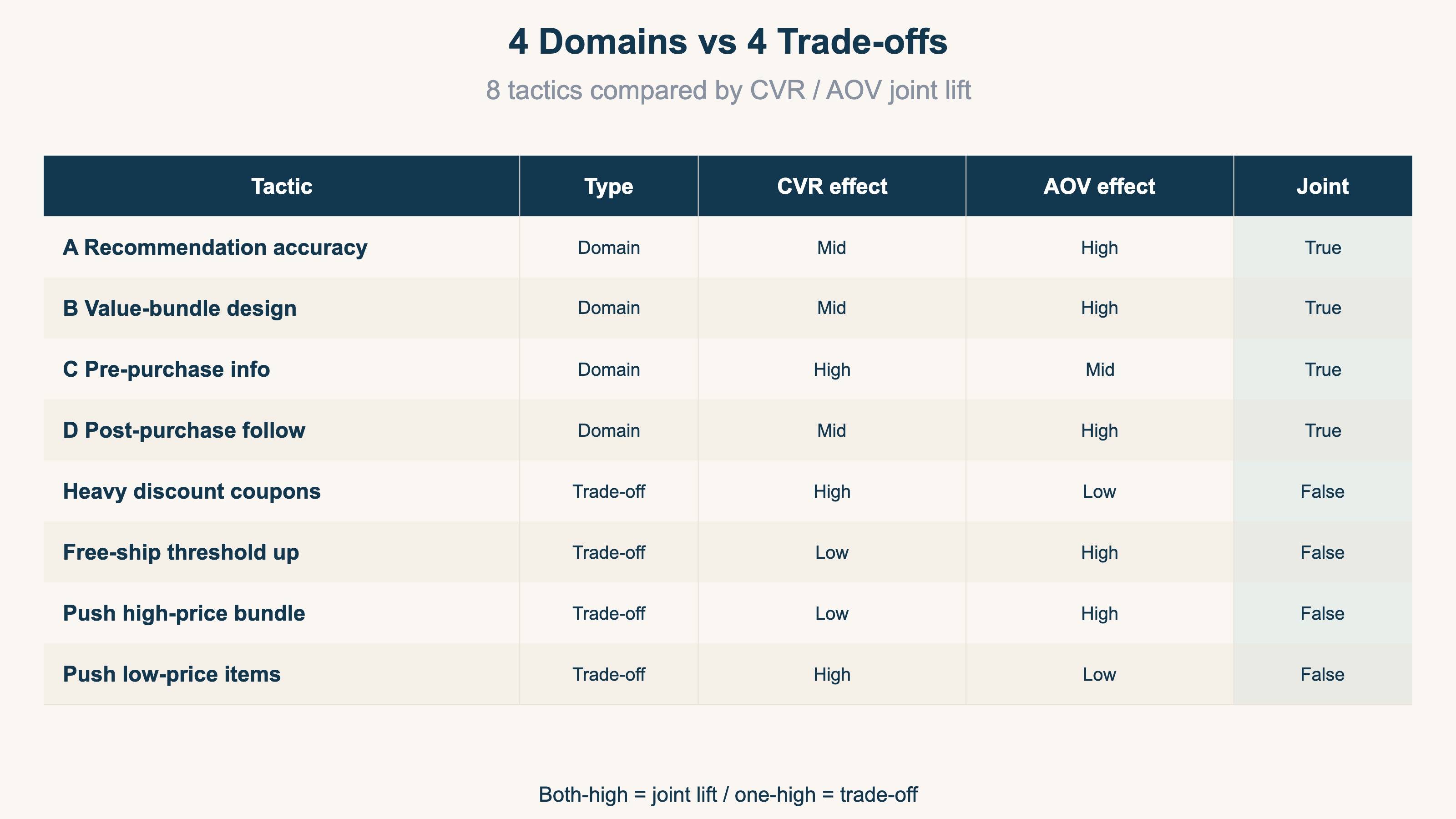
- A Recommendation accuracy: "Frequently bought together" modules on product / cart pages. BigCommerce reports high-precision cross-sell delivers AOV +10-30%[4]. McKinsey notes AI / generative AI personalization produces revenue lifts of +5-25% at the company level[5]
- B Value-bundle design: Not discount-bundles. Sell combinations single items cannot ("morning + night skincare set," "3-variety coffee tasting set"). Value, not price
- C Pre-purchase information: Stock status, delivery dates, return policy. Undisclosed shipping costs strongly correlate with cart abandonment[3]. "Delivery tomorrow morning" lowers the threshold even for higher-priced items
- D Post-purchase follow: Cart-recovery emails, post-purchase complement emails, member-only early access. Shopify reports membership programs deliver LTV +20-40%[1]. Lifts the second-and-onward AOV plus LTV
4. Priority — Where to Start#
Bottom line: Sequence the four domains by business phase. Running AOV tactics before traffic stabilizes drops CVR and shrinks revenue, so the early stage starts from CVR-safe moves.
Sequence the four domains by business phase. Running AOV tactics before traffic stabilizes drops CVR and shrinks revenue.
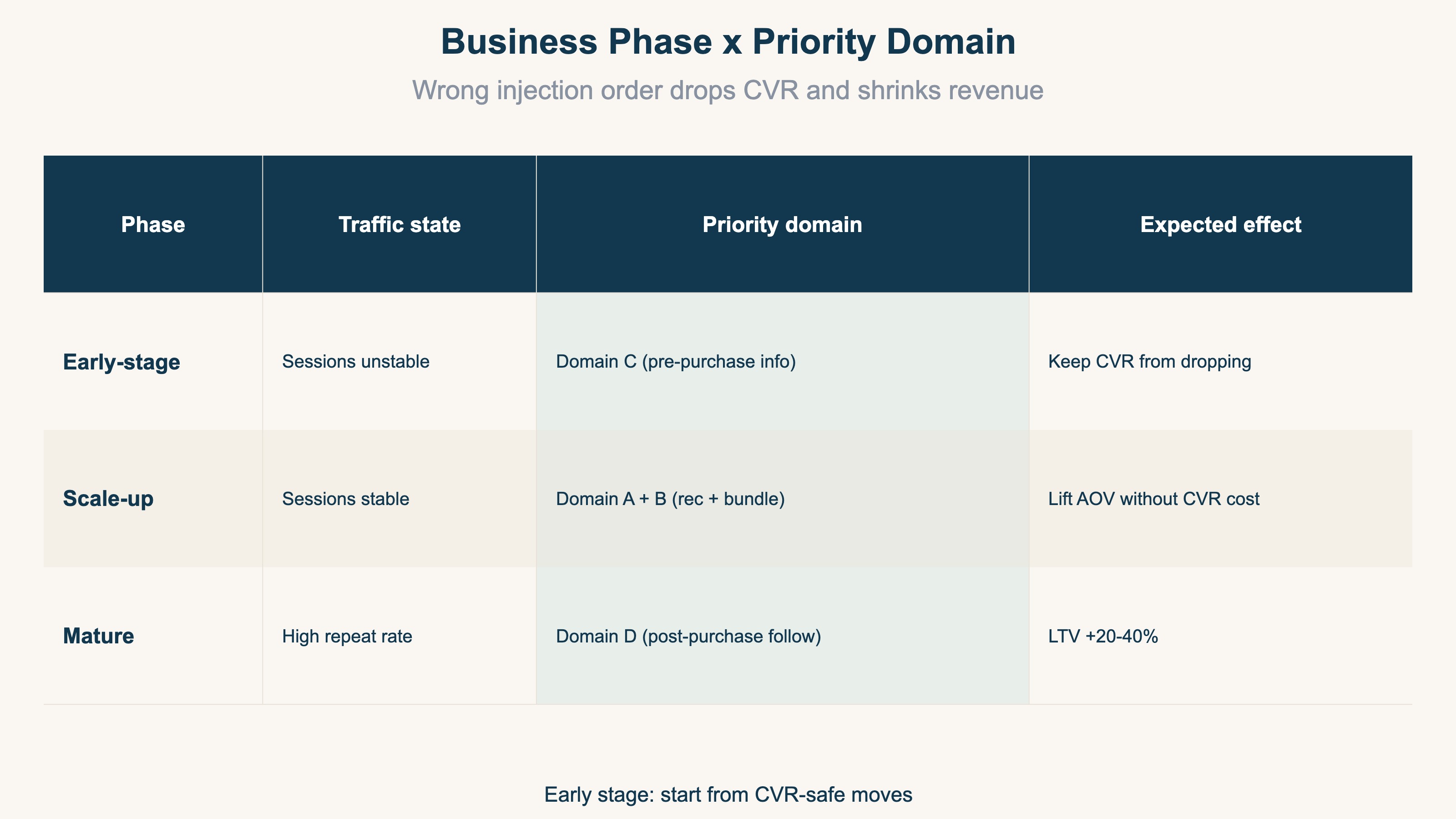
- Early-stage (sessions unstable): Protect CVR first. Start with Domain C (pre-purchase information). Low implementation cost, meaningful CVR impact[3]
- Scale-up (sessions stable): Domain A (recommendation) and Domain B (value-bundle). Add AOV without dropping CVR[4]
- Mature (high repeat rate): Domain D (post-purchase follow). Grow LTV via membership. AOV is reframed as a component of LTV[1][5]
As discussed in Marketing KPI Design: 5 Metrics from Revenue Reverse-Engineering, the dashboard itself shifts as phases change.
5. Measurement Pitfalls#
Bottom line: Even with the right tactics, broken measurement makes the call wrong. The silent one is not splitting by channel — and that channel-level comparison is structurally absent from standard GA4.
Even with the right tactics, broken measurement makes the "up / down" call wrong.
| # | Pitfall | Fix |
|---|---|---|
| 1 | Bots in CVR denominator | Recalculate using bot-filtered sessions |
| 2 | AOV using pre-discount price | Net revenue (post-discount) / order count |
| 3 | Ignoring device / channel splits | Decompose by device, channel, landing page |
Pitfall #3 is the silent one. Mobile AOV typically runs 20-40% below desktop. A rising mobile share alone makes overall AOV look like it is dropping. The cleanest joint view is RPS (Revenue Per Session) = CVR × AOV. If AOV rises but CVR drops by the same magnitude, RPS is flat and the tactic delivered no real joint lift. See RPS vs CVR for the matrix view.
But this "compare bot-filtered CVR, AOV, and RPS by channel" view is harder than it sounds. GA4's standard reports show CVR, AOV, and revenue each on a different screen, with no channel-level comparison table. The next chapter is about filling that gap.
RevenueScope solution
Bottom line: CVR and AOV don't tell you "where to lift" until you read them as real revenue by channel. And a table that puts channel-level CVR, AOV, and RPS side by side with bots excluded does not exist in standard GA4. RevenueScope fills that gap.
CVR and AOV mislead when you watch only the overall average, because which to lift, and how, differs by channel. But GA4's standard reports show CVR, AOV, and revenue each on a separate screen, with no bot-excluded channel comparison built in. To check, you have to rebuild the table by hand across channels every time.
RevenueScope replaces that manual work with a permanent view. Per channel, it gathers CVR, AOV, and RPS (revenue per session) onto one screen. Because it is rooted in your own sales, you can tell which channel and which metric to lift without entering ad spend.
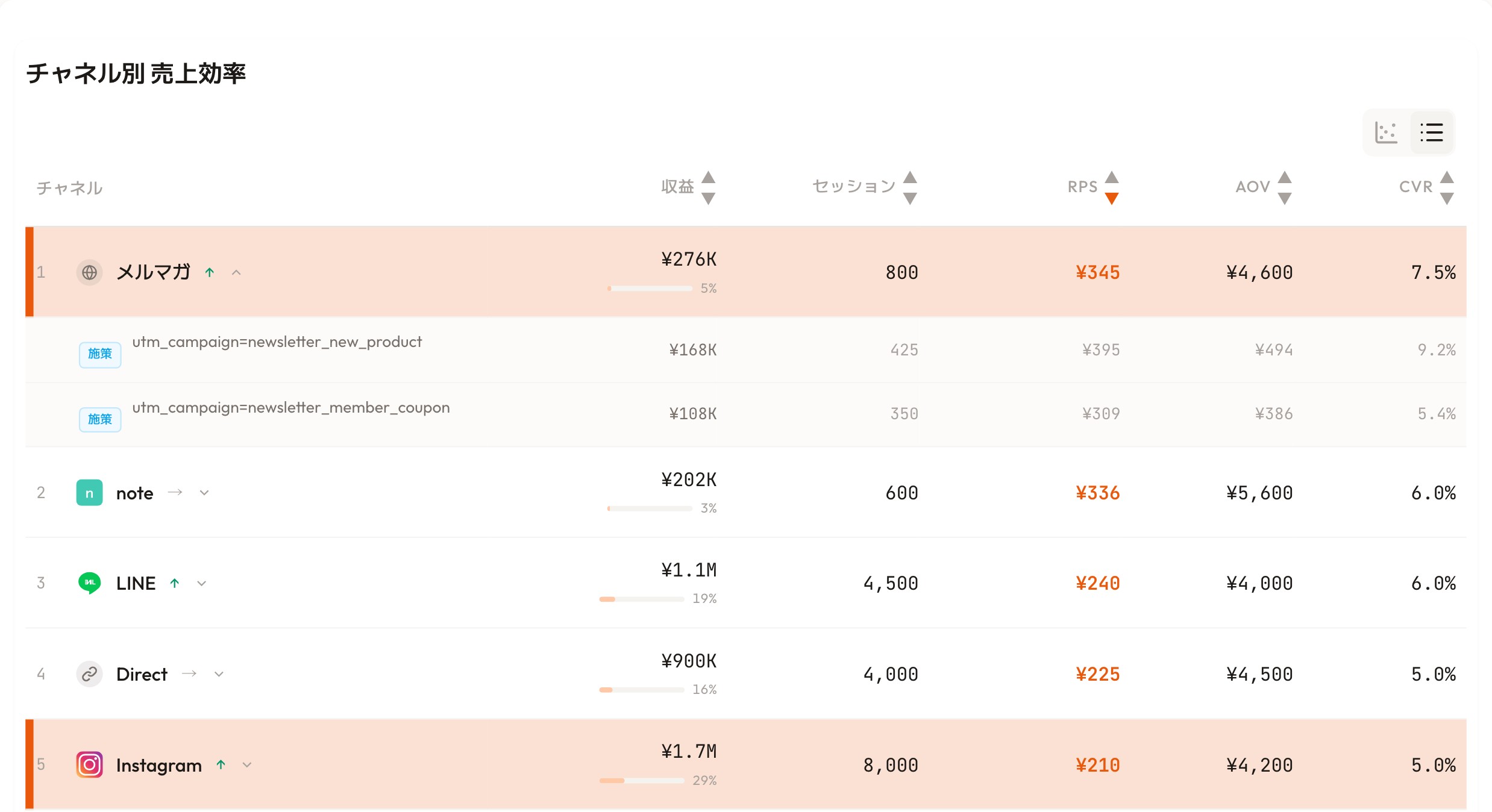
RevenueScope's dashboard (demo data shown). It gathers each channel's purchase rate, order value, and RPS onto one screen to show where lifting helps.
Take the screen above. The newsletter tops conversion rate (CVR) at 7.5%; Instagram is 5.0%. For the same act of "bringing in customers," the rate at which they buy differs this much by channel. Open the newsletter row and you see differences by campaign too: the new-product campaign converts at 9.2%, the member-coupon one at 5.4%. "Lift CVR" isn't one average to think about — pin it down to which channel and which campaign, and the move decides itself.
CVR and AOV ultimately roll up into RPS. RevenueScope gathers all three by channel onto one screen, so instead of nudging an average you pick "which channel gets the next budget to grow revenue efficiency" by concrete numbers. That's the next step toward not spinning your wheels on CVR and AOV.
FAQ#
Q1. Which should we lift first, CVR or AOV?#
It depends on phase. Early-stage starts from CVR-safe tactics (Domain C). Once traffic stabilizes, introduce AOV tactics (Domains A and B).
Q2. Are coupon campaigns always trade-offs?#
Unconditional coupons are trade-offs (#1). Threshold coupons ("10% off over $30") behave like value bundles (Domain B) and can deliver joint lift.
Q3. How do we measure recommendation accuracy?#
Track "recommendation CVR" separately: purchases attributed to the recommendation module / sessions seeing it. As McKinsey notes, personalization without a clean data foundation generates noise that hurts overall CVR[5].
Summary#
- Revenue = Sessions × CVR × AOV. CVR and AOV are on-site experience metrics that share tactical levers
- Most "lift one metric" tactics drop the other (discounts / free-ship thresholds / push-bundles / low-price funnels)
- Joint-lift tactics fall into four domains: recommendation accuracy, value-bundle design, pre-purchase information, post-purchase follow
- Sequence by phase: early-stage, scale-up, mature, with different priority domains in each
- The four domains and phase design are covered here. What is not is the judgment of "which channel gets the next budget to grow real revenue most" — and that needs channel-level CVR, AOV, and RPS, bot-excluded, gathered on one screen continuously
See which ads actually drive revenue, at a glance
Free up to 5,000 sessions/month, AI connection included. No credit card required. Up and running in 5 minutes.
References#
[1] Shopify "Average Order Value (AOV): Formula, Benchmarks and 7 Ways to Increase It" September 2025
[3] Baymard Institute "E-Commerce Cart & Checkout Usability Research" 2024
[4] BigCommerce "Ecommerce Growth with Upselling and Cross Selling Tactics" 2024
[5] McKinsey & Company "Unlocking the next frontier of personalized marketing" January 2025
[7] METI Japan "FY2024 Electronic Commerce Market Survey" August 2025