"We increased budget on a high-CVR ad and revenue did not grow." We hear this from EC operators several times a month. CVR (conversion rate, or purchase rate) improves, yet revenue stays flat — sometimes it drops. This happens when you judge an ad on CVR alone, because CVR is an intermediate metric that does not directly show revenue per session. This article covers the difference between RPS (revenue per session) and CVR, three traps where CVR rises but revenue does not, the RPS x CVR quadrant for decisions, and why channel rankings reverse once you line them up — all from a revenue-first view.
Note on terminology: We use Revenue Per Session (RPS) below. RPS is not yet a standardized industry metric in the way ROAS or LTV are — it is RevenueScope's core metric. We spell out the full term on first mention.
Table of contents
TL;DR#
-
CVR is an intermediate metric; RPS is an absolute revenue-efficiency metric.
CVR only shows the purchase rate. RPS — revenue per session — is the product of AOV (average order value) and CVR, and that is the number you judge on.
-
When CVR rises but AOV drops, RPS falls.
Bundle discounts, low-price funneling, and aggressive coupons all push CVR up while breaking unit price — the classic way revenue efficiency declines.
-
Rankings reverse once you line channels up.
The channel with the highest CVR can sit lowest on RPS. Move budget on CVR alone and money flows into your least efficient channels.
1. RPS vs CVR: How They Differ#
Bottom line: CVR is just one component of RPS, and the final call is made on RPS (revenue efficiency).
RPS and CVR have different formulas and different roles.
| Metric | Formula | Role | Standalone judgment |
|---|---|---|---|
| RPS | Revenue / Sessions | Absolute revenue-efficiency metric | Possible |
| CVR | Purchase sessions / Total sessions | Intermediate purchase-rate metric | Not possible |
CVR (conversion rate) is the share of all sessions that end in a purchase. GA4 also defines a purchase-rate indicator in forms such as "Purchase rate" [1]. RPS, by contrast, shows how much revenue a single session generated.
The two are linked by RPS = AOV x CVR, where AOV is average order value (revenue per order). So CVR is just one part of what builds RPS.
Here is a concrete case. With AOV 6,000 yen and CVR 2.0%, RPS is 120 yen. If CVR then rises to 3.0% but AOV drops to 3,500 yen, RPS becomes 105 yen — actually worse. An improvement in CVR does not guarantee an improvement in revenue. That is why you look at both. For practical tactics that lift CVR and AOV at the same time — instead of trading one for the other — see how to raise CVR and AOV together.
The full RPS formula and how to derive it in GA4 is covered in the RPS (Revenue Per Session) Guide: Formula and How to Calculate in GA4. The full dashboard design built around RPS is in Revenue Dashboard Design.
2. The CVR Myth: 3 Traps Where Revenue Stalls#
Bottom line: most tactics that lift CVR also lower unit price and erode revenue efficiency.
"If CVR rises, revenue will grow" is only half true, because CVR often rises while AOV (unit price) quietly drops. Here are the three most common cases.
Trap 1: Bundle discounts pull AOV down#
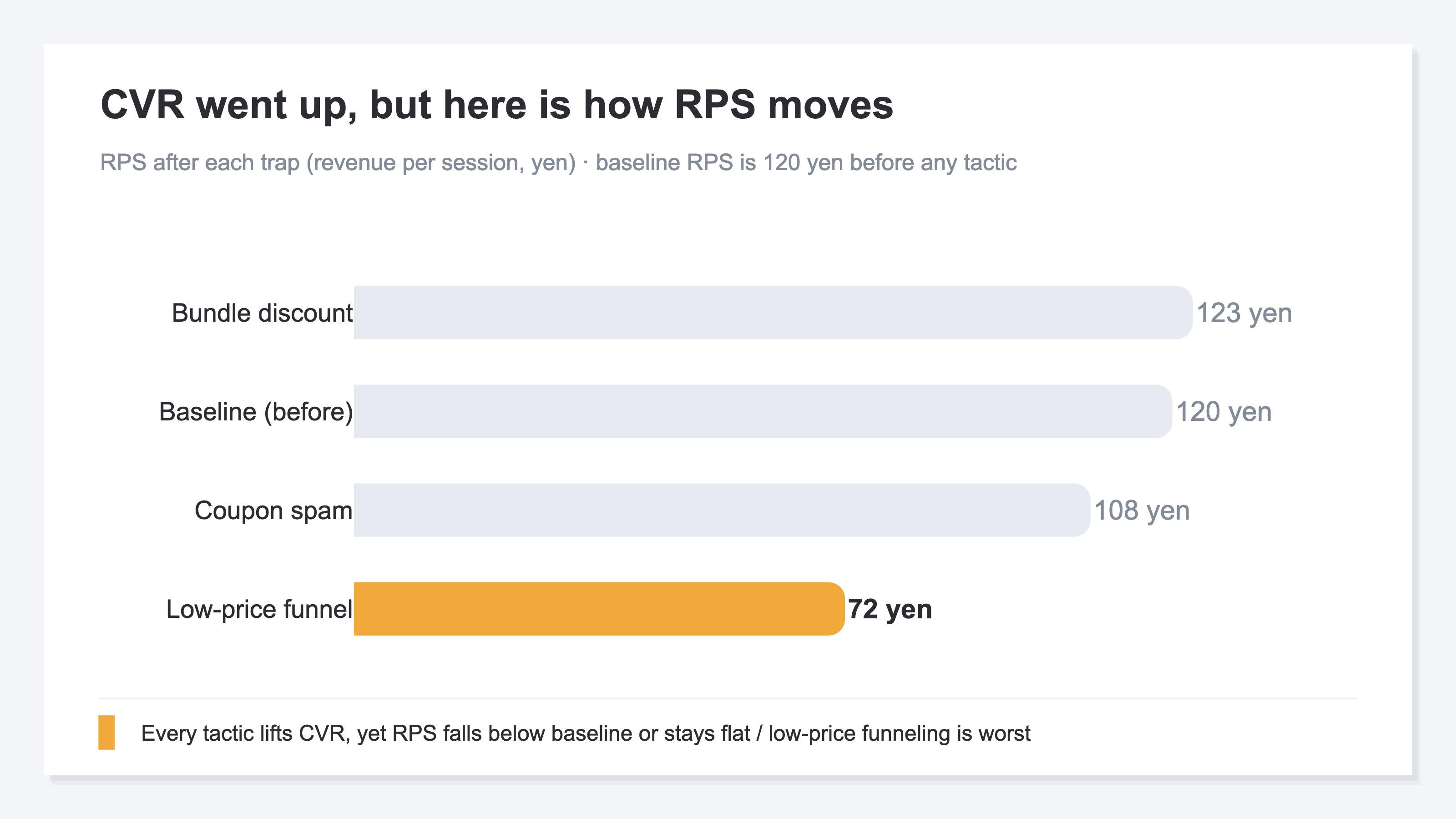
A "10% off the second item" bundle pushes CVR up. With AOV 6,000 yen and CVR 2.0%, RPS is 120 yen. Even if CVR rises to 3.5%, when AOV drops to 3,500 yen, RPS becomes 3,500 yen x 0.035 = 123 yen. Unit price fell more than 40%, yet RPS is essentially flat. Approaches to lift AOV the right way are in How to Properly Lift AOV (Average Order Value).
Trap 2: Funneling to low-price products#
A "trial product 980 yen" funnel spikes CVR while destroying unit price. CVR moving from 2.0% to 6.0% (3x) with AOV moving from 6,000 yen to 1,200 yen (1/5) drops RPS from 120 yen to 72 yen — a 40% decline. Outside of a long-term recovery model, monthly RPS falls.
Trap 3: Aggressive coupon distribution#
A site-wide 10-20% off coupon is the same shape. CVR rises, but unit price drops by the discount amount.
| Trap | CVR | AOV | RPS |
|---|---|---|---|
| 1. Bundle discount | Up (2.0% to 3.5%) | Down (6,000 to 3,500 yen) | Nearly flat (120 to 123 yen) |
| 2. Low-price funnel | Sharp up (3x) | Sharp down (1/5) | 40% loss (120 to 72 yen) |
| 3. Coupon spam | Up | Down | Flat or down |
All three share the same structure: CVR and RPS move in opposite directions. Industry-average CVR is roughly 2-3%, with 4-5% the ceiling even for strong ECs [2]. Lifting CVR is hard, so when it rises you tend to call it a "success" — and that call quietly endorses tactics that erode revenue efficiency.
3. Decide Where to Invest with the RPS and CVR Quadrant#
Bottom line: plot RPS against CVR and the channels to fund — and the "CVR trap zone" — separate at a glance.
To make the mismatch between CVR and RPS visible, a quadrant with both on its axes is useful.
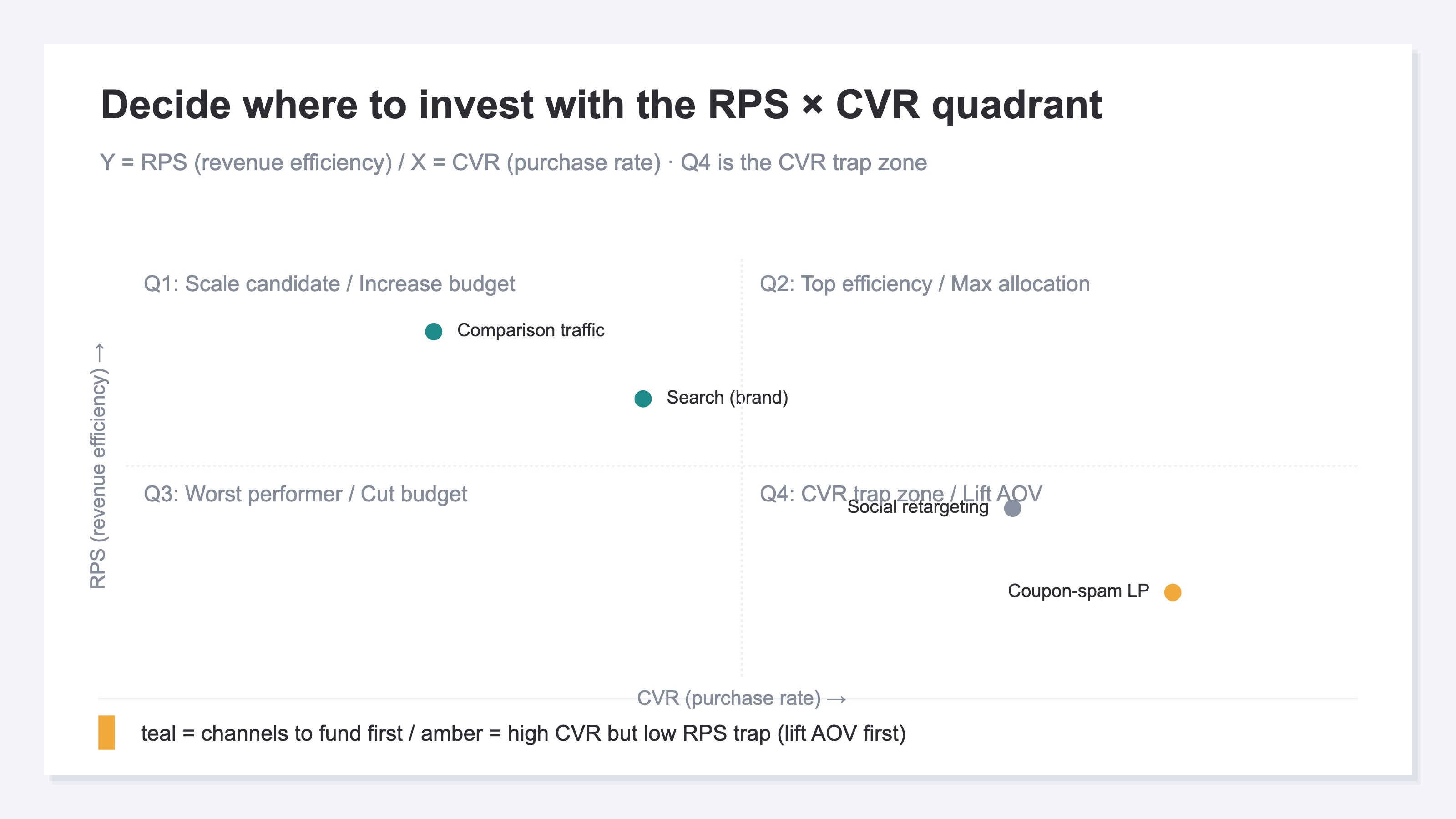
With CVR on the x-axis and RPS on the y-axis, each channel and ad falls into one of four quadrants.
| Quadrant | State | Action |
|---|---|---|
| Q1: High RPS x Low CVR | High-AOV hit, scale candidate | Increase budget |
| Q2: High RPS x High CVR | Best revenue efficiency, top priority | Maximize allocation |
| Q3: Low RPS x Low CVR | Largest room to improve, consider withdrawal | Cut budget or rebuild LP |
| Q4: Low RPS x High CVR | CVR trap zone | Not eligible unless AOV is lifted |
The call takes three steps: compute each channel's RPS and CVR monthly, plot them on the four quadrants, and for Q4 decide "not eligible for budget unless unit price is lifted" rather than "keep it because CVR is high."
Q4 looks like a "good channel" if you only watch CVR, but its real identity is usually one of traps 1-3. There is also the case where last-click — assigning revenue only to the final touch — underestimates an upstream channel's RPS. For that, read Moving Budget on Last-Click Alone Costs You alongside this.
4. That Reversal Cannot Be Lined Up in Standard GA4#
Bottom line: the higher a channel's CVR, the lower its RPS can be — and you only see it once you line channels up.
Let us take the quadrant to real channels.
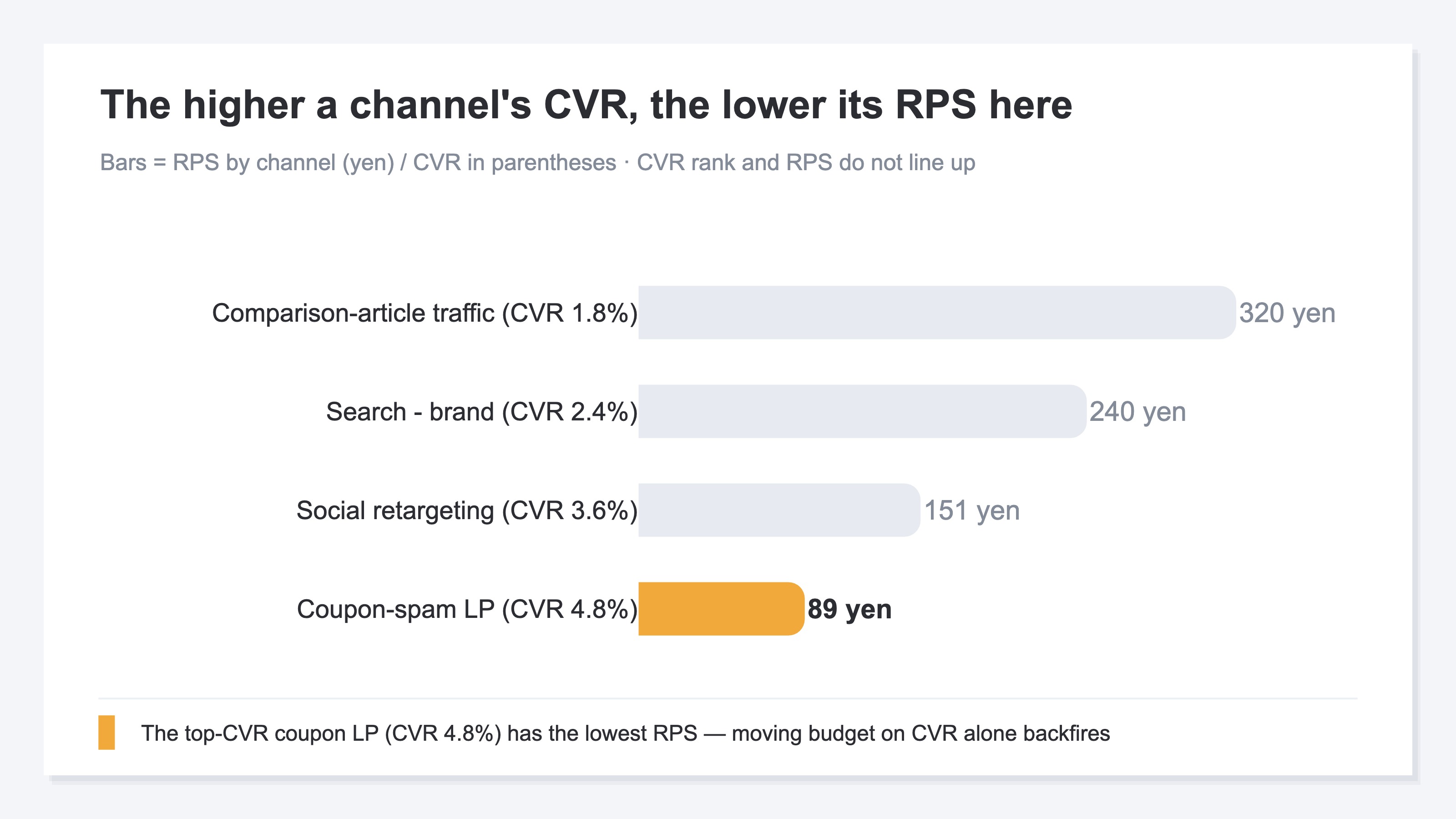
The chart above lines up four channels by CVR (high to low) and sets bar height to RPS. The point: the CVR order and the RPS order do not match. The coupon-spam LP with the highest CVR (4.8%) is last on RPS at 89 yen. The comparison-article traffic with the lowest CVR (1.8%) is first on RPS at 320 yen — because a channel with a higher unit price earns more per session even at a lower CVR.
You can produce this reversal yourself for one channel by running AOV x CVR on a calculator. That part is not hard. The hard part is lining it up across every channel, every month. Each channel has a different share of bot traffic and a different mix of new and returning customers. Only after you align those can you compare channels fairly.
Standard GA4 reports give site-wide purchase rate and unit price. But they are not built to line up channel-level RPS and CVR on one screen with bots removed. So confirming this reversal every month is structurally heavy manual work. After you understand the metrics, this "re-aligning every time" is the wall that stands in the way. The same wall, seen through the RPS-and-AOV lens, is covered in RPS vs AOV.
RevenueScope solution
Chasing cheap conversions because you judge ads on CVR, and failing to see the quadrant reversal, share one root: channel-level RPS, CVR, and AOV are not lined up on one screen with bots removed.
RevenueScope lines up each channel's RPS (revenue per session), CVR (purchase rate), and AOV (unit price) on a single screen, on clean numbers with bots removed. It computes AOV x CVR = RPS automatically, so a channel that is "high CVR but low RPS" surfaces on the spot. Ask it a question, and it answers like this.
Question: "Which channel is really driving revenue?"
| Channel | CVR | AOV | RPS | Verdict |
|---|---|---|---|---|
| Coupon-spam LP | 4.8% | 1,850 yen | 89 yen | Q4, CVR trap (lift AOV first) |
| Social retargeting | 3.6% | 4,200 yen | 151 yen | Watch |
| Search (brand) | 2.4% | 10,000 yen | 240 yen | Fund it |
| Comparison-article traffic | 1.8% | 17,800 yen | 320 yen | Top priority |
The coupon-spam LP that ranks first on CVR is plainly last on RPS. On top of that, RevenueScope can split each channel's revenue by new versus returning, and switch between attribution models beyond last-click. Before you move budget on CVR alone, you can confirm with concrete numbers where revenue efficiency is genuinely highest.
RevenueScope specializes in revenue-side numbers: revenue, RPS, AOV, CVR, and sessions. Gross margin, LTV (lifetime value), and inventory pair with accounting or CRM tools, while RS stays focused on channel-level revenue efficiency — lining channels up on clean numbers with bots removed so you decide budget on revenue efficiency without being misled by a high CVR.
FAQ#
Frequently asked questions#
Q. Should RPS or CVR take priority?
A. RPS. CVR is one component of RPS (RPS = AOV x CVR), and the composite RPS is what connects directly to revenue. Use CVR as a supplement to diagnose the purchase flow on your LP.
Q. Why does CVR rise while revenue stays flat?
A. AOV (unit price) is likely dropping. Bundle discounts, low-price funneling, and aggressive coupons lift CVR while pulling unit price down, keeping RPS flat or falling. The key is not to call a CVR rise a "success" on its own.
Q. Should we stop watching CVR?
A. No. CVR is useful for diagnosing your LP and cart-abandonment improvements. This article's argument is not "ignore CVR" but "do not make CVR the primary axis for ad budget allocation." Put RPS at the center of budget decisions.
Conclusion#
CVR is an intermediate purchase-rate metric and does not directly show revenue per session. Most tactics that lift CVR — bundle discounts, low-price funneling, coupon spam — pull unit price down and erode RPS (revenue efficiency). Line channels up, and you can even find a reversal where the highest-CVR channel sits last on RPS.
Japan's B2C EC market has grown past 20 trillion yen, and the quality of ad budget allocation directly drives business growth [3]. As a first step, line up CVR and RPS for your main channels once. Even running AOV x CVR on a calculator should surface a channel that is "high CVR but low RPS." Move from CVR-only judgment to RPS-as-primary — that is the line between funding efficiency and losing budget to cheap conversions.
See which ads actually drive revenue, at a glance
Free up to 5,000 sessions/month, AI connection included. No credit card required. Up and running in 5 minutes.