"I keep hearing upselling will lift revenue, but I never know what to actually offer." If you run an EC store, lifting the average order value is one of those questions every owner eventually hits. Raising prices is scary, and paid ads keep pushing CPA up. What's left is the tactic of getting a buyer who already intends to purchase to pick one tier higher. That tactic is upselling.
But upselling is not just "recommend the expensive one." Miss the link to AOV, the difference from cross-selling and down-selling, or the right pattern per industry, and you drop conversion and end up with lower revenue. The bottom line: upselling is one lever for lifting AOV, designed as a natural extension of the shopping experience. It works when you hand the customer a "slightly better" option they want, not a price hike.
This article does not stop at "what upselling is." The question it really answers is "did your upsell actually work, and which channel should you strengthen next." We cover the definition, the link to AOV, the difference from cross-selling and down-selling, 5 industry tactics, a 5-step playbook, how to measure impact, and why lining that impact up by channel and by new vs returning is hard in standard GA4.
Table of Contents
TL;DR#
-
Upselling = offering existing buyers a higher-tier product
It is one means of lifting AOV (the result metric), distinct from cross-selling a related item
-
It differs from cross-selling and down-selling in goal
Upsell = higher-tier offer / Cross-sell = related offer / Down-sell = cheaper offer to keep the sale
-
The upsell that works differs by industry
Apparel = premium line / Food = bulk packs / Supplements = subscription / Goods = bundles / Electronics = premium model + warranty
-
Measure impact by channel and by new vs returning AOV
Placement and channel both change the effect, so a blended average misleads — split by channel and by new vs returning
1. What is upselling?#
Bottom line: upselling offers a buyer the next tier up — product, plan, or size — raising the value of a single order.
The classic example is a product-page nudge like "See the next-tier model," or a supplement store's "one-off → subscription." Because it targets buyers whose intent is already set, it lifts revenue far more cheaply than new-customer ads. One analysis found upselling and cross-selling lifted revenue by about 20% and profit by about 30%, with selling to existing customers running 5 to 25 times more profitable than new acquisition[1].
1.1 Upselling vs. AOV#
Upselling and AOV (Average Order Value — revenue per order) are often confused but play different roles. AOV is the metric that measures the result; upselling is one means of moving it. When a higher-tier item is chosen, the per-order amount rises and AOV goes up. Watch AOV alone, though, and you miss when an upsell pushes conversion rate (CVR) down. See AOV calculation and tactics for the full picture.
2. Upsell vs. cross-sell vs. down-sell#
Bottom line: the three differ by what you offer — upsell goes upward, cross-sell goes sideways, down-sell goes downward.
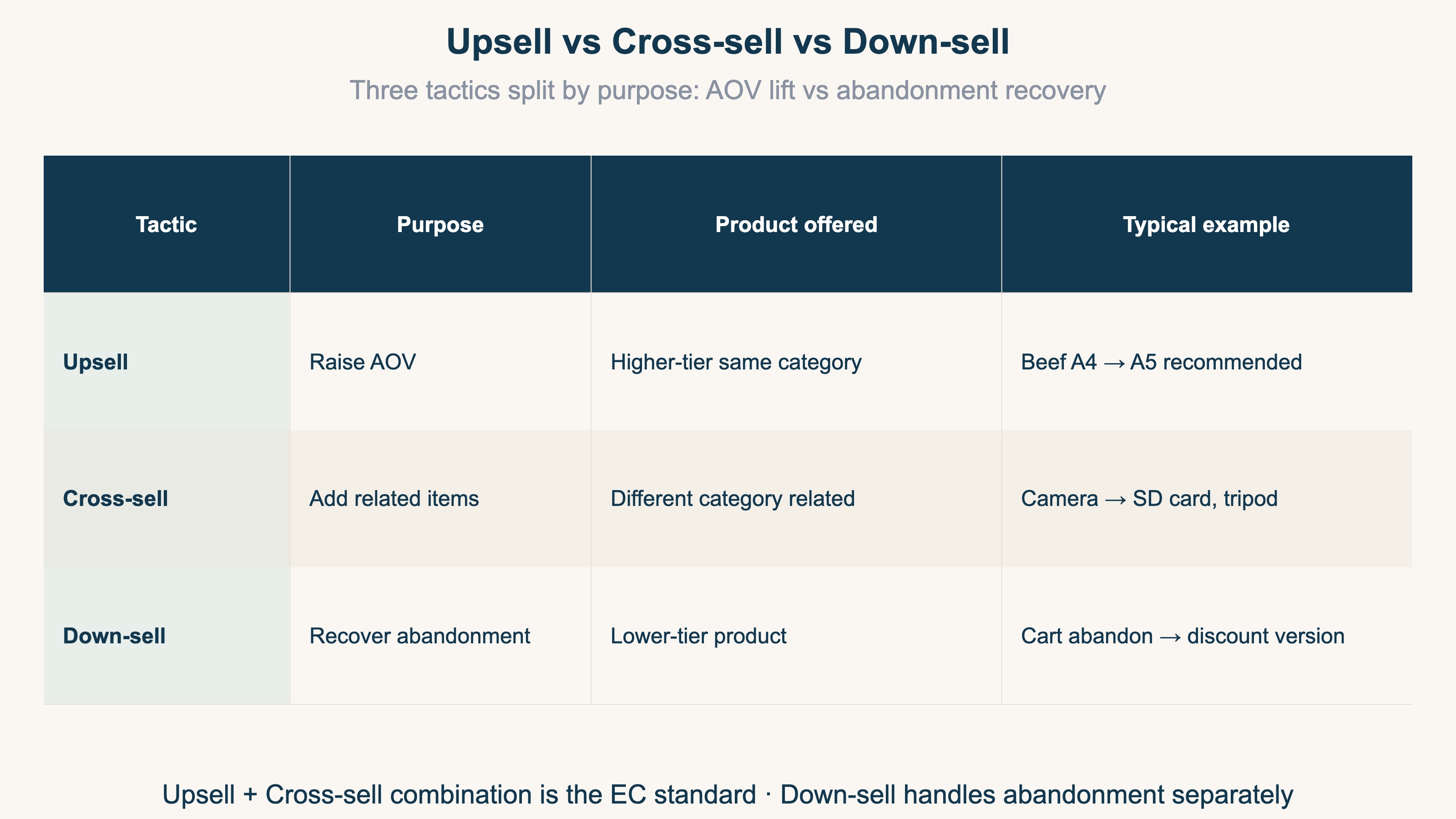
Upsell and cross-sell both lift AOV, but the direction differs: upsell is a higher-tier version of the same item, cross-sell is a related item from another category. Using both together is the standard play; the detailed design of related offers is in Cross-selling explained. Down-sell is used separately when conversion matters more than ticket size.
3. 5 upsell tactics by industry#
Bottom line: what works depends on the industry — the key is catching the moment a customer wants "a bit better" or "extra peace of mind."
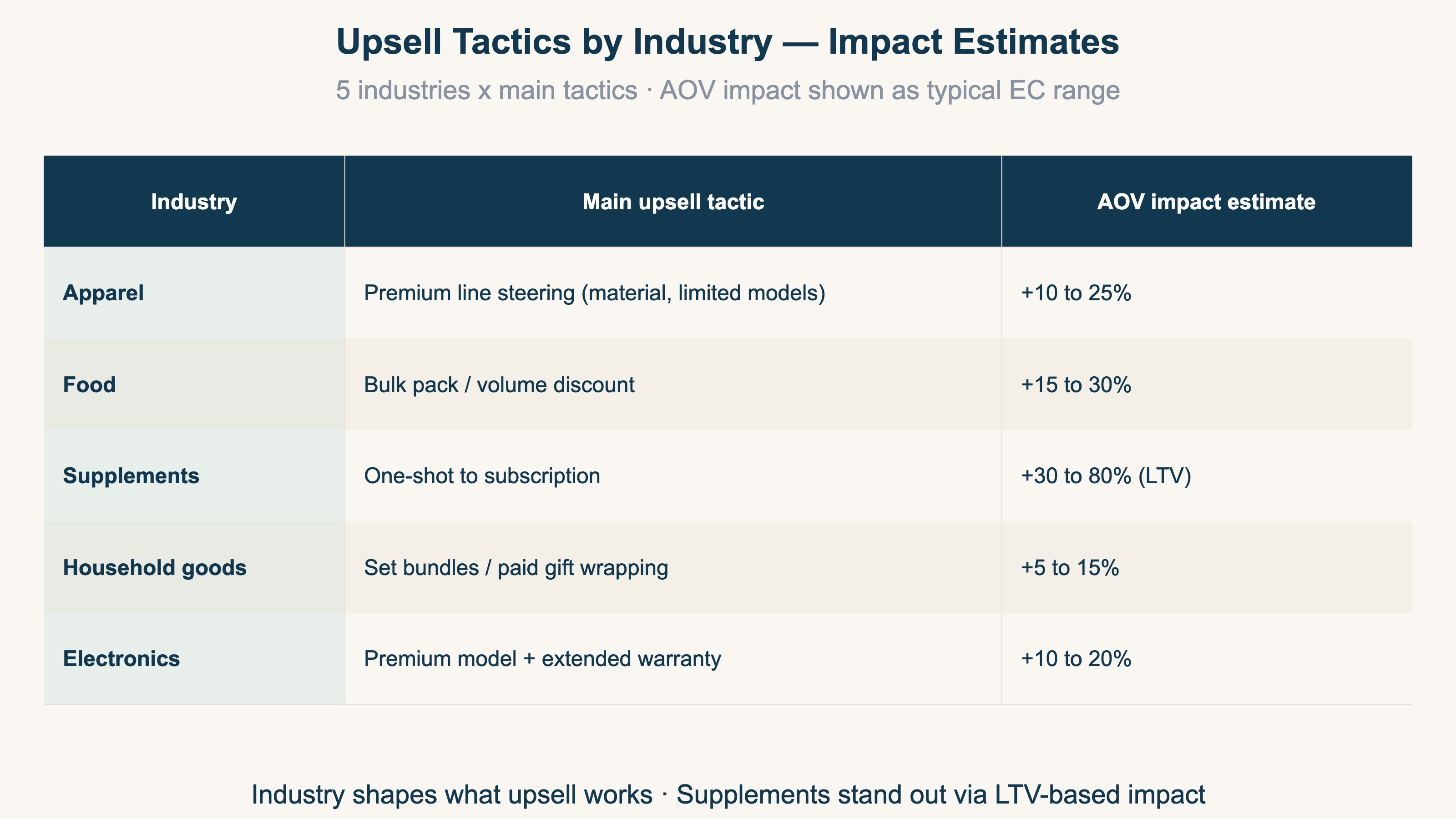
For apparel, steer to a premium fabric line of the same T-shirt; for food, offer bulk packs or volume discounts; for supplements, flip one-off purchases into a subscription. Electronics rely on a premium model plus extended warranty, and general goods do well with set bundles and paid gift wrapping. The AOV impact figures are typical EC-industry ranges, and the subscription flip in supplements stands out as the strongest lever on an LTV basis[1][2].
What they share: never let the upsell become "just a price hike." If the buyer cannot feel the value gap, conversion rate falls and total revenue drops.
4. Five steps to implement upselling#
Bottom line: placement and what you show change the impact a lot — narrowing hero SKUs and designing the surface are the keys.
Work through implementation in five steps. First, (1) narrow to three to five hero products from your top revenue contributors, then (2) prepare one or two "one rung up" options for each — too many choices cause drop-off, so keep upsell offers tight. Next, (3) decide where to surface them: the product page and cart are the standard wins, easy to implement with stable results[3]. A pre-checkout offer can hurt CVR, so (4) A/B test "shown / not shown" in parallel for two to four weeks before scaling. Finally, (5) revisit by season and price band and rotate the higher-tier options.
Always read AOV and CVR together. AOV going up while CVR drops, with total revenue actually falling, is a frequent pattern (see risks of AOV tactics).
5. Measuring impact: channel splits do not line up in standard GA4#
Bottom line: judge an upsell by the lift in AOV. But lining that lift up by channel and by new vs returning is structurally hard in standard GA4 reports.
Whether an upsell works is judged by how much AOV rose before and after. The idea itself is simple — measure in three steps:
- Record AOV for the 4 weeks before as a baseline (revenue ÷ orders)
- Record AOV and CVR for the 4 weeks after, in parallel. Watch AOV alone and you miss an upsell that pushed conversion down
- Split by channel and by new vs returning to judge
The third step is the problem. A small rise in the overall average AOV means something completely different depending on which channel and new vs returning customer it came from. And this is where many people get stuck in GA4: three things you need to line up AOV lift by channel and by new vs returning do not come ready out of the box.
1. The numbers are not bot-free
AOV is "revenue ÷ orders," but when you read it alongside CVR (conversion rate), the denominator becomes sessions. If automated crawler (bot) traffic sneaks into those sessions, conversion reads lower than reality. The tricky part is that the bot mix differs by channel. So the bot-share gap alone can reshuffle which channel's upsell "looks like it worked." Standard GA4 reports do not strip out this per-channel bot share for you.
2. There is no side-by-side channel view
You want to compare "did the ad channel or the email channel lift AOV more." But standard GA4 has no view that lines channels up as rows and AOV as a column on one screen. You could open each channel's screens and pull the numbers, but doing that by hand for every channel, every time you run a tactic, is not practical.
3. New and returning are still mixed together
Upselling works best on returning customers who already know the product and brand. So a "channel where AOV rose" may simply be skewed toward returning customers coming back. To see whether it also worked on new customers, you must split new vs returning AOV — but standard GA4 channel reports give a blended average, so that resolution is structurally missing.
In short, the 3-step idea is correct, but when you actually line up AOV lift by channel and by new vs returning, bot share and the new-customer mix differ by channel, so you cannot compare on GA4's raw numbers. The idea is simple; the heavy part is repeating, by hand and across channels every time, the work of removing bots, splitting new vs returning, and lining up AOV. That is the wall that stands after you understand how to measure. For lifting CVR and AOV together, see the CVR and AOV uplift framework.
RevenueScope solution
Bottom line: RevenueScope lines up bot-free, channel-level AOV split by new vs returning on one screen. You can judge an upsell down to "which channel, new or returning customers."
Failing to measure an upsell correctly, and not knowing which channel to strengthen next, share the root we saw in section 5: bot-free, new-vs-returning, side-by-side channel AOV is not visible together on one screen. GA4 shows AOV and CVR on separate screens and never lines them up by channel.
RevenueScope strips out bots with its own tracking, then lines up AOV, CVR, and RPS (revenue per session) for every channel on the same screen. Before and after an upsell, you can compare — on the same basis — which channel's AOV rose, and whether it rose without dropping CVR.
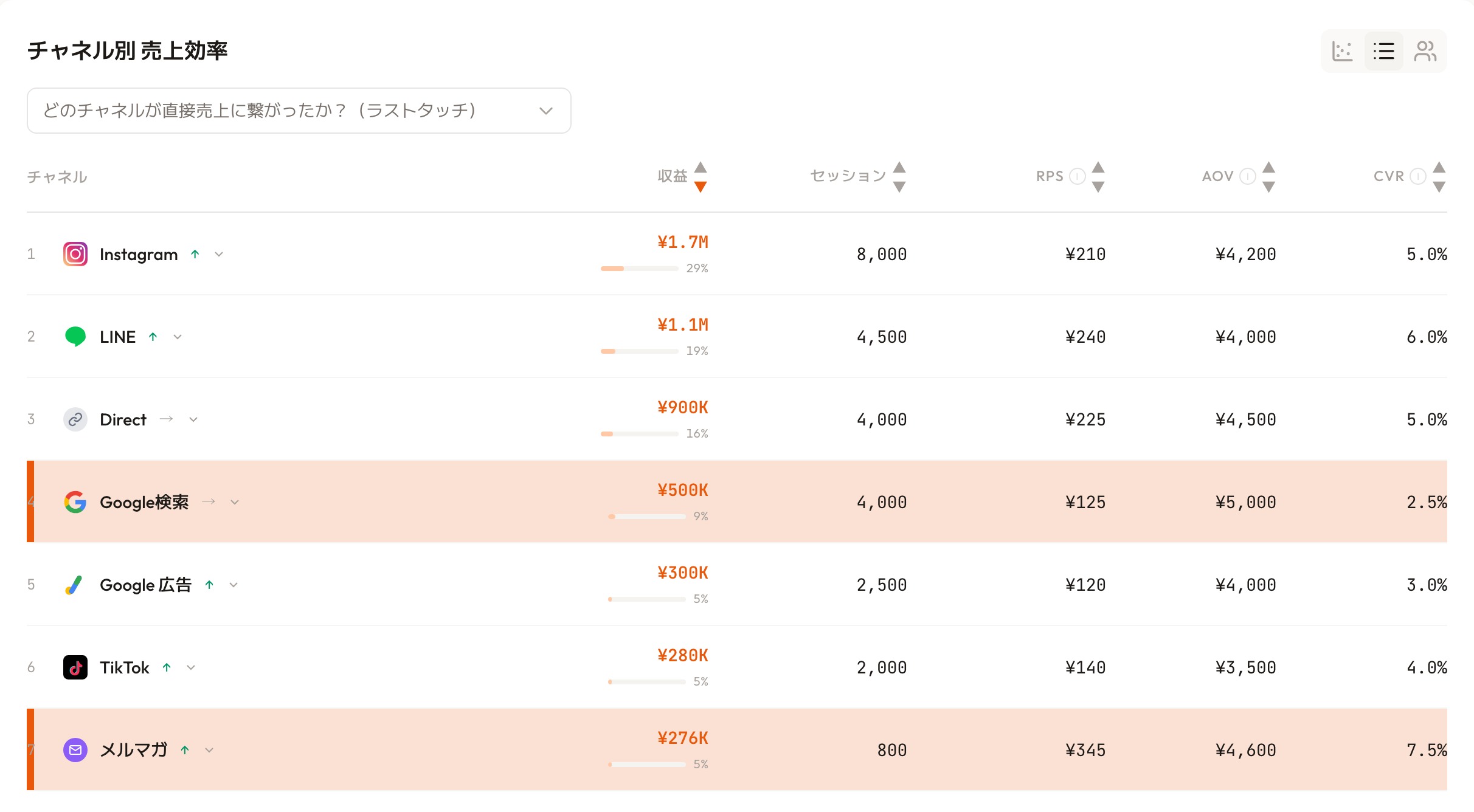
RevenueScope dashboard (demo data shown). AOV, CVR, and RPS line up by channel on one basis, exposing which channel an upsell actually moved.
For example, in the screen above Google search has the highest AOV here at ¥5,000, but its conversion rate (CVR) is a low 2.5%. The email newsletter, with a slightly lower AOV of ¥4,600, carries a 7.5% CVR. A high-AOV channel is not automatically the one to push upsell on — lining AOV up next to CVR shows it instantly. What you really want to strengthen is the channel where unit price and conversion both follow through.
On top of that, RevenueScope also splits these channel-level numbers by new vs returning customers.
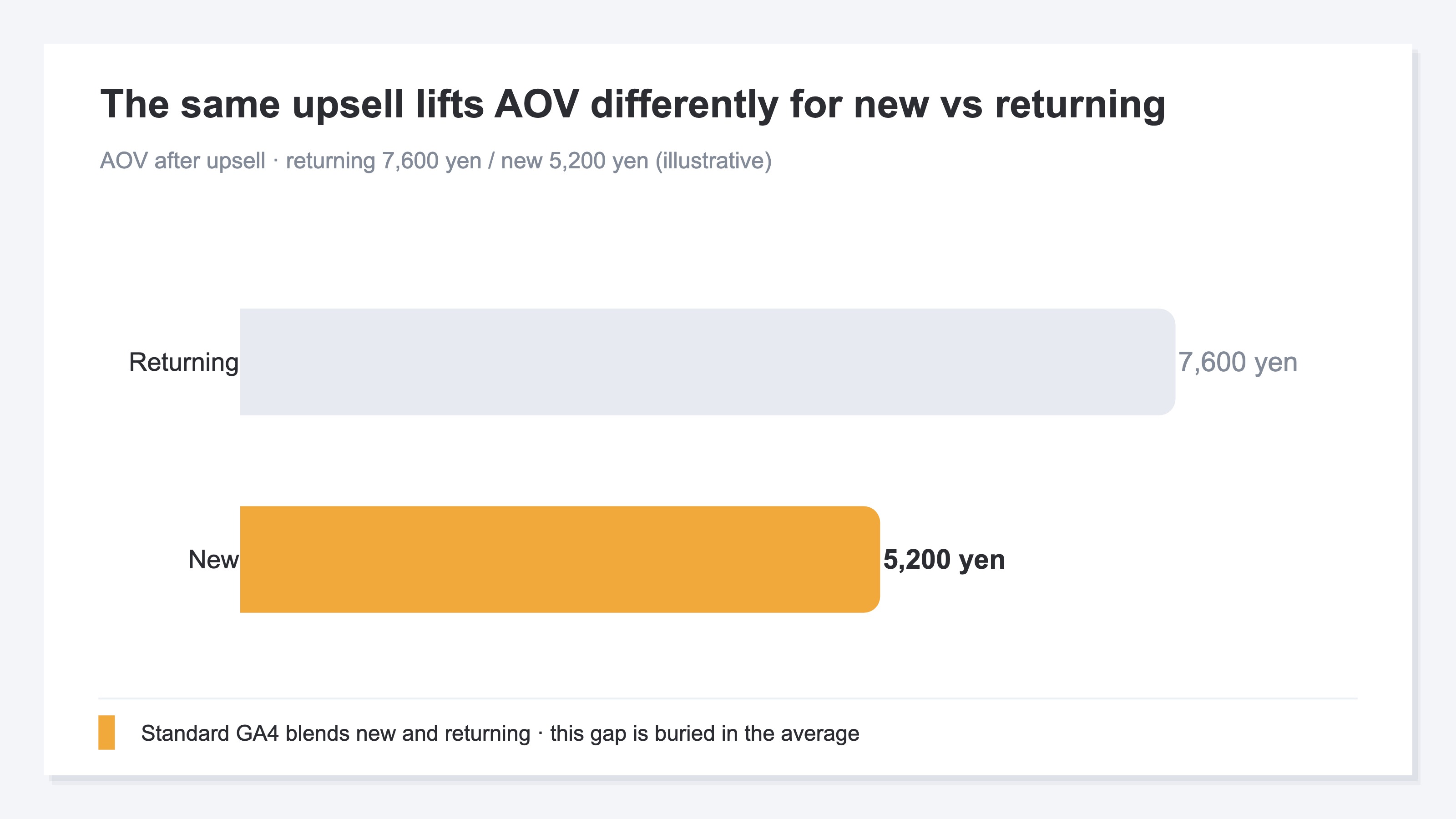
As above, the same upsell lifts AOV differently for new and returning customers. Returning customers know the product and brand, accept higher-tier offers more readily, and post higher AOV. So a channel where AOV rose may simply be skewed toward returning customers coming back. After removing bots, RevenueScope lines up channel-level AOV split by new vs returning, so you can separate "a tactic that worked on returning customers" from "one that also worked on new customers," and decide which channel to strengthen next. That is the move a blended-average AOV cannot reach.
FAQ#
Q. Upsell or cross-sell — which should I prioritize?
Use both, not one. Upsell "raises to a higher tier"; cross-sell "adds a related item sideways" — they work in different moments. Start by designing upsell on hero products where the value gap is easy to convey, then layer in cross-sell where related purchases make sense.
Q. How should I measure upsell impact?
By the lift in AOV before and after. But AOV alone hides an upsell that pushed conversion (CVR) down, so always watch CVR with it. And without splitting by channel and by new vs returning, you cannot tell "which channel, which customers" it worked on, and you misjudge the next move.
Q. How is upselling different from a price hike?
A price hike charges everyone a higher price across the board; an upsell presents a "better option" the customer chooses. Without a clear value gap, it reads as "just expensive" and triggers drop-off. Whether you can spell out the premium (material, volume, warranty, peace of mind) is the deciding factor.
Conclusion#
Upselling is not "recommend the expensive one" — it is designing a one-step-up extension of the existing buyer's shopping experience. The winning tactic differs by industry, impact changes with placement, and you cannot judge results without tracking AOV and CVR together.
And the most important point at the end: impact cannot be measured by a blended average. What you really want to know is "which channel, and new or returning customers, the upsell worked on." You can only make that call once channel-level AOV is lined up bot-free and split by new vs returning. Whether you can frame it as a natural value extension rather than a price hike, and whether you can read its impact at the right channel level, is what separates upselling that lifts revenue from upselling that does not.
See which ads actually drive revenue, at a glance
Free up to 5,000 sessions/month, AI connection included. No credit card required. Up and running in 5 minutes.
References#
- BigCommerce 「Ecommerce Growth with Upselling and Cross Selling Tactics」 2024 [1]
- Shopify 「Average Order Value: How to Calculate and Increase AOV」 September 2025 [2]
- Baymard Institute 「Product Page UX Research」 2024 [3]