"Lift CVR by 30%." "Push AOV up 20%." Run either lever alone and you hit a ceiling. CVR plateaus once you diverge too far from the industry baseline — competitor campaigns claw it back. AOV runs into price elasticity. Ecommerce revenue decomposes as sessions × CVR × AOV, a multiplication, so raising both metrics by a small amount is more efficient — mathematically and operationally — than blowing one of them up. This article simulates revenue under +10%/+20%/+30% simultaneous-uplift scenarios, benchmarks the realistic uplift range by industry, and maps five levers that push CVR and AOV together.
For the 4-area frame on raising CVR and AOV together, see Raising CVR and AOV Together — A 4-Area Frame from the Revenue Equation. For the side effects and defense plays of each AOV lever, see AOV Uplift Risks and Defense — Protect CVR, Stock, and LTV in 2026. This article connects both views from the angle of "how far revenue can actually move, in numbers."
Table of contents
In this article#
-
CVR +10% × AOV +10% lifts revenue by +21%, +20% each by +44%, +30% each by +69%
Because revenue is a product, simultaneous uplift compounds multiplicatively — not linearly
-
Realistic simultaneous uplift caps: +5–15% for SMB EC, +10–20% for Apparel, +15–25% for Beauty
Against the Shopify and Statista global benchmarks, "+30% on both sides" is not a credible target
-
Five levers move CVR and AOV together without tripping their tradeoffs
Recommendation accuracy, tiered free-shipping thresholds, loyalty tiers, personalized bundles, post-purchase upsell
1. Why aim for simultaneous uplift, not one at a time#
Revenue breaks down to sessions × CVR × AOV. Pushing CVR alone to +30% means your A/B test backlog runs out within a couple of years, and values too far from the industry average get pulled back when competitors run promotions. Pushing AOV alone to +30% hits the price-elasticity wall — CVR often drops -15% simultaneously, and net revenue lands in the red.
The multiplication math says moving both metrics a little beats moving one a lot. CVR +30% alone gives revenue +30%, and AOV +30% alone gives revenue +30%, but CVR +14% and AOV +14% together also hit +30% (1.14 × 1.14 = 1.30). Operators routinely report that "+14% on each looks doable; +30% on one feels impossible," and the math vindicates that intuition.
Baymard Institute[1] estimates that the average ecommerce site has roughly 35% conversion-rate headroom in unresolved abandonment reasons. Using all of that headroom on CVR alone is wasteful — pairing CVR gains with AOV uplift on the resulting traffic produces higher lever leverage.
2. Simulating CVR × AOV simultaneous uplift#
Below is the revenue multiplier when CVR and AOV move by 0%/+10%/+20%/+30%, holding sessions constant. With sessions fixed, this matrix doubles as the RPS (Revenue Per Session) multiplier — Sessions × CVR × AOV reduces to a per-session view when traffic is held flat.
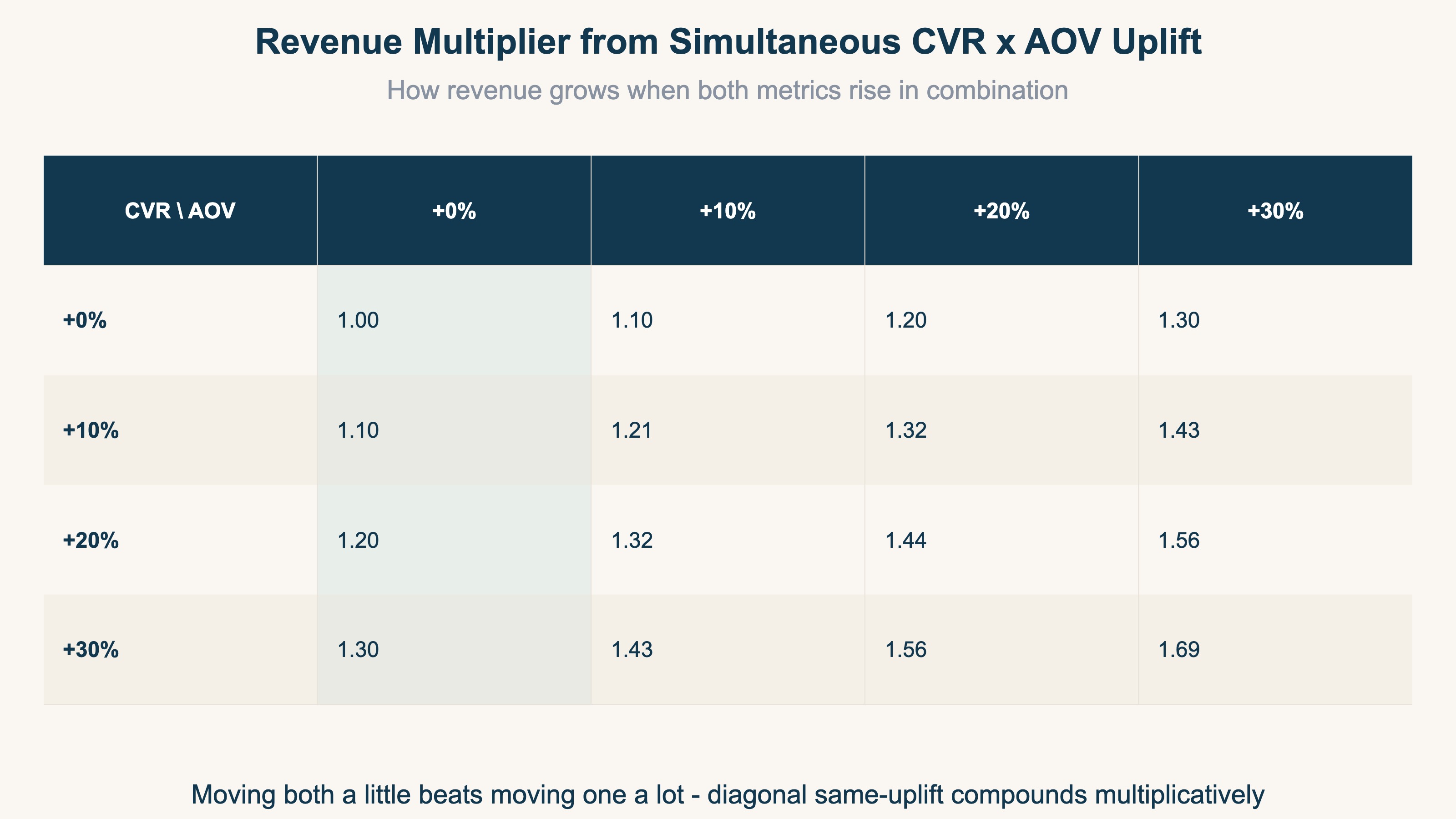
Watch the diagonal:
- CVR +10% × AOV +10% = revenue +21% (1.10 × 1.10 = 1.21)
- CVR +20% × AOV +20% = revenue +44% (1.20 × 1.20 = 1.44)
- CVR +30% × AOV +30% = revenue +69% (1.30 × 1.30 = 1.69)
Fixing one axis at 0% caps revenue at +30%, whether you push CVR alone or AOV alone. "A little on both" easily beats "a lot on one," confirmed in numbers.
This matrix assumes CVR and AOV are non-interfering. In practice, AOV-lifting moves erode CVR and CVR-lifting moves erode AOV. The next section uses Statista and Shopify benchmarks to bound the realistic ceiling.
3. Realistic uplift range by industry#
Combining Statista[2] industry CVR benchmarks (2024) with Shopify[3] industry AOV benchmarks, here is the realistic simultaneous uplift ceiling by industry.
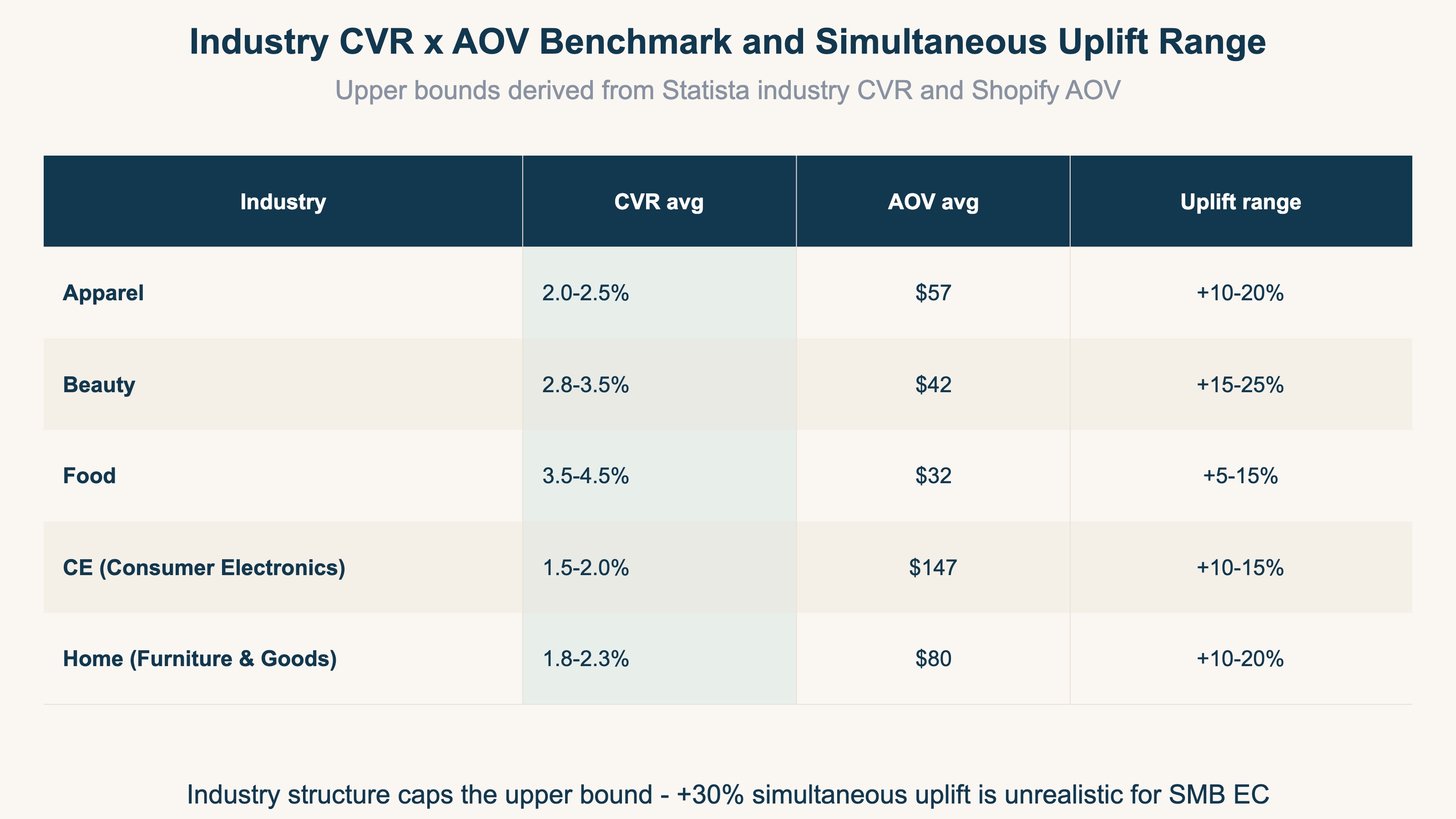
- Apparel: CVR 2.0–2.5% / AOV ≈ $57 · Simultaneous uplift cap +10–20% (seasonality is sharp, hard to hold list-price AOV)
- Beauty: CVR 2.8–3.5% / AOV ≈ $42 · Cap +15–25% (high repeat rate, strong bundle fit)
- Food: CVR 3.5–4.5% / AOV ≈ $32 · Cap +5–15% (thin margins, heavy shipping load, low AOV ceiling)
- Consumer Electronics: CVR 1.5–2.0% / AOV ≈ $147 · Cap +10–15% (high unit price, AOV room limited, CVR is the main lever)
- Home (Furniture & Goods): CVR 1.8–2.3% / AOV ≈ $80 · Cap +10–20% (bundle-friendly, but sizing issues destabilize CVR)
McKinsey[4] points out that rising new-customer CPA is forcing ecommerce operators to "extract more from the same visitor" across industries — but how much can actually be extracted depends on industry structure. Setting "+30% on both sides" as a target without checking your industry's ceiling guarantees that CVR or AOV breaks first.
4. Four tradeoffs blocking simultaneous uplift#
The biggest reason CVR and AOV don't move independently: four structural tradeoffs sit between them.
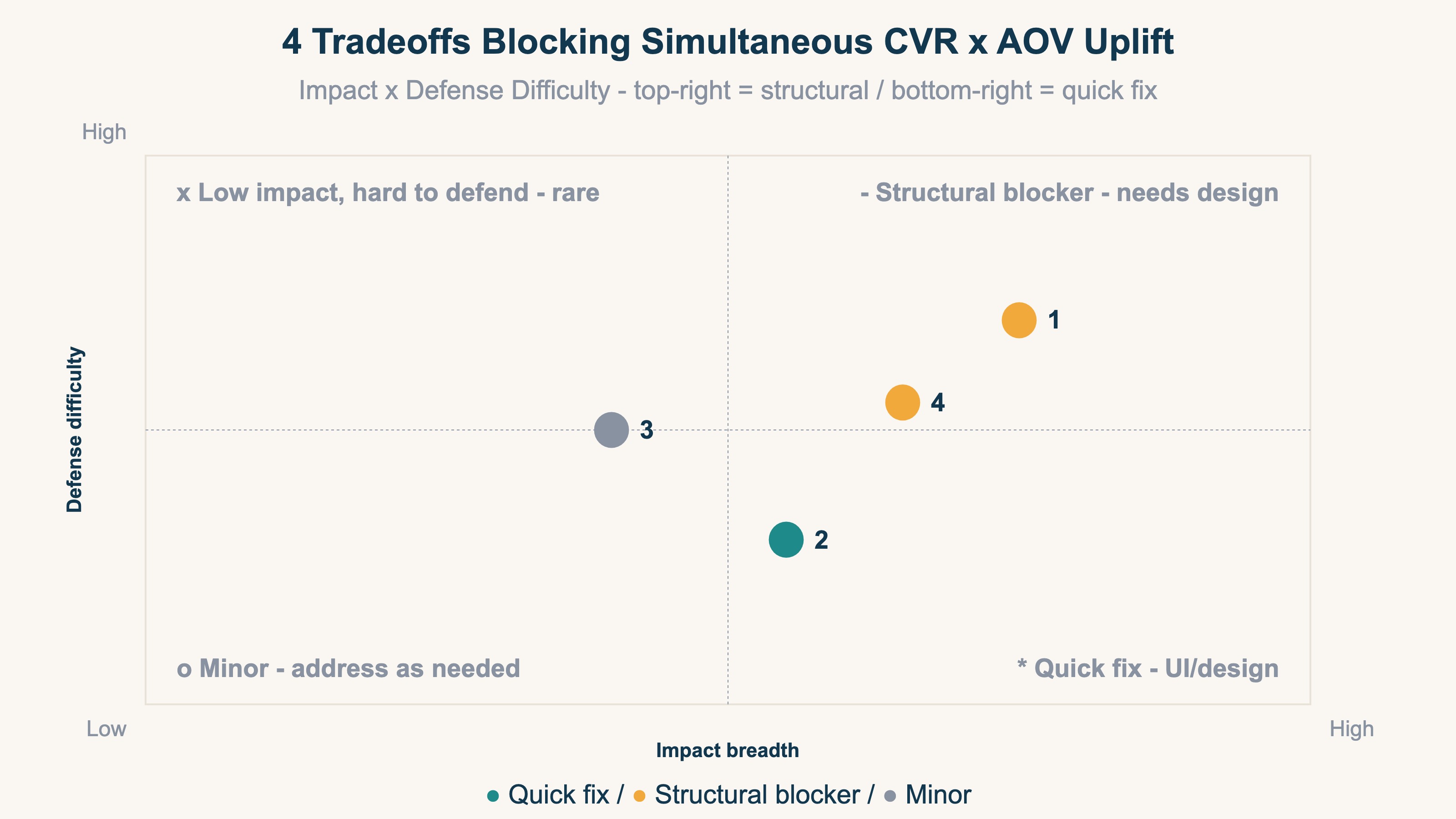
- Price elasticity tradeoff: Premium-product or bundle plays raise AOV but drop CVR in price-sensitive segments
- Upsell UI friction: Cart upsells lift AOV but add checkout friction that drops CVR
- Seasonal misalignment: CVR peak (promo periods) and AOV peak (full-price seasons) are different months — both can't be maximized simultaneously
- Segment-level elasticity gap: New customers are price-elastic (CVR drops first); repeat customers are LTV-elastic (AOV moves more freely)
Raising CVR and AOV Together — A 4-Area Frame from the Revenue Equation sorts plays into "joint-possible," "sacrifice-one," and "both-down" quadrants. The four tradeoffs here are the structural obstacles to staying in the joint-possible quadrant. Identifying which tradeoff your store is most exposed to before picking levers cuts your failure rate sharply.
5. Five levers that move CVR and AOV together#
Levers that minimize the tradeoffs in the previous section and push both metrics in the positive direction, ranked by difficulty.
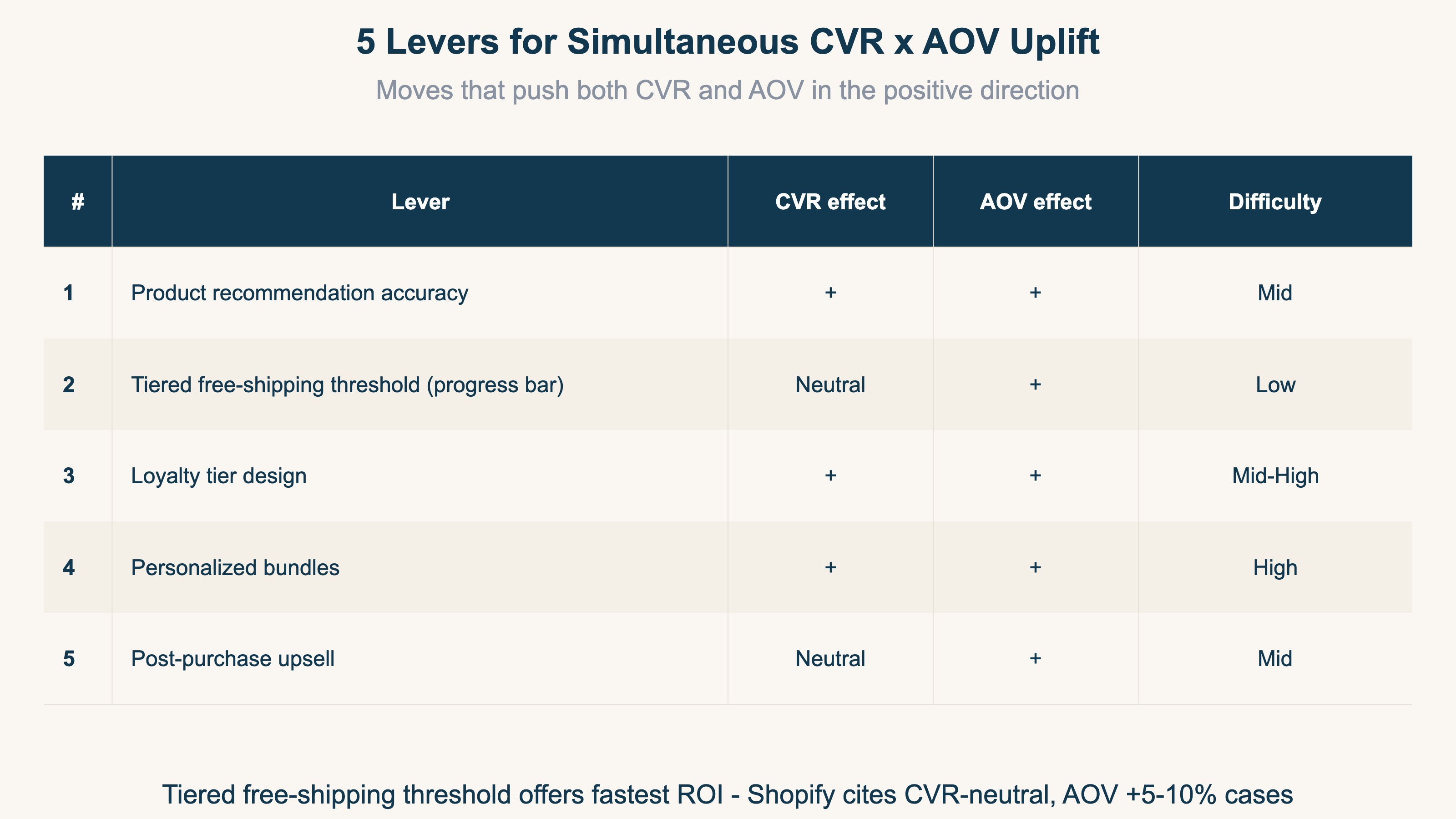
- Product recommendation accuracy: Showing genuinely relevant products lifts both CVR and AOV. Difficulty: Mid (recommender or AI tool)
- Tiered free-shipping threshold: A "$8 to free shipping" progress bar pushes AOV up while holding CVR. Difficulty: Low
- Loyalty tier design: Spend-based tier perks boost repeat CVR and encourage AOV uplift toward the next tier. Difficulty: Mid–High
- Personalized bundles: Per-customer bundle suggestions raise AOV while suppressing the "pushed" feeling. Difficulty: High (requires customer data)
- Post-purchase upsell: One-click add-ons after checkout lift AOV without touching the CVR flow. Difficulty: Mid
Among these, the tiered free-shipping threshold has the fastest ROI. Shopify[3] documents cases where CVR holds and AOV rises by +5–10%. For CVR-only improvements see CVR Improvement — 30 Checks, and for AOV-only levers see Average Order Value (AOV) — Calculation and 10 Levers; reading the three together sharpens the lever decision.
After implementation, plot your current CVR and AOV onto the revenue multiplier matrix from section 2 and against the industry benchmark caps from section 3, on a 4-week cadence. That turns lever selection into a quantitative decision.
6. Wrap-up and next actions#
Simultaneous CVR × AOV uplift, as the multiplication math shows, gives more revenue leverage than pushing one metric alone. The realistic target is +10–20% within your industry's benchmark ceiling, not +30% on both axes.
Three next actions:
- Benchmark your current CVR and AOV against industry caps (section 3)
- Pick a +10%/+20% target and simulate the revenue impact on the matrix (section 2)
- Choose 1–2 low-difficulty levers from the five (section 5) and run a 4-week test
CVR × AOV simultaneous uplift is the numerical strategy for breaking through single-lever ceilings. METI[5] reports that Japan's BtoC ecommerce market reached ¥26.1 trillion in 2024 (+5.1% YoY from ¥24.8 trillion), but rising new-customer CPA pressures the "extract more from the same visitor" play across the board. Use this framework to size your remaining headroom in numbers.
RevenueScope solution
Bottom line: RevenueScope is for viewing CVR and AOV side by side as measured figures, not simulations. Whether the trade-offs in this article are happening on your own site becomes visible once you compare CVR, AOV, and RPS (revenue per session) per channel on one screen. You can confirm which lever actually lifts site-wide revenue efficiency with your own numbers, not a hunch.
It outputs revenue, sessions, RPS, AOV, and CVR — not gross margin or LTV. It complements GA4 rather than replacing it, and connects read-only. You can try the metric layout first on the demo site (a sample-data fictional store).
See which ads actually drive revenue, at a glance
Free up to 5,000 sessions/month, AI connection included. No credit card required. Up and running in 5 minutes.
References#
- Baymard Institute "Reasons for Abandonments During Checkout" 2024
- Statista "Online shopper conversion rate worldwide by industry" 2024
- Shopify "Average Order Value: How to Calculate and Increase AOV" 2024
- McKinsey & Company "The state of the consumer 2025" 2025
- METI (Ministry of Economy, Trade and Industry) "FY2024 E-Commerce Market Survey" Aug 2025