LINE Ads will stop delivering ads around late October 2026, and the service will then be discontinued in stages[1][3]. What stops in October is delivery, and the destination the official notice points to is LINE Yahoo Ads Display Ads[1]. Reach late October without having completed the migration and delivery stops at that point.
A migration tool is provided for the work itself. The migration guide, however, states plainly that past delivery results and reports are not migrated[3]. Come November, when the question is whether efficiency improved compared with before the migration, the destination holds no material for the comparison. Reports at the origin stay viewable after delivery stops, but that viewing carries an expiry of its own, around the end of March 2027[3].
Contents
TL;DR#
-
What stops is delivery, and the deadline is around late October 2026
The migration guide gives late October 2026 as the planned date on which LINE Ads delivery stops
-
The destination is named LINE Yahoo Ads Display Ads
It is the service that launched in April 2026 when LINE Ads and Yahoo! Ads Display Ads were merged
-
The migration tool carries the delivery data and stops there
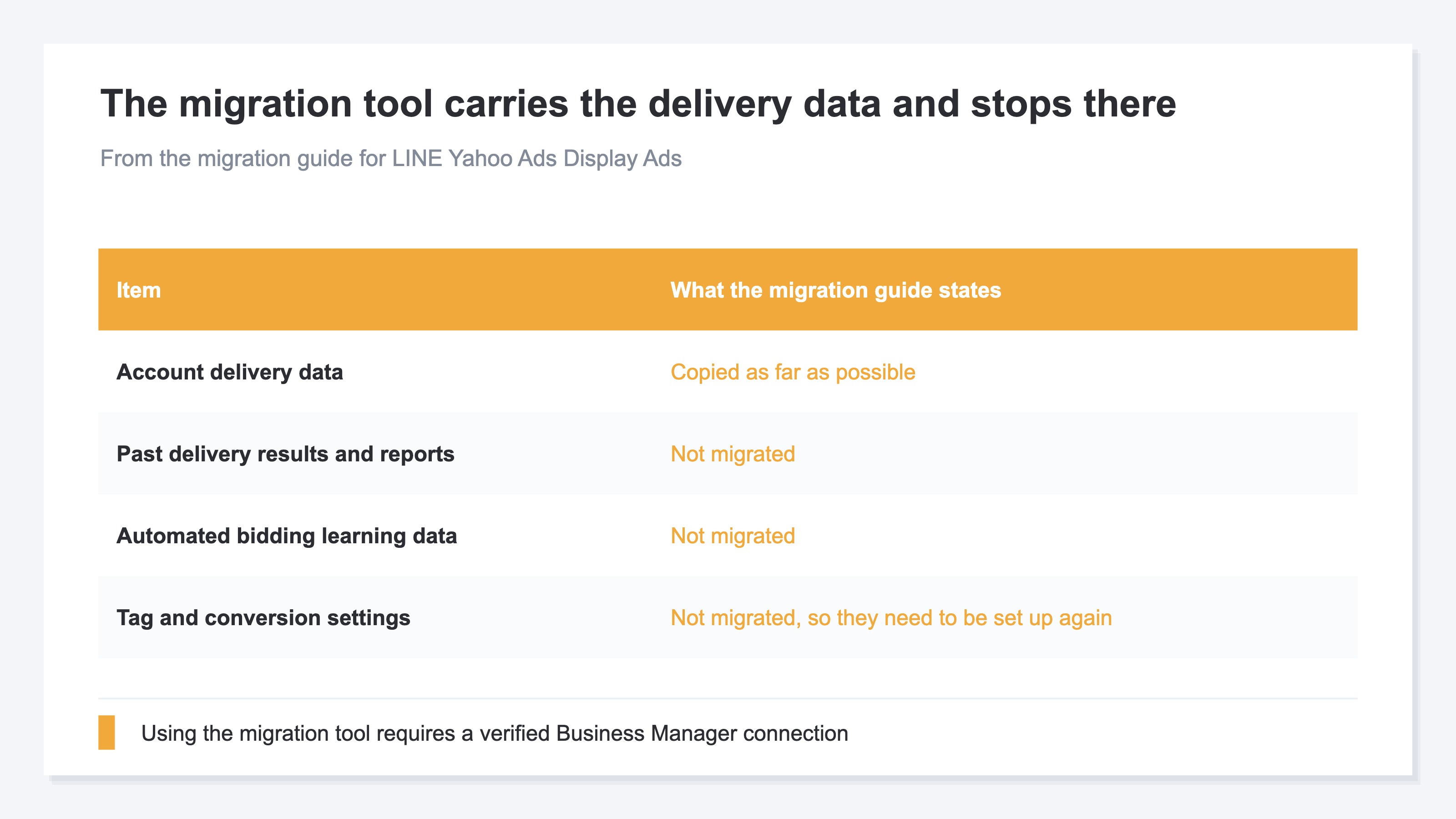
Past delivery results and reports, automated bidding learning data, and tag and conversion settings are not migrated
-
What compares before and after on the same basis is revenue measured on the site
With sessions and revenue measured on the site, the yardstick holds even when the ad console changes
1. What Stops in Late October Is Delivery for Accounts That Did Not Migrate#
The deadline and the name of the destination are both stated in the official schedule.
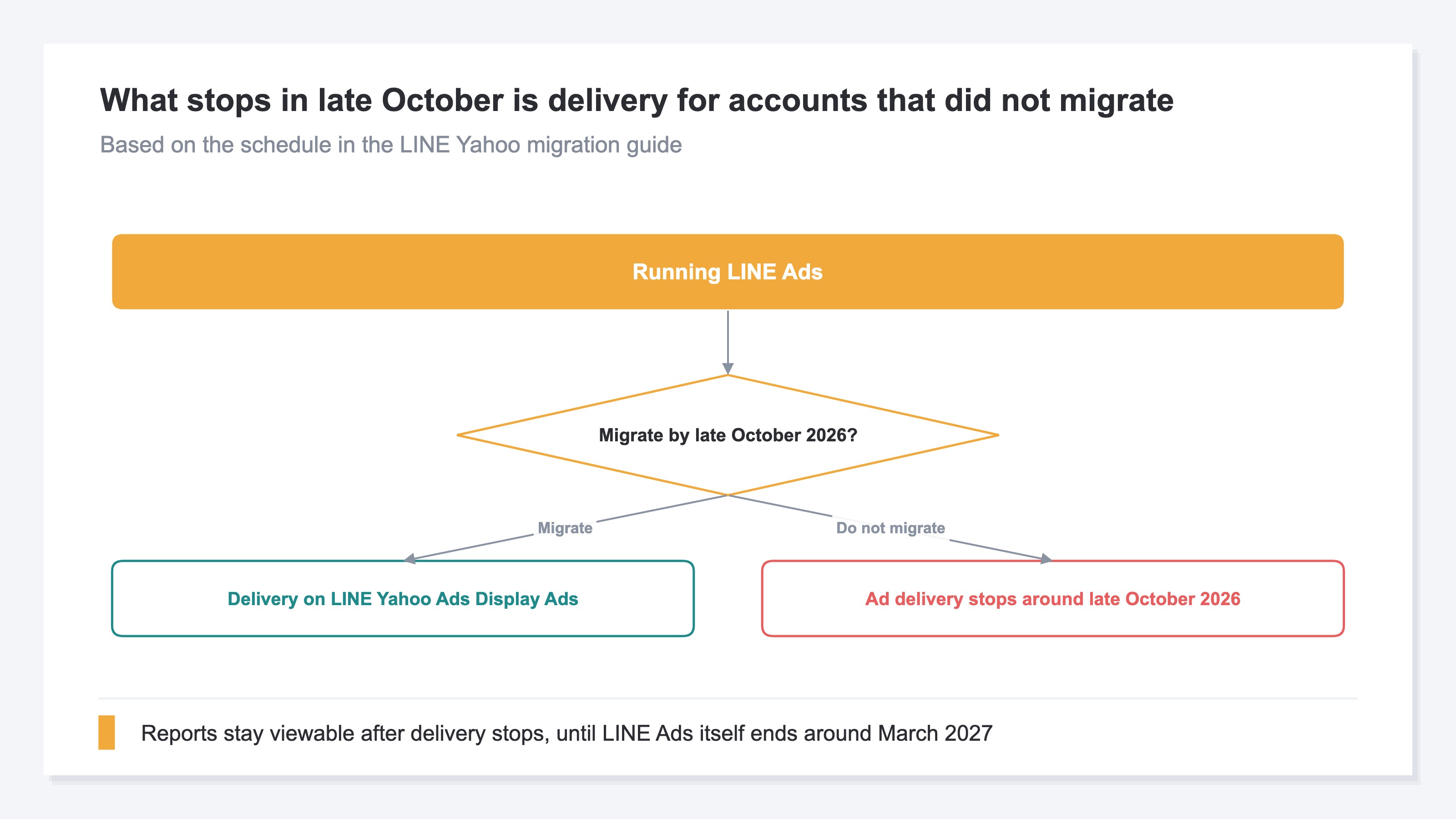
The official notice reads: "LINE Ads will stop delivering ads around late October 2026 and will then be phased out"[1]. It continues by asking advertisers to consider migrating to LINE Yahoo Ads Display Ads[1].
The part that is easy to misread is that the name given here is not Yahoo! Ads. According to the migration guide, LINE Ads and Yahoo! Ads Display Ads were merged in April 2026 and are offered as LINE Yahoo Ads Display Ads[3]. The destination is that merged service, not a move to a service named Yahoo! Ads.
The schedule comes in stages. April 2026 through late October is the migration window, and LINE Ads delivery can continue throughout it[3]. Late October is the planned date for delivery to stop, with a note that reports remain viewable after that[3]. Around the end of March 2027 is the planned end of LINE Ads itself, where the guide adds that reports can no longer be checked[3]. A caveat that the dates are subject to change sits in the same place[3].
Some functions end before delivery does. Creation of new campaigns, ad groups and ads is set out on the outline schedule for early to mid October 2026[2]. The migration does not proceed on its own either: "Migration from LINE Ads is not carried out automatically"[3].
The search ads change under the same brand covers something else#
On search ads, automatic creation of ad display assets begins in September 2026. That change is covered in LINE Yahoo Ads turns automated assets on in September. That one is about ad destinations multiplying, and it covers a different service.
The migration steps themselves are fine to follow as the official guide and tool describe them. Nothing is missing from the work itself. What ends up reversed is the order of the two. Try to check "how does this compare with before the migration" once the migration is done, and the ground for the comparison has already gone. Building that ground belongs before the migration, not after.
2. The Migration Tool Carries the Delivery Data and Stops There#
What the tool copies is delivery data; past results and reports are outside its scope.
The migration guide describes the tool as a function that copies LINE Ads delivery data to LINE Yahoo Ads Display Ads as far as possible[3]. Its condition is stated too: a verified Business Manager connection is required[3].
What does not carry over is itemised in the guide. "Past delivery results and reports are not migrated. Accordingly, learning data such as automated bidding is not migrated either"[3]. Measurement is the same: tag and conversion settings are not migrated and have to be set up again[3].
Learning data not carrying over shows up in how the account starts. The guide notes that LINE Yahoo Ads Display Ads optimises on accumulated delivery results and audiences, and on that basis recommends migrating early[3]. Accumulation is the starting point of the mechanism, and that accumulation begins from zero after the migration.
Initiatives under the LINE brand still belong to separate services#
Message delivery on a LINE Official Account is a separate service with its own pricing revision, covered in LINE add-on messages get revised in October. The notices land in the same period, but whether a migration is required is decided separately.
3. The Yardstick That Survives the Migration Sits on the Site#
Comparing before and after on the same basis means putting the point of measurement outside the ad console.
What gets checked after a migration is usually the same question. Did revenue efficiency from ads improve compared with before, or fall? Answering it takes values measured on the same definition on both sides of the migration.
The ad console does not suit that use. Past delivery results and reports do not travel to the destination[3], and the reports at the origin remain viewable only until the planned end of LINE Ads around March 2027[3]. Build the comparison on the platform side and the window available for reference carries an expiry.
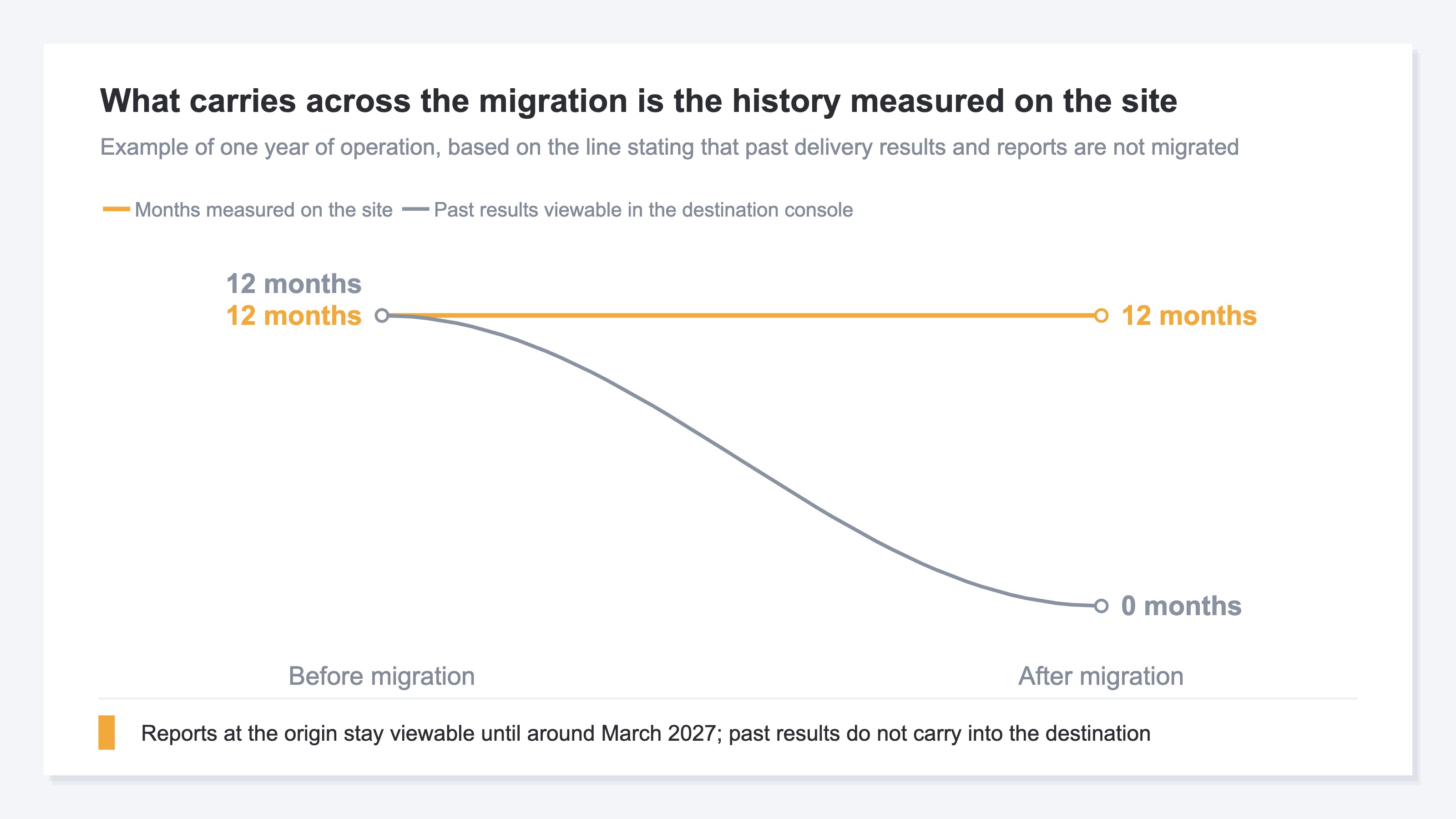
Measured on the site, no such expiry applies. Sessions and revenue occur on the site, and whichever ad console is in use, where they are recorded does not change. Revenue divided by sessions, RPS (revenue per session), holds the same definition even when the ad console is replaced. The same line runs through LINE Official Accounts, where the console reaches as far as the click, covered in what a LINE Official Account can show about revenue.
Doing it by hand means rebuilding the pre-migration period#
By hand, the reports come out of the LINE Ads console for the period before the migration, and out of the new console at the same granularity for the period after. Conversion settings there are the ones re-created after the migration[3], so the two cannot be put side by side as they are. Aligning definitions and labels comes first. And the pre-migration results have to be collected after delivery has already stopped.
Placed on the same screen, conversions counted by the platform (a count on the platform's own basis) and revenue counted by the site (the value of purchases that occurred on the site) are different units. Unless the units of the numerator and the denominator are settled first, the division carries no meaning. Summing ROAS across platforms drifts from reality for the same reason, covered in summed platform ROAS overstates.
RevenueScope solution
RevenueScope aggregates sessions and revenue measured on the site and displays them by channel. LINE Ads is one of the classified ad platforms, and the click ID ldtag_cl on the landing URL is captured automatically along with UTM parameters, which is also used for channel classification when no UTM is present. Classification looks only at the UTM parameters, click IDs and referrer the tag received, so a click carrying none of them is classified as Direct or Referral. Whether ldtag_cl continues under the same name after the migration cannot be confirmed from public information, so add UTM parameters after migrating and check how the breakdown falls.
Ad spend is registered through a form by year, month and channel, or as a CSV upload. Fourteen channels can be entered, LINE Ads among them. For periods with spend registered, ROAS by channel (RS-measured revenue divided by ad spend) can be compared on the same screen as revenue; for periods without it, ROAS is not shown. Comparing revenue efficiency alone needs no spend at all, since RPS is calculated from sessions and revenue on the site.
Asking an AI assistant through the RS MCP returns this#
Asked for revenue efficiency by channel, it returns the following.
| Channel | Sessions | Revenue | RPS |
|---|---|---|---|
| Google Search | 9,800 | ¥1,764,000 | ¥180 |
| Google Ads | 5,400 | ¥1,296,000 | ¥240 |
| LINE | 3,200 | ¥409,000 | ¥128 |
| 1,500 | ¥195,000 | ¥130 |
This LINE migration channel example is illustrative. A fictional site with sample data, modelled on a cosmetics store. The sample store runs on live data, so the figures on the actual screen differ.
By channel, the return reaches as far as RPS. Order value and purchase rate join once a channel is expanded to campaign level (utm_campaign). Expanding LINE returns the following.
| Campaign | Sessions | Revenue | RPS | Order value | Purchase rate |
|---|---|---|---|---|---|
| Awareness for new customers | 2,000 | ¥256,000 | ¥128 | ¥16,000 | 0.8% |
| Return visits from existing customers | 1,200 | ¥153,000 | ¥128 | ¥5,100 | 2.5% |
This campaign-level LINE comparison is illustrative. The campaign-level breakdown for the same fictional site.
The new-customer campaign runs a 0.8% purchase rate at an order value of ¥16,000, the existing-customer one a 2.5% rate at ¥5,100 — opposite in how purchases arise and in what each is worth. Multiplied out, both land at ¥128 RPS, so two campaigns whose levers point opposite ways read as the same efficiency. Learning data is what does not carry over on the automated bidding side[3], so the value to check first after the migration is the purchase rate.
FAQ#
Frequently asked questions#
Q. If we do not migrate, can we no longer advertise on LINE?
A. What stops is delivery from LINE Ads. The migration guide gives late October 2026 as the planned date for LINE Ads delivery to stop[3]. Pass that date without completing the migration and delivery from LINE Ads stops. On the destination, the official notice describes LINE Yahoo Ads Display Ads as a display advertising service that builds on the delivery platform previously offered as Yahoo! Ads Display Ads and can deliver ads to placements on LINE and Yahoo! JAPAN from a single integrated ad platform[1]. That is a description of the service, not a promise that any individual ad will be delivered the way it was before.
Q. Does the migration tool bring past reports across?
A. The migration tool does not carry those historical reports across. The guide states that past delivery results and reports are not migrated, and that learning data such as automated bidding is not migrated either[3]. Reports at the origin remain viewable after delivery stops, and stop being available at the planned end of LINE Ads around March 2027[3].
Q. How do we check whether ad efficiency improved across the migration?
A. Built on the ad console alone, the pre-migration period carries an expiry. With sessions and revenue measured on the site, RPS holds the same definition on both sides of the migration. Spotting a channel where spend rises without revenue following is covered in where ad spend leaks.
Summary#
LINE Ads plans to stop delivering ads around late October 2026, and the official notice points to LINE Yahoo Ads Display Ads as the destination[1]. The migration tool carries the delivery data and stops there: past delivery results and reports, automated bidding learning data, and tag and conversion settings are not migrated[3].
The material for comparing before and after on the same basis does not carry into the destination console. With sessions and revenue that occurred on the site measured on the site, RPS holds the same definition even when the console is replaced. Starting that measurement belongs before the migration work, not after.
See which ads actually drive revenue, at a glance
Free up to 2,000 sessions/month, AI connection included. No credit card required. Up and running in 5 minutes.
References#
- [1] LINE Yahoo for Business "About the LINE Yahoo Ads platform integration release" (2026)
- [2] LINE Yahoo for Business "LINE Ads: confirmed end date for billing changes and the end of new campaign creation" (2026)
- [3] LINE Yahoo for Business "For LINE Ads users: migration guide to LINE Yahoo Ads Display Ads" (2026)