Benefit is the concrete change a customer gets from buying a product. In ecommerce marketing, teams often confuse it with features and merits, but benefit design connects directly to revenue. This article maps the 3 benefit types that work in ecommerce, gives 4 industry benchmarks (apparel, food, cosmetics, electronics), lists 5 tactics to convert benefits into sales, and lays out a 3-step UTM-based measurement plan you can run on your own store.
Table of contents
In this article#
-
Benefit = the concrete change a customer gets
It is not the feature (product spec) and not the merit (objective advantage). It is the change in the customer's experience.
-
Three benefit types drive ecommerce sales
Functional benefit, emotional benefit, and self-actualization benefit. Each one carries the customer's purchase motive differently.
-
The right type depends on the industry
Apparel = emotional + self-actualization. Food = functional + safety. Cosmetics = self-actualization. Electronics = functional + cost.
-
Convert benefits to revenue with 5 tactics, measure with UTM separation
Rewrite head copy, product descriptions, cart, ads, and email. Split UTM by benefit and measure RPS for 4 weeks.
1. Benefit vs Merit vs Feature — and the 3 types that work in ecommerce#
Bottom line: Benefit is the concrete change a customer experiences after buying. It is different from features (product spec) and merits (objective advantage). In ecommerce, design your messaging around 3 types: functional, emotional, and self-actualization.
The three concepts get mixed up often. The subject of the sentence and the effect on the customer are different.
| Concept | Definition | Product page example | Copy example | CVR impact | Caveat |
|---|---|---|---|---|---|
| Feature | Product spec | 5,000mAh battery | "Large battery" | Weak (subject = product) | Loses in spec wars |
| Merit | Objective advantage | Lasts 2 days on one charge | "2 days of charge" | Medium (subject = performance) | Hard to differentiate |
| Benefit | Customer's change | Never hunt for a charger on a trip | "Travel without charger anxiety" | Strong (subject = customer) | Pick the wrong type and it falls flat |
Nielsen Norman Group research [1] reports several cases where rewriting product-page head copy from feature-style to benefit-style copy lifted CVR by 10-25%.
Benefits split into 3 types, which makes them easier to design.
- Functional benefit: Convenient, cheap, fast, accurate (example: same-day delivery means no waiting)
- Emotional benefit: Safe, fun, comfortable (example: free returns mean no fear of failure)
- Self-actualization benefit: The self you want to be, the group you want to belong to (example: "I want to be the kind of person who uses this brand")
The choice among the 3 types depends on the customer's emotional intensity and price sensitivity. The chart below maps 4 benefit types (the 3 above plus a price axis) on a 2×2 quadrant for ecommerce.
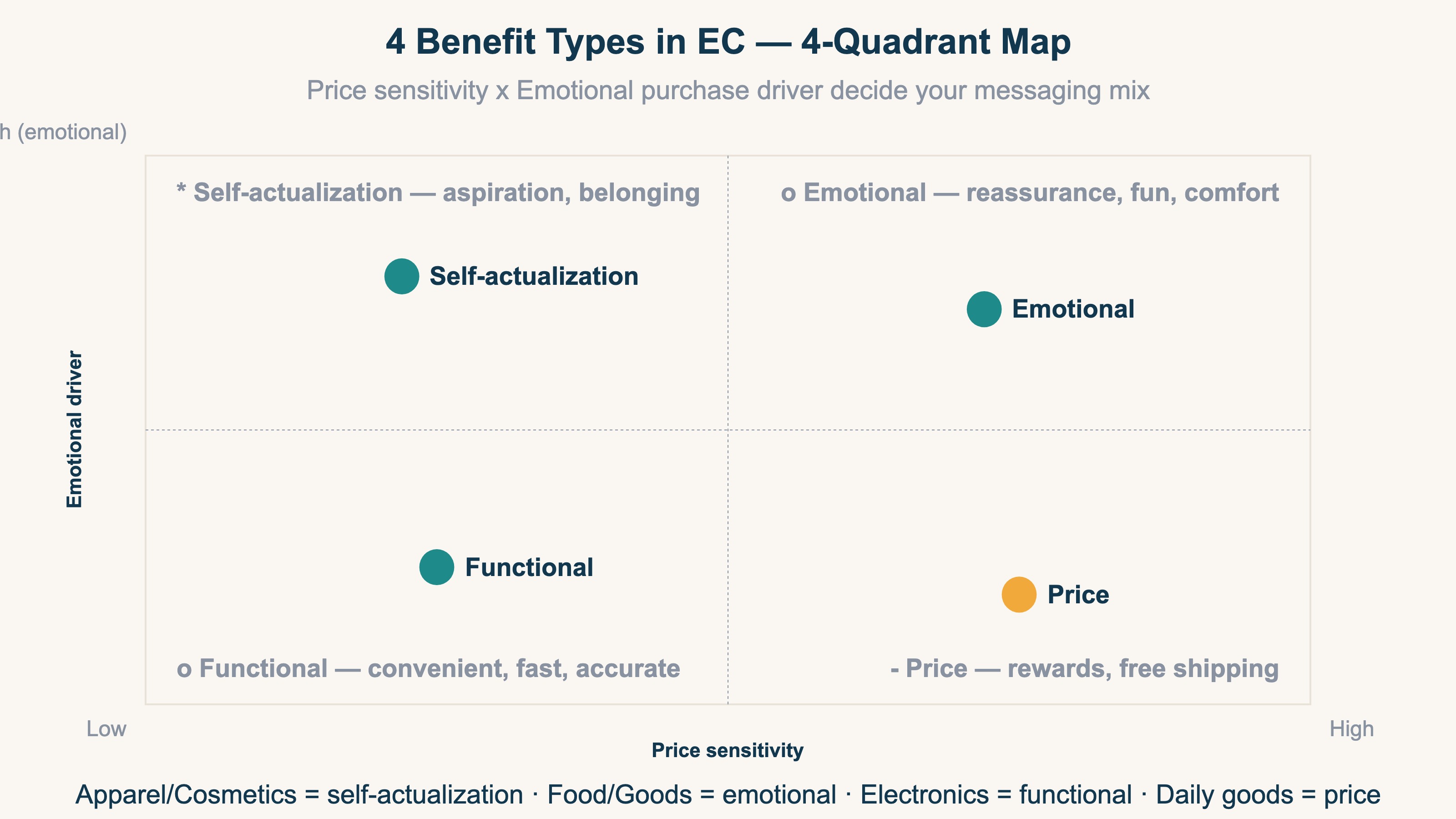
Emotion-driven customers who are not price-sensitive (apparel, cosmetics) respond to self-actualization benefits. Price-sensitive customers buying for function (daily goods, consumables) respond to price plus functional benefits.
2. Industry benchmarks — apparel, food, cosmetics, electronics#
Bottom line: The benefit type that works varies by industry. Apparel = emotional + self-actualization. Food = functional + safety. Cosmetics = self-actualization. Electronics = functional + cost. Industry sets the direction for your benefit design.
Average CVR, average AOV (Average Order Value), and repeat rate differ widely by industry. We organized 4 industries using Statista and Japan METI 2024 surveys [2][3].
| Industry | Avg CVR | Avg AOV (JPY) | Repeat rate | Effective benefit types |
|---|---|---|---|---|
| Apparel | 2.1% | 8,500 | 35% | Emotional + self-actualization ("the self I want to be") |
| Food | 3.8% | 5,200 | 60% | Functional + safety ("subscription, never forget to reorder") |
| Cosmetics | 2.5% | 6,800 | 55% | Self-actualization ("skin transformation experience") |
| Electronics | 1.6% | 22,000 | 18% | Functional + cost ("long warranty for peace of mind") |
The reason effective types differ by industry is the purchase motive. Apparel and cosmetics are extensions of self-expression, so self-actualization benefits hit hard. Food is closer to life infrastructure, so functional benefits and safety lead. Electronics carry a high unit price and low repeat rate, so feature comparison and warranty secure the "no-fail choice."
Japan METI's 2024 EC market survey [3] reports the annual ecommerce volume for the 4 industries. Apparel ecommerce reached around JPY 2.6 trillion, food ecommerce around JPY 3.1 trillion. Cosmetics ecommerce reached around JPY 840 billion, electronics ecommerce around JPY 2.7 trillion.
Market size matters less than choosing the benefit type that matches your industry's purchase motive.
If your store spans multiple industries (for example, apparel that also runs price campaigns), split the benefit type by product category. Mixing "function-led products" and "emotion-led products" on the same site is fine. Forcing uniformity will cost you conversion opportunities.
If you want to compare your own data with industry benchmarks, the CVR Improvement 30-Item Checklist covers a diagnostic flow.
3. Five tactics to convert benefits into sales#
Bottom line: To turn benefit design into revenue, rewrite 5 places. Head copy, product description, cart, ad creative, and email — switch from feature-led to benefit-led copy in each.
| Tactic | Where to rewrite | Effective benefit type | CVR / AOV impact | Related article |
|---|---|---|---|---|
| 1 | Head copy (H1) | Self-actualization / emotional | CVR +10-20% | CVR Improvement 30-Item Checklist |
| 2 | Product description + bundles | Functional / safety | AOV +5-15% | AOV Customer Unit Price Guide |
| 3 | Cart screen (shipping, delivery, returns) | Safety | Cart abandonment -10-25% | AOV Uplift Risks and Defense |
| 4 | Ad creative (per channel) | Channel-specific | RPS +20-40% | RPS Revenue Per Session Guide |
| 5 | Email / LINE (repeat) | Self-actualization | LTV +10-30% | ROAS Complete Guide |
Among the 5 tactics, rewrite the head copy first. Baymard Institute [4] reports cases where rewriting the copy in the top 100px of the product page from feature-style to benefit-style cut page exit rate by 6-15%. The top 100px is the Above the Fold zone — the area visible without scrolling.
In tactic 2, switching from single-item messaging to bundle messaging moves AOV. The subject shifts from "the person who buys this product" to "the person whose life changes with this combination."
Tactic 3 is the cart screen, the concentration point of safety benefits. Just stating shipping, delivery date, and return policy clearly on the screen reduces cart abandonment.
Tactic 4 is ad creative. The effective benefit type varies by channel. Search ads respond to functional copy, social ads respond to emotional copy. Compare per-channel efficiency with RPS (Revenue Per Session) and the misalignment in benefit type shows up in the numbers.
Tactic 5 is email, which reinforces the self-actualization benefit after purchase. Content that strengthens "the self who chose this brand" moves repeat rate.
4. A 3-step self-measurement plan with the RS dashboard#
Bottom line: Measure benefit-tactic impact with UTM separation. Tag your LP with utm_content=benefit and utm_content=feature. Compare per-channel RPS for 4 weeks in the RS dashboard.
Step 1 is to prepare 2 LP variants by message style and split the UTM. Add utm_content=benefit and utm_content=feature to your paid-traffic landing URLs. The first is the benefit-led version, the second is the feature-led version.
| Step | What to do | Metric in RS dashboard |
|---|---|---|
| 1 | Prepare 2 LP variants and split UTM | (no measurement yet) |
| 2 | Compare per-channel RPS over 4 weeks | Per-channel RPS (Revenue Per Session) |
| 3 | Watch AOV and CVR as 4-week trends | Weekly AOV / CVR trend |
In step 2, compare 4 weeks of per-channel RPS. If the RPS gap between the two utm_content values is 1.5× or more, benefit-led messaging is working. If the gap stays under 1.2×, the benefit type may not match your industry.
In step 3, watch AOV and CVR on separate axes. If CVR rises but AOV falls, you are leaning too hard on functional benefit and single-item purchases are dominating. If AOV rises but CVR falls, the self-actualization benefit is hitting only a small segment.
The RS dashboard shows per-channel RPS and the AOV / CVR 4-week trend side by side on one screen. Benefit-type judgment is a place where you should rely on numbers, not on feel.
After the judgment, the operation is simple. Standardize the remaining 5 tactics (H2-3 above) around the benefit type that works. If multiple types perform similarly, you can also split the type per tactic.
FAQ#
Q1. What is the difference between benefit and merit?
Merit is the objective advantage of the product (example: lasts 2 days on one charge). Benefit is the concrete change that brings to the customer (example: never worry about charging on a trip). The distinction is whether the subject is the product or the customer.
Q2. Which of the 3 benefit types should I start with?
It depends on the industry. Apparel and cosmetics start with self-actualization. Food starts with functional + safety. Electronics start with functional + cost. If several types apply, prioritize the area where your current CVR is below the industry average.
Q3. How long should the UTM separation test run before I can judge?
At least 4 weeks. An RPS gap of 1.5× or more is "working." A gap under 1.2× means "type mismatch." If sample size is small (under 100 sessions per week), extend to 6 weeks.
RevenueScope solution
Bottom line: RevenueScope is for measuring, after the fact, whether the benefits (perks, campaigns) you designed actually moved revenue. It lines up AOV, CVR, and RPS (revenue per session) per initiative and drills down by campaign, so you can compare how a discount shifted average order value and efficiency — on a revenue-first basis.
It outputs revenue, sessions, RPS, AOV, and CVR — not gross margin, LTV, or inventory. It complements GA4 rather than replacing it, and connects read-only. You can try the per-initiative view first on the demo site (a sample-data fictional store).
See which ads actually drive revenue, at a glance
Free up to 5,000 sessions/month, AI connection included. No credit card required. Up and running in 5 minutes.
References#
- Nielsen Norman Group Minimize Design Risk by Focusing on Outcomes not Features 2024
- Statista Ecommerce conversion rate by industry 2024
- Japan METI EC Market Survey FY2023 September 2024
- Baymard Institute Product Page UX Research 2024
- Shopify Ecommerce statistics 2024 2024