Pre-order transactions had expired before they could be captured. You were told this starts in October, and yet it has already begun. The cause is that the date on which the window for turning a card authorization into a capture shrinks to 25 days differs from one payment provider to the next. This article lays out how to tell whether a site is in scope, and why orders that pass the deadline stay in the revenue analytics reports.
Contents
TL;DR#
- The date on which the window for turning an authorization into a capture shrinks to 25 days differs by payment provider, and at GMO Payment Gateway it already switched over on July 23, 2026
- What begins in October is the automatic cancellation of expired authorizations. But the two dates are different in kind: GMO Payment Gateway's October 2 is the day the cancellation processing itself starts, while futureshop's F-REGI October 6 is the cutoff date for orders the 25-day rule applies to. On F-REGI the first automatic cancellations appear from the end of October onward
- What decides whether a store is in scope is neither the cart nor the payment provider but the capture mode setting in the admin. In capture-at-order mode there is no direct effect
- Cancellation by the payment provider alone does not update measured revenue. GA4 can measure separately reported refunds; RevenueScope does not automatically subtract cancellations. Check unpaid orders before allocating budget by channel.
1. The Start Date Differs by Payment Provider#
If you use GMO Payment Gateway's PG Multi-Payment Service, the understanding that "this is an October story" stopped holding as of July 23, 2026. From that day the window in which a capture can still be made got shorter. Authorizations established up to July 22 — an authorization being the stage where credit has been reserved with the card issuer, with the capture that finalizes the charge not yet done — keep the previous 60 days, while authorizations established on or after July 23 get 25 days[1]. The count treats the day of the authorization itself as day 0[1].
How transactions past the deadline get handled starts moving only once October arrives. At GMO Payment Gateway that is October 2, 2026. Transactions authorized on or after September 6, 2026 are in scope, and from October 2 onward the cancellation runs daily on the 26th day, once 25 days have passed. Transactions established up to September 5 are not subject to the cancellation even if they run past the deadline[1].
futureshop's F-REGI runs on yet another date. The 25-day rule applies to authorized orders received on or after October 6, 2026, and if the capture is not made within 25 days of the order date (the date the authorization was obtained), F-REGI cancels the authorization automatically on its side. Authorized transactions that arose before October 6 stay on the 60-day rule, and for those F-REGI does not run an automatic cancellation even past the period, so the store cancels them itself where needed[2].
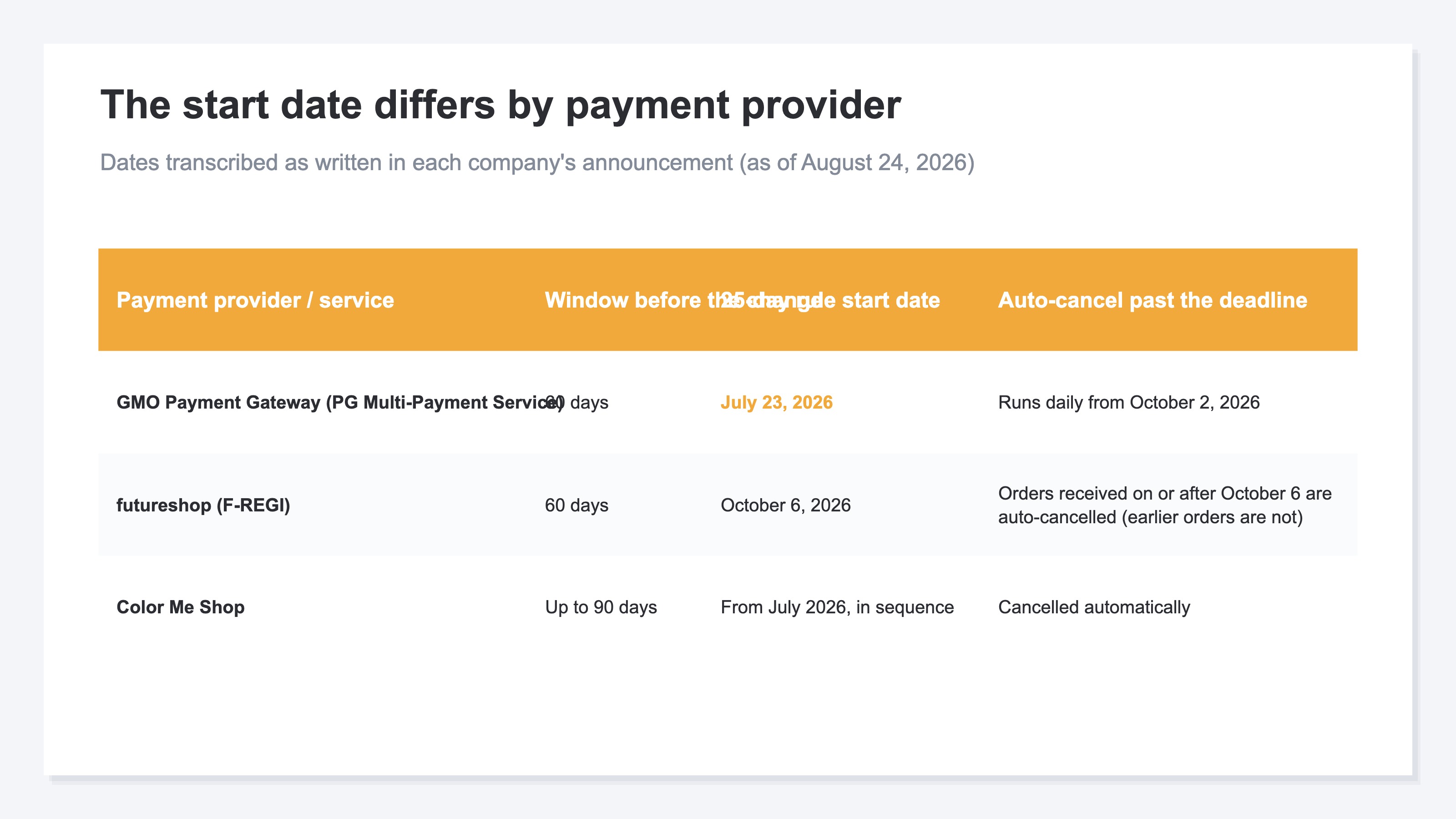
Color Me Shop's announcement writes the original period differently. It says the valid period of an authorization is being shortened from up to 90 days to 25 days, and that the change applies from July 2026 onward, in sequence by payment service[3]. If you read it as 60 days becoming 25 and built your schedule on that, the reduction is larger than you assumed, and that many more orders end up caught by the deadline.
Check the shortening date separately from the automatic cancellation start date. At GMO Payment Gateway, the 25-day capture window applies to authorizations from July 23, before cancellation processing starts in October[1].
2. The Capture Mode Setting Decides Whether It Applies to You#
You run pre-orders, but you can't tell whether your own site is in scope. This is not decided by the type of cart, and not by the name of the payment provider. The dividing line is the capture mode selected in the admin.
Color Me Shop's announcement states explicitly that the ones affected are stores using "authorization-hold" mode. The two in scope are Color Me Payment (credit card payment) and Credit (PG Multi-Payment). ZEUS, SMBC GMO PAYMENT, SG System and the like provide capture-at-order only, so there is no direct effect. Whether a store is in authorization-hold mode can be checked in the capture mode setting in the admin[3].
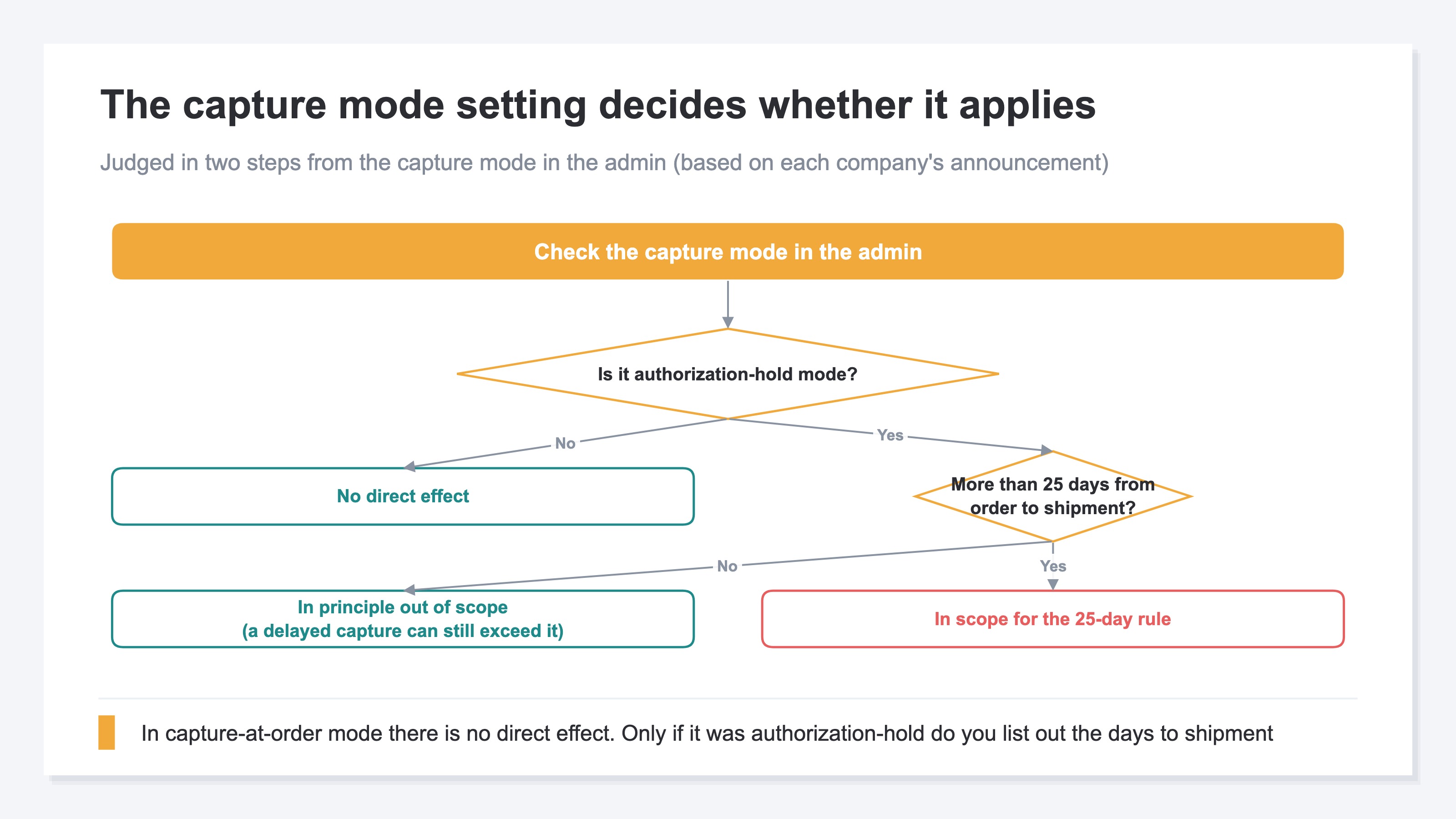
In capture-at-order mode, it ends here. If the setting was authorization-hold, the next step is to list out the days between order and shipment. futureshop names pre-orders, made-to-order production and special orders — anything that takes 25 days or more from order to shipment — as the operations most affected[2].
But fast shipping does not automatically make a store safe. The same announcement says that even a product whose shipment completes within a few days can fall in scope. If the capture processing after shipment is delayed, it can in some cases exceed 25 days and become subject to authorization cancellation[2]. Operations that batch their capture processing on a closing date land right here. Where in the admin to check revenue is covered in Color Me Shop's access analytics. What this article looks at is the capture mode setting that sits one step before that.
It is worth checking what can be done after the deadline has passed, too. With F-REGI, from October 6, 2026 the authorization can be taken again manually from the admin. But depending on the state of the card, the re-authorization itself can fail. Depending on the card issuer, a transaction alert may be sent to the customer. A transaction that has been re-authorized falls outside 3D Secure's coverage, and depending on the contract a transaction fee is charged as well[2]. On the GMO Payment Gateway side too, the cancellation processing incurs a transaction processing fee[1].
Before the step of re-taking an authorization after it has lapsed, there is a move futureshop points to. It is the pre-order feature's "authorize later." At the time of purchase only the validity of the card is checked, and the authorization is obtained in line with the timing of shipment. Because it is taken close to shipment rather than at the moment of the order, the announcement explains, it is less exposed to the 25-day rule. It also says that if you handle products that take 25 days or more to ship, capturing within the deadline is difficult, so the feature is worth considering. Using it requires applying for F-REGI's "card number storage" feature, and the caveats are the same four as with re-authorization: the authorization failing, the transaction alert, falling outside 3D Secure's coverage, and the transaction fee[2].
The announcement does not specify the amount or transaction category used for the initial validity check[2]. Do not infer that the feature is exempt from the separate restriction on small authorization holds used only for card validation[1].
There is one more case where the deadline runs shorter than 25 days: cards issued outside Japan. The same announcement gives the capture deadline as within 5 days for Visa and within 2 days for Mastercard. Capturing after that period results not in the automatic cancellation that applies to domestically issued cards but potentially in a chargeback. JCB, AMEX and Diners cards issued outside Japan, however, get the same 25 days as domestic ones[2].
3. Expired Orders Stay in the Measured Revenue#
When GMO Payment Gateway runs the cancellation, the status of that transaction changes to "returned." If a capture is to be made after that, a re-authorization or a fresh payment is required[1]. On the payment side, a transaction drops out this way.
When a purchase event is sent at order completion, analytics can record revenue before payment is captured. Cancellation by a payment provider alone does not automatically update that revenue. GA4 can measure refunds when a refund event with the relevant transaction_id is sent[4]. RevenueScope receives purchase information from the dataLayer in the same page and does not automatically subtract cancellations or refunds.
The same structure was covered in GA4 revenue doesn't match the books. There the source is returns; here it is an expired authorization. Because the mechanism — the booking being fixed at the moment of the order — is the same, the shape of the disagreement with the accounting figures comes out the same. A different pattern, where the booking itself runs higher than the actual number of orders, is in GA4 purchase counts higher than orders.
Check expired orders in the payment provider or shopping cart admin. Acquisition reports alone do not establish which orders remain unpaid. A matching order number and transaction_id can support reconciliation, but RevenueScope does not automatically match payment status to orders.
RevenueScope solution
Revenue recorded at purchase can include orders that are later cancelled. Before allocating ad spend, check expired and unpaid orders in the payment system. Compare sessions and RPS by channel alongside the recorded revenue.
If cancellations reduce revenue by the same percentage in every channel, the RPS ranking stays the same. That condition is not guaranteed. RevenueScope displays channel revenue, sessions and Revenue Per Session (RPS), allowing comparisons over the same period.
Even when reading relatively, though, there are channels to take out of the judgment.
Fictional Store D's channel breakdown (illustrative)
| Channel | Sessions | Revenue | RPS |
|---|---|---|---|
| 10,000 | ¥1,500,000 | ¥150 | |
| Google Ads | 5,000 | ¥600,000 | ¥120 |
| 200 | ¥60,000 | ¥300 |
Note: what appears on the demo screen is the sample store's sample data, refreshed daily. The table above is separate from that — the figures were assembled to explain how a channel with a small denominator looks. Neither the channel names nor the amounts match.
Email has the highest RPS at ¥300, 2x Instagram's ¥150. Its ¥60,000 revenue comes from two ¥30,000 orders. If one remains unpaid, excluding it gives ¥30,000 divided by 200 sessions, or ¥150 per session. This is a manual recalculation; the displayed RPS in RevenueScope does not automatically change to ¥150.
For Email, one unpaid order halves the recalculated RPS. Check payment status in the store's records before acting on the channel ranking. Cancellation rates may differ by channel.
Confirm Email's payment status before allocating more ad spend. For Instagram and Google Ads, also check unpaid orders and advertising costs. A higher RPS alone is not sufficient to decide the budget; keep comparing the same metrics over consistent periods.
FAQ#
Frequently asked questions#
Q. I was told this starts in October, so why are expired orders already appearing?
A. Because the start date differs by payment provider. At GMO Payment Gateway's PG Multi-Payment Service, the window in which a capture can be made has been 25 days for authorizations established on or after July 23, 2026[1]. What begins on October 2 is the cancellation processing for transactions past the deadline[1].
Q. Where do I check whether a site is in scope?
A. In the capture mode setting in the admin. Color Me Shop's announcement states explicitly that the shops affected are the ones using "authorization-hold" mode. Where a payment service that provides capture-at-order only is in use, the announcement says there is no direct effect[3].
Q. If a product ships within a few days, is it unaffected?
A. Not necessarily. futureshop's announcement says that even a product that ships within a few days can become subject to authorization cancellation — when the capture processing after shipment is delayed past 25 days[2]. Operations that batch their capture processing on a closing date belong on the checking list.
Summary#
Check the payment provider and capture mode in the admin. For authorization-hold transactions, check the applicable deadline and the time from authorization to capture, including any delay after shipment. Follow the provider's instructions to reauthorize or retry payment if the deadline will be exceeded.
At GMO Payment Gateway, the window for capturing authorizations established on or after July 23, 2026 is already 25 days[1]. If the schedule was built on waiting for October, that assumption is the first thing to check.
See which ads actually drive revenue, at a glance
Free up to 2,000 sessions/month, AI connection included. No credit card required. Up and running in 5 minutes.
References#
- [1] GMO Payment Gateway "[Spec] Changes to transaction specifications accompanying the credit card brand rule change (capture deadline change and others)" (2026)
- [2] futureshop "[Important: to shops using F-REGI] Changes to credit card payment specifications accompanying the Visa and Mastercard brand rule change" (2026)
- [3] Color Me Shop "[Important] Changes to credit card payment specifications accompanying the VISA and Mastercard rule change (updated 7/14)" (2026)
- [4] Google "Measure ecommerce" (2026)