
You run a cancellation from the admin, an error comes back, and the order will not cancel. How to proceed with the refund is unclear. From September 14, 2026, GMO Epsilon applies stricter judgment on cancellation processing. Where the card issuer does not accept it, an error is returned and the cancellation processing is not carried out. What to do next splits in two by the state of the payment.
Contents
TL;DR#
- GMO Epsilon applies stricter judgment on cancellation processing from September 14, 2026; where the card issuer does not accept it, an error is returned and the cancellation processing is not carried out
- An order that errors while in the "authorization hold" state stays an authorization hold even past 25 days, so the handling is to wait until the credit reservation is released automatically
- An order that errors while in the "captured" state cannot be refunded on the card, so the amount is returned individually by bank transfer or another method
- The cause of the error is not disclosed because it touches personal credit information, and GMO Epsilon states that it cannot look the reason up either
- An amount returned by bank transfer stays out of both the payment provider's records and the analytics, so allocation decisions continue on revenue and RPS by channel
1. Cancellation Stops Being an Operation That Always Goes Through#
A cancellation that used to go through regardless of the card issuer's judgment is, after the change, not carried out when an error comes back.
The assumption that "running a cancellation cancels it" is correct for GMO Epsilon before September 14, 2026 and incorrect after it. The meaning of the same operation swaps depending on which payment provider the store contracts with and on which point in time is being discussed.
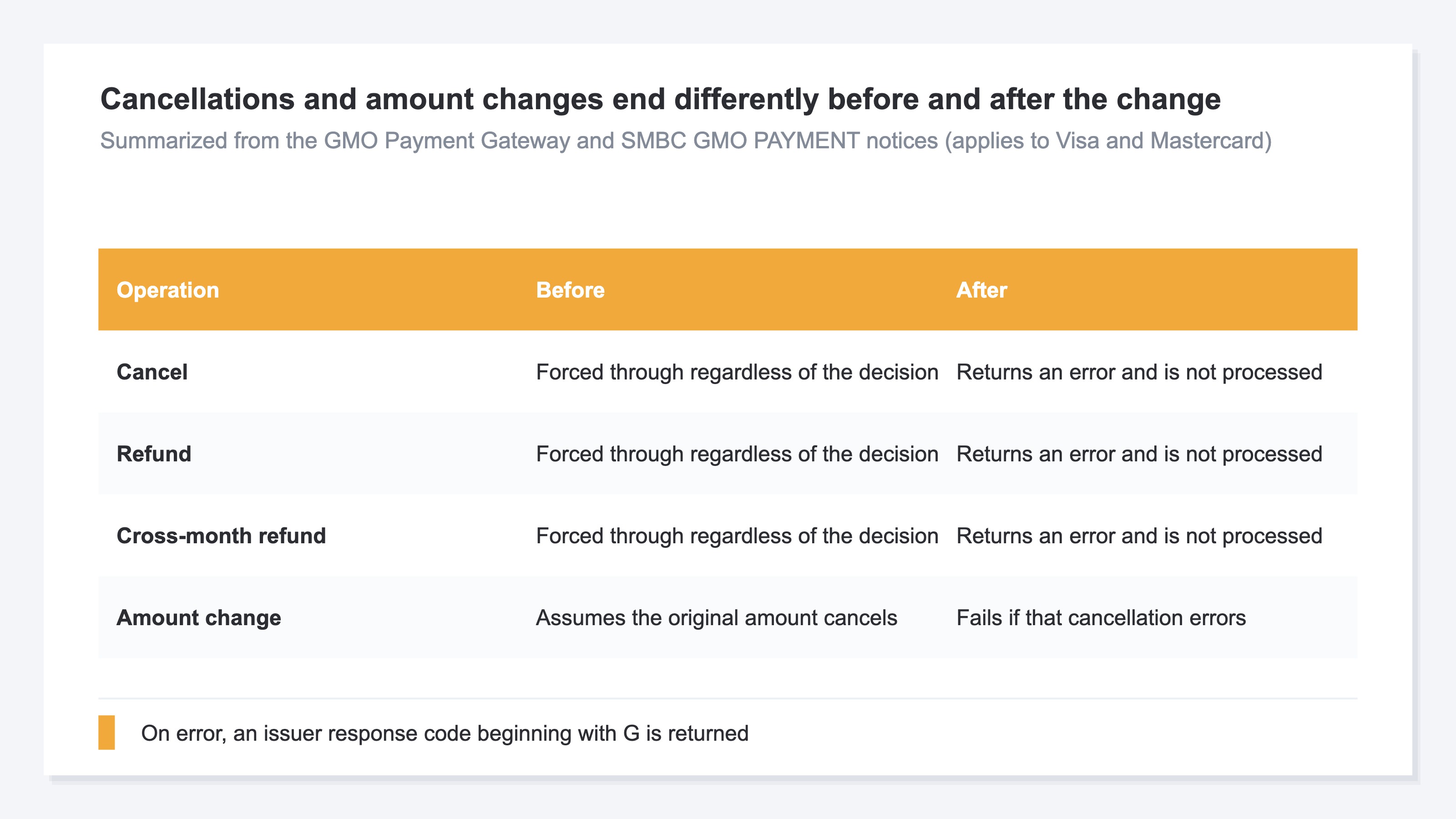
GMO Epsilon's notice states that stricter judgment on cancellation processing applies from Monday, September 14, 2026. Where the card issuer does not accept the cancellation, an error is returned and the cancellation processing is not carried out [1].
Zeus describes the previous specification this way. Before the change, cancellation processing was forced through regardless of the card issuer's judgment result, so a cancellation failure did not occur. After the change, where the card issuer's judgment returns an error, the cancellation processing does not run and a cancellation failure occurs [5].
The GMO Payment Gateway and SMBC GMO PAYMENT notices write the scope more narrowly. Both state that only the Visa and Mastercard brands are in scope, and that on an error a card issuer error code beginning with G is returned [2][4]. A separate notice gives G12 and G97 as examples [3]. GMO Epsilon's notice, for its part, does not state which brands are in scope.
Even where it looks as though an amount change is what fails, the side that failed is the cancellation. According to GMO Epsilon, amount change processing works by running a cancellation against the amount before the change. It can therefore error for the same reason, and where it does, the amount change processing is not carried out either [1]. The change to how the amount posted as revenue is decided is covered in SBPS ends partial refunds on September 30.
Two cases are given as producing an error: where the card issuer does not approve it, and where the card issuer or the brand does not approve it on a security judgment [1][3]. On the first, GMO Epsilon gives unpaid card balances and cards that have already been cancelled as examples, while GMO Payment Gateway states unpaid card balances and the like [1][3]. No notice states conditions beyond that.
2. What to Do After an Error Splits by the State of the Payment#
For the same cancellation error, the steps to take differ depending on whether the payment is in the "authorization hold" state or the "captured" state.
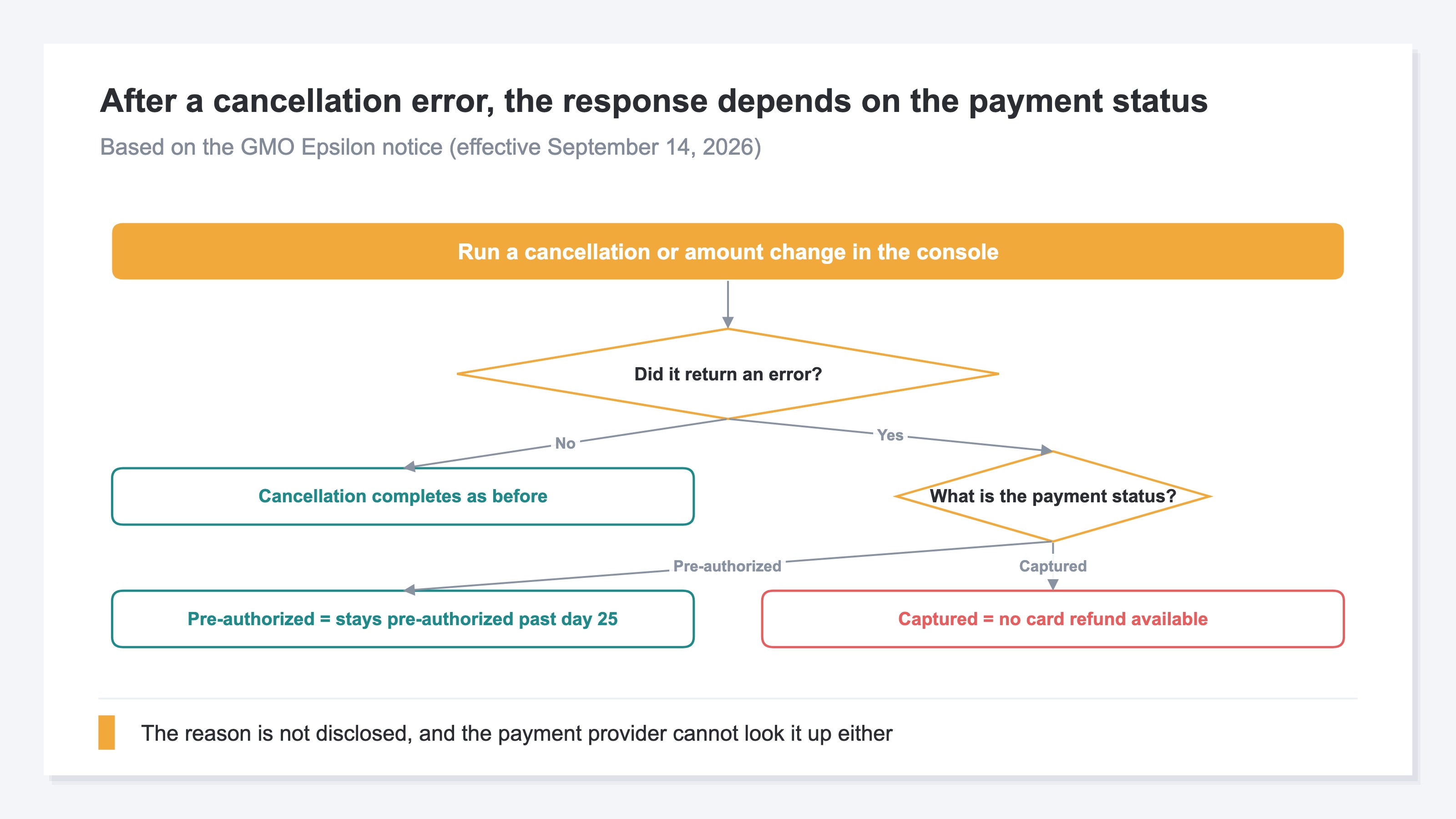
Where the state is "authorization hold," GMO Epsilon states that on a cancellation error the state remains "authorization hold" even past the 25-day window in which a capture can be made [1]. While it stays an authorization hold the charge to the buyer is never confirmed, so the handling is to wait until the credit reservation is released automatically [1].
The assumption that a state changes once a deadline passes does not hold here. The change cutting the window in which a capture can be made from 60 days to 25, and how transactions past the deadline are treated, are covered in the 25-day card authorization rule has already started. That article is about the deadline itself; this one is a separate change with a separate start date and separate content.
Where the state is "captured," the handling moves outside the payment provider. On a cancellation error, a refund on the credit card cannot be processed. Both GMO Epsilon and GMO Payment Gateway state that the amount is to be refunded individually by bank transfer or another method [1][3].
Trying to confirm the reason does not get you there either. Both companies state that the specific cause of the error is not disclosed, because it is content that touches personal credit information [1][3]. GMO Epsilon adds that the reason is not disclosed to it by the card issuer and that it cannot look it up either. Where a store wants it confirmed, the guidance is to have the cardholder contact the card issuer directly [1].
In other words, there is no way to narrow down in advance which orders will error. The order in which to prepare the steps is decided from the refund route, not from identifying the cause.
3. What to Prepare Is Not the Date but the Refund Flow#
The start dates sit roughly two weeks apart from one payment provider to the next. Rather than waiting on a date, preparing the refund steps in two branches is the surer move.
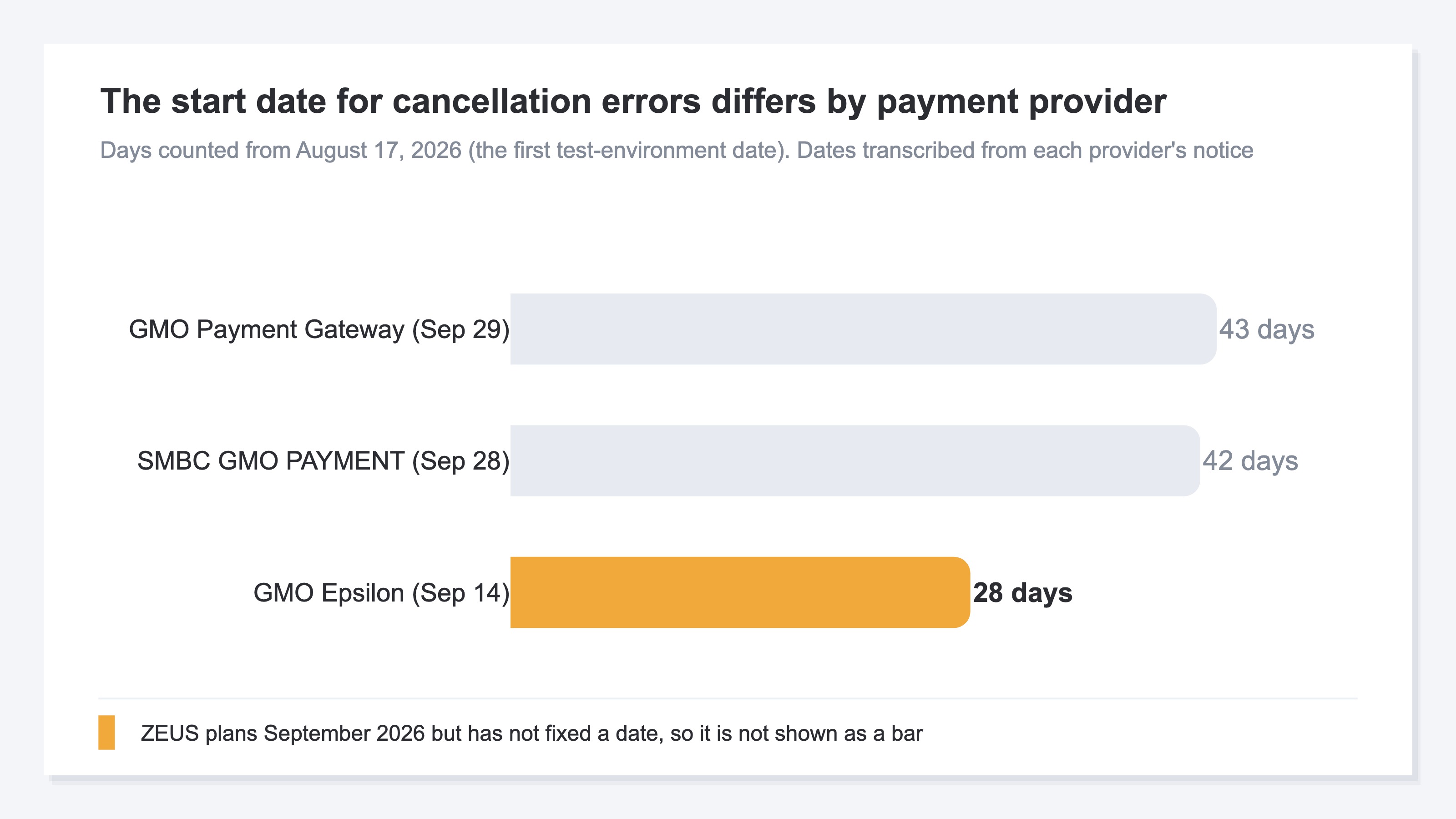
The earliest is GMO Epsilon, on Monday, September 14, 2026 [1]. For the production environment, SMBC GMO PAYMENT is Monday, September 28, 2026 and GMO Payment Gateway is Tuesday, September 29, 2026 [2][4]. Their test environments were August 17 and August 18 respectively, and have already started [2][4]. Zeus states that it is planned for around September 2026, with the detailed schedule not yet fixed [5].
The one writing a concrete measure in public is Zeus. Given the possibility that cancellation processing fails, it advises checking operational flows and refund flows. It also states that, so merchants can detect and handle a case where an error occurs on a cancellation, it plans to provide a notification email function, expected to be available from the September start [5].
If a notification email arrives, the fact that an error occurred is visible. What arrives, though, stops at the payment information: which channel the buyer visited from is not in the payment provider's records. That is enough to decide the refund route, and not enough to serve as material for where to allocate next month.
Measured revenue does not change across this update. Site-side analytics aggregate revenue from the event at the moment the purchase completes, so revenue stays in the report whether or not the cancellation goes through on the payment side. The mechanism by which returns are not deducted is covered in GA4 revenue does not match the books, and the pattern where the posted count exceeds the order count in GA4 purchase counts above orders.
One more thing stops being held on hand here. An amount returned by bank transfer is recorded as a refund neither in the payment provider's transaction records nor in the site-side analytics. On top of that, which orders take that route is not knowable in advance. Because the reason is not disclosed, the scale of what is missing cannot be estimated either.
That being so, the assumption that net revenue after refunds can be closed out on a single screen is not usable as is from September onward. The footing for decisions moves to metrics that keep being derived under a definition unaffected by whether a refund occurred. Revenue by channel, and revenue per session (RPS) — a term not yet standard across the industry — keep the same formula whether or not a cancellation goes through on the payment side.
RevenueScope solution
From September onward, an amount returned by bank transfer leaves no record on the payment side or the site side. Which orders take that route is not knowable in advance, and because the reason is not disclosed, the scale of what is missing cannot be estimated. The assumption that a total amount can serve as the footing for a decision breaks here.
One thing does not break. If what is missing is not weighted toward a particular channel, the relative order between channels holds. The total itself is distorted, and the ranking when compared per session survives.
The RevenueScope channel breakdown displays sessions, revenue and RPS for each traffic source. RPS is the revenue generated per session.
A fictional EC store K, one illustrative case by channel
| Channel | Sessions | Revenue | RPS |
|---|---|---|---|
| Google Ads | 20,000 | 1,600,000 yen | 80 yen |
| Meta | 12,000 | 960,000 yen | 80 yen |
| Yahoo! Ads | 5,000 | 1,750,000 yen | 350 yen |
Note: this table is composed to explain the point. The demo screen shows sample data from the reference EC store, refreshed daily, and neither the channel mix nor the scale of the amounts matches it.
Google Ads and Meta share the same RPS of 80 yen, and what differs is only the volume of sessions. Yahoo! Ads is at 350 yen, where the level of revenue a single session generates is different in kind. Even if unconfirmed refunds mix into all channels in the same proportion, the relationship of 80, 80 and 350 does not move. What moves is the total amount.
The source of record for net revenue after refunds is the payment-side data. From September onward, though, refunds that leave no record on that payment side mix into it. Closing out net revenue and reading which channel is working can no longer be carried by the same figure.
FAQ#
Frequently asked questions#
Q. When do cancellations start erroring?
A. GMO Epsilon states Monday, September 14, 2026; SMBC GMO PAYMENT states Monday, September 28, 2026 for the production environment; GMO Payment Gateway states Tuesday, September 29, 2026 for the production environment [1][2][4]. Zeus plans it for around September 2026, with the detailed schedule not yet fixed [5].
Q. Is an amount change failing the same cause?
A. GMO Epsilon states that amount change processing works by running a cancellation against the amount before the change, so it can error for the same reason. Where it errors, the amount change processing is not carried out [1].
Q. How is a captured order refunded?
A. GMO Epsilon states that on a cancellation error a refund on the credit card cannot be processed, so the amount is to be refunded individually by bank transfer or another method [1]. GMO Payment Gateway's notice states the same handling [3].
Q. Can the reason for the error be found by asking?
A. The specific cause of the error is not disclosed, because it is content that touches personal credit information [1][3]. GMO Epsilon states that the reason is not disclosed to it by the card issuer and that it cannot look it up either. Where a store wants it confirmed, the guidance is to have the cardholder contact the card issuer directly [1].
Summary#
The first thing to check is the start date at the payment provider the store contracts with. For GMO Epsilon that is September 14, 2026, which puts the store in a state where errors can come back by mid-September.
The next thing to prepare is an operation with the refund steps split in two. An order that errors as an authorization hold waits for the credit reservation to be released; an order that errors as captured is refunded individually by bank transfer or another method. Which one an order lands in is not knowable in advance, so both are decided ahead of time.
The reporting side is handled the same way before and after September 14. Neither the moment of posting nor the formula for deriving revenue and RPS by channel is affected by this change. The allocation judgment carries on with that yardstick.
See which ads actually drive revenue, at a glance
Free up to 5,000 sessions/month, AI analyst included. No credit card required. Up and running in 5 minutes.
References#
- [1] GMO Epsilon "Credit card / Are there cases where a cancellation cannot be made?" (2026)
- [2] GMO Payment Gateway "[Specification] Credit card / Transaction specification changes accompanying the brand rule change (capture deadline change, etc.)" (2026)
- [3] GMO Payment Gateway "[Brand rule change] In what cases do cancellations and amount changes error?" (2026)
- [4] SMBC GMO PAYMENT "[Specification] Credit card / Transaction specification changes accompanying the brand rule change (capture deadline change, etc.)" (2026)
- [5] Zeus "Notice of specification changes accompanying the brand rule change" (2026)