"I built my shop on BASE, but where do I even start with ads?" It is one of the most common worries from people who just opened an online store.
BASE lets you start an online store with zero upfront cost. Japan's EC market has grown to about 26 trillion yen [1], making it easier than ever for individuals to run a shop. But building it is not enough — no one comes on their own. The acquisition options range from free to performance-based, each with different costs and mechanics. The more you research, the harder it gets to move.
The one that draws the most attention is "BASE no Omakase Shukyaku" (BASE's managed acquisition). You pay nothing in ad spend. In exchange, 30% of what sells is taken as a fee. Whether that 30% is cheap or expensive actually flips depending on your product's gross margin.
This article sorts BASE acquisition and ads into three types — free, paid, and Omakase Shukyaku — then shows the margin line where the 30% fee pays off versus loses money, and how to check whether your sales really grew after you run ads. Written for pre-revenue to growth-stage shops.
Contents
TL;DR#
Here are the takeaways up front.
- BASE acquisition comes in three types: free, paid, and Omakase Shukyaku. Build a base with free first
- Paid ads start small, but you pay per click and they take hands-on management
- Omakase Shukyaku has zero upfront and zero fixed cost — but 30% of what sells is taken as a fee
- Whether the 30% fee pays off depends on your gross margin. Below roughly 30% margin, selling more tends to lose money
- Whatever channels you use, in the end you compare them by one number: how much sold per visit
1. The big picture of BASE acquisition and ads#
Conclusion: BASE acquisition is easiest to grasp when split into three types — free, paid, and Omakase Shukyaku.
BASE offers many acquisition features and services. They look scattered, but by how cost is charged they fall into three groups.
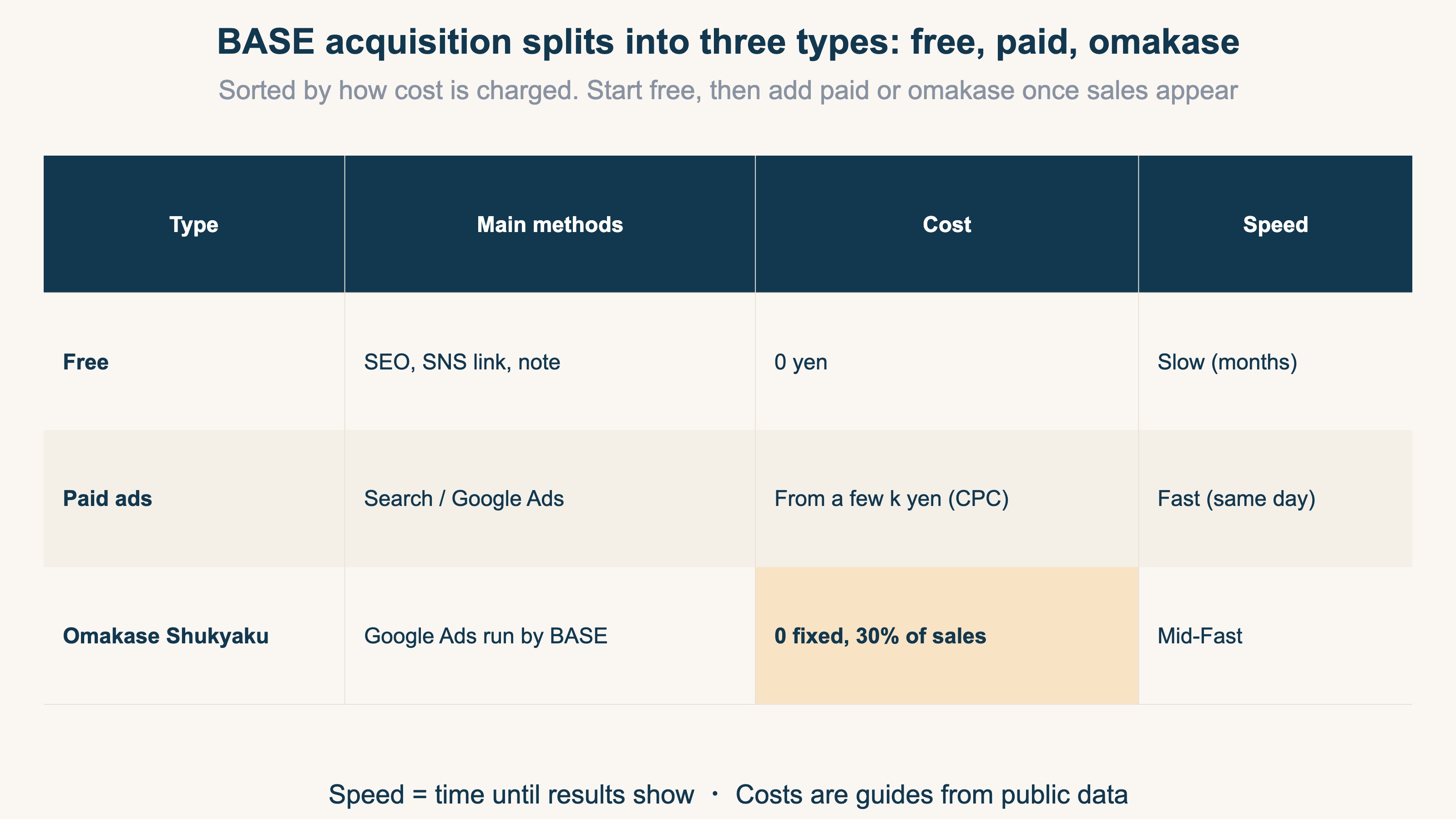
The first is free methods. BASE's SEO settings, SNS linking, note linking, and press-release distribution. They cost nothing but take time to show effect.
The second is paid ads. You run search or Google Ads with a budget you set. They start small and bring traffic quickly, but they take hands-on management.
The third is Omakase Shukyaku. A performance-based service where BASE runs the ads, and you pay a fee only when something sells.
You do not need to do all of it at once. Build a base with free methods first, then add paid or Omakase once sales come into view — that is the unforced order.
2. Start with free acquisition#
Conclusion: free methods, at zero cost, suit base-building while sales are still small.
BASE comes with a full set of acquisition features you can use at no extra cost.
- SEO settings: tune product page titles and descriptions for search. This becomes the doorway for people to arrive naturally from search.
- SNS linking: post products to Instagram or X and route people to your shop. A good fit for products whose appeal shows visually.
- note linking / press releases: tell the story and care behind your products in writing, and grow fans.
The weakness of free methods is that they take months to show effect. Not the choice when you want sales right now. But once people start arriving from search or as fans, acquisition keeps going without paying ad spend — it becomes an "asset."
That is exactly why it pays to plant them early, while sales are still small.
3. Know the cost of paid ads#
Conclusion: paid ads start from a few thousand yen, but you pay every time someone clicks.
The paid ads you run on your own budget are mainly search ads and Google Ads.
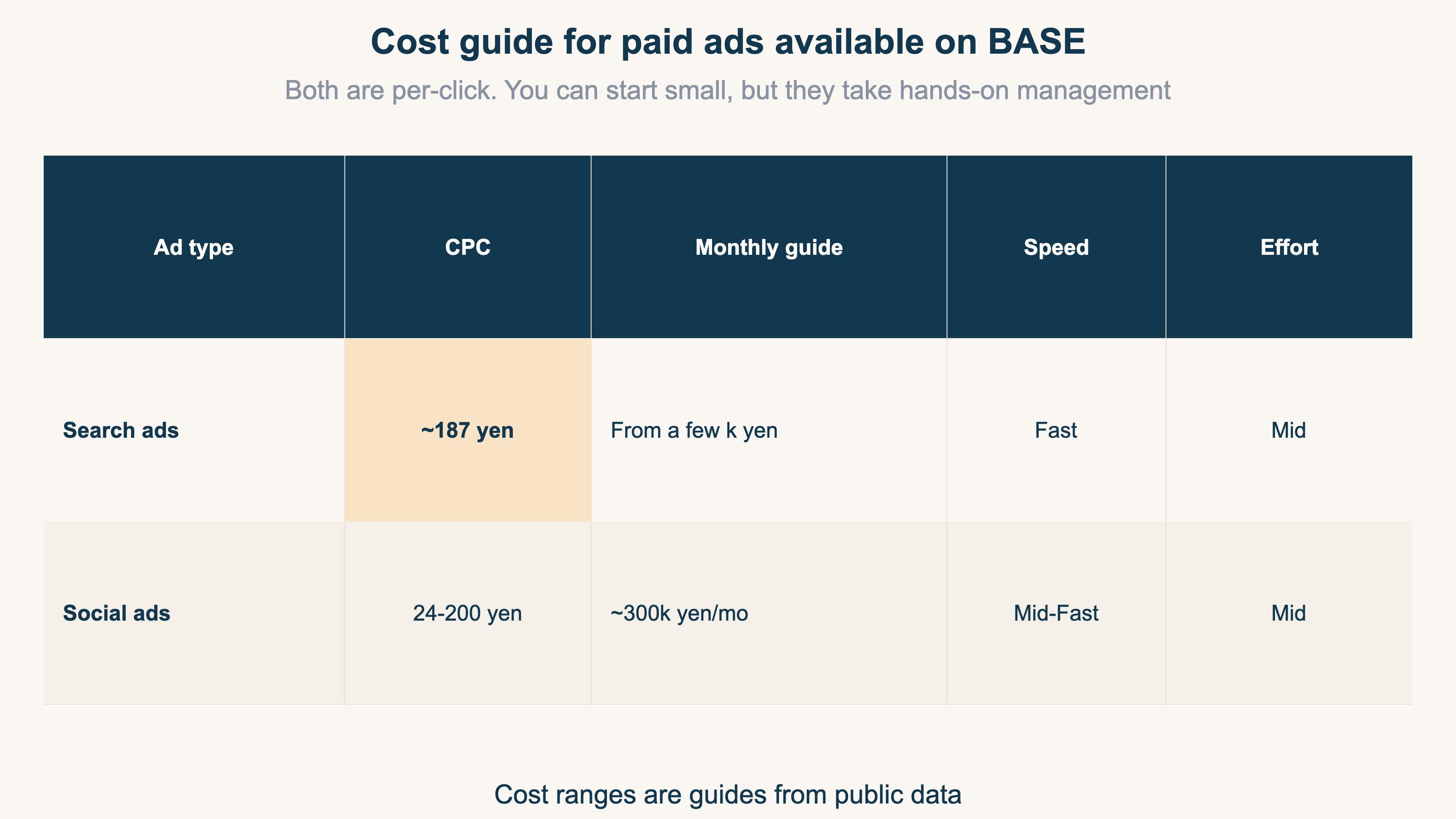
Search ads appear in search results tied to the keyword someone searched. You pay only for clicks (per-click pricing), so you can start from a few thousand yen. One survey puts EC-industry search-ad CPC at about 187 yen [2].
Social ads run roughly 24-200 yen per click, with a monthly operating guide around 300k yen [3]. They suit products that appeal visually. Note that paid social ads are separate from the free SNS linking above.
The upside of paid ads is the speed — traffic from the day you launch. The catch is the hands-on work: you set keywords and budgets yourself and adjust by results. Without experience, clicks can come without sales, and only the cost piles up.
This "running it yourself" work is exactly what you can hand entirely to BASE with the next option, Omakase Shukyaku.
4. How Omakase Shukyaku works and the 30% fee#
Conclusion: Omakase Shukyaku has zero upfront and zero fixed cost, but 30% of what sells is taken as a fee.
"BASE no Omakase Shukyaku" hands ad operation to BASE. It uses Google Ads' P-MAX to place ads automatically across Google Search, YouTube, Gmail, and more [4].
It has three traits.
- Zero upfront, zero fixed cost: no set cost to start or to continue [4].
- BASE covers the ad spend: BASE pays the ad placement cost, so no ad spend leaves your wallet [4].
- Performance-based: you pay 30% of the sale as a fee only when a product sells through the ads. No sale, no fee [4].
No downside risk, and no ad-operation know-how needed — that is the appeal. What to watch, though, is the 30% fee rate.
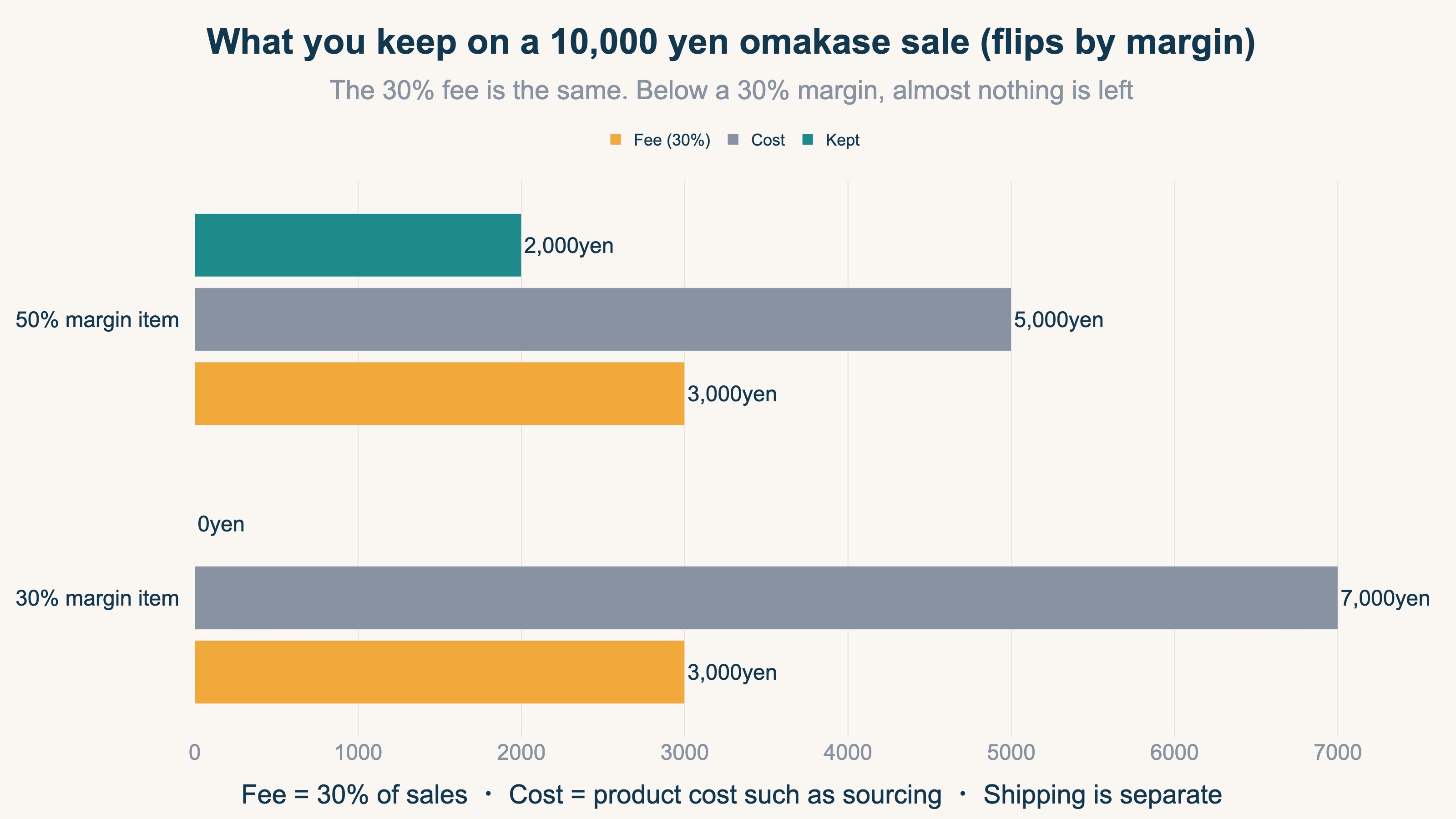
Say a product sells for 10,000 yen through Omakase Shukyaku. A 30% fee takes 3,000 yen, leaving 7,000 yen. Now subtract the product cost and see whether profit remains.
- 50% margin item (cost 5,000 yen): 7,000 − 5,000 = 2,000 yen left (profit)
- 30% margin item (cost 7,000 yen): 7,000 − 7,000 = 0 yen left (negative once shipping is added)
In other words, below roughly a 30% margin, Omakase Shukyaku can lose more the more you sell. Conversely, a high-margin product still leaves solid profit after the 30%. That is why "is Omakase a win or a loss" has to be judged together with your product's margin and how much actually sells.
5. After running ads, measure whether you really profited#
Conclusion: ads are not "set and forget" — you can only judge them once you measure, per channel, whether revenue really grew.
Once you start advertising, the dashboard fills with numbers like ROAS (how many times your ad spend came back as sales). But summing ROAS across channels is known to overstate it (Summing platform ROAS overstates it: use MER to see true overall ad efficiency). The numbers show up, yet the next move does not. This is where many people get stuck.
One EC operator put it this way: "Every dashboard gives off this 'you're in control' feeling. Ads flash ROAS like it's the truth, but in the end, zero direction on where to put budget." The numbers are visible, but they do not lead to a decision.
Omakase, search ads, free SEO — run several channels at once and this worry grows. "Total sales went up, but which channel drove it" becomes impossible to see.
To solve it, you compare efficiency across channels on the same basis. The channel with the most traffic is not always the most profitable. A channel with fewer visitors who buy reliably is more efficient. The number that measures this is "how much sold per visit" — revenue efficiency (RPS).
RevenueScope's solution
Conclusion: line up revenue efficiency across channels on the same basis, and which channel to invest in comes into view.
RevenueScope is a lightweight, revenue-focused dashboard you can use by adding a single tag to GA4. It lines up four core metrics by channel — Revenue, AOV (average order value), Revenue Per Session (RPS, a metric not yet standard across the industry), and CVR (purchase rate) — on one consistent basis. Add Sessions, and these five numbers let you decide "which channel to fund next" simply.
For example, lining up one BASE shop's channels in RevenueScope looks like this (demo data shown).
| Channel | Revenue | AOV | CVR | RPS (per-visit revenue) |
|---|---|---|---|---|
| Organic search (SEO) | 320k yen | 5,500 yen | 2.6% | 143 yen |
| Search ads | 280k yen | 6,100 yen | 1.6% | 98 yen |
| Omakase Shukyaku | 450k yen | 6,800 yen | 1.4% | 95 yen |
| Instagram ads | 380k yen | 9,200 yen | 0.7% | 64 yen |
The reversal is visible at a glance. Omakase Shukyaku has the largest revenue at 450k yen, yet its RPS (per-visit revenue) is a middling 95 yen. Instagram has the highest AOV at 9,200 yen, but a low purchase rate puts its RPS last. Organic search (SEO), middling on revenue and AOV, tops RPS at 143 yen thanks to a high purchase rate. "Biggest revenue or traffic" does not mean "best efficiency." We also explain reading revenue efficiency by channel in What is RPS? The metric, formula, and how to get it in GA4.
What RevenueScope shows here is revenue efficiency by channel, not profit itself. Whether profit remains after the 30% fee still needs the separate margin math above. The key is that GA4's standard view has no built-in way to line up per-channel revenue efficiency (RPS) on the same basis. Pulling the numbers channel by channel and re-aligning them every month is hand work that gets heavier over time. With RevenueScope that side-by-side comes together on one screen, so the call — keep running Omakase, or grow organic search — comes from numbers, not gut feel.
That said, RevenueScope does not calculate ROAS, or profit after fees and cost. Leave ad spend and margin management to your ad dashboard or other tools, and use RevenueScope as the tool for "how much sold per visit, by channel."
FAQ#
Q. If I'm starting ads on BASE, what should I do first?
Start with the zero-cost free methods (SEO settings, SNS linking). Once the base is in place, add small search ads or the low-risk Omakase Shukyaku.
Q. If I use both Omakase Shukyaku and search ads, do I pay the fee twice?
No. The 30% fee applies only to "sales through Omakase ads." Sales from search ads you run yourself do not carry this fee. Run both, and each is priced separately.
Q. Doesn't using several channels make the effect impossible to see?
It does. That is exactly why you need a way to see revenue efficiency by channel on the same basis. Look beyond traffic counts to revenue per session (RPS) and the channel that truly works becomes clear.
Conclusion#
BASE acquisition has many options, and it is natural to hesitate at first. But sort them into "free, paid, Omakase" and your move comes into view. Three points:
- Build a base first with zero-cost free methods (SEO, SNS linking)
- Omakase Shukyaku is easy to start at zero fixed cost, but keep in mind it tends to lose on items below a 30% margin
- Whatever channels you use, in the end measure "revenue efficiency by channel" on the same basis
In ads, "confirming it works" matters as much as "getting started." The idea itself isn't hard. What's hard is re-aligning revenue efficiency by channel every month and keeping the comparison up. Hand that side-by-side to one screen, and your limited budget and the fee you hand over flow to the channel that pays off most.
See which ads actually drive revenue, at a glance
Free up to 5,000 sessions/month, AI connection included. No credit card required. Up and running in 5 minutes.
References#
- [1] Ministry of Economy, Trade and Industry, "Survey on Electronic Commerce (FY2024)," 2025 meti.go.jp
- [2] Tomorrow Marketing, "A thorough guide to listing-ad CPC ranges," tomorrow-marketing.co.jp 2024
- [3] Data be at, "Social ad costs explained: pricing models and ranges," data-be.at 2026
- [4] BASE U, "Zero-risk: more than double your Google Ads sales — what is 'BASE no Omakase Shukyaku'?" baseu.jp 2026