You use a rank tracker, but is it legally safe? In July 2026, a US court handed down one ruling in the lawsuit between Google and SerpApi. What actually causes trouble in running an EC store, though, is not legality. It is the distinction between a number that is an estimate and a number that is measured.
Contents
TL;DR#
- In July 2026, a US federal court dismissed two of Google's claims brought under copyright law. The reasoning: for search results that contain no copyrighted work, there is no protected work to regulate access to, so bypassing the block does not amount to circumvention
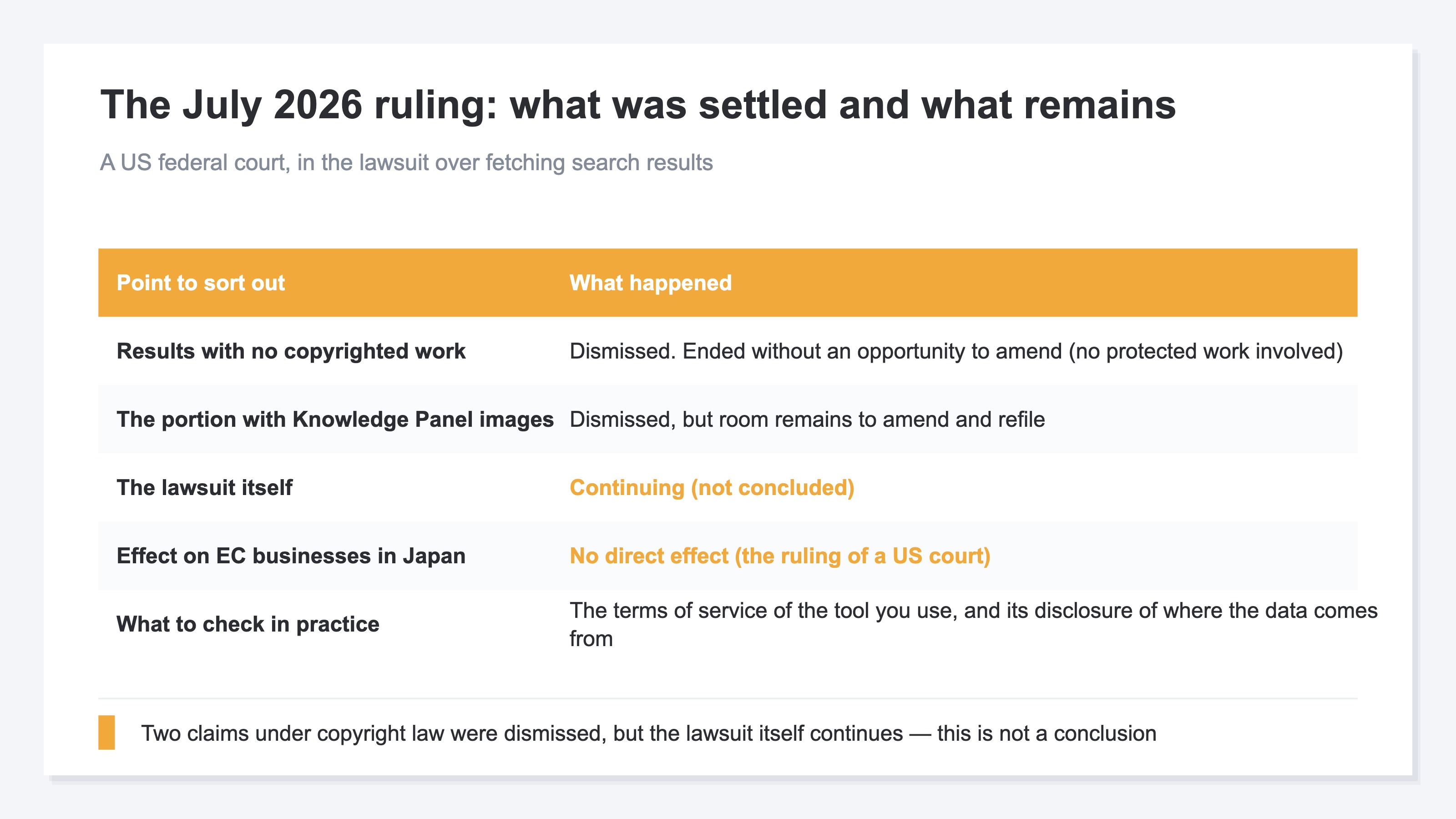
- The two claims are different inside, though. The portion covering results with no copyrighted content ended without an opportunity to amend, while the portion covering licensed images survives in a form that can be amended and refiled. The lawsuit continues, and as a US ruling it has no direct effect on EC businesses in Japan
- What to look at in practice is counting, not legality. A rank tracker's numbers are search results fetched from the outside, meaning an estimate as of the moment of fetching. Your own Google Search Console is a measured record of your own site
- The two not lining up is not a fault but a design. A moment versus a period, an observation from outside versus a record kept inside. Diverging is the specified behaviour
- The standard for using them separately is clear. External data to watch what competitors are doing, measured Google Search Console data to judge your own traffic and revenue
1. What the Court Actually Decided#
In July 2026, a US federal court ruled in the lawsuit Google brought against SerpApi, a provider of search result data[1]. Both claims brought under copyright law (the DMCA) were dismissed. The judge was Chief U.S. District Judge Yvonne Gonzalez Rogers. The question was whether bypassing a block on access to publicly available search results amounts to the circumvention of a technological protection measure that copyright law prohibits.
The two claims are different inside, though. The first concerned search results that contain no copyrighted work, and the court held that because there is no protected work involved, this is not circumvention. No opportunity to amend was given, so that portion effectively ends there. The second covered the portion containing licensed images. It was dismissed as well, but with permission to amend and refile. The reason was that Google could not show it was operating the access-blocking mechanism with the authorization of the copyright owners[1].
The part that ended, and the part that hasn't#
What deserves care is how far this ruling reaches. The portion with no copyrighted work was dismissed without an opportunity to amend, and that half is completely finished. The portion covering the images in the Knowledge Panel shown in search results survives in a form that can be amended and refiled[1]. Google has 21 days to amend, and discovery is paused for that stretch[1]. The lawsuit itself continues.
Which means this reads neither as "scraping has become legal" nor as "Google lost." It is a stage at which the extent of what copyright law can be used to reach has been sorted out.
No direct effect on EC businesses in Japan#
And this is the ruling of a US court, so it has no direct effect on EC businesses in Japan. If you are weighing whether to keep using a rank tracker in Japan, the thing to watch is not where the lawsuit lands. It is the terms of service of the tool you are contracted with, and how that tool discloses where its data comes from. Those are what feed a decision directly.
On top of that, here is the point at which the practical judgment actually changes: where the ranking numbers you look at every month come from. That is what the rest of this article is about.
2. Where Rank Tracker Data Comes From#
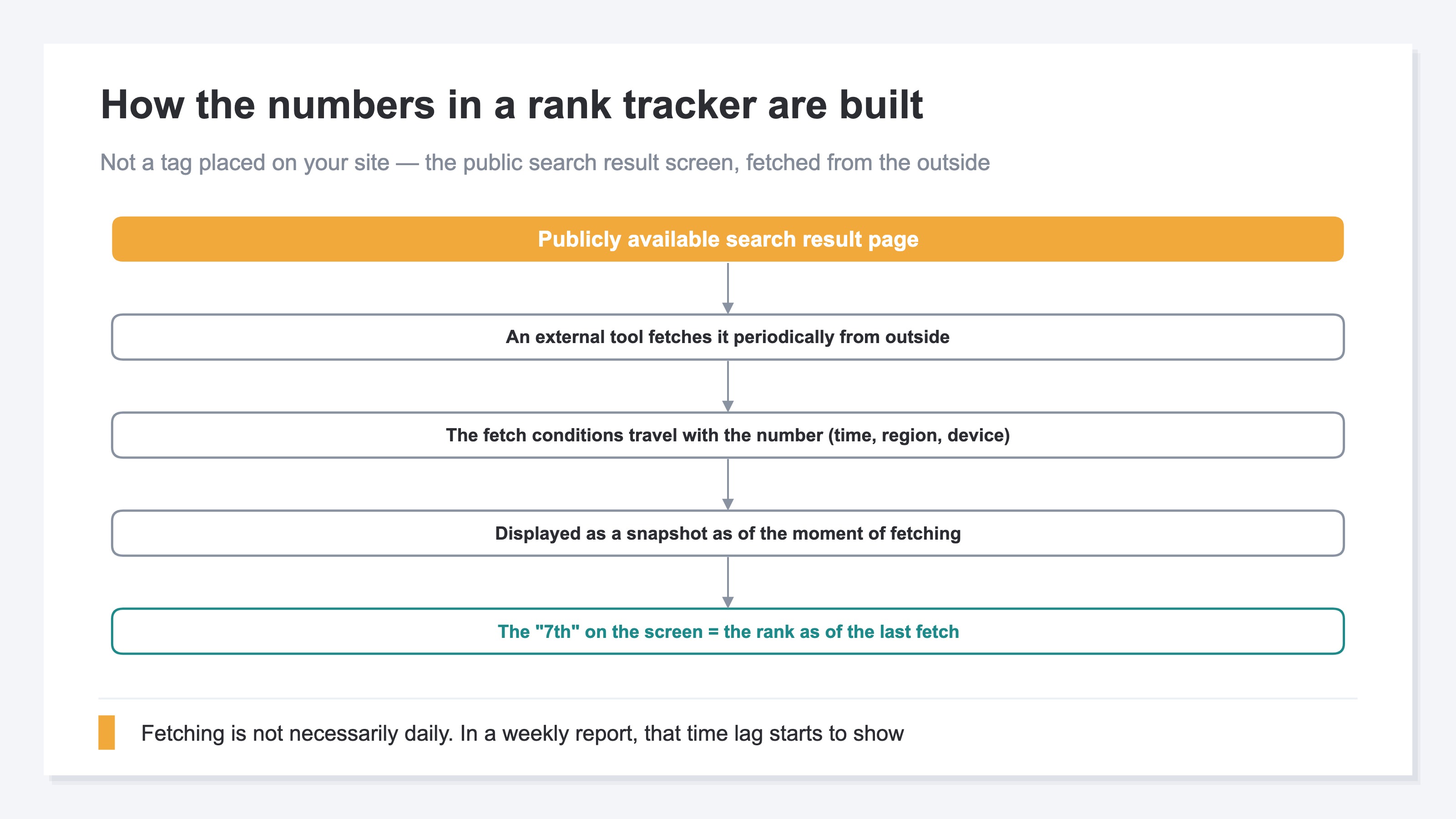
What a rank tracker displays is a snapshot as of the moment that tool fetched the search results.
Generally, rank trackers and competitor analysis tools take the publicly available search result page from the outside and turn it into numbers. They are not measuring by placing a tag on your site. From outside your own site, they go and look at a public screen called the search results. The point at issue in this lawsuit, the bypassing of an access-blocking measure, is this fetching part.
Every number carries a "when and under what conditions"#
As long as it is fetched from outside, the conditions of the fetch travel with the number. The time it was fetched, the region, the device. Change that combination and the same keyword comes back at a different rank. Google states that its search results vary by location and device[3], so the same ordering is not guaranteed to come back on every fetch.
The frequency of fetching is not necessarily daily either. The more keywords are covered, the longer one full pass takes. The "7th" on the screen is not 7th at this very moment but 7th as of the last fetch. It looks like a small difference, but it turns into a gap when you produce a weekly report.
Which tool to choose is covered in how to pick a rank tracker by revenue. What matters here is not the choosing but that whichever tool it is, the numbers are built the same structural way.
The question of "how was this number built" is already on the floor#
While reviewing what external tools cost, some practitioners have tried whether they could substitute a home-built version by having generative AI run the searches. What is interesting is the pushback those reports get. AI will invent plausible-looking keywords and search volumes that are nothing like the real figures. What got replaced was the layer that finds candidates; the layer of aggregation built up over time was lost.
That this conversation happens at all shows the question "how was this number built" is already on the floor. The news of a ruling is material for bringing it back into focus.
3. Do You Decide With Estimates or With Measured Data#
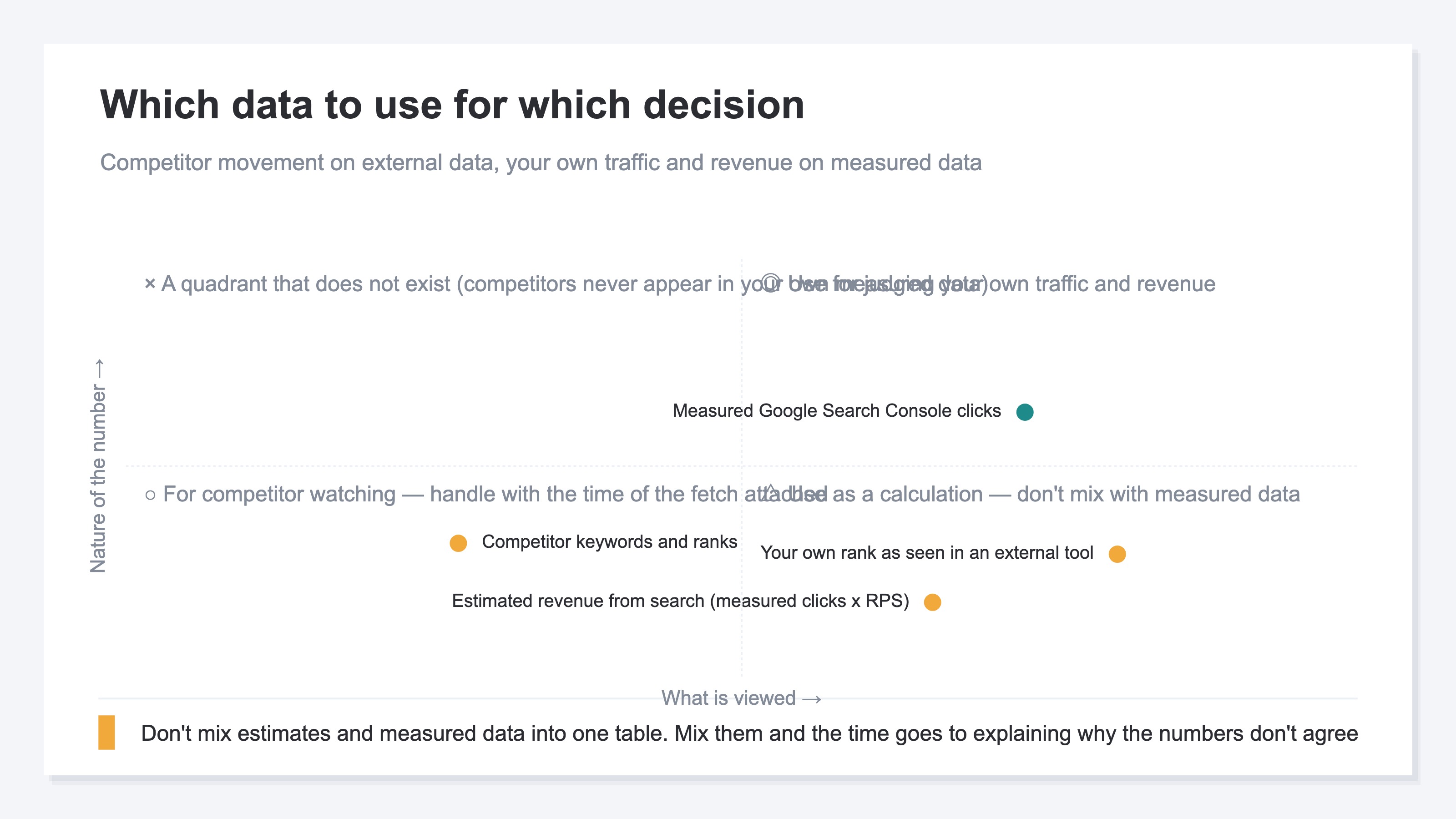
External data to watch what competitors are doing, measured Google Search Console data to judge your own traffic and revenue.
The numbers sitting in your own Google Search Console are not an estimate observed from outside. They are a record of how many times your site was shown in Google search and how many times it was clicked[2]. Position is also calculated as an average of the times your own site was shown. If what an external tool looks at is the search results screen, this is the performance of your own site as it remains on Google's side. What is being measured is a different thing to begin with.
Not lining up is not a fault but a design#
When an external tool's rank and Google Search Console's average position diverge, it does not mean one of them is broken. The former is "the position at that moment, under those search conditions," the latter "the average across the times it was actually shown during that period." A moment versus a period, an observation from outside versus a record kept inside. Matching would be the stranger outcome.
What to avoid is mixing the two into one table and chasing the reason for the difference. Ranked 3rd, yet no clicks come. That situation also resolves faster when read through impressions and clicks on the Google Search Console side rather than an external tool's rank. That is covered in when rankings rise but clicks don't follow. The divergence between GA4 and Google Search Console is a different pair again (why GA4 and Google Search Console keyword numbers don't line up).
That doesn't make external data unnecessary#
External data does not become unnecessary. The main reason practitioners give for continuing to pay for external tools is competitor information. And that is structurally invisible in your own Google Search Console. What Google Search Console holds is only the record of the keywords your own site was shown for; the keywords competitors are winning sit outside that record. What to do with the competitor keywords you obtain is handled in how to read competitor keyword gaps.
The standard for using them separately#
The standard is simple. Read competitor positions and the keywords they win from external data, and treat them as estimates carried with the time of the fetch. Read your own traffic volume and revenue from measured Google Search Console data and the records on your own site. Hold that standard and the work of re-investigating the reason every time the numbers fail to agree shrinks. The same goes for reading a report delivered by an outside vendor: check first which of the two kinds of data it is (checking an SEO vendor's report).
Checking your own side starts from the search performance report in Google Search Console. Read impressions and clicks by keyword, period by period[4]. There are parts, though, that this screen alone does not cover. The keywords competitors win do not appear here. Keywords do not connect to revenue either. The keyword list has a mechanism that drops entries with low counts[4], and the revenue figures live on a different screen. Every month, matching clicks by keyword against revenue by landing page, by hand. That repetition is the reason it stops being sustainable.
RevenueScope solution
RevenueScope displays external data figures and your own measured figures as separate numbers.
On the competitor side, it displays the keywords that competitor domains (up to four) are winning in Google's Japanese-language search, along with their ranks and monthly search volume, as a snapshot carried with the date and time it was fetched. It also displays the rank changes against the previous survey and the keywords that disappeared. Because the data is fetched from external search results, its nature is an estimate. The time of the fetch is always attached to what comes back.
On your own side, it displays measured Google Search Console clicks, the page each keyword landed on, and estimated revenue from search. Estimated revenue is a conservative calculation, revenue per session (RPS) multiplied by measured clicks. The starting point is the record left on your own site. The two sit on the same screen while each keeps its own nature, with the time of the fetch remaining on the external data and the date remaining on your own measured data.
Source and nature come back separated#
Ask "show me the keywords competitors are winning and our own search performance," and it comes back in the following form.
For the sake of explanation, written out as if produced for fictional Store B, it takes the following form.
| What is viewed | Source | Nature | Figure |
|---|---|---|---|
| Keywords won by 3 competitors | External search results | Estimate | 400 keywords |
| Of those, on page one | External search results | Estimate | 100 keywords |
| Own search clicks | Google Search Console | Measured | +12% month over month |
| Estimated revenue from search | Google Search Console + own revenue | Estimate | About a fifth of the total |
Note: the figures are an example built for explanation, using fictional Store B. What runs in the demo is the sample store's sample data (refreshed daily), so the same question returns different numbers.
The competitor rows carry the time of the fetch. In this example that is around 10 a.m. on July 24, and rank movement after that is not reflected until the next survey. Your own side, meanwhile, accumulates with dates attached and is not rewritten after the fact. Sitting on the same screen, they still don't get mistaken for one another when you pick which number feeds which decision.
Among the keywords where the competitor side holds the upper positions, any that show zero measured clicks on your own side is a candidate for adding one article.
FAQ#
Frequently asked questions#
Q. Is it safe to keep using a rank tracker?
A. What was dismissed here is two claims brought under copyright law, but the portion covering licensed images survives in a form that can be amended and refiled, and the lawsuit itself continues[1]. It is the ruling of a US court, so it has no direct effect on EC businesses in Japan either. Rather than following where the ruling lands, checking the terms of service of the tool you are contracted with and how it discloses where its data comes from connects more directly to a practical decision.
Q. Why does an external tool's rank differ from Google Search Console's position?
A. Because they measure different things. What an external tool returns is the position at the moment that tool ran the search. What Google Search Console returns is the average across the times your own site was actually shown during that period[2]. Change the time, the location or the device of the fetch and the rank changes, and a period average carries the weight of impressions. The difference comes out of the design; it is not a malfunction.
Q. Which numbers should I use in internal reporting?
A. Split them by purpose. External data for talk about competitor positions and the keywords they win, measured Google Search Console data for talk about your own traffic volume and revenue. Mix them into one table and the reporting session fills up with explaining why the numbers don't agree. Split them, then simply state which of the two a number is, and the conversation moves faster.
Q. If I have AI run the searches and build my own, do external tools become unnecessary?
A. Part of the work of finding candidates can be replaced, but the numbers themselves are a separate matter. Generative AI can invent plausible-looking keywords and search volumes, and they differ from measured figures. Nor can it carry over the time series built up in the past. If you are considering building your own, check first where the numbers that come out are coming from.
Summary#
Rank trackers have not become illegal, nor have they been ruled lawful. What was dismissed in July 2026 is two claims brought under copyright law, and one of the two survives in a form that can be amended and refiled[1]. The lawsuit continues, and as a US ruling it has no direct effect on EC businesses in Japan.
If practical judgment changes at all, it changes on counting rather than on legality. A rank tracker's numbers are an estimate as of the moment that tool fetched the search results. Your own Google Search Console is measured data for your own site as it remains on Google's side. The two not lining up is because what they measure is different.
So don't talk about clicks rising or falling with external numbers, and don't talk about competitor ranks with your own measured data. Follow what competitors do with external data, and judge your own traffic and revenue on measured Google Search Console data. Starting with this month's report, try writing the source next to each of the numbers.
See which ads actually drive revenue, at a glance
Free up to 5,000 sessions/month, AI analyst included. No credit card required. Up and running in 5 minutes.
References#
- [1] Search Engine Journal "Court Dismisses Google's DMCA Claims Against SerpApi" (2026)
- [2] Google Search Console Help "What are impressions, position, and clicks?" (2026)
- [3] Google Search Central "In-Depth Guide to How Google Search Works" (2026)
- [4] Google Search Console Help "Performance report (Search results): Overview and basic setup" (2026)