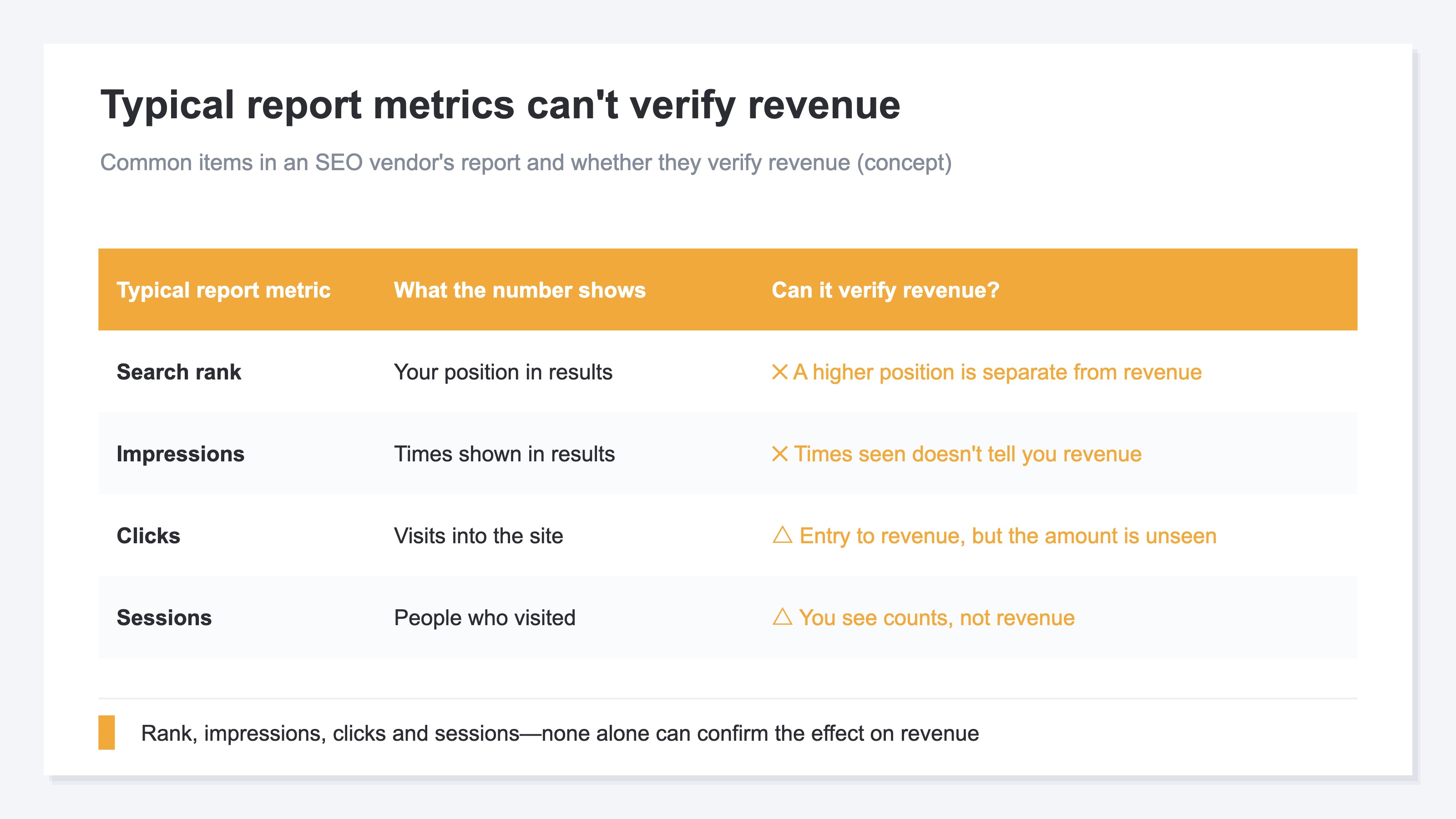
A polished report lands from your SEO vendor every month. "This term climbed to position 3." "Impressions are up." The numbers line up neatly. And yet, whether those rank gains moved your revenue is something the report never shows — because a higher rank and an effect on revenue are two different things. So plenty of buyers feel, in the back of their mind, that "the real question is what they actually did each month and what result it produced," while never quite holding a yardstick to verify that result. This piece lays out, in order, why a rank report alone can't let you sign off on a vendor's work, what the buyer should look at instead, and how to line up the rank gains against the revenue changes.
Table of contents
TL;DR#
- SEO vendors tend to report around "rank went up," but a rank gain and a contribution to your revenue are separate things. Rank alone can't let you sign off on the work.
- What the buyer should look at is estimated revenue per search term. Even if a rank climbs, if that term isn't actually moving revenue, you can't call it a result.
- The acceptance pattern is simple: get the report into a shape that answers one question — "which terms climbed in rank but aren't moving revenue?" Receiving a nice-looking table isn't acceptance.
- The idea is easy, but matching rank against revenue every month, across dozens of terms, is real work. That's exactly why having them lined up in one view starts to pay off.
1. A rank report alone can't verify a vendor's work#
Bottom line: a report that only says "the rank went up" can't let you sign off on the work, because a rank gain doesn't necessarily mean your revenue moved.
There's an easy-to-miss conflict of interest here, too. Both raising the rank and reporting on that rank are done by the vendor. In other words, the party being evaluated is also producing the numbers used to evaluate them. This isn't about bad faith — it's a structural point that reporting tends to lean toward "the ranks that went up." So when you take the ranks in the report at face value, you can tell the vendor "did work," but you're left unsure whether it "moved revenue," and the contract rolls on.
One more thing that happens constantly in practice: the nice report goes unread. A good-looking monthly report arrives, and the recipient just replies "looks good," without really understanding the contents. This isn't the buyer being lazy. It's because the report is built to be easy on the eyes, not built into a shape where the buyer can judge the result. What an acceptance pattern needs isn't a decorated table — it's a shape that answers one question. We'll make that question concrete in the next section.
2. What the buyer should look at is estimated revenue per search term#
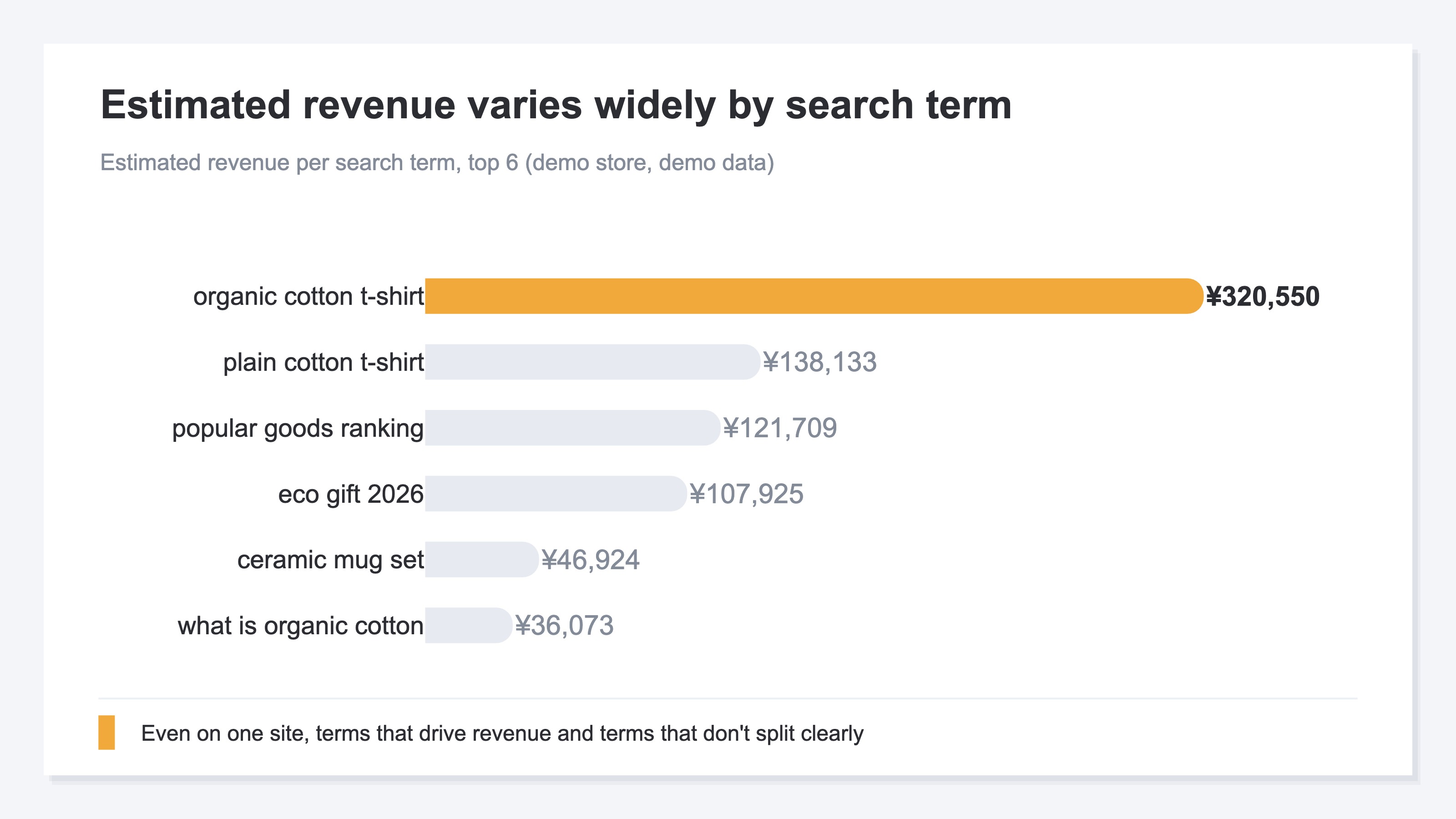
Bottom line: the yardstick for acceptance isn't search rank, it's estimated revenue per search term [2]. However far a rank climbs, if that term isn't moving revenue, it isn't a result.
Estimated revenue is a rough figure: the revenue per visit from search — Revenue Per Session (RPS), a term not yet settled across the industry — multiplied by that term's clicks. Loosely put, it's a way of reading, term by term, "roughly how much revenue does this term seem to lead to?" A term at position 1 whose visitors almost never buy has small estimated revenue. A term at position 5 whose visitors buy well has large estimated revenue. So how high a rank sits and how much a term moves revenue don't line up in the same order.
Let's also answer the distrust of the numbers themselves up front. Estimated revenue isn't a figure that nails the exact yen. It's a conservative approximation, deliberately skewed low. The underlying search data covers Google Search only — Bing and Yahoo! aren't included — and there's a two-to-three-day lag before it's reflected [1]. So use estimated revenue not as an "exact amount" but as a tool for reading the scale and direction of "which terms are large and which are small." It's not an unverifiable, fortune-telling metric; it's a conservative guide with its conditions stated plainly. How estimated revenue is calculated, and how to follow the full path from click to purchase, is covered in detail in How to read revenue per search keyword, so here we'll just hold the yardstick — "read by estimated revenue, not rank" — and move on.
3. The acceptance pattern: line up rank gains against revenue changes#
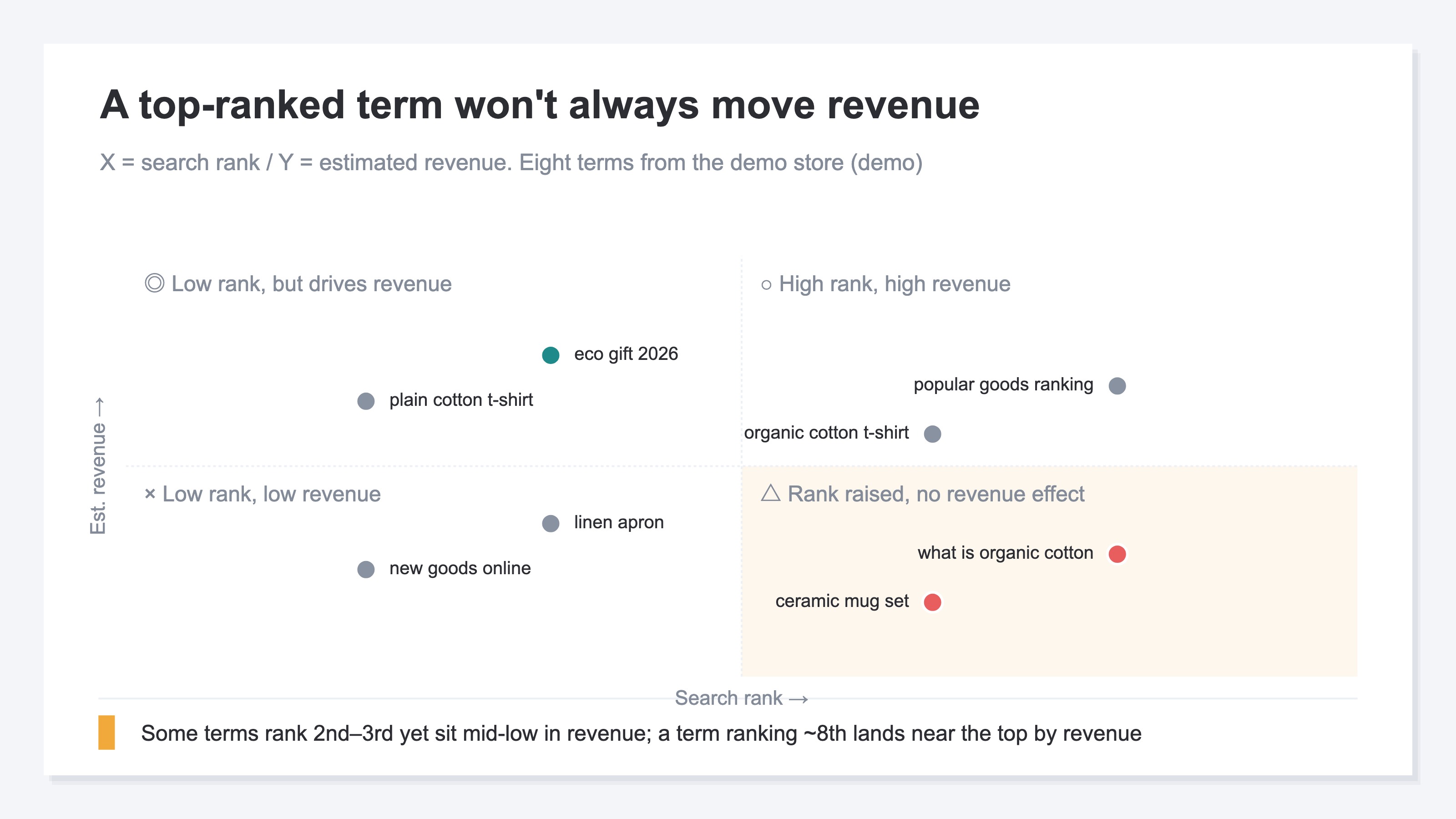
Bottom line: the acceptance pattern is simple. Get the report into a shape that answers one question — "which terms climbed in rank but aren't moving revenue?"
The way to do it is just to compare each search term on two axes: search rank and estimated revenue. Do that and the terms split clearly into ones that rank well but have low estimated revenue, and ones that rank only so-so yet have high estimated revenue. For example, one term sits at a very strong position 2.6, yet its estimated revenue stays mid-pack. Another ranks high at position 3.0, but its estimated revenue is on the low side. Meanwhile, a term ranking no higher than around position 8 can break into the top of the pack on revenue. A good rank does not equal a good result — a reversal you only start to see once you put it on these two axes.
Reading it this way makes your questions to the vendor concrete, too. "This term you raised the rank on — is it moving revenue?" "This term that ranks low but is moving revenue — can we go after it next?" You get to talk from revenue, not rank. Note that branded search (searches on your own company or brand name) tends to raise both rank and traffic, which can make the report's numbers look better than the real performance. How to factor out that inflation is covered in How branded search inflates your SEO numbers. And when you chase the terms competitors are drawing traffic on, the idea of choosing by your own revenue rather than by search volume is laid out in Pick competitor keywords by your own revenue.
The idea itself is easy enough, as far as we've gone. What's heavy is keeping this match-up going every month, across terms. There are dozens to hundreds of terms, and both rank and revenue shift month to month. Doing it by hand each time doesn't hold up. That's exactly why having rank and estimated revenue lined up in one view starts to pay off. The idea of picking your "next move" in revenue order once you've matched them up is laid out in Turn the monthly report into your next move.
RevenueScope helps
By now we've seen that you sign off by estimated revenue per search term rather than by rank, and that the pattern is a shape answering one question — "which terms climbed in rank but aren't moving revenue?" What's left is how to keep that match-up going every month.
RevenueScope takes over that match-up. For each search term, it lines up clicks, average search rank, and estimated revenue in one view, and lets you re-sort by estimated revenue, largest first (figures shown are demo data). It also surfaces the terms that are "one step from the top" (striking distance), ordered by the size of the estimated-revenue opportunity. "Did the terms whose rank went up actually move revenue?" and "which terms rank low but are moving revenue?" can be checked side by side on the same screen.
| Search query | Avg. position | Est. revenue |
|---|---|---|
| organic cotton t-shirt | 4.3 | ¥320,550 |
| plain cotton t-shirt | 5.5 | ¥138,133 |
| popular goods ranking | 3.3 | ¥121,709 |
| eco gift 2026 | 8.5 | ¥107,925 |
| ceramic mug set | 2.6 | ¥46,924 |
| what is organic cotton | 3.0 | ¥36,073 |
| new goods online | 6.4 | ¥24,049 |
| linen apron | 9.0 | ¥23,169 |
Output from the sample store (a fictional site with sample data)
What to read in this table is that a high rank and large estimated revenue don't sit in the same order. The bolded "ceramic mug set" sits at a very strong position 2.6, yet its estimated revenue stays mid-pack. "what is organic cotton" ranks high at 3.0, but its estimated revenue is on the low side. Meanwhile "eco gifts 2026," at position 8.5, breaks into the top on estimated revenue. Had you chased rank alone, you might have graded the terms glued to the top as "producing results" and put off the terms actually generating revenue. Line up rank and estimated revenue in one view, and you can choose which hands to keep and which to rework by revenue, not by gut.
The estimated revenue RevenueScope shows is a conservative approximation — revenue per visit from search times clicks — a tool for reading which terms move revenue by their scale and direction. Rather than gross margin or inventory, RevenueScope stays on rank and estimated revenue per search term and lines them up in one view, so you can sign off on a vendor's work by revenue. That lets you pick which terms to keep and which to rework by revenue.
FAQ#
Frequently asked questions#
Q. Should I treat "this term climbed to the top" as a result?
A. Not yet. A rank climbing and a term moving revenue are separate things. If the visitors buy well, a rank gain does move revenue; if they barely buy, revenue hardly moves however far the rank climbs. A rank report shows the vendor "did work," but whether it "moved revenue" can only be confirmed by matching it against estimated revenue per search term.
Q. Is estimated revenue an exact amount? Can I trust it?
A. It isn't a figure that nails the exact yen. It's a conservative approximation, deliberately skewed low: revenue per visit from search times clicks. It covers Google Search only, and there's a two-to-three-day lag. So use it not for the amount itself but to read the scale and direction of "which terms are large and which are small." It's a guide with its conditions stated plainly, which makes it different in nature from an unverifiable, fortune-telling metric.
Q. Out of all these search terms, where should I start reworking?
A. First, look at "terms whose rank is up but whose estimated revenue is low." These are candidates where the work hasn't connected to revenue. Next, look at "terms that rank only so-so but have high estimated revenue." Here, one more step of rank improvement tends to translate straight into revenue. Start from these two and the conversation with your vendor turns concrete — built on revenue, not rank.
Summary#
SEO vendors tend to report around "rank went up." But a rank gain and a contribution to your revenue are separate things, and rank alone can't let you sign off on the work. Since the party raising the rank and the party reporting it are the same, the report tends to lean toward "the ranks that went up," and a good-looking table goes unread while the contract rolls on.
What the buyer should look at is estimated revenue per search term. Estimated revenue is a conservative approximation, and it carries the premise of covering Google Search, but for reading the scale and direction of "which terms are moving revenue," it's plenty usable. The acceptance pattern is simple: get things into a shape that answers one question — "which terms climbed in rank but aren't moving revenue?" The idea is easy, but keeping the match-up going every month, across terms, is real work. That's exactly why having rank and estimated revenue lined up in one view lets you judge which hands to keep and which to rework by revenue, not by gut.
See which ads actually drive revenue, at a glance
Free up to 2,000 sessions/month, AI connection included. No credit card required. Up and running in 5 minutes.